

TL;DR:
- Personalized LinkedIn requests double acceptance rates compared to generic ones.
- A strong profile and pre-engagement strategy significantly improve outreach success.
- Quality and relevance outperform volume in building a sustainable B2B LinkedIn network.
Most small B2B teams send the same generic LinkedIn connection request to everyone on their list and wonder why acceptance rates hover around 15-20%. The result is a stagnant pipeline, wasted time, and the very real risk of account restrictions. The good news? Personalised connection requests consistently achieve 45-50% acceptance rates, more than doubling the returns from generic outreach. This guide walks you through every stage of a high-performance LinkedIn connection strategy, from defining your ideal prospect and preparing your profile, to executing targeted outreach and nurturing new connections into qualified sales conversations.
Table of Contents
- Set goals and define your ideal LinkedIn prospects
- Prepare your profile and pre-engagement for connection success
- Execution: Sending and personalising LinkedIn connection requests
- Nurture new connections and drive lead conversion
- Our perspective: Why less is more — quality beats quantity in LinkedIn strategy
- Accelerate your LinkedIn success with expert help
- Frequently asked questions
Key Takeaways
| Point | Details |
|---|---|
| Define your target | Identifying the right contacts is the foundation of high-acceptance LinkedIn strategies. |
| Personalise every request | Tailor invites with mutual context or pre-engagement to at least double acceptance rates. |
| Optimise profile and timing | A standout profile and well-timed outreach boost reply and conversion rates. |
| Nurture post-acceptance | Smart follow-ups after connection are essential for lead generation and building relationships. |
| Focus on quality over quantity | Sustainable B2B growth comes from targeted, relationship-driven connections, not mass outreach. |
Set goals and define your ideal LinkedIn prospects
Before you send a single connection request, you need clarity on two things: who you are targeting and what success looks like. Without this foundation, even the most polished outreach message falls flat. Start by setting both quantitative targets (number of accepted connections per week, reply rates) and qualitative goals (connecting with decision-makers in specific sectors, building relationships that lead to discovery calls).
Defining your ideal customer profile (ICP) on LinkedIn means going beyond job title. Think about firmographics such as company size, industry, and geography. For most SMBs, targeting companies of 100-500 employees at VP Sales or VP Marketing level, with shared connections or group memberships, produces the strongest results. Pre-engagement activities like liking or commenting on a prospect's posts before sending a request can double your acceptance rate.
Here is a quick reference for ICP targeting criteria:
- Job title: VP Sales, Head of Marketing, Managing Director, Commercial Director
- Company size: 100-500 employees for SMB focus; 500-2,000 for mid-market
- Industry: Align with your core service verticals
- Location: Prioritise regions where your team can follow up effectively
- Shared signals: Mutual connections, shared LinkedIn groups, recent content activity
Once your ICP is defined, set realistic benchmarks. A healthy B2B acceptance rate sits between 30-45% (good) and 45-60% (excellent), with a study of 16,492 requests averaging 37%. Use these figures to evaluate your campaigns honestly.
| Acceptance rate | Performance level | Action |
|---|---|---|
| Below 20% | Poor | Revisit ICP and message quality |
| 20-30% | Below average | Improve personalisation |
| 30-45% | Good | Maintain and optimise |
| 45-60% | Excellent | Scale with confidence |
Pro Tip: Before sending any requests, spend one week building your LinkedIn network through content engagement. Commenting on a prospect's post before connecting creates genuine familiarity and significantly boosts acceptance. This pre-engagement phase is often skipped and almost always worth it. For more on B2B connection growth success, a structured approach makes all the difference.
Prepare your profile and pre-engagement for connection success
Your LinkedIn profile is the first thing a prospect sees when they receive your connection request. If it does not immediately communicate credibility and relevance, they will decline or simply ignore you. Profile optimisation is not optional; it is the single biggest lever you control before outreach begins.
Focus on these core profile elements:
- Headline: Lead with the value you deliver, not just your job title. "Helping B2B SaaS firms generate qualified leads via LinkedIn" beats "Sales Manager at XYZ Ltd."
- Profile photo: A professional, clear headshot increases profile views and trust signals.
- About section: Write a concise value statement addressing your target audience's pain points, not a CV summary.
- Experience: Highlight outcomes and results, not just responsibilities.
- Featured section: Add case studies, testimonials, or lead magnets relevant to your ICP.
Once your profile is strong, begin a structured pre-engagement phase. Inbound-led strategies consistently outperform cold outbound, with inbound close rates reaching 12-18% versus just 1-3% for outbound, and sales cycles shortening from 60-120 days to 30-60 days. Building familiarity before you reach out is the fastest way to shift from outbound to inbound dynamics.
| Profile status | Avg. acceptance rate | Lead conversion rate |
|---|---|---|
| Optimised | 40-55% | 12-18% |
| Neglected | 10-20% | 1-3% |
Here is a pre-engagement checklist every B2B team should follow before sending requests:
- Like two or three of the prospect's recent posts
- Leave a thoughtful comment on a relevant article they have shared
- Follow their company page if applicable
- Check for mutual connections and note them for your request message
- Review their recent activity to identify talking points
Pro Tip: Content creation for LinkedIn leads is one of the most powerful pre-engagement tools available. When prospects see your name appearing in their notifications through your own posts and comments, they are far more likely to accept your request. Pair this with strong LinkedIn engagement tips to build genuine visibility before you ever reach out. Personalised requests referencing mutual connections or content interactions reach 45-50% acceptance, compared to just 15-20% for generic ones.
Execution: Sending and personalising LinkedIn connection requests
With a prepared profile and warm prospects, it is time to execute. The mechanics of sending requests matter as much as the message itself. Get the volume, timing, and personalisation right and your acceptance rates will reflect it.
Volume guidelines: Send 100-200 requests per week (20-30 per day) for free and premium accounts. If your acceptance rate drops below 20-30%, LinkedIn may throttle or restrict your account. Monitor this weekly.
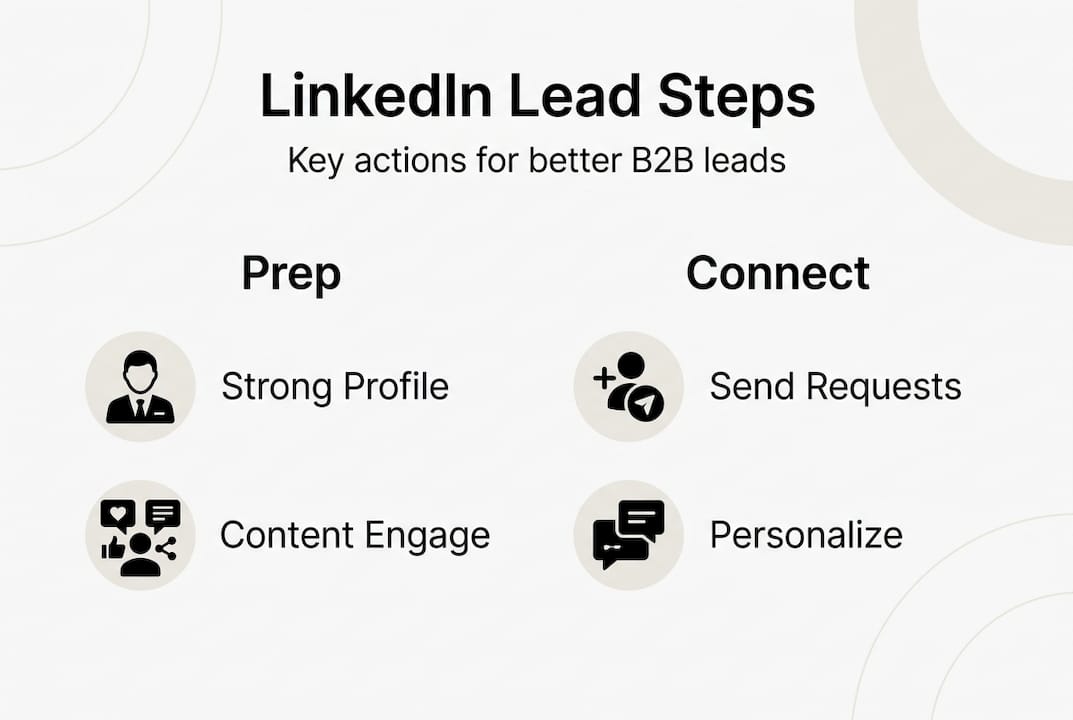
Timing: Send requests Tuesday to Thursday, 8-10AM in the recipient's time zone. Research shows 21% of recipients accept within 60 minutes, and 63% within 24 hours. Timing your requests to land during active working hours gives you the best chance of a prompt response.
Here is a step-by-step process for sending high-converting requests:
- Identify your target from your ICP list
- Complete the pre-engagement checklist (see previous section)
- Draft a personalised note of 200-300 characters referencing a specific post, shared group, or mutual connection
- Send between 8-10AM on a Tuesday, Wednesday, or Thursday
- Log the request in your CRM or tracking sheet
- Follow up with a welcome message within 24 hours of acceptance
A note on automation: Automation tools can help with volume, but misuse risks account bans and damages your brand reputation. Always review automated messages for genuine personalisation before sending. Manual outreach, while slower, consistently produces stronger relationships and fewer restrictions.
Personalised messages deliver a 9.36% reply rate versus 5.44% for unpersonalised outreach. That gap compounds significantly at scale. For more on driving B2B sales with LinkedIn and crafting effective LinkedIn messaging strategies, the fundamentals remain consistent: be specific, be relevant, and be brief.
Nurture new connections and drive lead conversion
Accepting a connection request is just the beginning. Most B2B teams make the mistake of either pitching immediately or going completely silent after a connection is made. Neither works. What does work is a structured, multi-touch nurture sequence that builds trust before you ask for anything.
Post-acceptance follow-up: Send a welcome DM within 24 hours, which achieves a 10-17% reply rate. Keep it warm and conversational. Thank them for connecting, reference something specific about their work, and ask a genuine question. Do not pitch.
Here are smart multi-touch ideas to build familiarity over time:
- Like and comment on their posts regularly over the following two to three weeks
- Share a relevant article or insight with a brief personal note
- Congratulate them on milestones such as work anniversaries, promotions, or company news
- Engage with their company page content
- Invite them to a relevant webinar or event your company is hosting
| Follow-up type | Timing | Avg. reply rate |
|---|---|---|
| Welcome DM | Within 24h of acceptance | 10-17% |
| Value-add content share | Day 5-7 | 8-12% |
| Milestone congratulation | As it occurs | 15-22% |
| Soft pitch or discovery invite | Day 14-21 | 6-10% |
Inbound-led nurture strategies deliver up to 8-9 times the close rates of outbound approaches, with shorter sales cycles and lower cost per lead. The numbers make a compelling case for patience. For more on LinkedIn inbound marketing results and building a content strategy for B2B leads, the principle is the same: educate first, sell second.
Pro Tip: Play the long game. The connections that convert best are those where you have added genuine value two or three times before mentioning your services. Share an insight, answer a question they have posted publicly, or send a relevant case study. By the time you suggest a call, it feels natural rather than pushy.
Our perspective: Why less is more — quality beats quantity in LinkedIn strategy
After managing LinkedIn campaigns for dozens of SMBs, one pattern stands out clearly. The teams that chase volume almost always underperform the teams that chase relevance. Sending 500 generic requests a week might feel productive, but it rarely builds a pipeline worth having.
Here is something that surprises many clients: blank connection requests can actually outperform sales-heavy personalised notes, with acceptance rates of 55% versus 28%. The lesson is not to abandon personalisation; it is to prioritise your profile strength and relevance above all else. When your profile clearly communicates value, even a simple request converts well.
Mass automation compounds this problem. It trains LinkedIn's algorithm to flag your account, and it trains your prospects to ignore you. Neither outcome helps building networks for B2B sales over the long term. The most sustainable SMB LinkedIn strategies we have seen combine a tight ICP, genuine pre-engagement, and a patient nurture sequence. That combination consistently outperforms any volume-first approach, and it protects your account and your reputation in the process.
Accelerate your LinkedIn success with expert help
For B2B teams ready to scale LinkedIn results or free up internal resources, working with experts can deliver results faster and with far less trial and error.
At IN Social, we build tailored LinkedIn lead generation strategies that combine human expertise with proven frameworks. Whether you need fully managed LinkedIn campaigns or a structured approach through our LinkedIn lead generation services, we focus on qualified leads, clear KPIs, and measurable results. We handle the strategy, the outreach, and the nurture sequences so your team can focus on closing. Book a call with us today to discuss which approach fits your goals best.
Frequently asked questions
What is a good LinkedIn connection acceptance rate for B2B?
A 30-45% acceptance rate is considered good for B2B LinkedIn outreach, while 45-60% is excellent. A large-scale study of 16,492 requests recorded an average of 37%.
How many LinkedIn connection requests can I send daily without restriction?
Stay within 20-30 requests per day or 100-200 per week to avoid LinkedIn's throttling and restriction thresholds for both free and premium accounts.
Does personalising LinkedIn connection messages actually increase replies?
Yes. Personalised messages achieve a 9.36% reply rate compared to 5.44% for unpersonalised outreach, a meaningful difference that compounds significantly at scale.
When is the best time to send LinkedIn connection requests?
Tuesday to Thursday, 8-10AM in the recipient's time zone produces the highest acceptance odds, with 21% of recipients accepting within the first 60 minutes.