

TL;DR:
- Building a compelling LinkedIn presence attracts qualified, high-intent B2B leads over time.
- Optimising profiles and consistently sharing valuable content are key to inbound success.
- Genuine engagement and relationship nurturing convert inbound interest into lasting business relationships.
Cold outreach has its place, but if your LinkedIn strategy depends entirely on it, you're leaving serious growth on the table. The most effective B2B marketers in 2026 are winning through attraction, not interruption. Inbound marketing on LinkedIn means building a presence so compelling that ideal prospects come to you, already warmed up and ready to talk. This guide walks you through every practical step: from profile optimisation and content creation to engagement tactics and measuring what actually matters. By the end, you'll have a clear, repeatable framework for generating qualified B2B leads without sending a single cold message.
Table of Contents
- What is LinkedIn inbound marketing?
- Optimising your LinkedIn profile for inbound success
- Content strategies for attracting the right leads
- Engagement tactics to nurture and convert inbound leads
- A pragmatic perspective: inbound isn't magic, but it is strategic
- Supercharge your LinkedIn inbound marketing with tailored support
- Frequently asked questions
Key Takeaways
| Point | Details |
|---|---|
| Inbound attracts, outbound interrupts | Inbound marketing on LinkedIn draws leads naturally with trust, while outbound relies on direct, often cold, messaging. |
| Profile optimisation is crucial | A polished LinkedIn profile is your foundation for attracting quality B2B leads and building instant credibility. |
| Consistent content unlocks leads | Posting valuable, regular LinkedIn content fuels steady inbound engagement and business pipeline growth. |
| Meaningful engagement nurtures | Thoughtful, authentic interactions convert interested viewers into sales opportunities without pushy tactics. |
| Patience delivers results | Inbound marketing requires persistence, with results building up over months—not overnight. |
What is LinkedIn inbound marketing?
LinkedIn inbound marketing is the practice of drawing potential clients towards you by consistently delivering value, rather than chasing them with unsolicited messages. Where outbound marketing interrupts, inbound attracts. It's a fundamentally different mindset, and for B2B professionals, it's a far more sustainable growth engine.
Inbound marketing on LinkedIn centres on attracting leads with valuable content rather than intrusive messages. Think insightful posts, well-crafted articles, and a profile that speaks directly to your buyer's challenges. When done consistently, this approach positions you as a trusted authority in your field.
Here's how inbound and outbound compare across the metrics that matter most to B2B teams:
| Factor | Inbound | Outbound |
|---|---|---|
| Approach | Attract through value | Push through direct contact |
| Lead quality | Higher intent, pre-qualified | Variable, often cold |
| Audience response | Receptive, trust-led | Frequently ignored or rejected |
| Scalability | Grows over time | Requires constant manual effort |
| Cost over time | Decreases as authority builds | Remains high or increases |
The data reinforces this shift. 80% of B2B leads sourced from LinkedIn come from content-driven engagement, not cold outreach. That's a significant signal about where buyer attention actually lives.
The key advantages of inbound for B2B professionals include:
- Trust by default. Leads who find you through content already respect your thinking before the first conversation.
- Higher quality pipeline. Inbound prospects self-select based on relevance, so they're closer to buying.
- Compounding returns. A well-crafted post or article continues generating enquiries long after it's published.
- Reduced friction. No cold rejection, no awkward introductions. The relationship starts on solid ground.
Understanding the role of LinkedIn content in this process is the first step. Once you see LinkedIn as a platform for building authority rather than broadcasting sales messages, everything else falls into place.
Optimising your LinkedIn profile for inbound success
Your LinkedIn profile is not a CV. It's a landing page for your ideal client. If it reads like a job application rather than a value proposition, you're losing inbound leads before they even reach out.

A well-optimised LinkedIn profile directly influences inbound enquiries and builds trust with your target audience. Every element needs to speak to what your prospect cares about, not just what you've done.
Here's a step-by-step approach to getting it right:
- Headline. Go beyond your job title. Use this space to communicate who you help and how. For example: "Helping SaaS founders generate qualified pipeline through LinkedIn" is far more compelling than "Sales Director at XYZ Ltd."
- Banner image. This is prime visual real estate. Use it to reinforce your value proposition or showcase a key result. Keep it clean and professional.
- About section. Write in first person. Lead with the problem you solve, not your career history. Include a subtle call to action at the end.
- Featured section. Pin your best content here: a case study, a key article, or a link to a free resource. This is where warm visitors convert into enquiries.
- Recommendations. Social proof matters enormously in B2B. Aim for at least three specific, results-focused recommendations from clients or colleagues.
"Your LinkedIn profile is your digital storefront. If a prospect lands on it and can't immediately understand how you help them, they'll leave within seconds."
Pro Tip: Weave industry-specific keywords naturally into your headline and about section. LinkedIn's search algorithm surfaces profiles based on these terms, so think about the phrases your ideal client would actually type when looking for someone like you. Pair keywords with proof points, such as specific outcomes or industries served, to build immediate credibility.
Common mistakes to avoid: leaving your summary blank, using a low-quality profile photo, and listing responsibilities rather than results. To optimise your LinkedIn profile for genuine inbound traction, every section must serve your prospect, not your ego.
Content strategies for attracting the right leads
Once your profile is optimised, drawing in the right audience relies on well-crafted, value-driven content. Content is the engine of LinkedIn inbound marketing. Without it, even the most polished profile sits dormant.
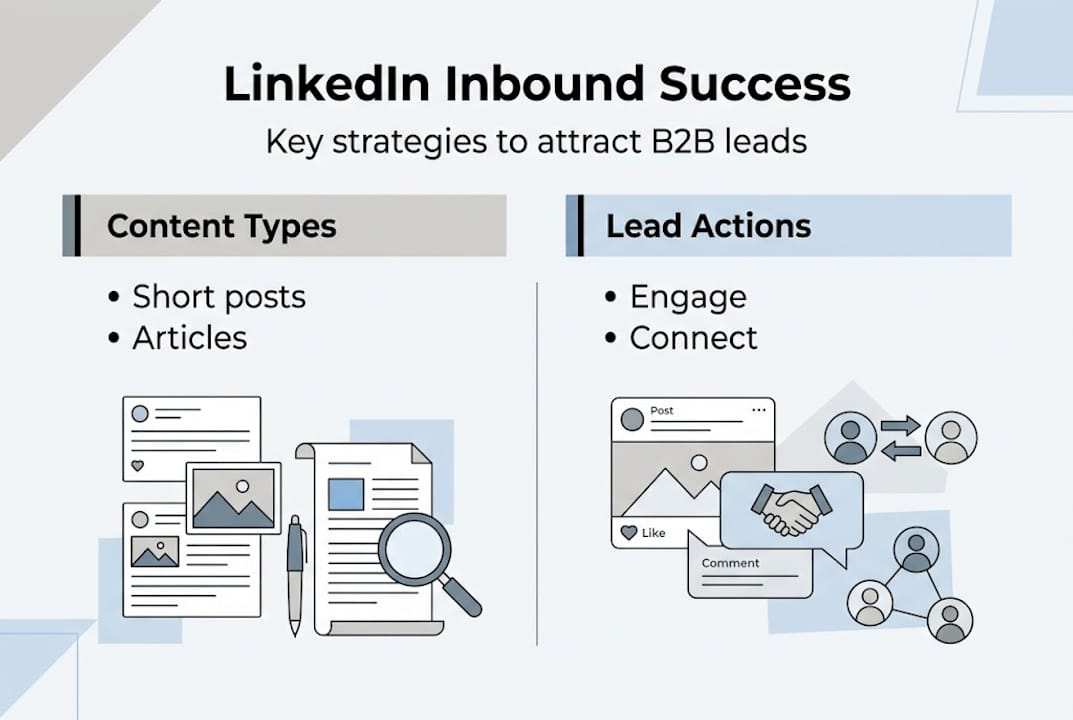
Valuable, consistent LinkedIn content drives inbound enquiries far more than one-off campaigns. The key word is consistent. Sporadic posting, even when the content is excellent, rarely builds the sustained visibility that generates a reliable pipeline.
The most effective content formats for B2B inbound on LinkedIn include:
- Short-form posts. Direct, opinion-led, and easy to consume. These drive the highest reach and comment activity.
- Long-form articles. Ideal for demonstrating deep expertise. They rank in LinkedIn search and attract serious buyers.
- Native video. Authenticity wins here. Short explainer videos or behind-the-scenes content build personal connection quickly.
- Polls. Underrated for engagement. A well-framed poll sparks discussion and surfaces your content to new audiences.
- Carousels (document posts). Highly shareable and visually engaging. Perfect for frameworks, checklists, and step-by-step guides.
Here's how these formats typically perform for SMB B2B marketers on LinkedIn:
| Content format | Average engagement rate | Lead quality | Best use case |
|---|---|---|---|
| Short-form posts | 3.5%+ | Medium | Awareness and reach |
| Long-form articles | 1.8% | High | Authority building |
| Native video | 4.2% | Medium-high | Personal connection |
| Polls | 5.1% | Low-medium | Audience insight |
| Carousel posts | 4.8% | High | Education and nurturing |
Pro Tip: Build a simple content calendar with three to four posts per week. Rotate formats to maintain variety and repurpose your top-performing content across different formats. A popular post can become a carousel, which can become an article. One idea, multiple touchpoints.
Audience alignment is everything. Study your buyers' real pain points and write directly to those. Explore the LinkedIn content creation guide for practical frameworks, and consider content's role in LinkedIn marketing as a long-term investment rather than a short-term tactic.
Engagement tactics to nurture and convert inbound leads
Content attracts leads, but it's clever engagement that transforms attention into lasting business relationships. Posting and disappearing is one of the most common mistakes B2B marketers make on LinkedIn. Engagement is where the real conversion happens.
Effective engagement through commenting, sharing, and direct responses amplifies the reach of your inbound efforts and improves lead conversion rates. It also signals to LinkedIn's algorithm that your content is worth distributing further.
Here's a practical sequence for turning content interactions into sales conversations:
- React to engagement promptly. When someone comments on your post, reply within a few hours. A thoughtful response keeps the conversation visible and shows you're genuinely present.
- Build rapport before pitching. Visit their profile, engage with their content, and understand their world. This creates genuine familiarity.
- Offer value first. Share a relevant article, tag them in useful content, or answer a question they've raised publicly. Give before you ask.
- Invite conversation naturally. When the time is right, send a short, personalised message referencing your shared interaction. No scripts. No templates.
Useful tools for efficient nurturing include LinkedIn Sales Navigator for tracking warm prospects, and CRM integrations that log LinkedIn interactions alongside your wider pipeline activity.
Pro Tip: Every direct message should reference something specific, a post they wrote, a comment they left, or a topic you've both engaged with. Generic messages get ignored. Personalised ones get replies.
Common engagement mistakes to avoid:
- Commenting with generic phrases like "Great post!" that add no value
- Jumping straight into a sales pitch after a single interaction
- Ignoring comments on your own posts, which signals disinterest
- Over-tagging people in irrelevant content
The journey from viewer to warm lead is rarely linear, but a consistent growth strategy for B2B leads built on genuine engagement shortens that journey considerably.
A pragmatic perspective: inbound isn't magic, but it is strategic
Here's the honest truth that most LinkedIn guides skip over: inbound marketing takes time. Not weeks. Often months. Anyone promising overnight results from content alone is selling you something you don't need.
The biggest wins we see come from businesses that resist the urge to copy what's trending and instead invest in understanding their specific audience deeply. Templates don't build trust. Genuine insight does.
There's also an often-overlooked element: follow-up. Many B2B marketers generate interest through content but fail to act on it. A profile visit, a post like, a comment on your article. These are warm signals, not passive noise. Treat them as invitations.
Offline connections matter too. LinkedIn inbound creates the warm introduction; the real relationship often deepens in a call, a meeting, or an event. Don't let digital engagement become a substitute for human connection.
The long game pays off. Businesses that commit to true LinkedIn business growth through consistent inbound activity build pipelines that become genuinely self-sustaining. That's not magic. That's strategy, executed with discipline.
Supercharge your LinkedIn inbound marketing with tailored support
Building an effective LinkedIn inbound strategy takes time, expertise, and consistent execution. If you're ready to accelerate your results without the trial and error, working with specialists can make a measurable difference.
At In-Social, we combine human expertise with advanced tools to build inbound strategies that generate real, qualified leads for B2B businesses. From LinkedIn lead generation without cold outreach to full profile management, content creation, and bespoke training, we tailor every solution to your goals and audience. Whether you need hands-on execution or strategic guidance, we're here to help you build a LinkedIn presence that works for you around the clock. Explore all LinkedIn solutions and find the right fit for your business today.
Frequently asked questions
What is the key difference between LinkedIn inbound and outbound marketing?
Inbound relies on attracting leads through valuable content and profile optimisation, while outbound focuses on direct messaging and cold outreach tactics. Inbound builds trust over time; outbound seeks immediate responses.
How long does it take to see results from LinkedIn inbound marketing?
Most B2B marketers observe meaningful inbound leads within three to six months of consistent content and profile optimisation. Results compound as your authority and audience grow.
What types of content work best for B2B LinkedIn inbound marketing?
Short posts, thought leadership articles, and practical video explainers consistently deliver the highest engagement and lead quality. Consistent, valuable content outperforms sporadic high-effort campaigns every time.
Should I use LinkedIn ads as part of my inbound strategy?
Ads can boost reach, but true inbound results come from organic engagement and authority-building content. Use ads to amplify what's already working organically, not to replace it.