

Many B2B marketers still treat LinkedIn as just another social platform, overlooking its unmatched potential for lead generation and sales growth. Unlike consumer-focused networks, LinkedIn connects you directly with decision makers actively seeking business solutions. For small to medium-sized companies, this professional environment offers 25% more qualified B2B leads than alternative channels. This guide reveals why prioritising LinkedIn transforms your marketing strategy, delivering practical insights to enhance lead quality, strengthen brand authority, and accelerate revenue growth through targeted professional engagement.
Table of Contents
- Key Takeaways
- Understanding LinkedIn's unique role in B2B marketing
- How effective LinkedIn branding accelerates B2B sales
- Crafting a LinkedIn content strategy for lead generation
- Building and leveraging your LinkedIn network for sales growth
- Accelerate your LinkedIn success with expert support
- Frequently asked questions
Key Takeaways
| Point | Details |
|---|---|
| Lead generation uplift | LinkedIn delivers 25% more qualified B2B leads for UK SMBs than alternative channels. |
| Targeting precision | You can identify prospects by job title, company size, industry sector, seniority and specific skills. |
| Branding boosts sales | Strong LinkedIn branding creates immediate credibility when prospects research your company. |
| Content drives engagement | Thoughtful, high quality content on LinkedIn increases lead engagement and positions you as an expert. |
Understanding LinkedIn's unique role in B2B marketing
LinkedIn stands fundamentally apart from other social platforms because every user maintains a professional identity. When someone logs into LinkedIn, they arrive with business intent, seeking industry insights, career opportunities, or solutions to workplace challenges. This mindset creates an environment where your marketing messages reach audiences already primed for B2B conversations.
The platform's professional user base offers unmatched targeting capabilities. You can identify prospects by job title, company size, industry sector, seniority level, and specific skills. Facebook and Instagram serve primarily consumer audiences browsing entertainment and personal updates. LinkedIn users actively engage with thought leadership, industry trends, and business solutions. This distinction matters enormously when you need to reach procurement managers, operations directors, or technology decision makers.
LinkedIn drives 25% more B2B leads for UK SMBs in 2026 compared to combined efforts across other social platforms.
Several platform features specifically support lead generation efforts:
- Professional profiles that reveal prospect pain points, interests, and business priorities
- Industry groups where target audiences discuss challenges and seek recommendations
- Content formats including articles, documents, and video that establish expertise
- Advanced search filters enabling precise prospect identification
- Company pages showcasing your services, culture, and client successes
- InMail messaging for direct outreach to prospects outside your network
These tools combine to create a comprehensive B2B marketing ecosystem. When you understand why use LinkedIn for B2B, you recognise that the platform functions as both marketing channel and sales intelligence resource. Your competitors' employees share insights about company initiatives. Prospects signal buying intent through their engagement patterns. Industry conversations reveal emerging needs before formal tenders appear.
The professional context also elevates content quality expectations. LinkedIn users scroll past generic promotional posts but engage deeply with substantive insights. They share articles that make them look knowledgeable to their networks. They comment on posts that spark genuine professional discussion. This dynamic rewards marketers who invest in valuable content over those chasing viral gimmicks.
For small to medium-sized businesses, LinkedIn levels the playing field against larger competitors. A well-crafted thought leadership article reaches the same audience whether you employ five people or five hundred. Your company page can showcase expertise and client results just as effectively as multinational corporations. Personal brands of founders and sales teams often outperform corporate accounts, giving SMBs a distinct advantage when leaders actively participate.
How effective LinkedIn branding accelerates B2B sales
Strong LinkedIn branding creates immediate credibility when prospects research your company. Before any sales conversation begins, potential clients examine your company page, review employee profiles, and assess the quality of content you share. This digital first impression directly influences whether they respond to outreach or dismiss your messages as spam.
Authentic branding on LinkedIn encompasses far more than logo placement and colour schemes. It reflects your company's expertise, values, and unique approach to solving client problems. When prospects encounter consistent messaging across your company page, employee profiles, and shared content, they perceive a cohesive organisation worthy of consideration. Inconsistent branding signals disorganisation and undermines confidence in your ability to deliver professional services.
Trust develops through transparent demonstration of expertise. Case studies showing measurable client results prove capabilities better than generic service descriptions. Employee advocacy, where team members share company content and insights, multiplies your reach whilst humanising your brand. Prospects trust peer recommendations and authentic employee voices more than corporate marketing messages.
Essential branding actions include:
- Optimising your company page with compelling descriptions, relevant keywords, and showcase pages for service lines
- Sharing detailed case studies that highlight specific client challenges, your solutions, and quantified outcomes
- Engaging authentically with follower comments to demonstrate responsiveness and expertise
- Aligning employee profiles with company messaging whilst allowing individual personality and expertise to shine
- Publishing regular thought leadership that addresses industry challenges and emerging trends
- Maintaining visual consistency across banner images, post graphics, and profile photos
Pro Tip: Develop a simple brand voice guide covering tone, key messages, and visual standards. Share this with everyone who posts on behalf of your company. Consistency builds recognition, and recognition builds trust that converts to sales conversations.
Your company page serves as a permanent showcase accessible to prospects at any stage of their buying journey. Unlike paid advertising that disappears when budgets run out, quality branding assets continue working indefinitely. A prospect might discover your content months before they need your services, then return when a relevant challenge emerges. Strong branding ensures they remember you when that moment arrives.
Employee profiles represent powerful branding extensions. When your sales team and subject matter experts maintain professional, engaging profiles, they become walking advertisements for your company's expertise. Prospects researching your organisation examine not just the corporate page but also the people they might work with. Well-branded employee profiles reassure prospects about the calibre of talent they'll access.
The cumulative effect of consistent LinkedIn branding manifests in shortened sales cycles. Prospects arrive at sales conversations already familiar with your expertise and convinced of your credibility. They've consumed your content, seen your case studies, and observed your professional engagement. This pre-qualification means you spend less time proving legitimacy and more time understanding needs and proposing solutions.
Crafting a LinkedIn content strategy for lead generation
A deliberate LinkedIn content strategy transforms random posting into systematic lead generation. Without strategy, you waste effort on content that fails to attract your ideal prospects or advance them through the buying journey. Strategic content addresses specific audience needs, demonstrates expertise, and includes clear pathways for engagement.

LinkedIn rewards several content types particularly well for B2B marketing. Thought leadership articles position you as an industry authority whilst providing genuine value to readers. Case studies prove your capabilities through concrete client success stories. Event announcements and recaps extend the value of webinars, workshops, and conferences. Educational posts teaching specific skills or frameworks establish expertise whilst helping prospects solve immediate problems.
Building an effective content calendar requires systematic planning:
- Research your audience's pressing challenges, common questions, and information gaps through conversations, surveys, and social listening
- Select monthly themes aligned with your services and seasonal business cycles, ensuring content remains relevant and timely
- Schedule posts consistently, typically three to five times weekly, maintaining presence without overwhelming followers
- Monitor engagement metrics including comments, shares, and profile views to identify resonant topics and formats
- Refine your approach based on performance data, doubling down on successful content types whilst eliminating underperformers
Different content formats serve distinct purposes in lead generation:
| Content Format | Engagement Level | Lead Generation Effectiveness | Best Use Case |
|---|---|---|---|
| Thought leadership articles | Medium to high | High for warm leads | Establishing authority and educating prospects |
| Case studies | Medium | Very high | Proving capabilities to decision makers |
| Quick tips and insights | High | Medium | Building awareness and followers |
| Video content | Very high | High | Demonstrating personality and complex concepts |
| Polls and questions | Very high | Low to medium | Sparking conversation and gathering insights |
| Document posts | Medium to high | Medium to high | Sharing detailed frameworks and resources |
Pro Tip: Every piece of content should include a clear call to action, whether that's commenting with experiences, downloading a resource, or booking a consultation. Interactive elements like questions, polls, and requests for opinions dramatically increase engagement whilst providing valuable audience insights.
Your content calendar should balance educational value with strategic business objectives. Purely promotional content repels audiences, but exclusively educational content fails to convert interest into business opportunities. The optimal mix typically includes 70% educational value, 20% industry insights and trends, and 10% direct promotion of services or offerings.
LinkedIn content creation demands understanding platform algorithms and user behaviour. Posts combining personal narrative with professional insights typically outperform generic corporate announcements. Content that sparks genuine discussion in comments receives algorithmic priority, extending reach beyond your immediate network. Document posts allow deeper exploration of complex topics whilst keeping readers on LinkedIn rather than clicking away.
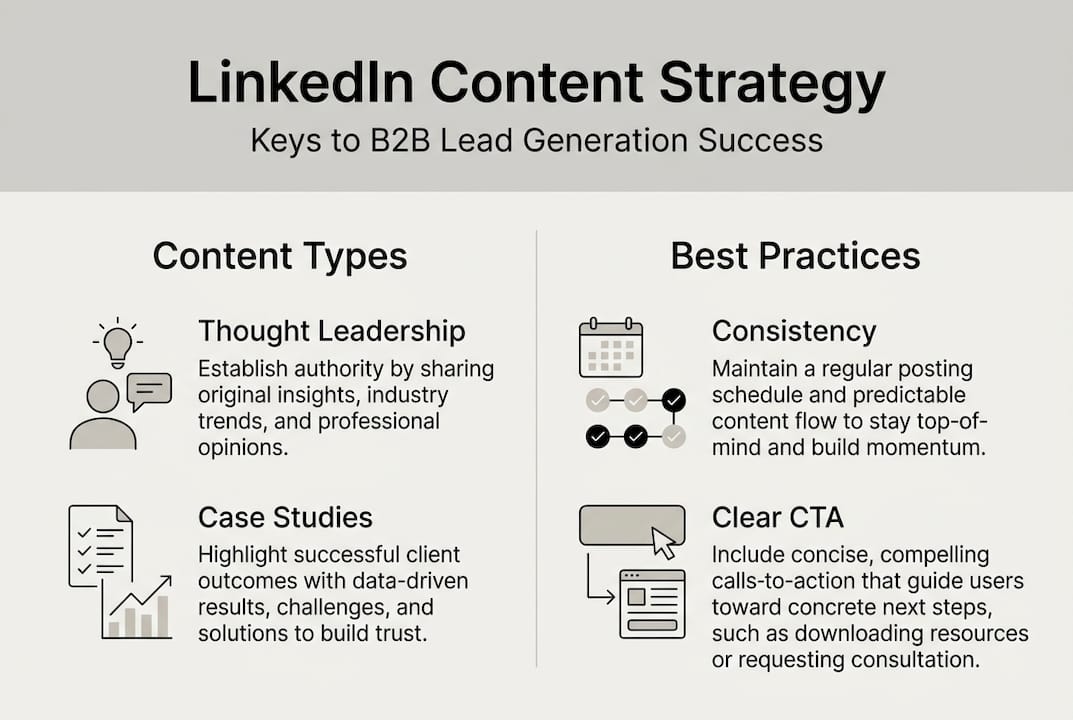
Consistency matters more than perfection. A regular posting schedule trains your audience to expect and watch for your content. Sporadic posting, even of exceptional quality, fails to build momentum or maintain top-of-mind awareness. Schedule content in advance using LinkedIn's native tools or third-party platforms, ensuring consistent presence even during busy periods.
Building and leveraging your LinkedIn network for sales growth
Your LinkedIn network represents potential revenue when cultivated strategically. Random connection collecting delivers little value, whilst thoughtfully building a LinkedIn network of relevant prospects, referral partners, and industry influencers creates ongoing sales opportunities. Quality connections who match your ideal client profile generate far more value than thousands of irrelevant contacts.
The distinction between quantity and quality fundamentally shapes network-building strategy. A network of 500 highly relevant connections, including decision makers in your target industries, produces more leads than 5,000 random connections. Relevant contacts see your content, engage with your insights, and remember you when needs arise. Irrelevant connections ignore your posts, diluting engagement signals that determine algorithmic reach.
Proven tactics for strategic network growth include:
- Sending personalised connection invitations referencing shared interests, mutual connections, or specific content they've shared
- Engaging regularly with target prospects' content through thoughtful comments that add value to discussions
- Requesting introductions from mutual connections who can vouch for your expertise and credibility
- Participating actively in industry groups where ideal clients gather to discuss challenges and share insights
- Following up promptly when connections engage with your content, continuing conversations and building relationships
- Offering genuine value before requesting anything, establishing yourself as a helpful resource rather than aggressive seller
Organic network growth versus paid LinkedIn campaigns each offer distinct advantages:
| Approach | Advantages | Disadvantages |
|---|---|---|
| Organic network building | Authentic relationships, no ongoing costs, sustainable long-term strategy | Slower growth, requires consistent personal effort, limited scale |
| Paid LinkedIn advertising | Rapid reach expansion, precise targeting, measurable ROI | Ongoing costs, stops when budget ends, less personal connection |
| Hybrid approach | Combines scale with authenticity, paid awareness feeds organic relationships | Requires budget and time investment, needs coordination |
Authenticity forms the foundation of successful LinkedIn networking. Prospects instantly recognise template messages and generic outreach. Personalised communication referencing specific details from their profile or content demonstrates genuine interest. This attention to detail separates professional relationship building from spam.
Sustained relationship building requires ongoing engagement beyond the initial connection. Comment on connections' posts, congratulate career milestones, share relevant resources, and offer introductions to helpful contacts. These touchpoints maintain visibility and goodwill, ensuring you remain top of mind when needs emerge. Many B2B sales cycles span months or years, making patient relationship cultivation essential.
Your network multiplies in value through second and third-degree connections. When well-connected contacts share your content or introduce you to prospects, they lend credibility that cold outreach never achieves. Cultivating relationships with industry influencers, satisfied clients, and complementary service providers creates a referral engine generating qualified leads continuously.
Network quality directly impacts content performance. LinkedIn's algorithm prioritises showing your posts to connections who previously engaged with your content. A network of genuinely interested, relevant contacts ensures your content reaches people likely to find it valuable, engage with it, and share it within their networks. This virtuous cycle expands reach organically whilst maintaining relevance.
Accelerate your LinkedIn success with expert support
Implementing these LinkedIn marketing strategies delivers results, but partnering with specialists accelerates your success whilst freeing your team to focus on core business activities. IN Social combines deep LinkedIn lead generation expertise with AI-powered sales tools, helping B2B SMBs maximise their LinkedIn presence without overwhelming internal resources.
Our tailored approach begins with understanding your specific business goals, target audience, and competitive landscape. We then develop customised LinkedIn strategies encompassing profile optimisation, content creation, network building, and lead nurturing. Whether you need complete LinkedIn management or focused support in specific areas, our flexible services adapt to your requirements and budget. The IN Social Sales Club provides ongoing training, community support, and resources for teams committed to mastering LinkedIn marketing themselves. Explore how we help businesses like yours transform LinkedIn into a consistent source of qualified leads and accelerated sales growth at in-social.co.uk.
Frequently asked questions
What industries benefit most from LinkedIn marketing?
Professional services, technology, manufacturing, and business consulting see exceptional LinkedIn results because decision makers in these sectors actively use the platform. However, any B2B company selling to businesses rather than consumers can leverage LinkedIn effectively by targeting the right professional audiences.
How often should I post content on LinkedIn for best results?
Consistency matters more than frequency. Three to five quality posts weekly maintains visibility without overwhelming followers. Focus on valuable content that serves your audience rather than posting daily just to maintain presence.
Is LinkedIn advertising necessary for effective lead generation?
Organic LinkedIn marketing generates substantial leads without advertising spend, especially for SMBs with focused target audiences. Paid campaigns accelerate reach and enable precise targeting, but strong organic strategies deliver results independently. Many successful B2B marketers combine both approaches strategically.
Can small teams manage LinkedIn marketing effectively without extra staff?
Absolutely. Strategic planning, content batching, and scheduling tools enable small teams to maintain strong LinkedIn presence efficiently. Focusing on quality over quantity and leveraging employee advocacy multiplies impact without requiring dedicated social media staff.
What metrics best indicate LinkedIn marketing success?
Track profile views, post engagement rates, connection requests from ideal prospects, and direct enquiries generated through LinkedIn. Ultimately, measure qualified leads entering your sales pipeline and revenue attributed to LinkedIn relationships, as these demonstrate genuine business impact beyond vanity metrics.