

Before a prospect answers your call, they've likely already judged you. Research reveals that 30% of buyers actively look for a LinkedIn profile when researching a salesperson, and a third reject calls based on what they find. Your LinkedIn profile isn't just a digital CV anymore; it's your first sales pitch, your credibility check, and often the deciding factor in whether a buyer engages. For B2B sales professionals, optimising your LinkedIn presence has become essential to generating leads and closing deals. This guide shows you why profile optimisation matters in 2026 and exactly how to transform your profile into a lead generation engine.
Table of Contents
- How buyer behaviour makes LinkedIn profile optimisation essential
- What optimisation actually means: elements that drive profile effectiveness
- The link between LinkedIn activity and sales success: beyond the profile static page
- Practical steps to optimise your LinkedIn profile for lead generation in 2026
- Boost your LinkedIn sales strategy with IN Social
Key takeaways
| Point | Details |
|---|---|
| Buyer research habits | Nearly 60% of B2B buyers use LinkedIn to research salespeople before engaging, making your profile a critical sales asset. |
| Profile impact on decisions | A third of buyers reject calls after viewing poor LinkedIn profiles, turning weak profiles into lost opportunities. |
| Optimisation drives results | Complete profiles with professional photos generate 9x more connection requests and 11x more profile views. |
| Activity matters | Sales reps with higher Social Selling Index scores generate 45% more opportunities and are 51% likelier to hit quota. |
| Regular updates essential | Only 25% of sellers updated their profiles in the past year, yet dynamic profiles significantly outperform static ones. |
How buyer behaviour makes LinkedIn profile optimisation essential
The way B2B buyers research and evaluate salespeople has fundamentally shifted. Nearly 60% of B2B buyers participate in LinkedIn, using the platform to vet potential partners before ever responding to outreach. This behaviour transforms your profile from a passive résumé into an active sales tool that works 24/7. When buyers land on your profile, they're asking themselves whether you understand their challenges, whether you're credible, and whether engaging with you is worth their time.
The stakes are higher than most salespeople realise. Research shows that 33% of buyers admit to not taking a call due to poor LinkedIn profiles. That's one in three potential opportunities lost before you even get a chance to speak. What makes a profile "poor" in buyers' eyes? Typically, it's profiles that read like static résumés, lack clear value propositions, or fail to demonstrate relevant expertise. Buyers want to see that you understand their industry, that you're actively engaged in your field, and that connecting with you will provide value beyond a sales pitch.
The problem intensifies when you consider bounce rates. Profiles treated as static résumés have high bounce rates, meaning visitors leave quickly without taking action. Buyers scroll through dozens of profiles during their research process, and if yours doesn't immediately communicate relevance and value, they move on. This makes optimisation not just beneficial but essential for staying competitive in modern B2B sales.
Beyond individual profiles, buyers also evaluate your engagement in LinkedIn groups, the quality of your content, and how you interact with others' posts. They're looking for signals that you're a trusted advisor, not just another salesperson. Understanding why use LinkedIn for sales helps frame your entire approach around buyer expectations rather than outdated sales tactics.
What optimisation actually means: elements that drive profile effectiveness
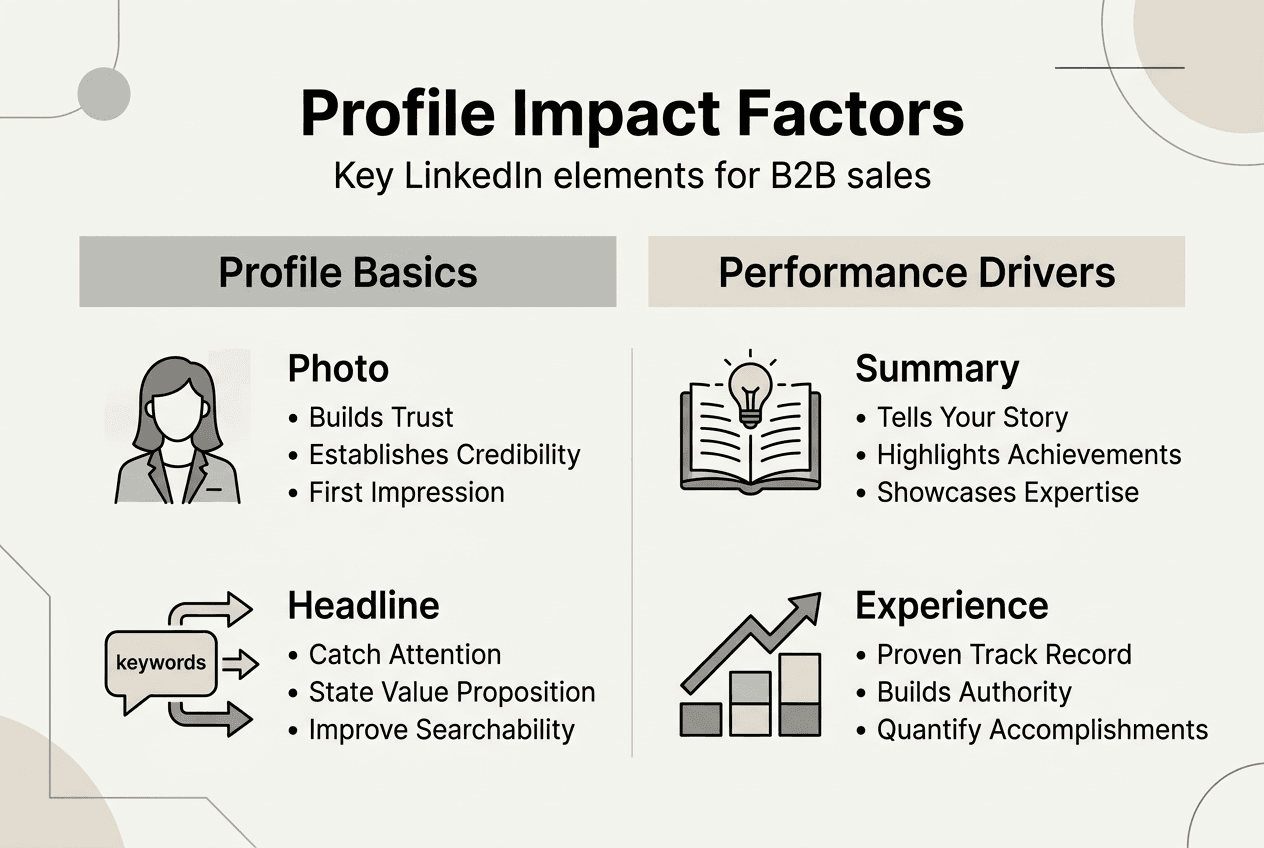
Optimising your LinkedIn profile isn't about adding buzzwords or inflating job titles. It's about strategically crafting each section to communicate value, build trust, and encourage engagement. The data on profile completeness is striking: profiles with complete info and professional headshots get up to 9x more connection requests and 11x more views. Yet despite this clear advantage, most sales professionals leave their profiles incomplete or outdated.
Your profile photo is your first impression. Buyers make snap judgements based on visual cues, and a professional headshot signals credibility and approachability. Your headline shouldn't just state your job title; it should communicate the specific value you deliver to clients. Instead of "Sales Manager at Company X," try "Helping manufacturing firms reduce supply chain costs by 20% through strategic partnerships." This immediately tells buyers what you do and why it matters to them.
Your summary section is prime real estate for keywords and value propositions. Buyers often search LinkedIn for solutions to specific problems, and keyword-rich summaries help you appear in those searches. But keywords alone aren't enough. Your summary should tell a story about the problems you solve, the clients you've helped, and the results you've achieved. Include a clear call to action, whether that's booking a consultation, downloading a resource, or simply connecting to continue the conversation.
The experience section should go beyond listing responsibilities. Frame each role around achievements and outcomes. Use specific metrics where possible: "Increased qualified leads by 40%" or "Reduced sales cycle from 90 to 60 days." These concrete results give buyers confidence in your capabilities. Recommendations and endorsements add social proof, showing that others vouch for your expertise.

Despite the clear benefits, only 25% of sellers updated their profiles in the past year. This presents a significant opportunity. Regular updates signal that you're active, engaged, and current with industry trends. Even small changes, like adding a recent achievement or updating your headline to reflect a new specialisation, keep your profile fresh and relevant.
Pro Tip: Treat your LinkedIn profile like a landing page for your personal brand. Every section should guide visitors towards a specific action, whether that's connecting, messaging, or visiting your website. Remove friction by making your value proposition crystal clear within the first few seconds of viewing.
For a comprehensive approach to profile optimisation, explore strategies for LinkedIn profile optimisation for B2B leads that align with modern buyer expectations.
| Profile Element | Impact on Performance | Optimisation Priority |
|---|---|---|
| Professional Photo | 9x more connection requests | High |
| Complete Profile Info | 11x more profile views | High |
| Keyword-Rich Summary | Improved search visibility | High |
| Regular Updates | Signals active engagement | Medium |
| Clear Call to Action | Reduces bounce rate | Medium |
The link between LinkedIn activity and sales success: beyond the profile static page
A polished profile is your foundation, but LinkedIn activity is what amplifies your reach and drives actual sales results. The Social Selling Index (SSI) measures how effectively you establish your professional brand, find the right people, engage with insights, and build relationships. The correlation between SSI and sales performance is remarkable: reps with higher SSI scores generate 45% more opportunities and are 51% likelier to hit quota.
Consistent content posting is one of the most powerful levers for increasing visibility and establishing thought leadership. Companies posting consistently see 2x engagement compared to sporadic posting, and the same principle applies to individual profiles. When you share valuable insights, industry analysis, or practical tips, you position yourself as a trusted resource rather than just another salesperson. This builds the credibility that converts profile views into conversations.
Timing matters significantly for content performance. Engaging with your own posts within the first hour of publication dramatically increases their reach. Comments are particularly valuable because they signal to LinkedIn's algorithm that your content sparks meaningful discussion. This creates a virtuous cycle: more engagement leads to greater visibility, which attracts more profile views and connection requests.
Personalisation in outreach is another critical factor. Sales reps who personalise their connection requests and messages based on profile insights see substantially higher response rates. Generic templates are instantly recognisable and often ignored. Instead, reference something specific from a prospect's profile, comment on their recent post, or mention a shared connection. This demonstrates genuine interest and increases the likelihood of engagement.
Pro Tip: Set aside 20 minutes each morning for LinkedIn engagement. Comment thoughtfully on posts from prospects and industry leaders, share relevant content, and respond to messages. This consistent daily activity compounds over time, steadily increasing your visibility and credibility.
To maximise your LinkedIn presence, learn how to improve LinkedIn engagement for B2B through strategic content and interaction patterns. Developing a structured LinkedIn content strategy workflow for B2B ensures consistency and quality in your posting schedule.
| Activity Type | Engagement Impact | Lead Generation Benefit |
|---|---|---|
| Daily commenting | Increases visibility 3-5x | Builds relationships with prospects |
| Weekly content posts | Doubles engagement rates | Establishes thought leadership |
| Personalised outreach | 30% higher response rate | Converts connections to conversations |
| Early post engagement | Boosts algorithmic reach | Expands audience beyond network |
Practical steps to optimise your LinkedIn profile for lead generation in 2026
Transforming your LinkedIn profile into a lead generation engine requires systematic optimisation across multiple elements. Start with the fundamentals: upload a professional headshot with good lighting and a clean background, craft a headline that communicates specific value, and write a summary that addresses your ideal client's pain points. These basics alone will put you ahead of most competitors.
Next, optimise each experience entry to highlight results rather than responsibilities. Use bullet points to break up text and make achievements scannable. Include relevant keywords naturally throughout your profile, particularly in your headline, summary, and skills sections. These keywords help you appear in buyer searches and signal your areas of expertise.
Regular profile maintenance is crucial. Set a quarterly reminder to review and update your profile with recent achievements, new skills, or evolved positioning. Add fresh recommendations by requesting them from satisfied clients. Update your featured section with your best recent content, case studies, or relevant resources. This ongoing refinement keeps your profile dynamic and relevant.
Your LinkedIn activity should complement your optimised profile. Develop a content calendar that balances industry insights, practical tips, and thought leadership pieces. Aim for at least one substantial post per week, supplemented by daily engagement through comments and shares. Join relevant LinkedIn groups where your ideal clients gather, and contribute meaningfully to discussions.
When building your network, prioritise quality over quantity. Focus on connecting with prospects, clients, industry peers, and thought leaders who align with your target market. Personalise every connection request with a brief note explaining why you'd like to connect. This small effort significantly increases acceptance rates and sets a positive tone for the relationship.
Avoid common pitfalls that undermine your efforts. Don't link to external websites in your posts, as LinkedIn's algorithm suppresses this content. Instead, drive engagement within the platform and move conversations to direct messages. Don't ignore your posts after publishing; engage actively with comments to boost reach. Don't treat LinkedIn as a one-way broadcast channel; genuine relationship building requires two-way interaction.
Pro Tip: Use LinkedIn's native analytics to track which content resonates most with your audience. Double down on topics and formats that generate high engagement, and refine or eliminate what doesn't work. Data-driven optimisation compounds your results over time.
Sales reps who personalise outreach see a 30% higher response rate, making customisation worth the extra effort. For comprehensive guidance on expanding your reach, explore how to build LinkedIn network for B2B sales and discover the benefits of LinkedIn lead generation for B2B sales in 2026.
- Audit your current profile against best practices and identify gaps
- Update your photo, headline, and summary with value-focused messaging
- Optimise experience sections with achievement-oriented bullet points
- Request recommendations from recent clients and colleagues
- Develop a content calendar with weekly posting commitments
- Set daily engagement targets for comments and interactions
- Personalise all connection requests and outreach messages
- Track your Social Selling Index monthly and work to improve it
- Review analytics quarterly to refine your content strategy
- Continuously test new approaches and iterate based on results
Boost your LinkedIn sales strategy with IN Social
Optimising your LinkedIn profile and maintaining consistent activity requires time, expertise, and strategic thinking. That's where IN Social comes in. We specialise in managed LinkedIn services designed specifically for B2B companies looking to turn LinkedIn into a reliable lead generation channel.
Our team combines human expertise with advanced AI tools to optimise your profile, create engaging content, and execute proven engagement strategies that drive measurable pipeline growth. Whether you're unsure if LinkedIn fits your sales approach or ready to scale your efforts, our LinkedIn sales strategy evaluation helps you make informed decisions. Discover how our LinkedIn lead generation and AI sales strategies can transform your LinkedIn presence into a consistent source of qualified leads and closed deals.
FAQ
How often should I update my LinkedIn profile to optimise for sales?
Update your profile at least quarterly to maintain relevance and signal active engagement to buyers. Significant changes like new roles, major achievements, or evolved positioning warrant immediate updates. Only a quarter of sellers updated their LinkedIn profile in the past year, creating a competitive advantage for those who maintain fresh, dynamic profiles. Regular updates also improve your search visibility as LinkedIn's algorithm favours active profiles.
What key elements make a LinkedIn profile stand out to B2B buyers?
A professional headshot, compelling headline that communicates specific value, and keyword-rich summary addressing buyer pain points form the foundation. Profiles with professional photos and complete info get 9x more connection requests and 11x more views. Include a clear call to action, showcase measurable achievements in your experience section, and gather recommendations from clients. Demonstrating active engagement through regular content and thoughtful comments further differentiates you from competitors with static profiles.
How does engaging with LinkedIn content boost my sales leads?
Engaging early with comments on your own posts boosts algorithmic reach significantly, expanding your visibility beyond your immediate network. Comments hold more weight than likes in LinkedIn's algorithm, sparking discussions that attract profile views from potential buyers. Consistent posting establishes thought leadership and builds trust with prospects who see your expertise demonstrated over time. This combination of visibility and credibility converts passive profile viewers into active leads who reach out or respond positively to your outreach.
Does personalising connection requests really improve response rates?
Absolutely. Generic connection requests signal that you're mass-connecting without genuine interest, leading to low acceptance rates and weak relationships. Personalised requests that reference something specific from a prospect's profile, comment on their content, or mention a shared connection demonstrate authentic interest. This approach respects the recipient's time and increases the likelihood they'll not only accept but also engage in meaningful conversation. The small additional effort per request yields substantially better results in both acceptance rates and relationship quality.