

Despite being the world's largest professional network, LinkedIn remains surprisingly underutilised by many B2B sales teams who default to cold calling and generic email campaigns. Yet evidence shows LinkedIn leads consistently outperform other channels, closing at higher rates and generating significantly larger deals. This guide reveals exactly why LinkedIn has become indispensable for sales professionals in 2026, backed by current data and proven strategies. You'll discover how to combine organic engagement with targeted paid campaigns to generate qualified leads, measure true ROI beyond surface metrics, and implement practical workflows your team can start using immediately to drive measurable sales growth.
Table of Contents
- Why LinkedIn Stands Out For B2B Sales Teams
- Maximising Lead Generation With LinkedIn: Organic And Paid Approaches
- Evaluating LinkedIn's Return On Investment For Sales Teams
- Practical Steps To Implement LinkedIn For Your Sales Team
- Discover Expert LinkedIn Lead Generation Services
- Frequently Asked Questions About LinkedIn For Sales Teams
Key takeaways
| Point | Details |
|---|---|
| Highest B2B adoption | LinkedIn commands 95.7% adoption among B2B marketers for lead generation, the highest of any platform. |
| Superior conversion rates | LinkedIn leads convert at 2 to 3 times higher rates than other channels whilst generating double the deal value. |
| Decision-maker access | Over 65 million business decision-makers actively use LinkedIn, with four in five members influencing purchasing decisions. |
| Hybrid approach works best | Combining organic content strategies with paid LinkedIn tools maximises lead quality whilst avoiding platform restrictions. |
| ROI justifies investment | Higher cost per lead is offset by dramatically better conversion rates and larger average deal sizes. |
Why LinkedIn stands out for B2B sales teams
LinkedIn's dominance in B2B lead generation isn't accidental. The platform hosts over 65 million decision-makers who actively shape purchasing choices at their organisations. This concentration of qualified prospects creates an environment fundamentally different from consumer-focused social platforms where business messaging feels intrusive.
What truly sets LinkedIn apart is professional context. When someone logs into LinkedIn, they expect business interactions and career-related content. Your outreach doesn't interrupt leisure time or personal connections. Instead, it arrives in a space where prospects are already thinking about work challenges, industry trends, and potential solutions. This mindset alignment dramatically improves receptivity compared to cold calls that disrupt busy schedules or emails buried in overflowing inboxes.
The numbers validate this advantage. 95.7% of B2B marketers use LinkedIn for lead generation, the highest adoption rate across all marketing channels. This widespread usage reflects proven results rather than trendy experimentation. Marketers allocate budgets to channels that deliver measurable outcomes, and LinkedIn consistently proves its value.
Targeting precision amplifies these benefits. Unlike broad demographic filters on consumer platforms, LinkedIn lead generation B2B guide enables you to reach prospects by exact job title, seniority level, company size, industry sector, and even specific skills. For SMB sales teams targeting niche markets, this granularity eliminates wasted outreach to unqualified contacts. You can build campaigns reaching only Chief Technology Officers at manufacturing companies with 50 to 200 employees, for example, ensuring every pound spent targets genuinely relevant prospects.
Key reasons LinkedIn suits SMB B2B sales teams:
- Direct access to decision-makers without gatekeepers filtering your message
- Professional environment where business conversations feel natural and expected
- Precise targeting parameters that eliminate wasted outreach to irrelevant contacts
- Built-in credibility signals through profiles, recommendations, and shared connections
- Content distribution that positions your expertise before formal sales conversations begin
LinkedIn's 95.7% adoption rate among B2B marketers and unmatched targeting precision make it the primary channel for reaching qualified business decision-makers in environments where they actively seek professional solutions.
For sales teams at small to medium-sized businesses, these advantages translate to more efficient prospecting. You spend less time chasing dead ends and more time engaging prospects already predisposed to business discussions. Understanding why use LinkedIn for B2B helps frame your approach around these platform-specific strengths rather than simply replicating tactics from other channels.
Maximising lead generation with LinkedIn: organic and paid approaches
Successful LinkedIn lead generation requires balancing organic relationship building with targeted paid campaigns. Each approach serves distinct purposes, and combining them creates a sustainable pipeline of qualified prospects whilst maintaining platform compliance.
Organic strategies centre on establishing credibility before asking for business. Start by optimising your profile to showcase specific expertise and tangible results rather than generic job descriptions. Prospects research salespeople before responding, and a well-crafted profile builds trust that facilitates warmer conversations. Organic methods like profile optimisation and thought leadership content generate 62% of leads when executed consistently.
Thought leadership content dramatically accelerates inbound enquiries. Posting insights about industry challenges, sharing case studies, and offering practical frameworks positions you as a knowledgeable resource rather than just another salesperson. This content marketing approach generates over three times more lead enquiries compared to generic company updates or product announcements. Prospects who engage with your content arrive at sales conversations already familiar with your expertise and perspective.

Personalised outreach remains essential for proactive prospecting. Generic connection requests and copy-paste messages get ignored, but tailored messages referencing specific profile details or shared interests earn responses. Mention a recent post they shared, comment on a career milestone, or reference mutual connections to demonstrate genuine interest rather than automated outreach.
Paid approaches complement organic efforts by accelerating reach and targeting precision. LinkedIn Lead Gen Forms capture prospect information without requiring them to leave the platform, reducing friction that typically kills conversion rates. Sales Navigator provides advanced search filters and lead recommendations that surface prospects matching your ideal customer profile, even those outside your existing network.
Cost considerations matter, particularly for smaller teams with limited budgets. Paid LinkedIn leads close at 2 to 3 times higher rates and generate deals worth twice as much as leads from cheaper channels, justifying the investment when targeting high-value accounts. The key is matching spend to potential deal value rather than chasing the lowest cost per lead.
| Approach | Primary benefit | Typical cost | Conversion rate | Best for |
|---|---|---|---|---|
| Organic content | Builds long-term authority | Time investment | Moderate, compounds over time | Thought leadership, inbound leads |
| Personalised outreach | Direct prospect engagement | Time investment | High with proper targeting | Specific account targeting |
| Lead Gen Forms | Frictionless lead capture | £75-150 per lead | Very high | Campaign-driven lead generation |
| Sales Navigator | Advanced prospect discovery | £79.99 monthly | High with skilled use | Proactive outreach at scale |
Step-by-step organic lead generation techniques:
- Audit and optimise your profile with client-focused language highlighting specific outcomes
- Establish a consistent posting schedule sharing insights, not sales pitches
- Engage authentically with prospects' content before sending connection requests
- Use voice notes or video messages to stand out from text-only outreach
- Track which content types generate the most engagement and double down
Pro Tip: Integrate LinkedIn activity with your CRM to track which content topics and outreach approaches generate qualified opportunities. This attribution reveals true ROI and helps you focus effort on tactics that actually convert rather than vanity metrics like connection count.
Balancing organic and paid tactics prevents over-reliance on either approach. Organic efforts build sustainable authority and inbound interest, whilst paid tools accelerate results and expand reach beyond your immediate network. Exploring LinkedIn content creation strategies and building LinkedIn network for sales provides frameworks for implementing both approaches systematically.
Evaluating LinkedIn's return on investment for sales teams
LinkedIn's higher cost per lead initially concerns budget-conscious sales managers, but focusing solely on this metric misses the complete financial picture. True ROI assessment requires examining conversion rates, deal sizes, and customer lifetime value rather than just acquisition cost.
Cost per lead on LinkedIn typically ranges from £75 to £150, significantly higher than channels like Facebook ads or cold email campaigns. This surface-level comparison causes some teams to dismiss LinkedIn as too expensive. However, LinkedIn leads close at 2 to 3 times higher conversion rates and generate deals worth approximately double the revenue of leads from cheaper sources. A £100 lead that closes at 15% with a £50,000 deal value delivers far better ROI than a £20 lead closing at 3% with a £15,000 deal.
Smart sales teams track cost per qualified lead rather than raw cost per lead. A qualified lead meets specific criteria indicating genuine purchase intent and budget authority, whilst raw leads include anyone who submitted a form regardless of fit. LinkedIn's targeting precision delivers higher qualified lead percentages, reducing wasted follow-up time on prospects who were never going to buy.
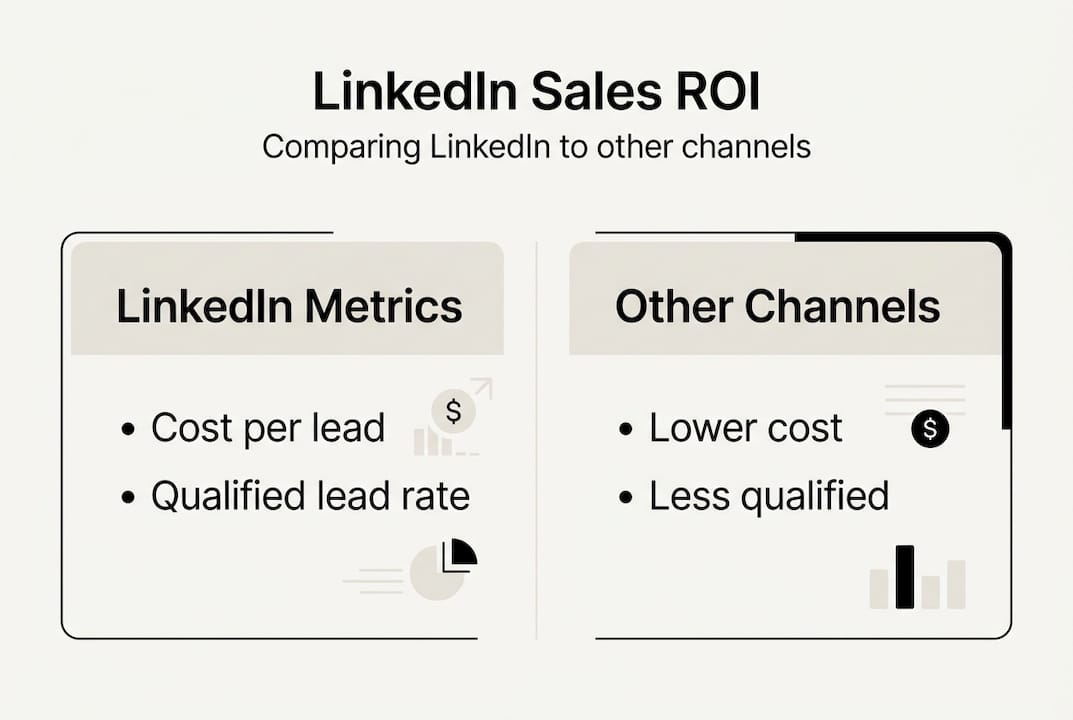
Customer acquisition cost provides the most complete financial view. Calculate total marketing and sales expenses divided by new customers acquired, then compare this against customer lifetime value. LinkedIn often produces lower CAC despite higher CPL because superior lead quality reduces sales cycle length and increases close rates. Fewer touches are needed to convert a warm LinkedIn lead compared to a cold prospect from generic advertising.
| Metric | Alternative channels | Why it matters | |
|---|---|---|---|
| Cost per lead | £75-150 | £15-40 | Surface metric, incomplete picture |
| Qualified lead rate | 45-60% | 15-25% | Indicates targeting precision |
| Lead-to-customer conversion | 12-18% | 4-8% | Shows sales efficiency |
| Average deal size | £45,000 | £22,000 | Revenue impact per customer |
| Customer acquisition cost | £850-1,200 | £900-1,400 | True cost efficiency |
Integrating LinkedIn campaigns with your CRM enables accurate attribution tracking. Tag leads by source and monitor their progression through your sales pipeline. This data reveals which LinkedIn tactics generate opportunities that actually close, not just surface-level engagement metrics. You can then optimise spend towards high-performing campaigns whilst cutting underperformers.
Pro Tip: Align LinkedIn investment with account value and relationship potential rather than chasing the lowest cost per lead. Spending £200 to acquire a qualified lead for a £100,000 annual contract opportunity makes perfect sense, whilst the same spend for a £5,000 one-time purchase doesn't. Match your acquisition strategy to deal economics.
Long-term relationship value amplifies LinkedIn's ROI advantage. Prospects who engage with your thought leadership content before becoming customers often have higher retention rates and lifetime values. They chose you based on expertise and alignment rather than just price, creating stickier relationships less vulnerable to competitor poaching.
Understanding LinkedIn lead generation results and implementing LinkedIn content best practices helps maximise these financial outcomes through systematic optimisation rather than ad hoc experimentation.
Practical steps to implement LinkedIn for your sales team
Transforming LinkedIn from occasional networking tool to systematic lead generation engine requires structured implementation. Follow these practical steps to establish sustainable processes your entire sales team can execute consistently.
Optimise team member profiles for credibility:
- Rewrite headline to highlight specific value you deliver to clients, not just job title
- Transform the About section into a client-focused narrative explaining problems you solve
- Detail quantifiable achievements in experience descriptions rather than generic responsibilities
- Request recommendations from satisfied clients addressing specific concerns prospects typically have
- Add relevant skills and ensure top skills align with your target audience's priorities
- Use a professional headshot and background image that reinforces your industry positioning
Company page optimisation runs parallel to individual profiles. Ensure your page clearly articulates your value proposition, showcases client results, and maintains active posting to demonstrate ongoing thought leadership. Prospects research both individual salespeople and their companies before engaging.
Create and schedule engaging content:
- Identify three to five topics where you have genuine expertise and your prospects face challenges
- Develop a content calendar mixing educational posts, case studies, industry insights, and conversation starters
- Write posts in conversational language addressing one specific idea per post
- Include questions or calls for opinions to encourage comment engagement
- Schedule posts during peak engagement times for your industry, typically Tuesday through Thursday mornings
- Respond promptly to all comments to foster ongoing dialogue and visibility
Personalised outreach requires discipline and genuine research. Avoid spray-and-pray connection requests that damage your reputation and waste time on unqualified prospects.
Best practices for LinkedIn outreach:
- Research prospects thoroughly before connecting, identifying specific relevance or shared interests
- Reference something specific from their profile or content in connection requests
- Wait until after connection acceptance to pitch, using initial messages to build rapport
- Offer value first through relevant insights or introductions before asking for meetings
- Follow up persistently but respectfully, spacing messages appropriately
- Track response rates by message template to identify what resonates
Combining organic content with paid Lead Gen Forms and Sales Navigator creates balanced lead flow. Combining organic and paid LinkedIn strategies avoids platform restrictions whilst ensuring consistent quality lead generation. Over-reliance on aggressive outreach risks account restrictions, whilst purely organic approaches limit scale.
Pro Tip: Conduct monthly performance reviews analysing which content topics, outreach messages, and paid campaigns generate qualified opportunities. Adapt your approach based on actual conversion data rather than assumptions about what should work. This prevents budget waste on underperforming tactics and helps you double down on proven winners.
Sales team training ensures consistent execution. Not everyone naturally understands LinkedIn etiquette or content creation. Provide templates, examples, and regular coaching to maintain quality standards across your team. Inconsistent or overly aggressive approaches from individual team members can damage your company's reputation.
Implementing LinkedIn content strategy workflow and following LinkedIn content tips provides structured frameworks that remove guesswork and accelerate results through proven processes.
Discover expert LinkedIn lead generation services
Whilst the strategies outlined above deliver results with consistent execution, many sales teams struggle to maintain momentum alongside daily selling responsibilities. Content creation, profile optimisation, and strategic campaign management require dedicated time and specialised expertise that internal teams often lack.
IN Social combines human expertise with AI-powered tools to deliver comprehensive LinkedIn lead generation & AI sales strategies tailored specifically for SMB B2B companies. Our managed LinkedIn services handle profile optimisation, content creation, and campaign execution, freeing your sales team to focus on conversations with qualified prospects rather than platform mechanics.
We understand that LinkedIn success requires more than just posting content or sending connection requests. Our approach integrates organic thought leadership with targeted paid campaigns, ensuring sustainable lead generation that complies with platform guidelines whilst maximising ROI. Whether you're just beginning to leverage LinkedIn or looking to optimise existing efforts, our team provides the strategic guidance and execution support to accelerate your results. Evaluate LinkedIn sales strategy fit for your specific business goals and discover how expert management can transform LinkedIn into your most productive sales channel.
Frequently asked questions about LinkedIn for sales teams
What makes LinkedIn better than other lead sources for B2B sales?
LinkedIn concentrates over 65 million business decision-makers in a professional context where they expect and welcome business discussions. This targeting precision and receptive mindset deliver conversion rates 2 to 3 times higher than channels where business messaging feels intrusive or irrelevant.
How can sales teams balance organic and paid LinkedIn activities?
Use organic content to build long-term authority and inbound interest whilst deploying paid campaigns for immediate lead generation and precise targeting. Allocate roughly 60% effort to consistent organic engagement and 40% to targeted paid campaigns, adjusting based on your specific goals and budget constraints.
Is LinkedIn lead generation cost-effective for small businesses?
Yes, when targeting high-value B2B deals where customer lifetime value justifies acquisition costs. LinkedIn's higher cost per lead is offset by superior conversion rates and larger deal sizes. Small businesses selling complex solutions with £20,000-plus deal values typically see strong ROI, whilst those with low-value transactions may find cheaper channels more suitable.
What are the best content types to post on LinkedIn?
Thought leadership posts addressing specific industry challenges, case studies demonstrating tangible client results, and conversation starters asking for community input generate the highest engagement. Avoid overly promotional content or generic company announcements that prospects scroll past without engagement.
How quickly can sales teams see results from LinkedIn campaigns?
Organic strategies typically require 3 to 6 months of consistent execution before generating significant inbound leads, as authority and visibility compound over time. Paid campaigns can generate qualified leads within weeks, though optimisation continues for several months as you refine targeting and messaging based on performance data.