

LinkedIn accounts for over 80% of B2B leads generated through social media, making it the essential platform for UK small and medium-sized businesses targeting sales growth. Yet many sales teams struggle with fragmented approaches that fail to unlock LinkedIn's full potential. This guide reveals why LinkedIn outperforms other platforms for B2B lead generation, explores powerful sales tools and content strategies, and shows you how to avoid common pitfalls whilst achieving measurable growth in qualified leads and revenue.
Table of Contents
- LinkedIn's unique advantages for B2B lead generation
- Effective content and engagement strategies on LinkedIn
- Common misconceptions and pitfalls in using LinkedIn for sales growth
- Advanced tools and AI integration to enhance LinkedIn sales efforts
- Practical implementation and measuring success on LinkedIn
- Conclusion: transforming sales growth with LinkedIn mastery
- Grow your B2B sales with expert LinkedIn services
- Frequently asked questions
Key takeaways
| Point | Details |
|---|---|
| LinkedIn dominates B2B lead generation | The platform delivers over 80% of social media B2B leads, offering unmatched professional targeting for UK SMBs. |
| Strategic content drives engagement | Consistent weekly posting increases visibility by 30%, whilst personalised outreach builds trust and improves conversion rates. |
| Sales Navigator boosts conversion | Advanced filtering and CRM integration can improve lead conversion rates by up to 35% when combined with personalised engagement. |
| Avoid common pitfalls | Over-automation reduces lead quality by 25%, whilst expecting immediate ad ROI (typically 4-6 months) leads to premature strategy abandonment. |
| Measure and refine continuously | Track connection acceptance, lead response, and conversion rates monthly to optimise your LinkedIn sales strategy for sustained growth. |
LinkedIn's unique advantages for B2B lead generation
LinkedIn's professional user base sets it apart from Facebook, Instagram, and other social platforms. Every user maintains a profile focused on business relationships, job roles, and industry expertise. This creates an environment where LinkedIn offers higher B2B lead quality than consumer-focused platforms because your prospects are already in a professional mindset when they engage with your content.

The platform's advanced search filters let you target decision-makers by job title, company size, industry, and location. Sales Navigator takes this further with lead recommendations, CRM integrations, and real-time alerts when prospects change jobs or share content. You can identify exactly who needs your solution and when they're most receptive to outreach.
| Feature | |||
|---|---|---|---|
| Professional targeting | Advanced job title, industry, company filters | Basic demographic targeting | Limited professional filters |
| B2B buyer intent | High (users expect business interactions) | Low (primarily personal use) | Medium (mixed personal and professional) |
| Lead quality | Premium (decision-makers actively networking) | Variable (broader audience mix) | Lower (shorter engagement window) |
| Sales tools | Sales Navigator, InMail, CRM integration | Basic ads and messaging | Limited lead generation tools |
This targeting precision means your outreach reaches people actively seeking solutions like yours. When a procurement manager searches for vendors or a business owner explores growth strategies, LinkedIn surfaces your profile and content at precisely the right moment. Other platforms require broader targeting and hope your message reaches the right person amongst thousands of irrelevant users.
Effective content and engagement strategies on LinkedIn
Storytelling transforms dry product pitches into compelling narratives that resonate with your audience. Share client success stories, behind-the-scenes insights into your problem-solving process, or lessons learned from industry challenges. Educational content like how-to guides, industry trend analysis, and actionable tips positions you as a trusted advisor rather than just another vendor.
Personalised connection requests dramatically improve acceptance rates. Reference a shared group, comment on their recent post, or mention a mutual connection to show genuine interest. Generic "I'd like to add you to my network" messages get ignored, whilst thoughtful requests that demonstrate you've researched their profile build immediate rapport and trust.
Consistent weekly posting increases visibility by 30% compared to irregular schedules. LinkedIn's algorithm rewards accounts that maintain steady activity, boosting your content to more followers and second-degree connections. Plan posts around your business cycles, product launches, or seasonal trends relevant to your audience.
Pro tip: Create a content calendar mapping out topics, formats (articles, videos, polls), and posting dates for the next quarter. This ensures consistent messaging aligned with your sales objectives and prevents last-minute scrambling for content ideas.
Engage authentically by commenting on prospects' posts before sending connection requests. Add thoughtful insights to their discussions, ask clarifying questions, or share relevant experiences. This warm introduction makes your eventual outreach feel natural rather than intrusive, establishing familiarity before you pitch your solution.
Common misconceptions and pitfalls in using LinkedIn for sales growth
Many sales teams expect immediate returns from LinkedIn advertising, but ad ROI typically appears after 4-6 months, not immediately. LinkedIn operates on relationship timelines where trust develops through multiple touchpoints. Prospects need to see your content, engage with your posts, and recognise your expertise before they're ready to discuss solutions.
- Expecting instant ad results leads to premature campaign cancellation just as momentum builds.
- Over-automation without personalisation decreases lead quality by approximately 25% because generic messages fail to resonate.
- Irregular posting causes algorithm penalties that reduce your content visibility to near zero.
- Treating LinkedIn like a billboard rather than a networking event alienates prospects seeking genuine connections.
- Neglecting to respond promptly to comments and messages signals disinterest and damages credibility.
Pro tip: Balance automation tools for efficiency with personalised human touches in every fifth message or interaction. Review automated sequences monthly and customise templates based on prospect behaviour and engagement patterns to maintain authenticity whilst scaling outreach.
Over-reliance on InMail blasts without prior engagement wastes your monthly credits. Prospects receiving unsolicited sales pitches from strangers rarely convert, whilst those who've already interacted with your content respond more favourably. Build familiarity through content engagement before using InMail for targeted offers.
Failing to optimise your profile undermines all other efforts. Decision-makers research you before accepting requests or responding to messages. An incomplete profile lacking client testimonials, case studies, or clear value propositions raises doubts about your professionalism and expertise, costing you opportunities before conversations even begin.
Advanced tools and AI integration to enhance LinkedIn sales efforts
Sales Navigator transforms basic LinkedIn into a powerful prospecting engine. Advanced filters let you search by seniority level, years in current role, company headcount growth, and technology usage. Save lead lists, receive alerts when prospects change positions, and integrate findings directly into your CRM for seamless workflow management.
Sales Navigator improves lead conversion rates by up to 35% through features unavailable on basic accounts. InMail credits let you message prospects outside your network, whilst TeamLink reveals connections between your colleagues and target accounts. Lead recommendations surface prospects matching your ideal customer profile automatically, reducing research time substantially.
| Feature | Basic LinkedIn | Sales Navigator |
|---|---|---|
| Search filters | Limited to 2nd connections | Unlimited advanced filters |
| InMail credits | None | 20-50 monthly depending on tier |
| CRM integration | Manual export only | Native Salesforce, HubSpot sync |
| Lead tracking | Manual notes only | Automated alerts and recommendations |
| Prospect insights | Basic profile data | Decision-maker maps, company news |
AI-powered lead scoring analyses prospect behaviour patterns to predict conversion likelihood. Tools track content engagement, profile views, and message response times to prioritise your outreach. However, AI must complement rather than replace personalisation, as AI lead management best practices emphasise maintaining human judgement in final outreach decisions.
Combining managed LinkedIn services with AI tools delivers optimal results. Expert strategists interpret AI insights to craft personalised campaigns whilst automation handles repetitive tasks. This hybrid approach maintains efficiency without sacrificing the authentic relationships that drive B2B sales success.
Practical implementation and measuring success on LinkedIn
Implement your LinkedIn strategy through these sequential steps for maximum impact. Rushing or skipping stages undermines results, whilst methodical execution builds sustainable growth.
- Define your ideal customer profile with specific job titles, industries, company sizes, and pain points your solution addresses.
- Plan a content calendar covering educational posts, client stories, industry insights, and engagement prompts for the next 90 days.
- Personalise connection requests referencing shared interests, mutual connections, or specific content the prospect has shared recently.
- Use Sales Navigator to identify high-priority prospects matching your ideal profile and track their engagement with your content.
- Track key performance indicators monthly including connection acceptance rate, content engagement, lead response time, and conversion percentage.
- Adjust your strategy based on data showing which content types, posting times, and outreach messages generate the strongest response.
Connection acceptance rate reveals how well your targeting and personalisation resonate. Rates below 30% suggest generic messaging or poor audience fit. Lead response rate indicates message quality and timing, whilst conversion rate measures your ability to move prospects through your sales funnel effectively.
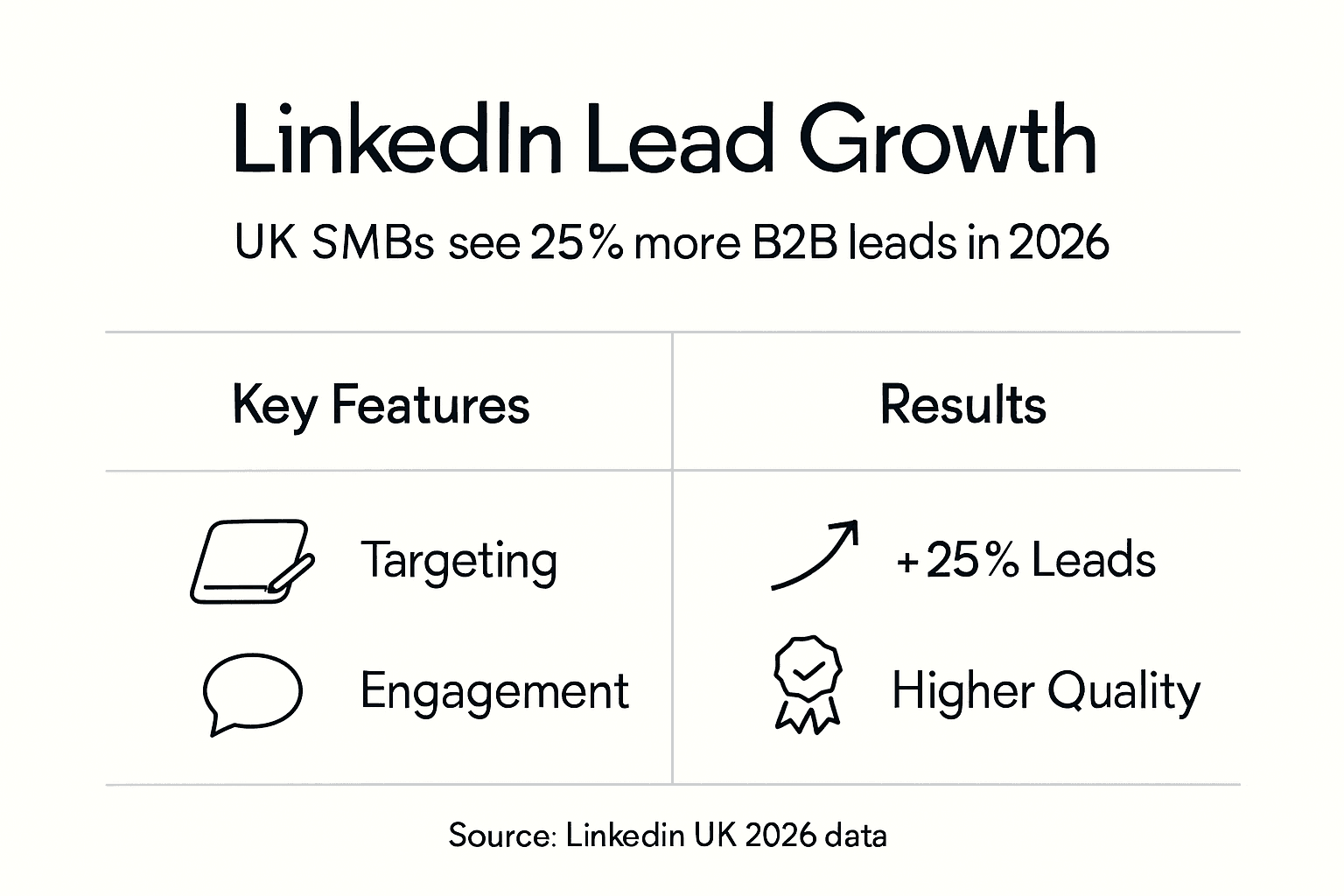
UK SMBs typically see 15-25% increases in qualified leads within six months using strategic LinkedIn approaches. This timeline accounts for relationship-building, content distribution, and trust development required in B2B sales cycles. Consistent execution matters more than perfection, as regular activity compounds visibility whilst sporadic efforts get lost in the noise.
Refine your approach quarterly based on performance metrics. Double down on content formats generating highest engagement, adjust targeting parameters to improve lead quality, and test new messaging angles to overcome objections surfacing in conversations. This continuous optimisation ensures your strategy evolves with market conditions and prospect preferences.
Conclusion: transforming sales growth with LinkedIn mastery
LinkedIn's dominance in B2B lead generation stems from its professional user base, advanced targeting capabilities, and relationship-focused environment. Strategic content creation, personalised outreach, and Sales Navigator integration deliver measurable increases in qualified leads when executed consistently over 4-6 month timeframes.
Avoid pitfalls like expecting immediate ad ROI, over-automating at the expense of personalisation, or posting sporadically. These mistakes undermine trust and reduce lead quality by significant margins. Instead, balance efficiency tools with genuine relationship-building, maintain consistent content schedules, and track metrics that reveal what's working.
UK SMBs adopting informed, strategic LinkedIn approaches position themselves for sustainable sales growth. The platform rewards patience, authenticity, and value-focused engagement with decision-makers actively seeking solutions. Apply these insights methodically to transform your LinkedIn presence from underperforming to revenue-generating.
Grow your B2B sales with expert LinkedIn services
Transforming LinkedIn insights into consistent lead generation requires expertise, time, and strategic execution. IN Social's managed LinkedIn services combine human sales experience with AI-powered targeting to accelerate your results without the learning curve.
Our team handles content creation, profile optimisation, personalised outreach, and CRM integration whilst you focus on closing deals. We've helped UK SMBs increase qualified leads by 15-25% within six months through tailored strategies matching your industry and growth objectives.
- Expert guidance on Sales Navigator usage and advanced targeting strategies
- Tailored content calendars aligned with your business cycles and audience preferences
- Seamless CRM integration tracking prospects from first contact through conversion
- Regular performance reporting with actionable insights for continuous improvement
Explore our LinkedIn AI sales strategies or visit the IN Social homepage to discover how professional LinkedIn management transforms your B2B sales growth in 2026.
Frequently asked questions
How long does it take to see results from LinkedIn lead generation?
Meaningful ROI from LinkedIn typically requires 4-6 months due to B2B relationship-building timelines. Decision-makers need multiple touchpoints with your content and profile before they're ready to engage in sales conversations. Consistent posting, personalised outreach, and strategic use of Sales Navigator compound over this period, with most UK SMBs seeing measurable lead increases by month six.
Is LinkedIn Sales Navigator worth the investment for small businesses?
Sales Navigator significantly improves targeting precision and lead conversion for active sales teams. The advanced filters, InMail credits, and CRM integration justify the cost when you're conducting regular prospecting. Small businesses sending fewer than 10 connection requests weekly may find basic LinkedIn sufficient, but those scaling outreach benefit from Sales Navigator's enhanced targeting and tracking capabilities that improve conversion rates by up to 35%.
What common LinkedIn mistakes should UK SMBs avoid?
Avoid expecting immediate returns from LinkedIn advertising, as campaigns need 4-6 months to build momentum. Over-automation without personalisation reduces lead quality by approximately 25%, whilst irregular posting triggers algorithm penalties that crush visibility. Balance efficiency tools with genuine relationship-building, maintain consistent content schedules, and focus on value-driven engagement rather than aggressive pitching to maximise your LinkedIn sales success.
How often should UK SMBs post on LinkedIn for optimal visibility?
Weekly posting increases visibility by 30% compared to irregular schedules, as LinkedIn's algorithm rewards consistent activity. Quality matters more than frequency, so focus on valuable content addressing your audience's challenges rather than posting daily just to maintain presence. Plan posts around business cycles and industry events to ensure relevance whilst maintaining the steady rhythm that keeps you visible in prospects' feeds.