

TL;DR:
- LinkedIn has evolved into a powerful B2B sales platform, but many businesses are not leveraging it effectively.
- Strategic management involving content, outreach, and consistency significantly improves lead flow, credibility, and recruitment success.
LinkedIn is no longer just a digital CV. It has quietly become one of the most powerful B2B sales platforms on the planet, and yet most small and medium-sized businesses are still barely scratching the surface of what it can do. If your team is logging in sporadically, sending the odd connection request, and hoping for the best, you are leaving real revenue on the table. Strategic LinkedIn management changes that picture entirely, turning a dormant profile into a consistent engine for qualified leads, credible brand visibility, and even top-tier recruitment.
Table of Contents
- How LinkedIn management transforms B2B results
- Key reasons to invest in LinkedIn management
- Comparing in-house versus outsourced LinkedIn management
- Real examples: LinkedIn management in action
- How to get started with LinkedIn management
- What most guides miss about LinkedIn management
- Ready to grow your B2B sales through LinkedIn?
- Frequently asked questions
Key Takeaways
| Point | Details |
|---|---|
| LinkedIn drives B2B success | Strategic LinkedIn management unlocks lead generation, stronger sales pipelines, and effective recruitment. |
| Professional management outperforms DIY | Outsourced LinkedIn management usually delivers greater ROI, efficiency, and consistency compared to managing in-house. |
| Results take time | Sustainable LinkedIn growth requires regular content, engagement, and long-term focus, not quick fixes. |
| Get started step-by-step | Businesses should audit their current presence, define goals, and choose the right management path for best results. |
How LinkedIn management transforms B2B results
Many business owners have heard the phrase "LinkedIn management" but assume it simply means posting once a week and accepting connection requests. The reality is far more structured and far more impactful. LinkedIn management explained covers this in depth, but to summarise: it encompasses profile optimisation, targeted content creation, consistent outreach, lead nurturing, and ongoing performance analysis. It is a joined-up strategy, not a collection of isolated tasks.
When this approach is applied consistently, the B2B sales benefits become tangible and measurable. Here is what well-managed LinkedIn activity delivers for growing B2B companies:
- Consistent lead flow from decision-makers actively seeking solutions
- Improved credibility through thought leadership content that builds trust before the first conversation
- Higher-quality connections that align with your ideal customer profile
- Streamlined recruitment by attracting candidates who already understand your brand values
- Reduced cost per acquisition compared to outbound cold calling and paid advertising
"LinkedIn generates 2x higher conversion rates than other social platforms for B2B marketers, making it the single most effective professional network for driving pipeline growth."
The difference between ad hoc effort and a managed strategy is consistency and intentionality. When you post randomly and follow up inconsistently, the LinkedIn algorithm deprioritises your content and prospects lose interest. A managed approach keeps your brand present, relevant, and trustworthy in the feeds of the people who matter most to your business.
Outsourcing or structuring your LinkedIn management also frees your sales team to focus on closing, rather than spending hours crafting posts, researching prospects, or managing inboxes. That shift alone is often worth the investment.

Key reasons to invest in LinkedIn management
Understanding the mechanics is one thing. But why should you actually allocate budget to this? Here are the five most compelling business drivers, each addressing a real pain point for B2B SMEs.
-
Sales pipeline growth. LinkedIn gives you a direct, warm route to prospects who are already in a professional mindset. When your outreach is relevant and your content adds value, prospects are far more receptive than they would be to a cold email or phone call. Driving B2B sales results through LinkedIn is about building a pipeline that does not dry up between campaigns.
-
Direct access to decision-makers. LinkedIn has over one billion members globally, with 65 million of them in senior decision-making roles. No other platform gives you this level of direct access to the buyers and budget-holders you need to reach. Traditional gatekeeping is reduced significantly when you build the right connections.
-
Thought leadership and brand authority. Consistent, insightful content positions your company as a credible voice in your sector. When a prospect has seen your content multiple times before you even reach out, the initial conversation is warmer, shorter, and more productive. This is particularly valuable for B2B companies where trust is a prerequisite for any sale.
-
Algorithm-driven visibility. LinkedIn's algorithm rewards engagement and consistency. The more you post, comment, and interact authentically, the broader your organic reach becomes without spending a penny on advertising. Many B2B firms are achieving remarkable visibility simply by staying active and relevant. Understanding LinkedIn marketing tips helps you work with the algorithm rather than against it.
-
Talent acquisition and recruitment. LinkedIn is where your next hire is likely already active. LinkedIn marketing delivers unique advantages not just for sales, but for attracting talent who align with your culture and expertise. Managed recruitment activity on LinkedIn reduces time-to-hire and improves candidate quality significantly.
Pro Tip: Posting frequency matters, but quality and consistency matter more. Aim for three to four posts per week, using a mix of formats such as short insights, industry observations, and case study snippets. Pair this with genuine engagement on other people's content, and your visibility will grow steadily over weeks rather than years.
Comparing in-house versus outsourced LinkedIn management
Once you are convinced of the value, the practical question becomes: should you manage LinkedIn internally or bring in specialists? Both routes have merit, and the right answer depends on your resources, ambitions, and current capabilities. Here is a direct comparison to help you decide.
| Factor | In-house management | Outsourced management |
|---|---|---|
| Cost | Staff time plus learning curve | Fixed monthly fee, predictable |
| Expertise | Variable, often developing | Specialist knowledge from day one |
| Scalability | Limited by capacity | Scales with your growth |
| Time commitment | High, often inconsistent | Handled externally, freeing your team |
| Consistency | Depends on individual bandwidth | Structured and reliable by design |
| Measurable outcomes | Harder to track without tools | Regular reporting and clear KPIs |
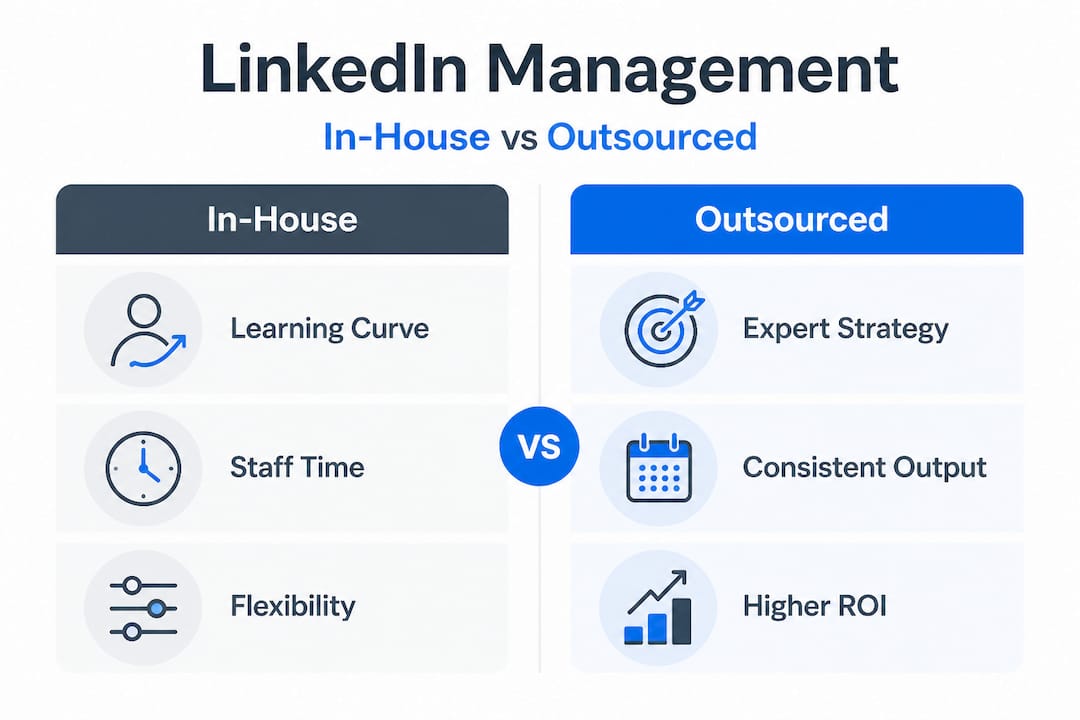
The table above illustrates a consistent pattern: in-house vs outsourced LinkedIn management comes down to capacity and strategic ambition. For many growing B2B businesses, internal resource is simply stretched too thin to manage LinkedIn with the rigour it requires.
Consider outsourcing when:
- Your sales or marketing team lacks dedicated LinkedIn time
- You have tried posting inconsistently and seen poor results
- You need rapid pipeline growth and cannot afford a slow learning curve
- You want a tested content and outreach strategy without building it from scratch
- You need expertise in LinkedIn's algorithm, Sales Navigator, and targeting tools
Agencies deliver higher ROI through specialist knowledge, proven frameworks, and consistent execution. For companies at growth stage, outsourcing is rarely a cost; it is an accelerator. That said, in-house management can work well if you have a dedicated individual, strong editorial support, and clear KPIs to keep performance on track.
Real examples: LinkedIn management in action
Theory is useful. Numbers are better. Here is what B2B companies can realistically expect when LinkedIn management is executed with consistency and strategic intent.
| Business type | Activity focus | Outcome achieved |
|---|---|---|
| SaaS provider (15 staff) | Weekly thought leadership content plus targeted connection outreach | 34 qualified leads in 90 days, 6 converted to clients |
| Recruitment consultancy | Personal branding for consultants plus direct messaging campaigns | 47% reduction in cost-per-placement versus job boards |
| Management consultancy | Executive profile optimisation plus sector-specific content | 3x increase in inbound enquiries within 6 months |
These outcomes are not outliers. They reflect what happens when LinkedIn is treated as a serious sales channel rather than an afterthought. LinkedIn lead generation drives measurable pipeline outcomes for companies across sectors when the activity is structured and sustained.
A standout 2026 data point worth noting: LinkedIn's own research indicates that content posted by company employees generates twice the engagement of content posted from company pages alone. This reinforces the importance of activating your team's personal profiles as part of a broader content creation for 2026 strategy, rather than relying solely on your brand page.
For B2B SMEs specifically, the realistic expectation is this: within the first 30 to 60 days, you will see improvements in profile visibility and connection quality. Between 60 and 90 days, inbound enquiries and content engagement will begin to grow. Beyond 90 days, with consistent execution, qualified leads and sales conversations become a regular feature of your pipeline. Patience is required, but progress is predictable.
How to get started with LinkedIn management
Knowing the value is one thing. Taking the first step is another. Here is a straightforward process to initiate or significantly improve your LinkedIn management, whether you plan to handle it internally or work with a specialist.
-
Audit your current presence. Review your company page and key team profiles. Are they optimised for your ideal client? Do they clearly articulate your value proposition? A weak foundation will undermine even the best content strategy.
-
Set clear KPIs. Define what success looks like before you start. This might include number of qualified connections per week, content engagement rates, inbound messages from prospects, or leads entering your CRM. Clarity here keeps activity focused and measurable.
-
Assign or outsource management. Decide whether to dedicate an internal resource or engage a specialist. If you outsource, ensure your partner understands your sector, tone of voice, and ideal customer profile.
-
Develop a content and connection plan. This means mapping out your content themes, posting schedule, and outreach strategy. Your LinkedIn content creation guide should reflect your audience's pain points and buying triggers, not just what you want to say about your product.
-
Measure, learn, and iterate. Review performance weekly and refine monthly. LinkedIn analytics will tell you which content resonates, which outreach converts, and where to double down. If something is not working after six weeks, change it. Data removes the guesswork.
Consistent content and outreach produce the best long-term results on LinkedIn, and that applies whether you are building relationships organically or using a structured sales approach. For those looking to build pipeline without aggressive tactics, lead generation without cold outreach is a growing and effective alternative worth exploring.
Pro Tip: Storytelling is one of the highest-performing content formats on LinkedIn right now. A short, honest account of a client challenge you helped solve, or a lesson from a project that did not go to plan, will generate far more engagement than a standard product post. Authenticity drives conversation, and conversation drives conversion.
What most guides miss about LinkedIn management
Here is the honest reality that most LinkedIn guides gloss over. Businesses come to LinkedIn management expecting it to function like a lead-generation tap: turn it on and watch the enquiries flow. That is not how it works, and organisations that approach it with that mindset are often disappointed within the first four weeks.
What actually works is patience combined with intentionality. The companies achieving the strongest results are not necessarily posting the most or sending the most connection requests. They are building genuine credibility with a specific audience, showing up consistently, and starting conversations before asking for anything. That takes time.
"Authenticity and long-term engagement are the two factors most consistently linked to sustainable B2B success on LinkedIn, far more than any single tactic or tool."
The benefits of LinkedIn marketing are real and substantial, but they are proportional to the quality and consistency of your effort. A well-crafted post that genuinely helps your audience will outperform ten mediocre promotional posts every single time.
Another truth that gets overlooked: many firms underestimate how much LinkedIn management is actually relationship management. The best performing accounts are those where the human behind the profile is clearly present, engaged, and genuinely interested in the sector. Automation has its place, but it cannot replicate the impact of a well-timed, personal response to a comment or a thoughtful reply to a prospect's post.
If your expectations are realistic and your strategy is sound, LinkedIn management is one of the most cost-effective B2B growth levers available to you in 2026.
Ready to grow your B2B sales through LinkedIn?
If this article has clarified why LinkedIn management deserves a serious place in your growth strategy, the next question is straightforward: what does that look like for your business specifically? At IN Social, we work with B2B companies and entrepreneurs to build LinkedIn strategies that produce real, measurable results. Not vanity metrics, not inflated connection counts, but genuine pipeline growth and qualified sales conversations.
Whether you are starting from scratch or looking to sharpen an existing approach, our LinkedIn lead generation guide is a strong first step. If recruitment is your priority, explore our dedicated LinkedIn recruitment services to see how we help businesses attract the right talent faster. Or simply discover IN Social and find out how we combine human expertise with smart technology to help your business grow on LinkedIn, month after month.
Frequently asked questions
What is LinkedIn management, exactly?
LinkedIn management involves optimising your company profile, creating content, nurturing leads, and growing connections strategically to boost sales and recruitment outcomes on LinkedIn.
How quickly can LinkedIn management increase B2B sales?
With a focused approach, B2B firms can start seeing meaningful uplift within 2 to 3 months, though sustainable sales growth typically builds over a 6 to 12-month period.
Is outsourcing LinkedIn management worth it for small businesses?
Outsourcing brings specialist strategy and consistent execution, saving critical internal time and generally delivering higher ROI than inconsistent in-house effort.
How is LinkedIn management different from traditional social media marketing?
LinkedIn management is specifically designed to target business decision-makers, using professional insights and relationship-building to drive B2B sales and recruitment rather than general brand awareness.