

Many B2B sales professionals question whether investing time in LinkedIn networking truly delivers results. Yet LinkedIn ads achieve 121% ROAS, outperforming both Google and Meta for B2B contexts. The platform's power extends beyond advertising. Building a strategic network unlocks warm introductions, expands your reach to decision-makers, and creates multiple pathways to qualified leads. This guide reveals why your LinkedIn network matters and how to build it effectively for measurable sales success.
Table of Contents
- Key takeaways
- Understanding the importance of a LinkedIn network for B2B sales
- Who to include in your LinkedIn network and why it matters
- Managing LinkedIn connections effectively to avoid pitfalls and boost conversion
- Why LinkedIn networking needs to be part of a multi-channel sales strategy
- Boost your LinkedIn lead generation with tailored services
- Frequently asked questions
Key Takeaways
| Point | Details |
|---|---|
| LinkedIn delivers ROI | LinkedIn ads achieve 121 per cent ROAS, outperforming Google and Meta in B2B. |
| Strategic network growth | A strategic network accelerates lead generation and expands reach to decision makers, enabling warmer introductions. |
| Manage outreach limits | There are limits on request volume and spammy behaviour should be avoided to maintain trust. |
| Multi channel approach | With organic reach shrinking, a multi channel approach that combines paid tactics with earned activity helps sustain visibility. |
Understanding the importance of a LinkedIn network for B2B sales
LinkedIn stands apart as the premium channel for B2B lead generation. LinkedIn ads deliver 121% ROAS, crushing Google's 67% and Meta's 51% returns in B2B contexts. This performance stems from LinkedIn's unique demographic alignment with business decision-makers and its professional context that primes users for business conversations.
Yet organic reach is shrinking across the platform. Algorithm changes prioritise paid content and engagement-driven posts, making standalone organic strategies less viable. This shift demands strategic network growth combined with targeted ad spend to maintain visibility and influence. Your network becomes the foundation for both earned and paid reach.
The platform's demographic composition makes it uniquely valuable. LinkedIn users actively seek professional development, business solutions, and industry insights. They expect business conversations and sales outreach in ways that would feel intrusive on other platforms. This context transforms your network from a vanity metric into a strategic asset.
Building your network expands your influence exponentially. Each connection opens pathways to their network through second-degree visibility and warm introductions. A diverse network multiplies your access to relevant prospects whilst establishing credibility through mutual connections. These shared relationships create trust before your first conversation.
Consider these network-building priorities:
- Target prospects who match your ideal customer profile using LinkedIn's advanced filters
- Connect with colleagues and team members to amplify your collective reach
- Include existing clients who can provide testimonials and referrals
- Add industry partners and complementary service providers for cross-referral opportunities
"Your LinkedIn network isn't just about quantity. It's about creating strategic pathways to decision-makers through people who already trust you."
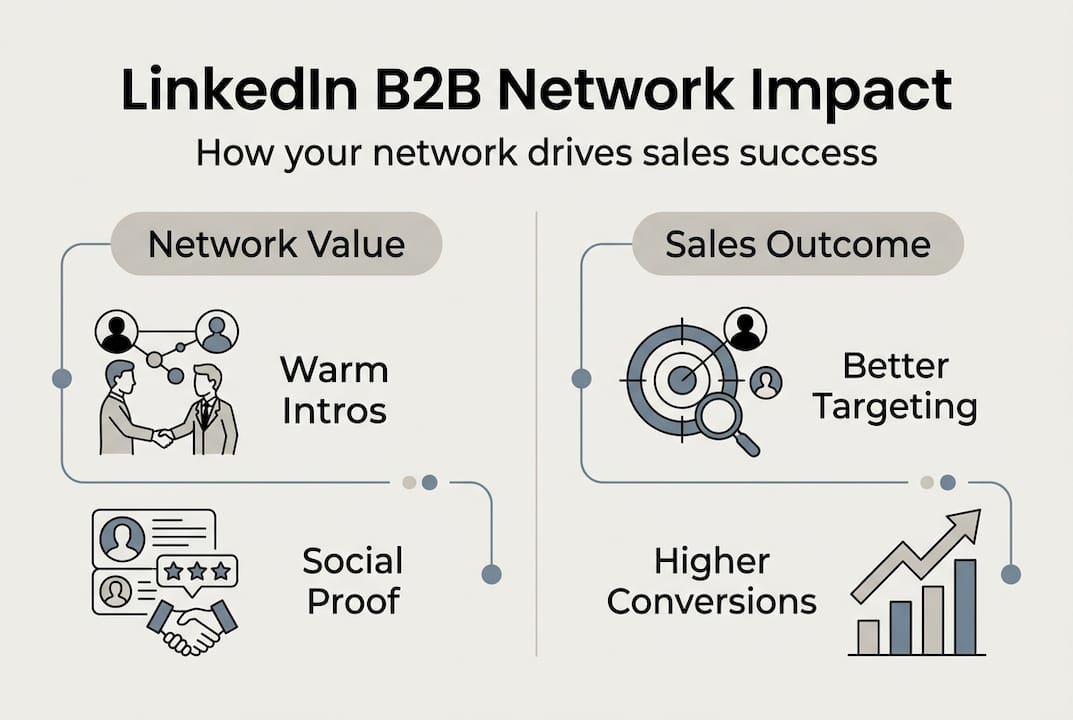
The benefits of LinkedIn for sales extend beyond direct prospecting. Your network enhances ad targeting precision, improves content distribution, and creates social proof that validates your expertise. When prospects research you, a robust network signals credibility and industry standing.
Effective LinkedIn for B2B lead generation requires treating your network as a living ecosystem. Regular engagement strengthens relationships, whilst strategic additions expand your reach into new markets and verticals. This foundation supports every other LinkedIn activity from content marketing to direct outreach.
Who to include in your LinkedIn network and why it matters
Successful LinkedIn networking extends far beyond connecting with prospects. Sales professionals build networks that include colleagues, existing clients, and strategic partners to enable warm introductions and multi-pathway access to decision-makers. This diverse approach transforms cold outreach into warm conversations backed by mutual trust.
Your colleagues and team members form your network's core. They amplify your content reach, provide social proof through engagement, and create multiple touchpoints with shared prospects. When a prospect sees three people from your organisation in their network, your credibility multiplies. Team connectivity also enables internal collaboration on complex deals.
Existing clients deserve prominent placement in your network. They validate your expertise through recommendations, engage with your content to boost visibility, and provide referrals to peers facing similar challenges. Client connections also keep you informed about their evolving needs, creating opportunities for account expansion and retention.

Strategic partners and complementary service providers unlock cross-referral opportunities. A web developer connects you with their clients needing marketing services. An accountant introduces you to growing businesses requiring sales support. These partnerships create win-win scenarios where both parties expand their reach.
Prospects naturally form a significant network segment, but quality trumps quantity. Use LinkedIn's powerful filters to identify connections worth pursuing:
- Search by job title, seniority level, and company size to match your ideal customer profile
- Filter by industry, location, and company growth signals
- Leverage second-degree connections to identify warm introduction pathways
- Monitor recent job changes that signal new budget authority or fresh priorities
Pro Tip: Before important sales calls, search your network for second-degree connections to your prospect. A warm introduction from a mutual contact dramatically improves response rates and shortens sales cycles.
The building a LinkedIn network process requires intentional curation. Each connection should serve a strategic purpose, whether enabling introductions, amplifying reach, or providing industry insights. Random connections dilute your network's value and reduce algorithmic relevance.
Maintaining a relevant network improves ad targeting precision. LinkedIn's advertising platform uses your connections and their characteristics to identify similar prospects. A tightly focused network trains the algorithm to find better leads whilst reducing wasted ad spend on irrelevant audiences.
Regular engagement strengthens network relationships beyond the initial connection. Comment thoughtfully on connections' posts, share relevant insights, and celebrate their achievements. These micro-interactions keep you visible and position you as a valuable network member rather than a transactional contact.
The pathway to generate LinkedIn leads effectively runs through strategic network composition. When your network includes the right mix of advocates, partners, and prospects, every piece of content reaches further and every outreach message carries more weight through social proof and mutual connections.
Managing LinkedIn connections effectively to avoid pitfalls and boost conversion
LinkedIn imposes strict limits on connection activity to maintain platform quality and prevent spam. Connection limits range from 15-25 weekly, with an absolute maximum around 150 per week before triggering restrictions. Exceeding these thresholds risks temporary bans or permanent account limitations that cripple your networking efforts.
Respecting these limits demands quality over quantity. Each connection request should target a specific prospect or strategic contact rather than spray-and-pray approaches. Personalise every request with context about why you're connecting, referencing mutual connections, shared interests, or relevant content they've posted.
The biggest mistake new LinkedIn users make is immediately pitching after connection acceptance. This behaviour screams spam and destroys trust before building any relationship foundation. Instead, engage with their content, share relevant insights, and establish rapport before introducing business conversations.
Multi-touch sequences dramatically improve conversion rates. Follow-ups boost conversions to 60-70% compared to single-message outreach. A systematic approach maintains momentum without feeling pushy:
- Send a personalised connection request mentioning specific common ground
- After acceptance, send a brief thank you message without any sales pitch
- Engage with their content over the following week to build familiarity
- Share a relevant resource or insight that addresses their likely challenges
- After establishing rapport, introduce a specific business conversation
Sales Navigator's TeamLink feature amplifies warm introduction opportunities at scale. This tool identifies which team members connect to your prospects, enabling coordinated outreach strategies. When a colleague can introduce you, conversion rates soar compared to cold contact.
Pro Tip: Set up a simple spreadsheet tracking your weekly connection requests, acceptance rates, and follow-up sequences. This data reveals which personalisation approaches work best for your target audience.
Compare these approaches:
| Approach | Conversion Rate | Trust Level | Scalability | Risk |
|---|---|---|---|---|
| Cold outreach without personalisation | 5-10% | Low | High | High spam risk |
| Personalised single-touch | 15-20% | Medium | Medium | Moderate |
| Multi-touch warm sequences | 60-70% | High | Lower | Low if done properly |
| TeamLink warm introductions | 70-80% | Very high | Limited by team network | Very low |
The most effective LinkedIn engagement strategies balance automation with genuine personalisation. Tools can help manage follow-up sequences, but every message should feel individually crafted. Generic templates destroy credibility faster than no outreach at all.
Timing matters significantly in connection management. Avoid sending bulk requests on Monday mornings when prospects face overflowing inboxes. Tuesday through Thursday afternoons typically yield better acceptance rates as people take breaks from focused work.
Monitor your connection acceptance rate as a health metric. Rates below 30% suggest your targeting needs refinement or your personalisation lacks relevance. Above 50% indicates strong targeting and compelling connection requests that resonate with recipients.
Why LinkedIn networking needs to be part of a multi-channel sales strategy
Organic reach on LinkedIn continues declining as the platform prioritises paid content and high-engagement posts. Declining organic reach makes standalone LinkedIn strategies increasingly ineffective for sustained lead generation. Relying solely on organic networking leaves revenue vulnerable to algorithm changes beyond your control.
Paid LinkedIn ads deliver exceptional ROAS whilst complementing organic networking efforts. The 121% return on ad spend creates a powerful combination when paired with warm network relationships. Prospects who see your ads and recognise you from their network respond at dramatically higher rates than cold audiences.
Integrating email, phone, and content marketing creates sustained engagement across multiple touchpoints. Prospects rarely convert from a single LinkedIn interaction. They need repeated exposure across channels before taking action. Your LinkedIn network becomes one touch in a coordinated campaign:
| Channel | Strength | Best Use | Timing |
|---|---|---|---|
| LinkedIn networking | Warm introductions and social proof | Initial relationship building | Ongoing |
| LinkedIn ads | Precise targeting and scale | Awareness and retargeting | Campaign-based |
| Direct communication and resources | Nurturing and specific offers | Weekly/bi-weekly | |
| Phone | Personal connection and objection handling | High-value prospects and closing | Strategic moments |
| Content marketing | Thought leadership and education | Long-term trust building | Consistent |
Multi-channel approaches boost both brand visibility and lead conversion rates. When prospects encounter your brand across LinkedIn, email, and your website, you occupy more mental real estate. This repeated exposure builds familiarity that translates into trust and eventual conversion.
LinkedIn's network functions as a warm channel within broader campaigns. Use it to:
- Identify prospects for targeted email sequences
- Research decision-makers before phone outreach
- Distribute content that supports email nurturing themes
- Provide social proof for prospects evaluating your solution
- Enable account-based marketing with multiple stakeholder touchpoints
The LinkedIn lead generation benefits multiply when integrated strategically. Your network data informs email targeting, your content performance guides ad creative, and your engagement insights reveal which prospects show buying signals worth phone follow-up.
Successful B2B sales teams recognise why use LinkedIn for sales as part of a coordinated strategy rather than a standalone channel. LinkedIn excels at relationship building and research whilst other channels handle different conversion stages. This orchestrated approach delivers consistent pipeline growth.
Consider your buyer's journey across channels. They might discover you through LinkedIn content, visit your website for deeper research, receive a personalised email with case studies, and finally convert after a phone conversation. Each channel plays a specific role in moving prospects forward.
Boost your LinkedIn lead generation with tailored services
Applying these LinkedIn networking strategies requires consistent effort and expertise. IN Social specialises in managed LinkedIn services designed specifically for SMB B2B sales teams looking to accelerate lead generation without draining internal resources. Our approach combines strategic network building, ad optimisation, and content creation into cohesive campaigns that deliver measurable ROI.
Our team handles the complexity of multi-channel LinkedIn strategies whilst you focus on closing deals. We build your network strategically, craft engaging content that resonates with your audience, and optimise paid campaigns for maximum return. Partner with IN Social to transform your LinkedIn presence from sporadic activity into a systematic lead generation engine. Explore our comprehensive LinkedIn lead generation strategies and discover how AI-powered sales solutions streamline your outreach for consistent results.
Frequently asked questions
How many LinkedIn connection requests should I send weekly?
LinkedIn recommends sending 15-25 connection requests weekly to maintain account health, with an absolute maximum around 150 per week before triggering restrictions. Exceeding these limits risks temporary bans or permanent limitations. Focus on quality targeting and personalisation rather than volume to maximise acceptance rates whilst staying within platform guidelines.
What types of contacts should I prioritise in my LinkedIn network?
Prioritise prospects matching your ideal customer profile, existing clients who can provide referrals, colleagues who amplify your reach, and strategic partners enabling cross-referrals. Use LinkedIn's filters to identify second-degree connections with relevant job titles, industries, and company sizes. This diverse network creates multiple pathways to decision-makers whilst establishing credibility through mutual connections.
How can I increase conversion rates when reaching out on LinkedIn?
Implement multi-touch follow-up sequences with 2-3 messages after initial connection to boost conversions up to 70% compared to single-message outreach. Personalise every message with specific context, avoid immediate sales pitches, and engage with prospects' content before introducing business conversations. Use Sales Navigator's TeamLink to identify warm introduction opportunities through colleagues' networks.
Is organic LinkedIn networking enough for lead generation in 2026?
Organic reach continues declining as LinkedIn prioritises paid content and high-engagement posts. Standalone organic strategies prove insufficient for sustained lead generation in 2026. Integrate paid LinkedIn ads delivering 121% ROAS with multi-channel outreach including email and phone. Use your LinkedIn network as one strategic touchpoint within coordinated campaigns that nurture prospects across multiple channels.