

TL;DR:
- LinkedIn sales acceleration involves a strategic system that combines platform tools, AI, and human skills to speed up the sales cycle. It aims to improve conversion rates by optimizing each stage from prospecting to closing, emphasizing process, people, and data-driven metrics. Effective implementation requires workflow redesign, targeted technology use, and consistent execution by skilled sales teams.
Most sales professionals have heard the term, but what is LinkedIn sales acceleration, really? It is not simply a tool you buy or a setting you switch on. It is a deliberate system that compresses your sales cycle by combining LinkedIn's features, AI capabilities, and sharp human selling skills. Sales acceleration aims to improve conversion rates by optimising the entire process from first contact to closed deal. If you are spending too much time chasing cold leads and too little time having real sales conversations, this guide will show you exactly where to focus.
Table of Contents
- Key takeaways
- What LinkedIn sales acceleration actually means
- Techniques the top sales teams use on LinkedIn
- AI and automation: what they can and cannot do
- Building your LinkedIn sales acceleration system
- My honest take on what actually works
- How In-social accelerates your LinkedIn sales pipeline
- FAQ
Key takeaways
| Point | Details |
|---|---|
| Sales acceleration is a system | Compressing the sales cycle requires aligning people, process, and technology together. |
| LinkedIn tools are central | Sales Navigator uses AI to automate lead discovery and prioritise the contacts most likely to convert. |
| Human skills remain critical | AI handles repetitive tasks, but objection handling and trust-building must come from your salespeople. |
| Multi-channel cadence wins | Combining LinkedIn with other outreach channels yields significantly higher engagement than single-channel efforts. |
| Metrics drive improvement | Tracking deal velocity and conversion rates is how you identify where your pipeline stalls and fix it. |
What LinkedIn sales acceleration actually means
LinkedIn sales acceleration is the practice of using LinkedIn's platform, tools, and data to speed up every stage of your sales process. The goal is not just more activity. It is faster movement from prospecting to pipeline to revenue.
At its core, this means reducing the friction that slows deals down. Too many salespeople spend hours researching prospects manually, crafting outreach from scratch, and following up without a structure. LinkedIn sales acceleration replaces those inefficiencies with a repeatable system.
Here is what that system typically involves:
- LinkedIn Sales Navigator as the engine for finding and qualifying prospects, using filters like seniority, company size, industry, and recent activity to build targeted lists automatically
- AI-driven lead recommendations that surface contacts showing buying signals, so your team focuses on the right people at the right time. Sales Navigator enables scalable relationship management across every stage of the sales process
- Automated connection and message sequences that keep your outreach consistent without requiring manual effort for every single touch
- Profile and content optimisation to build credibility before a prospect even responds, so your first conversation starts from a position of trust
- CRM integrations that pull LinkedIn activity into your existing sales workflow, removing data entry and keeping your pipeline clean
The aim is to move leads through your pipeline faster, with less wasted effort and more qualified conversations. B2B sales teams are targeting NPS improvements from 16% to 51% by 2026 through AI-enabled engagement, which tells you exactly how much the industry is betting on these capabilities.
Techniques the top sales teams use on LinkedIn
Understanding LinkedIn for sales is one thing. Knowing which techniques actually move the needle is another. The highest-performing LinkedIn sales teams share a few common habits that go beyond basic profile optimisation.
Build a network around your Ideal Customer Profile. Every connection request, content post, and outreach message should be aimed at a specific type of buyer. Vague networks produce vague results. When you define your ICP tightly and build your LinkedIn presence around it, every interaction compounds. You are not just sending messages; you are building an audience of potential buyers who already know what you do.
Use value-based messaging, not feature-based pitching. Shifting to value-based messaging creates urgency and relevance far faster than talking about your product's capabilities. When your first message to a prospect frames a specific business problem they recognise and hints at the financial or operational cost of leaving it unsolved, you earn the conversation. Features come later.
Implement a structured multi-touch sales cadence. This is where most LinkedIn outreach falls apart. A single connection request and one follow-up is not a cadence. It is a guess. Multi-touch approaches linked to a clear ICP yield up to 287% higher engagement than single-channel outreach. Your cadence should span LinkedIn messages, email, and potentially phone, with each touchpoint building on the last.
- Start with a personalised connection request that references something specific
- Follow with a value-led message that addresses a pain point directly
- Use LinkedIn content engagement (commenting, reacting) as a warm-up before the next direct message
- Introduce a soft call-to-action, such as a relevant article or a question, before asking for a meeting
Pro Tip: Set aside 20 minutes each morning to engage with your target prospects' posts before sending any outreach. When you comment intelligently on their content, your name becomes familiar before your message arrives. That familiarity shortens your sales cycle meaningfully.
You can go deeper on LinkedIn social selling strategies that tie these techniques together into a coherent B2B approach.
AI and automation: what they can and cannot do
This is where many sales teams go wrong. They adopt AI tools, automate their outreach, and then wonder why their reply rates are low and their reputation is taking a hit. LinkedIn sales acceleration is not the same as LinkedIn sales automation.
Here is the distinction that matters. AI and automation excel at the repetitive, preparatory work that eats into a salesperson's day. AI frees salespeople for high-value activities like persuasion and trust-building, which is where real deals are made. Used well, AI handles the groundwork. Your salespeople handle the conversations.
Here is a practical way to think about the split:
- Let AI handle research. Tools can pull firmographic data, recent news, job changes, and engagement history in seconds. What used to take 30 minutes per prospect now takes 30 seconds.
- Let AI handle data entry and CRM updates. Every minute your salesperson spends logging activity is a minute away from a prospect. Automate this entirely.
- Let AI handle initial outreach sequencing. Templated first touches with light personalisation can be scheduled and sent at optimal times without manual effort.
- Keep humans in charge of objection handling. No AI tool handles a "we already use a competitor" response well. That requires reading the room, adjusting tone, and building a case in real time.
- Keep humans in charge of urgency creation. Momentum in a deal comes from a salesperson who believes in what they are selling and can transfer that conviction. That is not automatable.
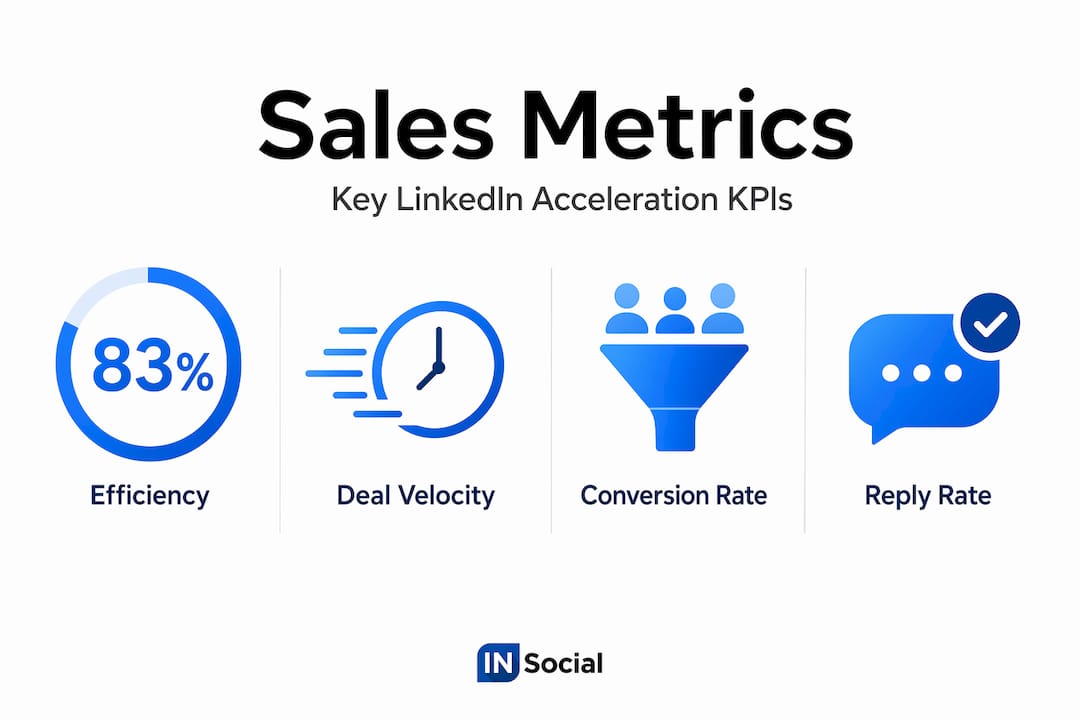
83% of SMB leaders believe AI increases sales efficiency for lead scoring and personalised outreach. But that efficiency only pays off if the human on the other end of the conversation is skilled enough to convert it. Avoid the "spray and pray" trap, where volume replaces quality and your LinkedIn account gets flagged or your brand suffers.
Pro Tip: Before automating any outreach sequence, send it manually to 10 prospects first. If your reply rate is below 15%, fix the messaging before you scale it. Automating a bad message just speeds up failure.
Building your LinkedIn sales acceleration system
Getting occasional results from LinkedIn is relatively easy. Building a system that produces consistent pipeline growth is a different challenge entirely. True sales acceleration requires alignment of people, process, and technology, supported by continuous data-driven adjustment.

Here is how to think about the three layers:
People: execution competency matters more than tools
Execution competency — including objection handling, multi-stakeholder navigation, and conversation confidence — is the differentiator between sales teams that get meetings and those that close deals. Training is not optional. Realistic practice, role play, and coaching on live conversations is what builds the muscle memory your team needs.
Investing in LinkedIn training for your sales teams gives your people the execution skills to turn qualified leads into booked meetings and closed revenue.
Technology vs. process: what actually drives results
| Element | What it does | Where it fails without the other |
|---|---|---|
| LinkedIn Sales Navigator | Surfaces and qualifies leads at scale | Useless without a clear ICP and trained salespeople |
| AI outreach sequencing | Maintains consistent multi-touch contact | Produces noise without value-based, personalised messaging |
| CRM integration | Keeps pipeline data clean and current | Generates reports nobody acts on without a review process |
| LinkedIn events and webinars | Educates and qualifies prospects at scale | Low attendance without a promoted, targeted invitation strategy |
| Analytics and reporting | Identifies bottlenecks in the pipeline | Ignored without a culture of weekly data review |
LinkedIn events and webinars are particularly underused. The ability to invite thousands of qualified prospects monthly and move them from problem awareness to product consideration, without a single paid ad, is one of the most cost-effective acceleration channels available on the platform.
Metrics: track what actually predicts revenue
Deal velocity (how quickly prospects move between pipeline stages) and conversion rate by stage are your two most telling numbers. If you know 40% of your leads stall after the first meeting, you fix that specific part of your process. You do not add more top-of-funnel volume and hope something changes. Build a winning LinkedIn pipeline by measuring what matters and adjusting weekly.
My honest take on what actually works
I've worked with enough B2B sales teams on LinkedIn to say this plainly: the biggest mistake is treating sales acceleration as a technology procurement decision. Leaders buy Sales Navigator, bolt on an automation tool, and expect the pipeline to fill itself. It does not.
What I've found actually works is treating acceleration as workflow redesign. You look at where your salespeople's time goes, you identify the steps that do not require human judgement, and you remove them from the human's workload. That is when the real gains appear.
I've also seen the confidence piece underestimated consistently. When a salesperson believes in their message, their tone changes. Their follow-ups feel purposeful rather than desperate. Buyers notice. Workflow design and momentum management are as important as any tool you choose.
The teams that win on LinkedIn are not the ones with the most automations running. They are the ones whose salespeople have clear targets, sharp messaging, practised responses to common objections, and a daily routine that puts them in front of the right people consistently. Technology supports that. It does not replace it.
— Ian
How In-social accelerates your LinkedIn sales pipeline
If you have read this far, you already know that LinkedIn sales acceleration is not a single tool or a quick fix. It is a system, and building it properly takes expertise. That is exactly what In-social delivers.
In-social works with B2B sales teams and business owners to design and run LinkedIn lead generation systems that produce qualified pipeline, not just activity. From Sales Navigator setup and ICP-driven outreach to bespoke sales training that builds execution competency, every element is built around measurable results.
If you want to hand over the LinkedIn workload entirely, In-social's managed LinkedIn service gives you a fully managed pipeline engine. If your team needs the skills to do it themselves, In-social's training programmes are built for exactly that. Either way, you get a clear strategy, transparent KPIs, and a partner who is invested in your growth.
FAQ
What is LinkedIn sales acceleration?
LinkedIn sales acceleration is the process of using LinkedIn's tools, data, and AI capabilities to shorten the sales cycle and generate qualified leads faster. It combines platform features like Sales Navigator with structured outreach techniques and human selling skills.
How does Sales Navigator support sales acceleration?
Sales Navigator automates lead discovery, builds targeted prospect lists, and uses AI-driven recommendations to prioritise contacts showing buying intent, enabling salespeople to focus their time on the highest-value conversations.
What sales acceleration techniques work best on LinkedIn?
The most effective techniques include multi-touch sales cadences across LinkedIn and email, value-based outreach messaging, ICP-focused network building, and using LinkedIn events to educate and qualify prospects at scale.
Can AI replace salespeople on LinkedIn?
No. AI speeds up activity but trust, objection handling, and momentum in a deal still require experienced human salespeople. AI works best when it handles research and sequencing while your team handles conversations.
How do you measure LinkedIn sales acceleration success?
Track deal velocity (time spent in each pipeline stage) and conversion rates by stage. These two metrics tell you precisely where your pipeline stalls and where to focus your improvement efforts.