

Many small to medium-sized businesses still view LinkedIn as merely a digital CV platform, missing its true power as a revenue-generating engine. For B2B companies and sales teams, LinkedIn offers unmatched opportunities to connect with decision-makers, build authority, and convert conversations into qualified leads. This guide breaks down exactly what business growth on LinkedIn means, why it matters for your business, and how to implement proven strategies that deliver measurable results. You'll discover practical frameworks tailored specifically for B2B contexts, helping you transform LinkedIn from a passive networking tool into an active growth channel.
Table of Contents
- Key Takeaways
- Understanding business growth on LinkedIn
- Key strategies to drive business growth on LinkedIn
- Comparing LinkedIn growth tactics with traditional B2B methods
- Practical steps to implement LinkedIn-driven business growth
- Boost your LinkedIn business growth with expert help
- Frequently asked questions
Key Takeaways
| Point | Details |
|---|---|
| Growth on LinkedIn | Growth on LinkedIn means expanding qualified leads, boosting brand visibility and increasing revenue through tailored LinkedIn strategies. |
| Quality connections | Prioritise quality connections over quantity and build a network of engaged contacts that support business growth. |
| Profile optimisation | Optimise personal profiles and your company page with relevant keywords and clear value propositions to boost trust and discoverability. |
| Personalised outreach | Execute personalised outreach by researching prospects and referencing their content before making any request. |
Understanding business growth on LinkedIn
Business growth on LinkedIn refers to the systematic expansion of qualified leads, enhanced brand visibility, and increased revenue through platform-specific strategies. Unlike general social media marketing, LinkedIn growth focuses on building professional relationships that directly support your sales pipeline. For B2B SMEs and sales teams, this means connecting with decision-makers, establishing thought leadership, and nurturing prospects through personalised engagement.
The core components of LinkedIn business growth include strategic network building, content marketing that addresses specific pain points, targeted outreach to ideal customer profiles, and consistent relationship nurturing. Each element works synergistically to create a sustainable lead generation system. LinkedIn drives 25% more B2B leads for UK SMBs in 2026, demonstrating the platform's effectiveness when used strategically.
LinkedIn uniquely suits B2B contexts because it concentrates professionals actively seeking solutions, unlike consumer-focused platforms where business messaging feels intrusive. The platform's advanced search capabilities, company page features, and professional context make it ideal for reaching procurement managers, executives, and technical buyers. You can filter prospects by job title, company size, industry, and even recent activity, ensuring your outreach reaches genuinely relevant contacts.
Pro tip: Prioritise quality connections over quantity. A network of 500 engaged, relevant contacts will generate far more business than 5,000 random connections. Focus on building relationships with people who match your ideal customer profile and can genuinely benefit from your solutions.
The measurable outcomes of effective LinkedIn growth include increased profile views, higher engagement on posts, more inbound connection requests from qualified prospects, and ultimately, more sales conversations. By tracking these metrics consistently, you can identify which strategies work best for your specific audience and refine your approach accordingly. The key is treating LinkedIn as a strategic business development tool rather than a passive profile showcase.
Key strategies to drive business growth on LinkedIn
Successful LinkedIn business growth follows a systematic approach that combines visibility, credibility, and consistent engagement. Here's a proven framework for B2B companies and sales teams:
-
Optimise your profiles for searchability and trust. Ensure your personal profile and company page include relevant keywords, clear value propositions, and professional imagery that builds immediate credibility.
-
Create valuable content addressing audience pain points. Share insights, case studies, and practical advice that demonstrate your expertise whilst helping prospects solve real challenges.
-
Expand your network strategically. Connect with ideal customer profiles, industry peers, and potential partners using personalised connection requests that reference shared interests or mutual connections.
-
Execute personalised outreach sequences. Move beyond generic sales messages by researching prospects, referencing their content or achievements, and offering genuine value before making any ask.
-
Maintain consistent follow-up and relationship nurturing. Most sales require multiple touchpoints, so develop a system for staying in contact without being pushy or repetitive.
Content marketing stands as the cornerstone of LinkedIn growth because it builds trust at scale. When you consistently share helpful insights, you position yourself as a knowledgeable resource rather than just another salesperson. LinkedIn content strategy significantly impacts lead generation and business growth by attracting prospects who already recognise your expertise.
Personal branding for sales teams amplifies this effect. When individual team members establish their own thought leadership, they expand your company's reach exponentially. Each team member can connect with different segments of your target market, share content from unique perspectives, and build relationships that feed your collective pipeline. This distributed approach creates multiple entry points for prospects to discover your business.
Pro tip: Follow the 80/20 rule for content. Share 80% educational, helpful, or entertaining content that serves your audience's interests, and only 20% promotional material about your products or services. This balance keeps your network engaged whilst still advancing your business objectives.
Consistent networking and genuine relationship building improve both lead quality and conversion rates. When prospects feel they know you through your content and interactions, sales conversations start from a position of trust rather than scepticism. Building a LinkedIn B2B network strategically ensures your connections represent actual business opportunities rather than vanity metrics.

Comparing LinkedIn growth tactics with traditional B2B methods
Traditional B2B marketing and sales methods have served businesses for decades, but LinkedIn introduces capabilities that fundamentally change the growth equation. Understanding these differences helps you allocate resources effectively and build hybrid strategies that maximise results.
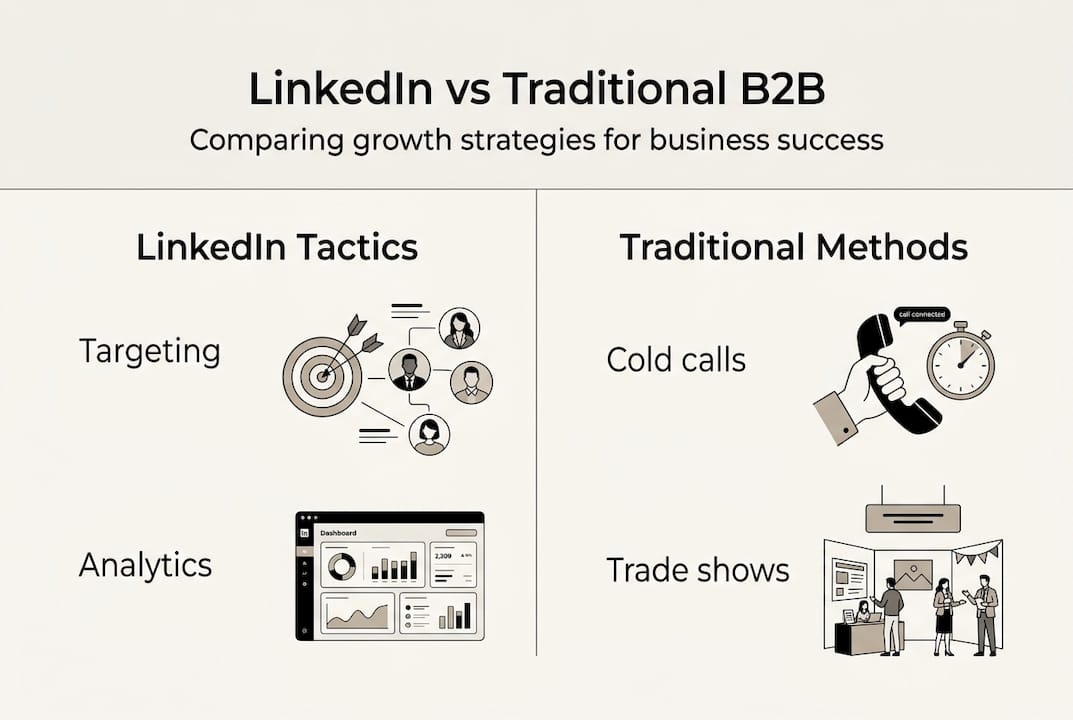
Traditional B2B methods typically include cold calling, trade show attendance, email marketing campaigns, print advertising, and referral programmes. These approaches remain valuable but face increasing challenges. Cold calling struggles with gatekeeper barriers and declining answer rates. Trade shows require substantial investment with unpredictable returns. Email campaigns battle spam filters and inbox overload. Referral programmes, whilst effective, scale slowly.
| Factor | LinkedIn tactics | Traditional methods |
|---|---|---|
| Cost per lead | Lower (organic reach possible) | Higher (event costs, advertising spend) |
| Targeting precision | Extremely precise (job title, company, industry filters) | Broader (purchased lists, event attendees) |
| Lead quality | Higher (self-qualified through engagement) | Variable (depends on list quality, event relevance) |
| Engagement speed | Faster (immediate messaging, real-time interaction) | Slower (phone tag, email delays, event scheduling) |
| Scalability | Highly scalable (automation tools, content leverage) | Limited (time-intensive, resource-dependent) |
| Relationship depth | Deeper (ongoing content interaction, visible activity) | Shallower (transactional touchpoints) |
| Measurability | Detailed analytics (views, clicks, engagement rates) | Less precise (attribution challenges, delayed feedback) |
LinkedIn excels at reaching decision-makers because professionals actively maintain updated profiles, making targeting accuracy far superior to purchased contact lists. You can identify and message the exact person responsible for purchasing decisions, bypassing gatekeepers entirely. The platform's professional context also means your outreach feels appropriate rather than intrusive, as people expect business conversations on LinkedIn.
LinkedIn lead generation drives stronger B2B sales results than some traditional methods because it combines targeting precision with relationship building. Instead of interrupting prospects with cold outreach, you attract them through valuable content and engage them in their preferred professional environment.
Integrating LinkedIn with traditional tactics creates powerful hybrid approaches. Use LinkedIn to research prospects before trade shows, then connect immediately after meeting them in person. Complement email campaigns with LinkedIn content that warms up your list. Support referral programmes by making it easy for advocates to share your LinkedIn posts. This integration amplifies the strengths of each channel whilst mitigating their individual weaknesses.
Pro tip: LinkedIn's analytics tools provide faster feedback loops than traditional marketing metrics. You can test messaging, content themes, and targeting parameters, then see results within days rather than waiting weeks for campaign reports. Use this speed advantage to optimise continuously.
Practical steps to implement LinkedIn-driven business growth
Transforming LinkedIn from a passive profile into an active growth engine requires systematic implementation. Follow these steps to build a sustainable lead generation system:
-
Set specific, measurable LinkedIn goals. Define exactly what business growth means for you, whether that's 20 qualified leads per month, five new client conversations weekly, or expanding your network by 100 relevant connections quarterly. Clear goals enable focused action and meaningful progress tracking.
-
Optimise all profiles for maximum credibility and discoverability. Update your company page with compelling copy, relevant keywords, and showcase pages for different service lines. Ensure team members' personal profiles clearly communicate their expertise, include professional headshots, and feature customised URLs. These optimisations improve search visibility both within LinkedIn and on Google.
-
Develop a content calendar aligned with your sales funnel. Plan content that addresses awareness stage questions for cold prospects, consideration stage comparisons for warm leads, and decision stage case studies for hot opportunities. LinkedIn content creation process for maximum B2B impact ensures your content supports actual buying journeys rather than random posting.
-
Leverage LinkedIn Sales Navigator for targeted prospecting. This premium tool enables advanced search filters, lead recommendations, and CRM integration that dramatically improves prospecting efficiency. Save searches for your ideal customer profiles, receive alerts when prospects change jobs or share content, and track engagement systematically.
-
Track key performance indicators consistently. Monitor connection growth rate, post engagement percentages, profile view trends, and most importantly, lead conversion rates. Establish a weekly review process to identify what's working and what needs adjustment.
Continuous improvement through testing separates good LinkedIn strategies from exceptional ones. Experiment with different post formats, publishing times, and messaging approaches. Test whether video content outperforms text posts for your audience. Try various connection request templates to see which generates higher acceptance rates. LinkedIn lead generation tips 2026 emphasise the importance of data-driven refinement.
LinkedIn's native analytics provide detailed insights into content performance, audience demographics, and engagement patterns. Review these metrics monthly to understand which topics resonate most, when your audience is most active, and which content formats drive the most meaningful interactions. Use these insights to refine your content calendar and posting strategy continuously.
The most successful LinkedIn growth strategies evolve based on results rather than assumptions. What works brilliantly for one industry or audience segment may fall flat for another. Commit to testing, measuring, and adapting your approach based on actual performance data rather than best practice generalisations.
Boost your LinkedIn business growth with expert help
Whilst implementing these strategies yourself is entirely possible, many B2B companies accelerate their results by partnering with specialists who understand LinkedIn's nuances. If you're ready to transform your LinkedIn presence from a static profile into a lead-generating asset, professional support can compress your learning curve and amplify your outcomes.
IN Social specialises in helping B2B SMEs and sales teams leverage LinkedIn for measurable business growth. We combine human expertise with AI-powered tools to optimise your profile, create compelling content, and execute targeted outreach that fills your pipeline with qualified prospects. Our clients typically see significant improvements in connection quality, engagement rates, and most importantly, sales conversations within the first 90 days.
Whether you need comprehensive LinkedIn lead generation and AI sales strategies, hands-on training through the IN Social Sales Club, or bespoke consulting, we tailor our approach to your specific business goals and market context. Explore how we can support your LinkedIn growth journey at IN Social.
Frequently asked questions
What exactly does business growth on LinkedIn mean for B2B companies?
Business growth on LinkedIn means systematically expanding your qualified lead pipeline, increasing brand visibility amongst decision-makers, and converting professional relationships into revenue. For B2B companies, this translates to connecting with prospects who match your ideal customer profile, establishing thought leadership through valuable content, and nurturing relationships that support your sales objectives.
How does LinkedIn actually generate business growth and sales opportunities?
LinkedIn generates growth through network effects and strategic visibility. When you share valuable content, it reaches your connections and their networks, exponentially expanding your reach to relevant prospects. Consistent engagement builds trust and positions you as a knowledgeable resource, making prospects more receptive when you initiate sales conversations. The platform's targeting capabilities also enable precise prospecting that traditional methods cannot match.
What are the most effective practices for maximising LinkedIn's business impact?
The most effective practices include optimising your profile for searchability, publishing valuable content consistently, engaging authentically with your network's posts, sending personalised connection requests, and following up systematically with warm leads. Success requires treating LinkedIn as a long-term relationship-building platform rather than a quick-win sales channel. Patience combined with consistent effort yields the strongest results.
How do I measure and track business growth outcomes on LinkedIn?
Track measurable outcomes including connection growth rate, post engagement percentages, profile view trends, inbound message volume, and most critically, lead conversion rates. Use LinkedIn's native analytics to monitor content performance and audience demographics. Implement a simple CRM or spreadsheet to track which LinkedIn activities generate actual sales conversations and closed deals, ensuring you can attribute revenue to your LinkedIn efforts.
What common misconceptions exist about LinkedIn's role in B2B growth?
Many businesses mistakenly view LinkedIn as purely a recruitment platform or digital CV repository, missing its powerful sales and marketing capabilities. Another misconception is that LinkedIn success requires massive follower counts, when actually, a smaller network of highly relevant connections delivers better business results. Some also believe LinkedIn growth happens overnight, whilst sustainable results require consistent effort over months, not days.