

TL;DR:
- LinkedIn generates 277% more B2B leads than other social platforms.
- Proper training improves lead quality, engagement, and team consistency.
- Leadership commitment and ongoing reinforcement are crucial for lasting success.
LinkedIn generates 277% more B2B leads than any other social platform, yet many sales managers still treat it as little more than an online CV board. That gap between perception and reality is costing businesses real revenue. If your team is only using LinkedIn to accept connection requests and scroll through updates, they are leaving qualified leads on the table every single day. This article explains why LinkedIn has become the most powerful tool in modern B2B sales, what thorough training actually involves, and how you can implement it in a way that produces consistent, measurable results for your team.
Table of Contents
- The evolving role of LinkedIn in B2B sales
- Top reasons to train your sales teams on LinkedIn
- What LinkedIn training should cover for maximum sales impact
- How to implement LinkedIn training in your sales team
- What most sales managers miss about LinkedIn training
- Take your team's LinkedIn skills to the next level
- Frequently asked questions
Key Takeaways
| Point | Details |
|---|---|
| LinkedIn is B2B critical | Training sales teams on LinkedIn is vital for modern lead generation and growth. |
| Effective training pays off | Structured LinkedIn training boosts both the quality and quantity of sales leads. |
| Holistic learning matters | Cover mindset, accountability, and practical steps to see lasting sales impact. |
| Implementation drives results | Success depends on proper planning, delivery, and ongoing support for your team. |
The evolving role of LinkedIn in B2B sales
Cold calling used to be the default. Reps would work through lists, face rejection after rejection, and occasionally land a conversation worth having. Today, buyers do their research before they ever speak to a salesperson. They check credibility, read content, and form opinions about suppliers long before any meeting is booked. LinkedIn is where that research happens.
"LinkedIn has shifted from a passive networking site to an active sales environment where credibility, content, and conversation drive revenue."
For B2B sales teams, this shift changes everything. LinkedIn is now a research tool, an engagement platform, and a credibility builder all at once. Your prospects are already on it. The question is whether your team knows how to meet them there effectively. LinkedIn's essential role in modern selling cannot be overstated, and sales teams using LinkedIn consistently outperform those who rely on traditional outreach methods alone.
Still, misconceptions persist. Many sales managers assume LinkedIn is primarily for recruiters and job seekers. Others believe it only works for enterprise-level businesses with large marketing budgets. Neither is true. LinkedIn's features are built for relationship-led selling at every scale.
Here is what makes LinkedIn so well suited to the B2B sales process:
- Sales Navigator allows reps to filter prospects by industry, company size, seniority, and geography, making outreach highly targeted
- Social Selling Index (SSI) gives individual reps a measurable score for their LinkedIn sales activity, helping managers track progress
- Content visibility means a well-written post from a sales rep can reach hundreds of decision-makers without a single cold call
- InMail messaging opens doors to prospects who are not yet in your CRM but are actively engaged on the platform
- Company pages reinforce credibility and give prospects somewhere to validate your brand before responding
LinkedIn is no longer a supplementary channel. For most B2B companies, it is the primary place where trust is built and pipelines are filled.
Top reasons to train your sales teams on LinkedIn
With LinkedIn now at the heart of modern B2B sales, the case for training your sales teams is undeniable. But investing in training requires confidence that it will pay off. The data is clear. B2B companies see significant increases in qualified leads when their sales teams are properly trained on LinkedIn. This is not marginal improvement. It is a structural upgrade to how your team finds, engages, and converts prospects.
Here are the top reasons to prioritise LinkedIn training for your sales team:
- Better lead quality. Trained reps know how to identify and approach the right prospects, not just any prospects. This means fewer wasted conversations and more deals worth pursuing.
- Faster rapport building. LinkedIn provides context before a conversation even starts. Trained reps use profile information, shared connections, and content interactions to personalise outreach in ways cold callers simply cannot.
- Greater efficiency. Advanced features like boosting lead generation with saved searches and alert notifications help reps spend more time selling and less time searching.
- Consistency across the team. Without training, LinkedIn usage varies wildly from rep to rep. Training creates a shared approach, shared language, and shared standards.
- Increased confidence. Many reps feel uncertain about what to post, how to message prospects, or how to engage with content without looking pushy. Training removes that hesitation.
Pro Tip: Train your team to focus on building genuine relationships before pitching anything. A rep who consistently adds value through comments and content will always outperform one who leads with a sales message. The goal is to become a trusted voice in your prospect's feed long before you ask for a meeting.
The cumulative effect of effective LinkedIn training is a sales team that operates with clarity, purpose, and a steady flow of warm conversations rather than cold, uncertain outreach.

What LinkedIn training should cover for maximum sales impact
Recognising the value of training is one thing; understanding what to actually train is another. Not all LinkedIn training is equal. Generic courses that teach reps how to set up a profile and send a connection request will not move the needle. You need proven LinkedIn training that is structured around sales outcomes, not platform familiarity alone. Structured LinkedIn training consistently enhances both individual and team performance in B2B sales environments.
Here is what a high-impact training programme should include:
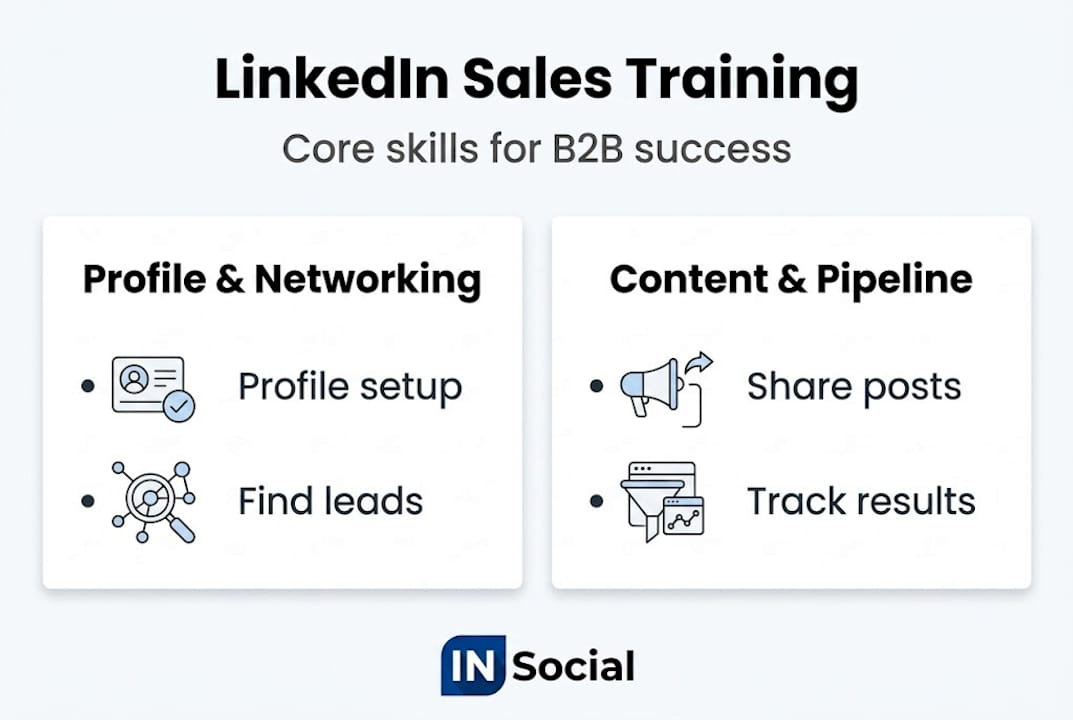
- Profile optimisation. A sales rep's LinkedIn profile is their first impression. Training should cover headlines, summaries, featured sections, and how to position a profile for a buyer rather than a recruiter.
- Targeted network building. Reps need to know how to identify and connect with the right people, including decision-makers, influencers, and referral sources within target accounts.
- Messaging and outreach. Crafting messages that get responses is a skill. Training should include frameworks for personalised connection requests, follow-up sequences, and conversation starters that feel natural.
- Content and engagement strategy. Posting relevant content and engaging with others' posts builds visibility and trust over time. Reps should learn what to post, how often, and how to engage without being promotional.
- Pipeline analytics. Using LinkedIn's data and SSI scores to track activity and adjust strategy keeps performance measurable and improvement ongoing.
| Training topic | Key outcome |
|---|---|
| Profile optimisation | Stronger first impressions with prospects |
| Targeted network building | Higher quality connections and warmer leads |
| Messaging and outreach | Better response rates and more booked calls |
| Content and engagement | Increased visibility and long-term credibility |
| Pipeline analytics | Measurable activity and data-driven improvement |
This step-by-step LinkedIn guide approach ensures training connects directly to sales results rather than simply teaching platform mechanics.
How to implement LinkedIn training in your sales team
Knowing what to cover is just the start. Here is how to make LinkedIn training work in practice.
Successful implementation follows a clear sequence. Rushing straight to delivery without preparation leads to inconsistent results and low adoption. Teams that follow a clear LinkedIn training process see long-term sales gains, not just short-term spikes.
- Assess current skills. Start by understanding where each team member is now. A simple audit of profile quality, connection count, posting frequency, and SSI scores gives you a clear baseline.
- Set clear objectives. Define what success looks like before training begins. Is it more booked meetings? A higher SSI score? More content published per month? Specific targets make training accountable.
- Choose your delivery model. You can train in-house, bring in an external specialist, or blend both. External specialists bring fresh perspective and proven frameworks. In-house delivery works when someone on your team already has strong LinkedIn expertise.
- Deliver in stages. Break training into manageable sessions rather than a single long workshop. Cover one topic at a time and allow reps to practise between sessions.
- Build in accountability. Weekly check-ins, peer sharing of what is working, and manager reviews of SSI scores keep momentum going after formal training ends.
Pro Tip: Start with a small pilot group of three to five reps before rolling out to the whole team. This lets you refine the approach, gather feedback, and prove results before a full investment. It also creates internal advocates who can support their colleagues through the wider rollout.
Using network-building methods as a practical focus during early sessions gives reps immediate, visible results that sustain their motivation to keep developing.
| Implementation stage | Key action | Expected output |
|---|---|---|
| Skills audit | Assess profiles and SSI scores | Clear baseline and skill gaps |
| Objective setting | Define KPIs for each rep | Accountable targets |
| Training delivery | Stage-by-stage sessions | Consistent skill building |
| Ongoing reinforcement | Weekly reviews and peer sharing | Long-term adoption |
What most sales managers miss about LinkedIn training
Here is an uncomfortable truth. Many sales teams go through LinkedIn training, tick the box, and see limited results. It is rarely because the training was poor. It is almost always because of what happens after the final session.
The missing ingredient is leadership commitment. When senior managers treat LinkedIn training as a one-off initiative rather than an ongoing priority, teams quickly revert to old habits. The information was there. The motivation was not sustained. Mindset and ongoing reinforcement are as important as the technical training itself, and most organisations underinvest in both.
Cultural inertia is real. If your team sees that leadership does not practise what they preach on LinkedIn, adoption stalls. The most effective sales managers we work with do not just train their teams. They model the behaviour themselves. They post. They engage. They share wins from LinkedIn openly.
Sustained results come from building LinkedIn into the rhythm of your sales culture, not treating it as a separate skill set that lives outside normal working life. Social selling strategies only compound when they are practised consistently, and that consistency starts at the top.
Take your team's LinkedIn skills to the next level
If you are ready to shift from theory to action, support is available. At in-social.co.uk, we offer expert-led, practical training designed specifically for B2B sales teams who want real results, not generic LinkedIn advice.
Our LinkedIn lead generation training gives your team the frameworks, confidence, and skills to generate qualified leads consistently. For managers who want a fully managed approach, our managed LinkedIn solutions handle the heavy lifting so your team can focus on closing. And if you want ongoing support, peer learning, and fresh strategies every month, the Sales Club for ongoing growth gives your team an always-on resource for continuous improvement. Your team's next level is closer than you think.
Frequently asked questions
Is LinkedIn training effective for small B2B sales teams?
Yes, LinkedIn training can significantly boost lead quality and consistency, even in small sales teams. Properly trained sales teams on LinkedIn see meaningful increases in qualified leads regardless of team size.
How long does it take to see results from LinkedIn sales training?
Sales teams often see positive changes in lead generation and engagement within two to three months of consistent LinkedIn training. Structured training accelerates both individual and team performance from early on.
What should training include to be most effective?
Effective training should cover profile optimisation, networking, messaging, content, and pipeline analytics. Profile, network, and analytics skills form the core foundation for lasting LinkedIn sales impact.
Can LinkedIn training help with long-term sales strategy, not just quick wins?
Yes, ongoing LinkedIn training supports long-term pipeline growth and relationship-building, not just immediate results. Teams following a clear process consistently see sustained sales gains over time.