

TL;DR:
- Many B2B teams treat LinkedIn as a casual platform, missing its potential as a revenue engine.
- Strategic management involves targeted content, audience segmentation, consistent engagement, and proper measurement.
LinkedIn is not a digital CV board. It never really was. Yet a surprising number of B2B marketing managers still treat it that way, posting sporadically and hoping the right people will notice. The reality is that LinkedIn hosts over one billion professionals globally, and 80% of B2B leads sourced through social media come from this single platform. When you shift from casual activity to structured LinkedIn management, you stop relying on luck and start building a predictable, measurable engine for generating qualified leads and driving real revenue.
Table of Contents
- Why LinkedIn management matters for B2B lead generation
- Core benefits of strategic LinkedIn management
- Content and engagement: The backbone of LinkedIn success
- Maximising ROI: Measurement, attribution, and revenue focus
- The uncomfortable truth about LinkedIn management most teams miss
- Accelerate your LinkedIn lead generation with expert support
- Frequently asked questions
Key Takeaways
| Point | Details |
|---|---|
| Quality over quantity | Modern LinkedIn management focuses on attracting the right leads, not just increasing numbers. |
| Engagement powers growth | Meaningful content and authentic interactions drive greater reach and lead quality on LinkedIn. |
| Measure what matters | Revenue attribution and qualified lead tracking showcase your campaign’s actual business impact. |
| Frictionless lead capture | Tools like Lead Gen Forms boost conversions by making it easy for prospects to share their details. |
Why LinkedIn management matters for B2B lead generation
Most B2B marketing managers understand that LinkedIn exists. Fewer understand what separates a managed LinkedIn strategy from simply showing up. Casual posting means sharing an update when inspiration strikes, accepting connections without a plan, and measuring success by likes. A managed strategy is something entirely different. It involves defined audiences, structured content calendars, deliberate outreach sequences, and clear KPIs tied directly to business outcomes.
LinkedIn's strength as a B2B platform lies in its targeting precision. You can reach decision-makers by job title, company size, industry, seniority level, and even specific skills. No other social platform offers that depth of B2B targeting without significant guesswork. When you combine that targeting capability with consistent, strategic content, the result is visibility with exactly the people who matter most to your pipeline.
Understanding LinkedIn content for B2B lead generation is where many teams start to see the gap between what they are currently doing and what is possible. The key shift is moving from a channel-first mindset to a full-funnel approach.
A full-funnel approach on LinkedIn means considering your audience at every stage of the buyer journey. Some content builds awareness. Some nurtures consideration. Some drives a direct action such as booking a call or downloading a guide. When these layers work together consistently, LinkedIn stops being a broadcast channel and becomes a genuine revenue driver.
"Campaign mechanics, including full-funnel framing, attribution, and revenue-oriented objectives, are increasingly emphasised in LinkedIn's B2B marketing guidance."
What makes consistency so powerful? LinkedIn's algorithm rewards accounts that post regularly and generate meaningful engagement. Sporadic activity sends a signal that your brand is unreliable or unengaged. Consistent management builds compounding momentum. Each post, comment, and connection strengthens your platform authority over time, making future content more likely to reach the right people organically.
Key differences between ad hoc activity and managed LinkedIn strategy:
- Audience targeting: Managed strategies define ideal customer profiles and engage them deliberately
- Content planning: Calendars ensure a steady mix of awareness, nurture, and conversion content
- Engagement discipline: Responding to comments and messages is treated as a priority, not an afterthought
- Measurement: Success is tracked by lead quality, pipeline influence, and revenue, not vanity metrics
Learning how to create LinkedIn content for B2B success is the practical starting point for transforming your approach from passive to purposeful.
Core benefits of strategic LinkedIn management
The benefits of managed LinkedIn activity extend well beyond brand awareness. When executed properly, LinkedIn management delivers qualified leads, shorter sales cycles, and measurable return on investment. Let's look at what this actually means in practice.
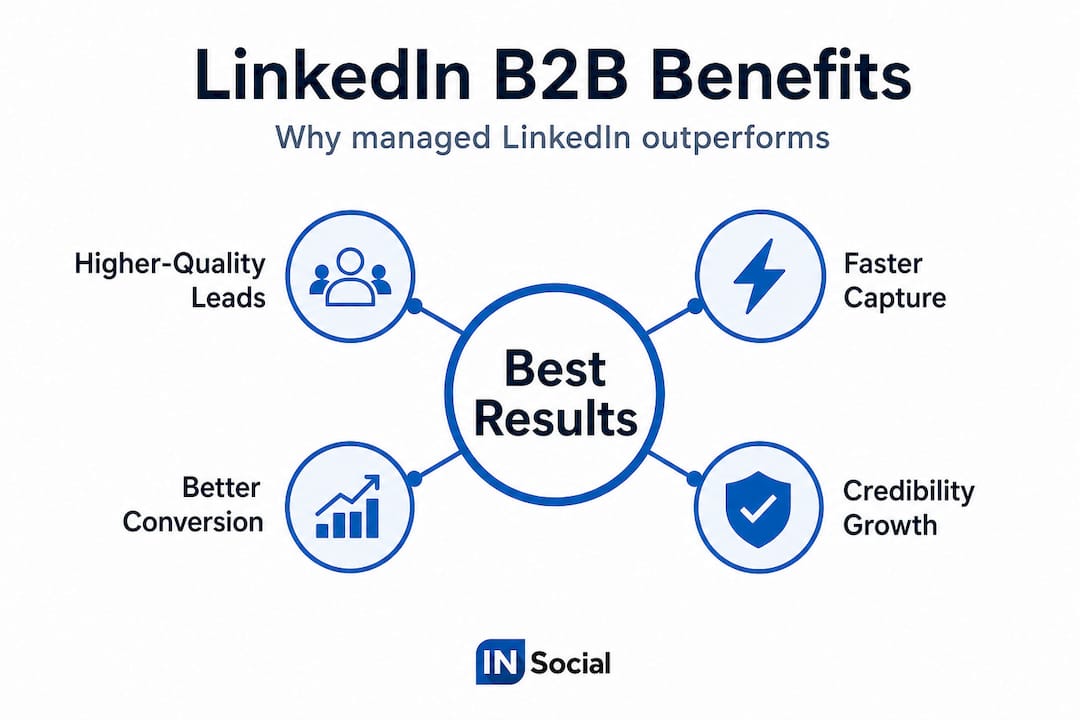
Higher-quality leads. LinkedIn's professional context means your audience is already in a business mindset. They are not scrolling to unwind. They are actively seeking insights, solutions, and connections relevant to their work. This intent translates into significantly higher lead quality compared with other social channels.

Frictionless lead capture. LinkedIn's native Lead Gen Forms are designed to collect leads in-platform using pre-filled profile data, which eliminates the need for prospects to manually type out their details. The result is a lower drop-off rate and higher conversion. When someone sees a compelling piece of content and clicks through to a Lead Gen Form, their name, job title, company, and email address are already populated. The barrier to conversion is almost zero.
Improved conversion rates. In-platform lead capture consistently outperforms external landing pages for cold audiences. Prospects stay within a trusted environment, and the pre-filled form removes the friction that typically causes people to abandon the process halfway through.
| Old approach | Strategic LinkedIn management |
|---|---|
| Focus on follower volume | Focus on lead quality and fit |
| Generic content for broad reach | Targeted content for defined personas |
| External landing pages | Native Lead Gen Forms |
| Engagement as the end goal | Revenue as the end goal |
| Monthly reporting on impressions | Weekly tracking of pipeline contribution |
| Reactive posting | Proactive content calendar |
Improving LinkedIn engagement strategies is what turns passive audiences into active prospects. Strategic management keeps your engagement consistent and meaningful rather than burst-and-fade.
Alongside lead capture, managed LinkedIn activity builds your credibility as a brand authority. Decision-makers research vendors thoroughly before making contact. If your LinkedIn presence demonstrates expertise, consistent value, and genuine engagement, you are positioned as a safer, more trustworthy choice before the conversation even begins.
Pro Tip: Set up LinkedIn's conversion tracking and connect it to your CRM from day one. Many teams delay this step and lose months of attribution data. Knowing exactly which content and campaigns are driving pipeline lets you double down on what works and stop wasting budget on what doesn't.
Understanding the role of content in LinkedIn marketing helps you prioritise the activities that actually move the needle for your business, rather than those that simply look busy.
Content and engagement: The backbone of LinkedIn success
Content is the vehicle for everything else. Without the right content strategy, even the most precise targeting and the best Lead Gen Forms will underperform. LinkedIn's algorithm has shifted significantly in recent years. It now favours expertise, authenticity, and relevance over posting frequency and generic motivation posts.
This is good news for B2B marketers. It means you do not need to post three times a day to get results. You need to post the right things consistently.
An optimal content strategy for LinkedIn follows a structured approach:
- Define your audience first. Know exactly who you are writing for, their job titles, challenges, goals, and the language they use. Every piece of content should speak directly to that person.
- Plan content across three pillars. Authority content showcases your expertise. Community content invites conversation and builds relationships. Conversion content drives a specific action such as a lead magnet download or a discovery call booking.
- Write in a human voice. LinkedIn rewards posts that feel personal and credible. First-person insights, real case studies, and honest observations consistently outperform polished corporate messaging.
- Use formats strategically. Document posts, short videos, and native articles each serve different purposes. Test formats against your audience's preferences rather than defaulting to one style.
- Post on a consistent schedule. Three to four posts per week is a manageable and effective frequency for most B2B brands. Consistency matters more than volume.
- Monitor and iterate. Review your content performance weekly. Look at which topics generate meaningful comments and shares, not just impressions, and produce more of what resonates.
The nuance of creating effective LinkedIn content lies in balancing consistency with quality. One genuinely useful post outperforms five generic ones every time.
Comparing old and new engagement metrics helps clarify where to focus your energy:
| Vanity metric (old thinking) | Meaningful metric (new thinking) |
|---|---|
| Total impressions | Impressions from target personas |
| Number of likes | Comments from decision-makers |
| Follower count | Connection request rate from ICP |
| Post frequency | Content saves and shares |
| Click-through rate | Lead form completions |
| General reach | Profile visits from target accounts |
Pro Tip: Your comment strategy is as important as your posting strategy. When you leave thoughtful, expert comments on posts by your target prospects or industry peers, you appear in their notifications and in the feeds of their followers. This builds visibility and warm familiarity before you ever send a connection request or direct message.
Refining your LinkedIn content creation process ensures your output stays aligned with both platform best practices and your audience's evolving needs. Studying LinkedIn content examples that have genuinely driven B2B leads gives you a real-world benchmark to aim for.
Maximising ROI: Measurement, attribution, and revenue focus
Understanding what is working and why is where most B2B teams fall short. They generate leads but cannot trace them back to specific content, campaigns, or outreach sequences. Revenue attribution on LinkedIn means connecting your marketing activity directly to pipeline value and closed revenue. This is not complicated to set up, but it requires intention from the start.
LinkedIn's full-funnel approach to campaign measurement moves beyond click data and asks a deeper question: which activities are contributing to revenue? When you optimise for value rather than volume, you shift your budget and effort towards the activities that generate high-value leads rather than the highest number of leads.
The mechanics that consistently drive B2B lead generation results on LinkedIn work together as a system. Relevance-first content earns genuine engagement. Frictionless capture via Lead Gen Forms converts that engagement into leads. And value optimisation ensures your budget flows towards the prospects most likely to convert into paying clients.
Best-practice metrics every LinkedIn manager should track:
- Lead quality score: Are the leads matching your ideal customer profile?
- Cost per qualified lead: How much are you spending to generate each relevant lead?
- Pipeline contribution: What percentage of your sales pipeline originated from LinkedIn?
- Revenue attribution: Which campaigns can be directly tied to closed deals?
- Engagement-to-conversion ratio: How many meaningful engagements lead to a sales conversation?
- Connection acceptance rate: How relevant and compelling is your outreach messaging?
"The most effective LinkedIn campaigns combine relevance-first content, frictionless lead capture, and value-based optimisation. Volume was never the goal. Qualified pipeline is."
Tracking how to improve LinkedIn engagement as a leading indicator helps you predict pipeline performance weeks before it shows up in your CRM. And implementing engagement strategies for B2B growth ensures your measurement is rooted in activities that actually influence revenue.
The uncomfortable truth about LinkedIn management most teams miss
Here is what no one tells you when you first start taking LinkedIn seriously. Posting more is not the answer. It never was. The teams we see struggling most on LinkedIn are not the ones posting too little. They are the ones posting constantly with no clear strategy, chasing engagement numbers, and wondering why their pipeline remains empty.
LinkedIn management is a discipline. It requires the same rigour as any other revenue-generating function in your business. It demands an understanding of your audience, a tested content approach, patience through the early stages, and a willingness to iterate based on data rather than gut feeling.
The biggest pitfall is treating LinkedIn as a set-and-forget channel. Posting three times a week without reviewing performance, adjusting messaging, or testing new formats will flatline your results within months. The platform shifts. Audience expectations shift. The content that worked six months ago may need a complete rethink today.
Authenticity is not a buzzword on LinkedIn. It is a measurable competitive advantage. Decision-makers are bombarded with polished corporate content. When a post feels genuinely human, specific, and expert-led, it stands out immediately. The comments and conversations that result from authentic content are infinitely more valuable than the passive likes generated by generic motivational posts.
Exploring advanced LinkedIn content creation approaches helps you move beyond surface-level tactics and build a strategy that compounds in value over time. Patience and iteration are the two most underrated elements of LinkedIn success. Give your strategy 90 days of consistent, measured effort before drawing conclusions. The teams that do this consistently see results that others simply cannot replicate.
Accelerate your LinkedIn lead generation with expert support
Knowing the strategy is one thing. Executing it consistently alongside every other demand on your time is another challenge entirely.
At IN Social, we combine human expertise with advanced AI tools to build LinkedIn management systems that generate qualified leads and real revenue for B2B businesses like yours. Whether you want a fully managed service or the skills to do it yourself, we have the resources to move you forward. Explore our in-depth LinkedIn lead generation guide to see the full picture of what strategic management can deliver, or discover how to drive results through LinkedIn lead generation without cold outreach. The right support turns strategy into results, faster than you think.
Frequently asked questions
What is LinkedIn management for B2B marketing?
LinkedIn management for B2B involves planning, executing, and optimising LinkedIn activities to generate and nurture high-quality business leads. It includes content strategy, audience targeting, engagement, and performance measurement.
Do Lead Gen Forms really improve lead quality on LinkedIn?
Yes. Lead Gen Forms reduce friction by auto-filling prospect details from their LinkedIn profiles, leading to higher-quality submissions and significantly improved conversion rates compared with external landing pages.
How does the LinkedIn algorithm impact my content strategy?
LinkedIn now prioritises authentic content and meaningful engagement signals such as expert comments and saves over simple posting frequency, meaning quality and relevance matter far more than volume.
Which metrics matter most in LinkedIn campaign measurement?
Focus on lead quality, conversion value, and revenue attribution rather than impressions or click volume. Full-funnel measurement reveals which campaigns are genuinely contributing to your pipeline and closed revenue.