

TL;DR:
- Most B2B teams lack structured LinkedIn content workflows, leading to inconsistent engagement and results.
- A seven-stage process, blending human oversight and AI tools, ensures consistent, high-quality content creation.
- Employee advocacy and diverse media formats significantly boost reach, engagement, and pipeline generation.
LinkedIn is the single most powerful channel for B2B thought leadership, yet most marketing and sales teams treat it as an afterthought. Posts go out when someone remembers, topics are chosen on a whim, and accountability for results sits with nobody in particular. The outcome is predictable: flat engagement, inconsistent messaging, and a pipeline that never quite fills. 64% of B2B marketers cite the absence of a documented workflow as their biggest content challenge, even as the same research confirms LinkedIn is the top thought leadership channel for B2B. This guide gives you a structured, start-to-finish process to change that.
Table of Contents
- Assessing your LinkedIn content starting point
- Blueprint: The seven-stage workflow for LinkedIn content creation
- Amplifying reach: Employee advocacy and team distribution
- Rich media, cadence, and ongoing optimisation
- Why rigid workflows fail and what actually works for B2B LinkedIn
- Take your LinkedIn lead generation further with proven expertise
- Frequently asked questions
Key Takeaways
| Point | Details |
|---|---|
| Seven-step proven process | A structured seven-stage workflow delivers consistent, scalable LinkedIn content that drives B2B results. |
| Employee-led distribution wins | Posts shared via select employees gain up to five times more engagement than company pages alone. |
| Rich media boosts engagement | Incorporating video, polls, and graphics can raise engagement rates up to twenty-four times. |
| Human oversight is essential | Automated tools improve efficiency, but human review is vital for authenticity and impact. |
| Optimisation, not just output | Prioritising quality and analytics-driven refinements sustains results and brand credibility over time. |
Assessing your LinkedIn content starting point
Before building anything new, you need to be honest about where you currently stand. Most B2B teams, when pressed, describe their LinkedIn activity as "ad hoc." Posts go live when someone has a spare hour. Messaging varies depending on who wrote it that week. There is no owner, no calendar, and no measurement. Sound familiar?
The most common challenges teams report include:
- Ad hoc posting with no editorial calendar or topic planning
- Unclear team roles, meaning content gets delayed or duplicated
- Inconsistent brand messaging across personal profiles and the company page
- No performance review process, so nothing ever improves
- Content bottlenecks, typically caused by a single person owning everything
A properly structured content strategy workflow removes every one of these blockers. But you cannot fix what you have not measured. Start by benchmarking where you are right now.
| Metric | Typical starting point | Healthy benchmark |
|---|---|---|
| Post frequency | 1 to 2 times per month | 3 to 5 times per week |
| Avg. engagement rate | Below 1% | 2 to 5% |
| Number of active contributors | 1 (usually the owner) | 3 to 5 team members |
| Content formats used | Text only | Mix of video, polls, text, carousels |
| Performance review cadence | Never | Weekly or fortnightly |
Looking at this table, most small B2B teams sit firmly in the left-hand column. That is not a failure. It is simply the starting point. The LinkedIn content benefits for B2B businesses are significant, but only accessible once you have a reliable process in place.
Pro Tip: Document your current process, even if it is just a single line that reads "we post when we remember." Writing it down forces clarity and immediately reveals where the gaps are. You cannot improve a process you have not acknowledged exists.
Blueprint: The seven-stage workflow for LinkedIn content creation
Once your baseline is clear, you can build a robust, repeatable process. Here is how it breaks down across seven distinct stages, each one designed to remove guesswork and replace it with clear action.
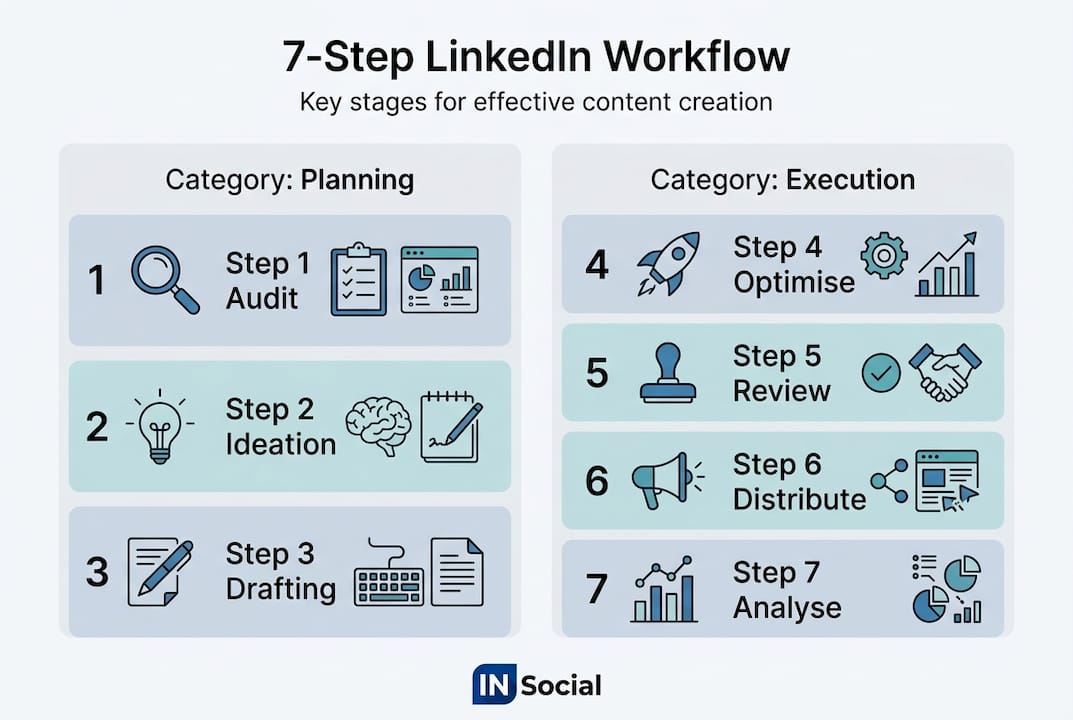
AI-assisted workflows that follow these seven stages can deliver up to ten times the content volume, but only when human oversight is baked in at every step. Volume without quality is just noise. Keep that in mind as you read through the stages below.
| Stage | Manual workflow | AI-assisted workflow |
|---|---|---|
| Audit | Spreadsheet review | Automated performance scraping |
| Ideation | Brainstorm meeting | AI topic clustering from trending data |
| Drafting | Writer produces full post | AI draft refined by human editor |
| Optimising | Manual keyword check | AI-powered readability and keyword tool |
| Reviewing | Single editor sign-off | Structured approval process with checklist |
| Distributing | One person posts manually | Scheduled across multiple profiles |
| Analysing | Monthly glance at stats | Weekly dashboard with clear KPIs |
Here is what each stage involves in practice:
- Audit: Review the last 90 days of posts. Note which topics, formats, and posting times generated the most engagement. Delete assumptions; use real data.
- Ideation: Generate topics using customer questions, sales call themes, industry news, and competitor analysis. AI tools can accelerate this, but the best ideas almost always come from your sales team.
- Drafting: Write for your ideal client, not for yourself. Use plain language. Start with a hook. End with a clear, low-pressure call to action.
- Optimising: Review for readability, keyword relevance, and LinkedIn-specific formatting. Short paragraphs perform better. Line breaks matter more than most marketers realise.
- Reviewing: Every post, regardless of who wrote it, should pass through a brief approval process. One editor, one checklist, ten minutes. This protects brand voice and catches errors before they go live.
- Distributing: Schedule posts across company and personal profiles using a tool like Buffer, Hootsuite, or LinkedIn's native scheduler. Stagger timing for maximum reach.
- Analysing: Review weekly. Track impressions, engagement rate, profile views, and connection requests. These metrics tell you what to do more of, and what to drop.
The real value of B2B content creation at this level is repeatability. You stop relying on inspiration and start relying on process. Your team knows what they own, when it is due, and what good looks like. A comprehensive guide to optimising LinkedIn content covers the technical side of stages four and five in considerable depth if you want to go further.

Pro Tip: Always assign a human editor to the reviewing stage, even when AI drafts the content. AI can produce plausible-sounding posts that miss your tone entirely. A ten-minute human edit is the difference between content that sounds like your brand and content that sounds like everyone else's.
Amplifying reach: Employee advocacy and team distribution
With a workflow in place, the next step is to maximise your reach through strategic team distribution. This is where most B2B teams leave an enormous amount of value on the table.
Your company page has followers. Your people have networks. And those networks include the exact decision-makers you want to reach. Employee-led posts generate 2.75 times more impressions and five times the engagement compared to the same content shared from a company page. The reason is simple: people trust people.
"Buyers do not connect with logos. They connect with faces, stories, and people who have something genuine to say. Your team is your most credible distribution channel."
The numbers reinforce this point. 92% of B2B buyers trust recommendations from individuals over branded advertising. That is not a small preference gap. It is a fundamental shift in how purchasing decisions are made, and your content distribution strategy needs to reflect it.
To build an effective employee advocacy programme, focus on these best practices:
- Choose 3 to 5 credible advocates from across your team, ideally people with relevant expertise and existing LinkedIn presence
- Align messaging clearly so that each person shares a consistent narrative, even when they add their own voice
- Train for consistency, not uniformity. Advocates should sound like themselves, within agreed brand guidelines
- Make it easy. Provide draft posts, suggested images, and posting reminders. Remove friction at every point
- Recognise and reward participation so that advocacy becomes a habit rather than a chore
A guide on how to create LinkedIn content for B2B success explores the role of personal branding within advocacy in more detail, which is worth reading alongside this workflow. When your workflow feeds content to advocates consistently, reach compounds week on week. That compounding effect is one of the most powerful and underused growth levers available to B2B teams.
Rich media, cadence, and ongoing optimisation
Optimising your team's engagement means not just posting more, but posting smarter. Here are the crucial factors that determine whether your content actually builds pipeline or just fills a feed.
The format of your content matters significantly. Not all post types perform equally, and the difference can be dramatic. The top-performing formats on LinkedIn right now include:
- Video posts, which deliver up to 24 times more engagement than text-only posts in some categories
- Polls, which are fast to create and generate high interaction because they invite a response
- Carousel documents, which keep readers engaged for longer and perform well for educational content
- Infographics and rich images, which increase interaction by 50% compared to plain text
- Long-form text posts, which still perform well when they tell a compelling story or share a counterintuitive insight
The key word here is balance. Cycling through formats prevents audience fatigue and keeps your content feed feeling varied and valuable rather than repetitive.
For posting cadence, follow a 90-day ramp rather than trying to go from zero to full speed overnight:
- Month one (foundation): Establish your content pillars, create templates, and begin posting two to three times per week on the company page. Focus on consistency over volume.
- Month two (consistency): Increase to three times per week. Introduce at least one advocate profile. Begin testing different formats and tracking which ones perform best.
- Month three (amplification): Activate your full advocacy team. Introduce richer media formats. Review analytics weekly and refine based on what the data tells you.
This phased approach keeps quality high. Teams that try to scale too quickly almost always sacrifice content quality, which damages credibility rather than building it.
A detailed LinkedIn content creation checklist can serve as your quality gate at each stage of this ramp. Use it before every post goes live.
Pro Tip: Review your analytics every week without fail. Track which formats, topics, and posting times generate the most profile visits and connection requests, not just likes. Profile visits and connection requests are much stronger indicators of genuine pipeline interest than surface-level engagement metrics.
Why rigid workflows fail and what actually works for B2B LinkedIn
Here is something most workflow guides will not tell you: an overly rigid system can be just as damaging as having no system at all.
We have seen it many times. A B2B team spends weeks building a beautifully structured content calendar. Topics are mapped, formats are assigned, posting times are optimised. Then the world changes. A competitor launches something unexpected. A client shares a compelling success story. A trending conversation appears that your audience is deeply invested in. And the rigid workflow, built for predictability, has no room to respond.
The result is content that feels stale, generic, and completely disconnected from what your audience actually cares about right now.
Pure AI automation carries the same risk. When content is generated, optimised, and scheduled entirely by tools without human intervention, it tends to produce posts that are technically correct but personality-free. They sound like a press release written by a committee. Nobody follows a logo because a logo said something interesting. People follow humans who have a genuine point of view.
The real impact of LinkedIn content comes from the intersection of structure and spontaneity. You need the workflow to maintain consistency, quality, and accountability. But you also need the flexibility to deviate from the plan when something more important demands your attention.
Build flexibility into your workflow deliberately. Keep two or three "reactive" slots in your content calendar each month. These are intentionally left blank for timely, unplanned content that responds to real events. This approach lets you stay organised without becoming robotic.
The best B2B LinkedIn strategies we have supported combine a structured editorial backbone with genuine human voice at every touchpoint. Your workflow is the scaffolding. Your people are the building.
Take your LinkedIn lead generation further with proven expertise
Building and sustaining a high-performing LinkedIn content workflow takes more than good intentions. It takes time, specialist knowledge, and consistent execution across every stage.
Even B2B teams with strong internal capabilities benefit from external expertise to sharpen strategy, accelerate results, and avoid the common pitfalls that stall growth. If you are serious about turning LinkedIn into a predictable source of qualified leads, it is worth exploring what a dedicated partner can do for you. Our LinkedIn lead generation approach removes the guesswork and puts a proven, measurable process behind your content. For teams who want hands-on support, our managed LinkedIn service handles everything from content creation to distribution and performance reporting. Explore the full range of IN Social solutions and find the right level of support for where your business is right now.
Frequently asked questions
What are the key stages in a LinkedIn content workflow?
The seven critical stages are audit, ideation, drafting, optimising, reviewing, distributing, and analysing content. AI-assisted workflows can handle much of this at scale, but human oversight at each stage is essential for quality results.
How does employee advocacy impact LinkedIn post performance?
Employee-led posts see 2.75 times more impressions and five times the engagement compared to company pages, making personal profile distribution one of the highest-return activities available to B2B teams.
What content formats drive the most engagement on LinkedIn?
Video and polls can deliver 5 to 24 times more engagement, while rich media overall boosts interaction by 50 per cent compared to text-only posts. Rotating formats regularly helps prevent audience fatigue.
How should a small team distribute LinkedIn content efficiently?
Distribute posts across 3 to 5 employees, training them for aligned messaging to maximise credibility and reach. Providing pre-written draft posts removes friction and significantly increases participation rates.
Why is human review crucial in an AI-driven workflow?
Human review safeguards brand voice and authenticity, preventing the generic, off-brand messaging that pure AI automation frequently produces. Even a brief ten-minute editorial check makes a significant difference to post quality and audience trust.