

TL;DR:
- A focused, customer-centric LinkedIn profile attracts more B2B leads and fosters trust with decision-makers.
- Regularly update and optimize each profile section, emphasizing clarity, results, and a clear call to action to maximize conversions.
Your LinkedIn profile is working for you or against you right now. If it reads like a generic CV rather than a focused sales tool, decision-makers are landing on it, failing to see their problem reflected, and leaving without making contact. Generic language repels B2B prospects, and with thousands of pounds in potential revenue at stake, that is a problem worth fixing today.
Table of Contents
- What you need before optimising your LinkedIn profile
- Step-by-step: Optimise every section of your profile
- Common mistakes and how to avoid them
- Tracking results and continual improvement
- The uncomfortable truth about LinkedIn profile optimisation for sales
- Take your LinkedIn sales strategy further with IN Social
- Frequently asked questions
Key Takeaways
| Point | Details |
|---|---|
| Start with customer focus | Profiles that put client needs first dramatically increase views and conversions. |
| Optimise every section | Enhance your photo, headline, summary and content for maximum B2B impact. |
| Avoid common pitfalls | Watch out for buzzwords and unclear messaging that lose sales opportunities. |
| Track and improve | Continuously update your LinkedIn profile based on key metrics for lasting success. |
What you need before optimising your LinkedIn profile
Before jumping in, ensure you have what you need for a strategic LinkedIn revamp. Rushing into changes without a clear plan is one of the most common mistakes sales professionals make. You end up rewriting your headline three times, still not knowing whether it speaks to the right person.
Start with absolute clarity on two things: who your ideal client is and what specific outcome you help them achieve. Not a vague answer like "I work with businesses" but something precise, such as "I help operations directors at manufacturing SMEs cut procurement costs by 15% within six months." That kind of specificity shapes every word you write.
Next, gather the raw material you will need:
- Customer pain points: Pull these from discovery calls, sales emails, and CRM notes. What words do your best clients use to describe their problem?
- Industry keywords: Search for profiles of people in roles similar to your ideal client and note the language they use.
- Proof points: Actual numbers, percentages, and named outcomes from your work. "Helped a logistics firm reduce delivery errors by 30%" beats "experienced sales professional."
- Competitor analysis: Look at the profiles of your top-performing competitors. Where are the gaps you can own?
Understanding why LinkedIn optimisation matters for B2B sales gives context to this groundwork. The goal is not to create an impressive personal brand. It is to make your ideal client think: "This person gets my problem." A customer-focused profile approach consistently outperforms one built around creative self-promotion, because decision-makers are busy and they respond to relevance.
You also need to decide on your visual assets before you start editing. A professional headshot taken in good lighting, a banner image that reinforces your value proposition, and a clear call to action for your contact section are all non-negotiables.
| Asset | What to avoid | What to aim for |
|---|---|---|
| Profile photo | Casual selfie, group photo | Clean headshot, professional background |
| Banner image | Blank or generic stock photo | Branded visual with a clear message |
| Contact CTA | No call to action | Link to a calendar, landing page, or email |
Pro Tip: Keep your LinkedIn presence consistent with your website and other platforms. If your website says "manufacturing cost reduction specialist" and your LinkedIn says "passionate problem solver," the mixed message erodes trust immediately.
Step-by-step: Optimise every section of your profile
Once you have assembled the building blocks, here is exactly how to transform each part of your profile for conversion impact.
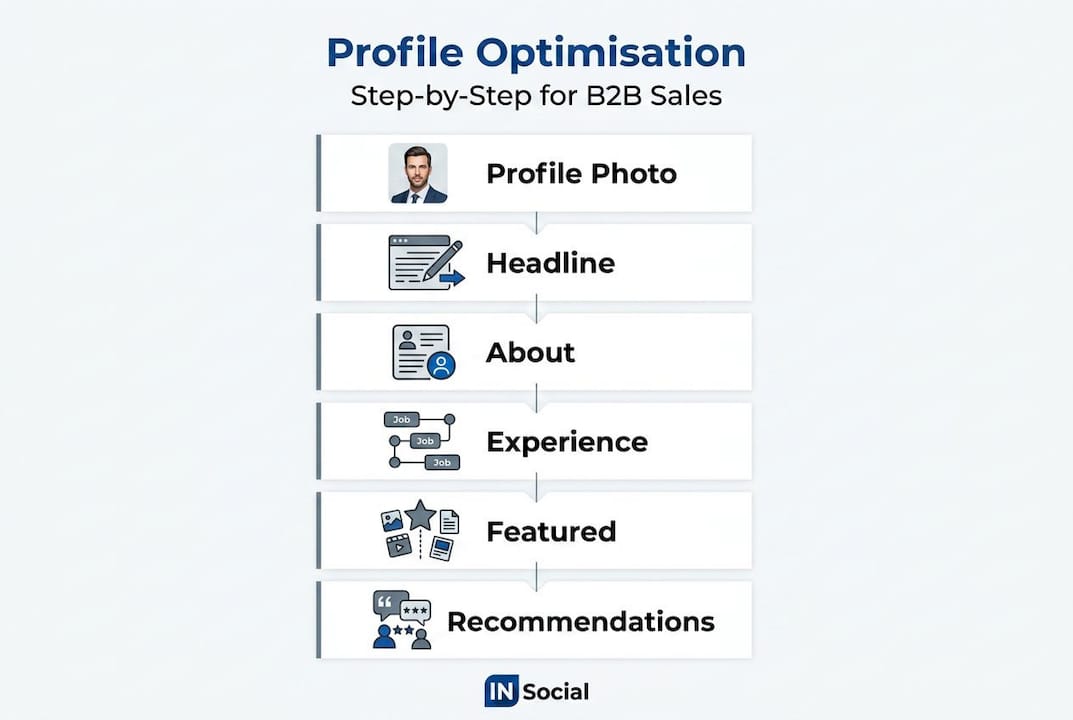
1. Profile photo Your photo is the first signal of professionalism. Use a headshot where your face takes up 60 to 70 percent of the frame. Natural lighting, a clean background, and a confident expression are all you need. Avoid filters or overly polished edits that make you look unlike yourself in person.

2. Headline This is the single most valuable piece of text on your entire profile. Most salespeople write their job title here. Do not do that. A customer-focused headline dramatically increases profile views and inbound interest from decision-makers. Instead of "Account Executive at XYZ Ltd," try "I help [target client] achieve [specific outcome] without [common pain point]."
3. About section (summary) Write this in first person and open with the problem you solve, not your career history. Your reader does not care that you have 12 years of experience yet. They care whether you understand their world. Use the first two lines to hook attention because that is all that shows before LinkedIn's "see more" cut-off. Then expand on your approach, your results, and end with a clear next step such as "Message me to discuss your current challenges."
4. Experience section Each role should include a brief context sentence followed by bullet points that lead with outcomes. Avoid a list of responsibilities. Responsibilities are forgettable. Results are not. Write "Generated £2.3M in new business in 18 months" rather than "Responsible for new business development."
5. Featured section Use this to showcase case studies, client testimonials, video content, or articles. This is prime real estate directly below your summary. Most sales professionals leave it empty or filled with irrelevant posts. Use it intentionally to build credibility and guide the reader towards taking action.
6. Recommendations Aim for at least five recommendations from clients, not just colleagues. A recommendation from a client who describes a specific problem you solved is worth ten times more than a colleague saying you are "great to work with." Request them proactively and suggest the client mention a specific result.
Here is a direct comparison showing what a weak profile looks like versus an optimised one:
| Section | Typical sales profile | Optimised, client-focused version |
|---|---|---|
| Headline | Senior Sales Manager at ABC Solutions | Helping B2B SaaS firms reduce churn by 20% |
| About opening | "I am a results-driven professional with 10 years..." | "If your churn rate keeps climbing despite your team's best efforts..." |
| Experience bullet | "Managed key accounts across the UK" | "Retained £1.8M in at-risk accounts through a revised onboarding strategy" |
| Featured section | Recent company news post | Client case study PDF with measurable outcomes |
Profiles built around this profile checklist for B2B leads consistently attract more qualified inbound enquiries because each section is designed to resonate with a specific type of buyer. The detail matters. Decision-makers read closely when something feels relevant to them. Optimising for B2B leads means treating every section as a conversion touchpoint rather than a biographical record.
Pro Tip: Write your headline, summary, and experience bullets as if your ideal client is reading them alone in a room with no context about who you are. If the text still makes sense and speaks to their situation, you have got it right.
Common mistakes and how to avoid them
Even with best efforts, there are pitfalls every sales professional should be aware of. Knowing what to avoid is just as important as knowing what to do.
The most frequent errors we see include:
- Buzzwords without substance: Words like "dynamic," "passionate," "results-driven," and "innovative" appear on so many profiles that they have lost all meaning. Replace them with specific claims backed by evidence.
- Writing in passive voice: "Sales were increased by 40%" is weaker than "I grew sales by 40% in Q3 by restructuring the outbound calling process." Passive voice distances you from your own achievements.
- Including irrelevant content: Listing roles from 20 years ago that have no bearing on your current offer creates noise. Edit ruthlessly. Every line should serve your sales goal.
- No call to action: Profiles that end with experience and skills but offer no clear next step leave visitors with nowhere to go. Always tell the reader what to do next, whether that is booking a call, downloading a resource, or sending a message.
- Neglecting the skills section: Your skills directly influence LinkedIn's search algorithm. Add skills that match the language your ideal client uses, and ask colleagues or clients to endorse the most relevant ones.
"Generic, creative or unclear profiles reduce the chance of conversions from B2B prospects. Clarity and customer-focus are what drive real sales outcomes on LinkedIn."
To spot weak points in your own profile, read it aloud as if you are your target client. Ask yourself: does this text solve my problem? Does it show me proof? Does it tell me what to do next? If the answer to any of those is no, you have found your next edit.
Building a strong B2B network amplifies the impact of an optimised profile. The best profile in the world generates limited results if it is not visible to the right people. Use your step-by-step guide for outreach to complement your profile work.
Tracking results and continual improvement
You have updated your profile. Now ensure it is delivering ongoing results for your sales goals. Too many professionals treat profile optimisation as a one-time task and then wonder why results plateau after a few months.
Here are four key metrics every sales professional should monitor after optimising their profile:
- Profile views: Track these weekly via LinkedIn's analytics dashboard. A significant increase in views after an update confirms the changes are working. A drop or stagnation signals that something is still not resonating.
- Search appearances: LinkedIn shows you how many times you appeared in search results each week and what search terms triggered those appearances. This is a direct indicator of keyword relevance.
- Connection request acceptance rate: If you are sending targeted connection requests, track how many are accepted. A low rate often points back to a weak profile rather than a bad message.
- Inbound enquiry volume: This is the ultimate metric. Count how many inbound messages, calls, or emails originate from LinkedIn contacts month over month. This is your true return on optimisation effort.
Consistent profile optimisation leads to measurable improvements in B2B lead quality and response rates, and it is an ongoing process rather than a single sprint. Set a quarterly review cadence. Every three months, revisit your headline, your about section, and your featured content. Ask yourself whether your offer has shifted, whether client pain points have evolved, and whether you have new results to add.
LinkedIn's algorithm also rewards active, updated profiles. Fresh content, recent activity, and regular profile edits signal to the platform that you are an engaged user, which increases organic visibility. Pair your profile work with consistent social selling strategies to build a compounding effect where profile credibility and outreach activity reinforce each other.
Pro Tip: Create a simple tracking spreadsheet with columns for date, profile views, search appearances, connection acceptance rate, and inbound messages. Reviewing this monthly shows you trends that LinkedIn's own dashboard sometimes obscures.
The uncomfortable truth about LinkedIn profile optimisation for sales
Here is something most LinkedIn advice will not tell you plainly. The obsession with personal branding has become a genuine obstacle for sales professionals. You see posts about "authentic storytelling," "building your personal brand," and "showing your human side." Some of that has value. But when it starts to crowd out clarity about what you actually do and who you help, it actively costs you business.
We have reviewed hundreds of profiles from sales professionals at B2B companies. A consistent pattern emerges. The profiles that generate the most inbound enquiries are almost always the least "creative." They do not open with a story about climbing a mountain or reference a personal philosophy. They say, clearly and directly, what problem they solve, for whom, and with what result.
Prioritising clarity over creativity is not about being boring. It is about respecting your reader's time. A busy procurement director scanning LinkedIn has roughly seven seconds to decide whether your profile is worth reading. If those seven seconds are spent on your backstory rather than their problem, you have lost them.
The balance to strike is this: be human enough that people trust you, but be specific enough that the right people know exactly why they should reach out. Share context about your approach. Show personality through how you describe your work. But always anchor everything back to the client's world, not your own. LinkedIn is powerful for sales precisely because it allows you to speak directly to decision-makers at scale. Do not squander that by writing a profile designed to impress your peers rather than attract your clients.
The most successful salespeople we work with are not the most interesting storytellers. They are the clearest communicators.
Take your LinkedIn sales strategy further with IN Social
Optimising your profile is one of the most high-impact steps you can take right now. But it is only the starting point for a complete B2B sales system on LinkedIn.
At IN Social, we combine human expertise with advanced tools to help B2B sales teams go further. From crafting client-focused profiles through to building targeted outreach sequences and managing your LinkedIn presence end to end, we deliver measurable results you can track. Whether you want hands-on support through our proven LinkedIn lead generation service or prefer a fully managed LinkedIn service that runs in the background while you focus on closing deals, we have a solution that fits. Get in touch today and let us show you exactly what a properly optimised LinkedIn strategy looks like in practice.
Frequently asked questions
How often should I update my LinkedIn profile for best sales results?
Review your LinkedIn profile every quarter, updating with new achievements and shifting client needs to maintain relevance and strong B2B results.
What is the most important LinkedIn profile section for sales?
Your headline and summary are the most critical sections, as they instantly communicate your value and a customer-focused headline significantly increases inbound interest from decision-makers.
Does a professional profile photo really matter for lead generation?
A professional photo builds immediate trust and measurably boosts profile views, making it a foundational element for attracting B2B leads on LinkedIn.
How do I measure if my LinkedIn profile changes are working?
Track weekly profile views, search appearances, connection request acceptance rates, and inbound message volume to get a clear picture of improvement over time.
Should I use creativity or stick to clarity in my profile?
Clarity and client-focus consistently outperform creativity on LinkedIn. Generic or unclear language actively repels B2B prospects, so always prioritise specificity and relevance over clever phrasing.