

TL;DR:
- Optimizing LinkedIn profiles boosts inbound inquiries and positions you as an industry authority.
- Key elements like professional photos, targeted headlines, and measurable experience impact lead generation.
- Regular updates and genuine, relevant content improve visibility and trust with your target audience.
Your LinkedIn profile gets views. But the inbound messages, connection requests from ideal clients, and genuine sales conversations? They're nowhere to be seen. This is one of the most common frustrations for B2B business owners and sales managers, and it almost always comes down to a profile that looks incomplete or unconvincing to the right people. Optimising your LinkedIn profile can unlock substantial B2B lead opportunities, but only when you approach it strategically. This guide walks you through exactly how to prepare, execute, and verify improvements so your profile starts working as hard as you do.
Table of Contents
- Why LinkedIn profile optimisation matters for B2B
- Essential elements for LinkedIn profile optimisation
- Step-by-step guide to optimising your profile
- Verifying results and avoiding common optimisation mistakes
- Why most LinkedIn profile advice misses the mark
- How IN Social can accelerate your LinkedIn success
- Frequently asked questions
Key Takeaways
| Point | Details |
|---|---|
| Trust signals win leads | A professional, consistent profile helps convert viewers into high-value B2B prospects. |
| Content drives engagement | Showcase achievements, case studies, and value for your target buyers in your summary and experience sections. |
| Verify and improve | Measure results regularly and refine your profile to maintain continuous lead generation success. |
| Avoid common pitfalls | Overly generic or outdated profiles cost you visibility and credibility in B2B markets. |
Why LinkedIn profile optimisation matters for B2B
LinkedIn is not just another social platform. It is the only professional network where your ideal clients, partners, and prospects are actively looking for solutions. For B2B companies, this makes it the most valuable digital real estate you own. Yet most profiles sit half-finished, with generic headlines and outdated roles that do nothing to attract the right attention.
The benefits of LinkedIn marketing for B2B businesses are well documented, but they only materialise when your profile is set up correctly. A weak profile signals a lack of professionalism, even if your actual service is outstanding. First impressions on LinkedIn happen in seconds, and prospects make decisions about whether to engage based almost entirely on what they see in those initial moments.
Consider what a well-optimised profile actually does for you:
- It communicates your value proposition clearly and immediately
- It positions you as a credible authority in your sector
- It attracts inbound enquiries from relevant decision-makers
- It supports your outreach by making prospects more receptive
- It reinforces your company's brand at every touchpoint
The profile optimisation value goes beyond aesthetics. A well-optimised profile establishes trust and attracts relevant prospects, which directly affects your conversion rates and lead quality.
Here is a quick look at how optimisation affects key performance indicators:
| Metric | Unoptimised profile | Optimised profile |
|---|---|---|
| Profile views per week | Low, inconsistent | Significantly higher |
| Inbound connection requests | Rare | Regular from target audience |
| Search appearance frequency | Minimal | Featured in relevant searches |
| Message response rates | Below average | Noticeably improved |
"Your LinkedIn profile is your digital handshake. If it doesn't communicate value immediately, prospects move on before you've had a chance to speak."
The LinkedIn cheat sheet for B2B sales confirms that profiles optimised with the right keywords and content consistently outperform those that are left generic. The opportunity cost of ignoring this is real and measurable.
Essential elements for LinkedIn profile optimisation
Understanding the stakes, here are the profile sections you must focus on for maximum impact. Not all sections carry equal weight. Some have an outsized influence on whether prospects trust you enough to reach out.
Here is how the key profile elements compare in terms of lead generation impact:
| Profile element | Impact on lead generation | Common mistake |
|---|---|---|
| Profile photo | Very high | Low resolution or no photo |
| Headline | Very high | Job title only, no value statement |
| About section | High | Generic, inward-focused language |
| Experience | Medium to high | Duties listed, no results shown |
| Skills and endorsements | Medium | Outdated or irrelevant skills listed |
| Banner image | Medium | Left as default LinkedIn background |
| Contact details | High | Missing or incomplete |
Profiles with professional headshots get 14 times more views. That single change alone can dramatically shift how often you appear in search results and how seriously prospects take you.
Here is how to prioritise your profile updates:
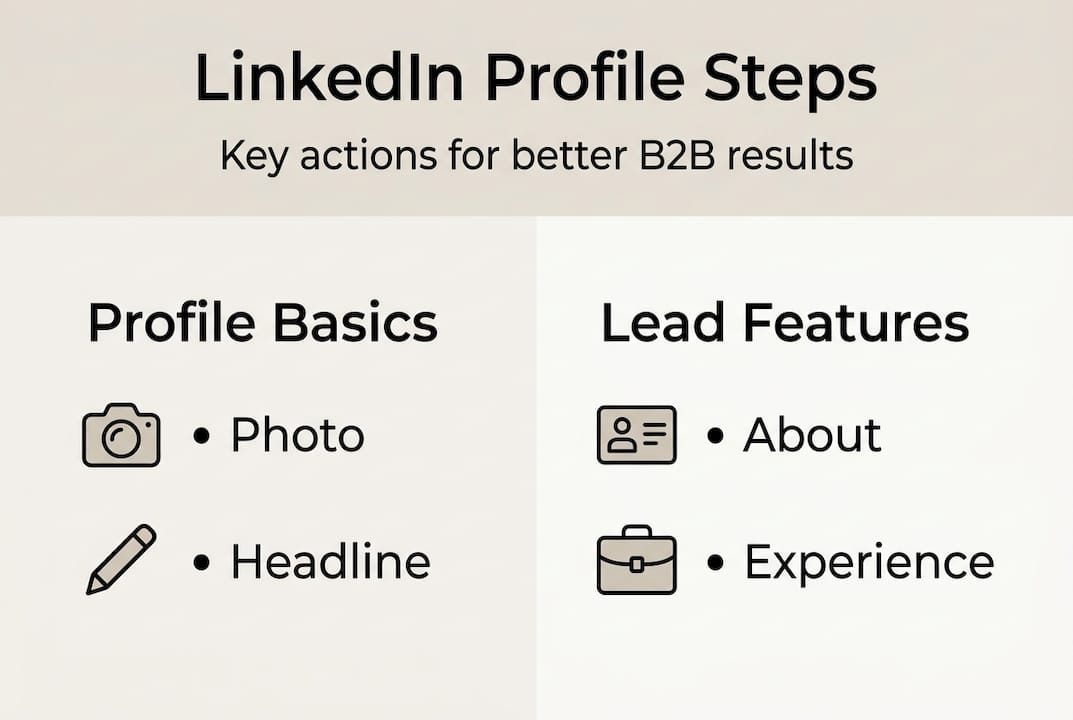
- Profile photo: Use a high-resolution, professionally shot headshot with a clean background.
- Headline: Go beyond your job title. State who you help and what outcome you deliver.
- About section: Write in the first person, focus on client outcomes, and include relevant keywords naturally.
- Experience: Use bullet points that highlight measurable results, not just responsibilities.
- Banner image: Create a branded banner that reinforces your company's message and visual identity.
- Skills: Select skills that align with what your ideal clients are searching for.
- Contact and call-to-action: Make it easy for prospects to reach you. Include your website, email, and a clear next step.
Pro Tip: Use your headline to speak directly to your target client. Instead of "Sales Director at XYZ Ltd," try "Helping mid-sized manufacturers reduce procurement costs through smarter supply chain solutions."
For a detailed content checklist that covers every profile section, and to understand how to create successful LinkedIn content that complements your profile, both resources will save you considerable time. The LinkedIn profile guide also provides a useful foundation for getting the basics right.
Step-by-step guide to optimising your profile
With the essential elements identified, here is exactly how to upgrade your profile step by step.
Step 1: Audit your current profile Start by reviewing every section objectively. Ask yourself whether a stranger landing on your profile would immediately understand what you do, who you serve, and why they should trust you. Note what is missing, what is outdated, and what is unclear.
Step 2: Update your photo, banner, and contact details These are the quickest wins. A professional photo and a branded banner take little time to implement but have an immediate impact on how your profile is perceived.

Step 3: Rewrite your headline and About section This is where most people underinvest. Your headline should include the keywords your prospects search for. Your About section should read like a conversation, not a CV. Focus on the problems you solve and the results you deliver.
Step 4: Strengthen your Experience section For each role, add at least one or two bullet points that highlight specific, measurable outcomes. Numbers, percentages, and named results build credibility far more effectively than a list of duties.
Step 5: Add multimedia and case studies LinkedIn allows you to attach documents, links, and presentations to your Experience and Featured sections. Use this to showcase work samples, client results, or relevant articles.
Step 6: Request endorsements and recommendations Ask colleagues, clients, and partners to endorse your key skills and leave a short recommendation. Social proof is one of the most persuasive elements on any professional profile.
Pro Tip: Set a clear goal before you start optimising. Whether it is generating leads, attracting partners, or recruiting talent, your goal shapes every decision from your headline to your featured content.
Consistent profiles across team members help strengthen your brand image and improve prospect trust. If your sales team all have optimised, aligned profiles, the cumulative effect on brand perception is significant. Reviewing the most important elements to optimise can also help you prioritise where to focus first.
Once your profile is updated, focus on improving engagement and building your LinkedIn network to amplify the impact of your newly optimised presence.
Verifying results and avoiding common optimisation mistakes
After you have implemented the changes, it is crucial to check what is working and what is not.
LinkedIn provides a built-in dashboard showing your profile views, search appearances, and post impressions. Check these weekly for the first month after optimising. You are looking for upward trends, not overnight transformations.
Here is what to track and what good progress looks like:
| Metric | How to track | What to look for |
|---|---|---|
| Profile views | LinkedIn dashboard | Week-on-week increase |
| Search appearances | LinkedIn dashboard | Higher frequency in relevant searches |
| Inbound connections | Notifications tab | More requests from target audience |
| Message open rates | LinkedIn inbox | Improved response to outreach |
| Inbound enquiries | Direct messages | Prospects reaching out unprompted |
Regularly monitoring your profile stats helps maintain momentum and maximise ROI. Without tracking, you are optimising blind.
Avoid these common mistakes that undermine even well-intentioned profile updates:
- Jargon-heavy summaries: If your About section reads like an internal company document, prospects will disengage immediately.
- Outdated roles and dates: Gaps or stale information raise questions about your current activity and credibility.
- Missing profile photo: Still one of the most common oversights, and one of the most damaging.
- No clear call-to-action: Prospects should always know what to do next after viewing your profile.
- Keyword stuffing: Forcing too many keywords into your headline or summary makes it unreadable and unnatural.
"The profiles that generate the most leads are not the most polished. They are the most relevant and the most honest about the value they deliver."
Gather feedback from a trusted colleague or mentor once you have made your changes. A fresh pair of eyes will catch things you have missed. For additional profile improvement tips, external resources can also help you benchmark your progress. Use your lead generation effectiveness metrics to validate whether your changes are translating into real business outcomes.
Why most LinkedIn profile advice misses the mark
Here is something worth saying plainly: most LinkedIn profile advice tells you to copy what works for influencers and personal brand builders. That approach is largely irrelevant for B2B business owners and sales managers.
The profiles that consistently generate qualified leads are not the ones with the most followers or the most creative headlines. They are the ones that communicate genuine expertise and business relevance with absolute clarity. Your prospects are busy decision-makers. They are not looking for inspiration. They are looking for a credible solution to a specific problem.
Authenticity matters far more than polish. A profile that clearly articulates your company's values, your team's expertise, and the outcomes you deliver will always outperform one that chases trending tactics. One-time profile overhauls also miss the point. LinkedIn rewards consistency. Regular updates, active engagement, and a profile that evolves with your business will generate compounding returns over time. That is the standard worth aiming for.
How IN Social can accelerate your LinkedIn success
Ready to put these insights into action? Here is how you can get support to fast-track your LinkedIn growth.
Optimising a LinkedIn profile takes time, expertise, and ongoing attention. If you would rather focus on running your business while a specialist team handles the strategy and execution, IN Social is built for exactly that.
From generating leads without cold outreach to fully managed LinkedIn services that handle your profile, content, and outreach, we combine human expertise with advanced tools to deliver measurable results. Every strategy is tailored to your business, your audience, and your goals. Visit IN Social to find out how we can help you turn LinkedIn into a consistent source of qualified leads and real business growth.
Frequently asked questions
How often should I update my LinkedIn profile?
Update your profile every quarter to reflect new achievements, skills, and responsibilities. Regular updates maintain a strong B2B brand presence and keep your profile relevant in search results.
What is the most important LinkedIn profile section for lead generation?
Your headline and About section are the most critical. First impressions matter most for attracting leads, and these two sections are what prospects read first.
How can I measure if my LinkedIn optimisation is working?
Track profile views, connection requests from your target audience, and inbound messages weekly. Monitoring these metrics validates your optimisation efforts and shows where further improvements are needed.
Should my whole team optimise their LinkedIn profiles similarly?
Yes. Consistency across your team's profiles strengthens your brand and builds trust with prospects. Team alignment increases credibility for B2B buyers who often review multiple team profiles before making contact.