

TL;DR:
- Most LinkedIn connections require nurturing to convert into sales effectively.
- Building trust through personalized, consistent engagement increases lead conversion and shortens sales cycles.
- Automated nurturing combined with genuine personalization significantly boosts qualified lead generation and pipeline stability.
Most B2B sales teams believe that a LinkedIn connection request is the beginning of a sales relationship. It isn't. It's barely an introduction. 79% of marketing leads never convert into sales due to lack of nurturing, which means the majority of effort spent on LinkedIn prospecting is quietly haemorrhaging value. This guide will show you exactly why lead nurturing is the difference between a pipeline that stalls and one that consistently converts, what it looks like in practice, and how your team can start applying it today.
Table of Contents
- The expensive mistake: why most LinkedIn leads vanish
- What nurturing LinkedIn leads really means
- The business impact: what effective nurturing delivers
- How to build a nurturing process that actually works
- A perspective you rarely hear: nurturing isn't about speed, it's about trust
- Boost results with expert LinkedIn nurturing support
- Frequently asked questions
Key Takeaways
| Point | Details |
|---|---|
| Nurturing prevents lost leads | Most LinkedIn leads won’t convert unless you engage and build trust through nurturing. |
| Higher conversions, lower cost | Companies focused on nurturing see more sales-ready leads at a lower cost per conversion. |
| Automation magnifies results | Marketing automation can dramatically increase qualified leads when paired with genuine relationship-building. |
| It’s about trust, not speed | Lasting B2B wins come from authentic engagement, not just rapid outreach. |
The expensive mistake: why most LinkedIn leads vanish
You put in the work. You research prospects, craft connection requests, and build a list of relevant contacts. Then what? For most sales teams, the answer is a brief, generic follow-up message, a pitch that arrives far too soon, or nothing at all. That silence is costing you more than you realise.
"The real loss isn't in prospects saying no. It's in prospects who never hear from you again after connecting."
The data is stark. Marketing leads fail to convert 79% of the time when there is no nurturing in place. That is not a marginal inefficiency. It represents the bulk of your prospecting budget, your team's time, and your pipeline potential being wasted before a single sales conversation begins.
Here are the most common mistakes sales teams make after a LinkedIn connection is accepted:
- Pitching too early: Sending a sales message within 24 to 48 hours of connecting signals desperation and kills trust before it forms.
- Generic messaging: Copying and pasting the same message to every lead ignores the individual's context and needs.
- No follow-up at all: Many teams connect and then move on, leaving warm prospects cold indefinitely.
- Inconsistent contact: Reaching out sporadically, with no structure or intent, leaves leads confused about your value.
- Ignoring content engagement: Failing to interact with a prospect's posts before outreach removes a key trust-building step.
If any of these sound familiar, you are not alone. Most LinkedIn lead conversion issues stem not from poor targeting but from poor follow-through. The lead may have been perfect. The process let it down.
Lead nurturing is the missing piece. It transforms your LinkedIn activity from a series of one-off introductions into a structured, intentional process that moves prospects through a relationship funnel at their pace, not yours. That shift is what separates businesses that consistently close deals from those that are permanently chasing cold leads.
What nurturing LinkedIn leads really means
Let's be direct. Lead nurturing is not sending three messages and hoping someone bites. It is the deliberate process of building trust and staying relevant over time, so that when a prospect is ready to buy, your name is the first one they think of.
50% of leads are qualified but simply not ready to buy yet. Nurturing is how you stay in the picture until they are.
Here is how nurturing differs from standard outreach:
| Standard outreach | Lead nurturing | |
|---|---|---|
| Goal | Immediate response | Long-term relationship |
| Timing | One-off or sporadic | Structured sequence |
| Personalisation | Low | High |
| Content shared | Sales pitch | Relevant value |
| Outcome | Short-term | Consistent pipeline |
A solid strategy for nurturing LinkedIn leads follows a clear sequence. Here is a simple process to apply:
- Connect with context: Send a personalised connection request that references something specific about their role or recent activity.
- Engage with their content: Like, comment meaningfully on, and share their posts for one to two weeks before your next message.
- Offer something of value: Share a relevant article, insight, or resource that addresses a real challenge they face, with no strings attached.
- Personalised follow-up: After providing value, follow up with a message that references your previous interaction and opens a natural dialogue.
- Repeat the cycle: Keep showing up consistently with relevant content and genuine interest.
Understanding the types of LinkedIn leads you are working with also matters. Cold, warm, and hot leads each need different nurturing approaches.
Pro Tip: Track relationship signals, not just reply rates. Is your prospect engaging with your content? Viewing your profile? These micro-signals indicate warming intent, even when they haven't replied yet.
The business impact: what effective nurturing delivers
The case for nurturing is not just logical. It is measurable. Companies excelling at nurturing generate 50% more sales-ready leads at 33% lower cost per lead. Read that again. More leads. Lower cost. That is a compelling argument for any sales director or business owner watching their cost per acquisition closely.

Here is what the outcomes typically look like when nurturing is in place versus when it is not:
| Metric | Without nurturing | With nurturing |
|---|---|---|
| Lead-to-meeting rate | Low (under 5%) | Significantly higher (10%+) |
| Conversation quality | Cold, resistant | Warmer, more engaged |
| Sales cycle length | Longer | Shorter |
| Cost per acquisition | High | Reduced by up to 33% |
| Pipeline consistency | Unpredictable | Steady and scalable |
The impact of automation adds another dimension. Marketing automation for nurturing yields a 451% increase in qualified leads. That figure comes from combining smart sequencing with personalised touchpoints, not from blasting out mass messages.
For small and medium B2B businesses, the practical gains are clear:
- More meetings booked from existing connections, reducing the need for constant new prospecting.
- Warmer conversations that shorten the time from first contact to closed deal.
- Lower wasted effort on leads that were simply not yet ready, rather than not interested.
- A more predictable LinkedIn sales funnel that compounds over time.
You don't need a large team to see these results. You need the right process. And if you are looking to understand what driving B2B sales results through LinkedIn actually looks like end to end, the foundations always begin with nurturing.
How to build a nurturing process that actually works
Knowing nurturing works is one thing. Building a process that your team will actually follow is another. Here is a practical framework to get you started.
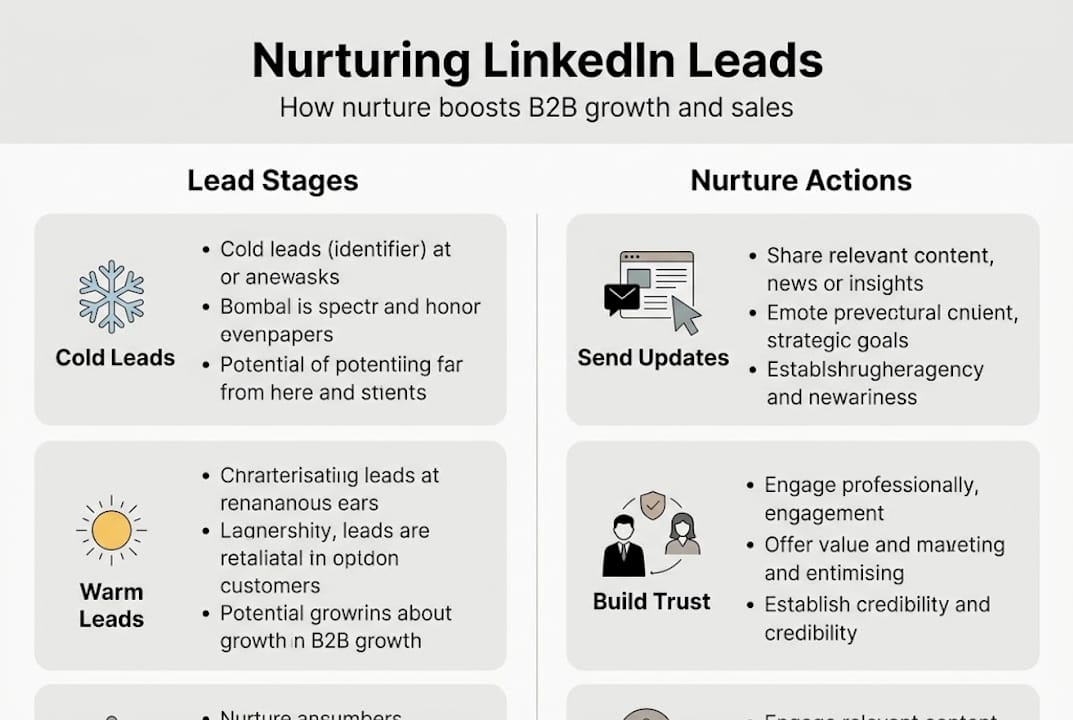
Step 1: Segment your leads Not all prospects are the same. Group your LinkedIn connections by industry, role, buying stage, or pain point. This allows you to send messages that feel relevant rather than recycled.
Step 2: Create a nurturing sequence Map out your interactions in advance:
- Week 1: Accept or send connection with a personalised note.
- Week 2 to 3: Engage with their content without any direct message.
- Week 3 to 4: Send a value-driven message with a useful resource.
- Week 5 to 6: Follow up referencing your earlier message and their activity.
- Week 7 onwards: Continue sharing relevant content and checking in periodically.
Step 3: Integrate automation carefully LinkedIn outreach automation can help you stay consistent at scale. The 451% increase in qualified leads from automation comes from pairing it with genuine personalisation, not replacing it.
Pro Tip: Avoid using the same opening line for every automated message. Even a small personalisation, such as referencing a prospect's recent post or industry challenge, dramatically improves reply rates.
Here are the practical tools and habits to maintain consistency:
- CRM tagging: Label LinkedIn contacts by nurturing stage so nothing slips through the cracks.
- Content calendar: Prepare weekly value-adding posts that keep you visible in your prospects' feeds.
- Reminder system: Use your CRM or a simple spreadsheet to flag follow-ups so you never go dark on a warm lead.
- Monthly review: Check which leads have moved stages and adjust your approach accordingly.
Exploring LinkedIn growth strategies alongside your nurturing process will help you maintain a consistent flow of new prospects entering the top of your funnel while you nurture those already in it.
A perspective you rarely hear: nurturing isn't about speed, it's about trust
Everyone talks about scaling outreach faster and automating more touchpoints. We get it. Speed feels productive. But here is what we have seen time and again: the sales teams that win long-term are not the fastest. They are the most trusted.
Automation is a brilliant tool for consistency and scale, but it cannot replicate the feeling of a message that was clearly written for you. Every lead is a person with real pressures, real goals, and a full inbox. They can tell when something is mass-produced.
The businesses that stand out are the ones willing to do the less glamorous work: reading a prospect's recent post before messaging, referencing a challenge specific to their sector, or simply being patient enough to add value before asking for anything in return. Understanding why LinkedIn works for B2B sales comes down to this: relationships compound. Trust built slowly pays dividends that a quick pitch never will. Play the long game, and the results speak for themselves.
Boost results with expert LinkedIn nurturing support
If you've read this far, you already know that nurturing is not optional. It's the engine behind sustainable LinkedIn growth. The challenge is building a process that your team can maintain consistently while still running the rest of the business.
At IN Social, we combine human expertise with smart tools to help B2B sales teams build and run nurturing systems that actually convert. Whether you want to explore LinkedIn lead generation strategies without cold outreach, or you're ready to join a community of growth-focused sales professionals through the IN Social Sales Club, we can help you move from knowing what to do to actually doing it. Book a free strategy call and let's build your pipeline together.
Frequently asked questions
What is lead nurturing on LinkedIn?
Lead nurturing on LinkedIn is the process of building ongoing relationships and trust with prospects before they are ready to buy, using personalised engagement over time. Because 50% of leads are qualified but not yet ready to purchase, nurturing keeps you relevant until the timing is right.
How does nurturing leads improve LinkedIn sales conversions?
Nurtured leads become more sales-ready because trust and familiarity have been established before any sales conversation begins. Companies excelling at nurturing generate 50% more sales-ready leads at 33% lower cost, making it one of the highest-return activities in B2B sales.
What are the common mistakes when nurturing LinkedIn leads?
The biggest mistakes include pitching too early, sending generic messages that ignore the individual's context, failing to follow up consistently, and not engaging with a prospect's content before reaching out directly.
Can automation really help with LinkedIn lead nurturing?
Yes, when used correctly. Marketing automation for nurturing can increase qualified leads by 451%, but the key is pairing automation with genuine personalisation so messages feel relevant rather than mass-produced.