

TL;DR:
- Most B2B teams treat LinkedIn as a simple notice board, but complex algorithms reward strategic engagement. Genuine, targeted activity, understanding feed mechanics, and compliance are crucial to building trust and pipeline growth. Shifting from cold sales to social selling and meaningful interactions leads to more effective and sustainable results.
LinkedIn has over one billion members, yet most B2B sales teams treat it like a notice board: post something, add a few connections, and wait for the leads to arrive. They rarely do. The reality is that LinkedIn's algorithm, compliance rules, and shifting user behaviour create a genuinely complex environment that rewards strategic thinking over volume tactics. If your team is putting in the effort without seeing qualified pipeline, this guide will show you exactly why that happens and what you can do about it today.
Table of Contents
- Why LinkedIn networking is more complex than expected
- Algorithm mechanics: What really drives visibility and connection
- Compliance and data rules: Staying legitimate on LinkedIn
- Social selling, not cold selling: The strategic shift for 2026
- Our hard-won lessons on mastering LinkedIn networking
- Next steps: Amplify your LinkedIn networking advantage
- Frequently asked questions
Key Takeaways
| Point | Details |
|---|---|
| Algorithm favours engagement | The LinkedIn algorithm boosts posts that keep users’ attention and prompt early interaction. |
| Compliance restricts shortcuts | Using member data or unofficial tools for lead generation can result in bans or compliance risk. |
| Shift to social selling | Success depends on building relationships and demonstrating value, not cold pitches. |
| Be consistent and relevant | Regular posting and engagement with genuinely useful content lead to greater visibility and trust. |
Why LinkedIn networking is more complex than expected
The first myth worth dismantling is that LinkedIn lead generation is straightforward. Many small and medium-sized businesses set up a profile, publish a few posts, and send out connection requests, only to find that their inbox stays quiet. The platform looks simple on the surface, but the mechanics running underneath are anything but.
LinkedIn's feed is not chronological. It is driven by a sophisticated ranking system that decides which content reaches which users. A key part of that system is dwell time behaviour, meaning how long someone actually spends looking at your post before scrolling away. This single signal has a profound impact on whether your content gets distributed broadly or quietly buried. Most business owners have no idea this exists, let alone how to influence it.
Compliance adds another layer of difficulty. LinkedIn restricts how you can interact with its data, limits connection request volumes, and actively monitors for automation. Try to shortcut the process and you risk having your account restricted or banned entirely. That is a serious operational risk for any B2B sales team relying on LinkedIn for pipeline.
The channel also behaves very differently for B2B versus B2C audiences. Consumer brands thrive on viral reach and emotional content. B2B networking requires something more deliberate: trust, relevance, and sustained relationship building. The engagement strategies for B2B that work are far more nuanced than simply boosting post frequency.
Here is what genuinely trips up B2B teams on LinkedIn:
- Assuming more connections automatically mean more leads
- Posting content without understanding how the feed ranks it
- Using third-party tools that violate platform terms
- Treating LinkedIn like email marketing with mass outreach blasts
- Neglecting the comment section, where real trust is built
"LinkedIn's feed ranking is not a simple popularity contest. It rewards content that keeps people on the platform, and it penalises anything that causes users to scroll away quickly."
Understanding these systemic challenges is the first step to turning LinkedIn into a genuine pipeline channel rather than a time sink.
Algorithm mechanics: What really drives visibility and connection
Once you recognise that networking is more than just adding connections, you need to understand the technical rules of the game. The algorithm is not your enemy, but it will work against you if you ignore how it operates.
Dwell time and early engagement are the two most powerful signals in LinkedIn's feed ranking system. Dwell time measures how long someone pauses on your content. Early engagement velocity refers to how quickly likes, comments, and shares accumulate in the first hour or two after you post. Together, these signals tell the algorithm whether your content is worth distributing to a wider audience.
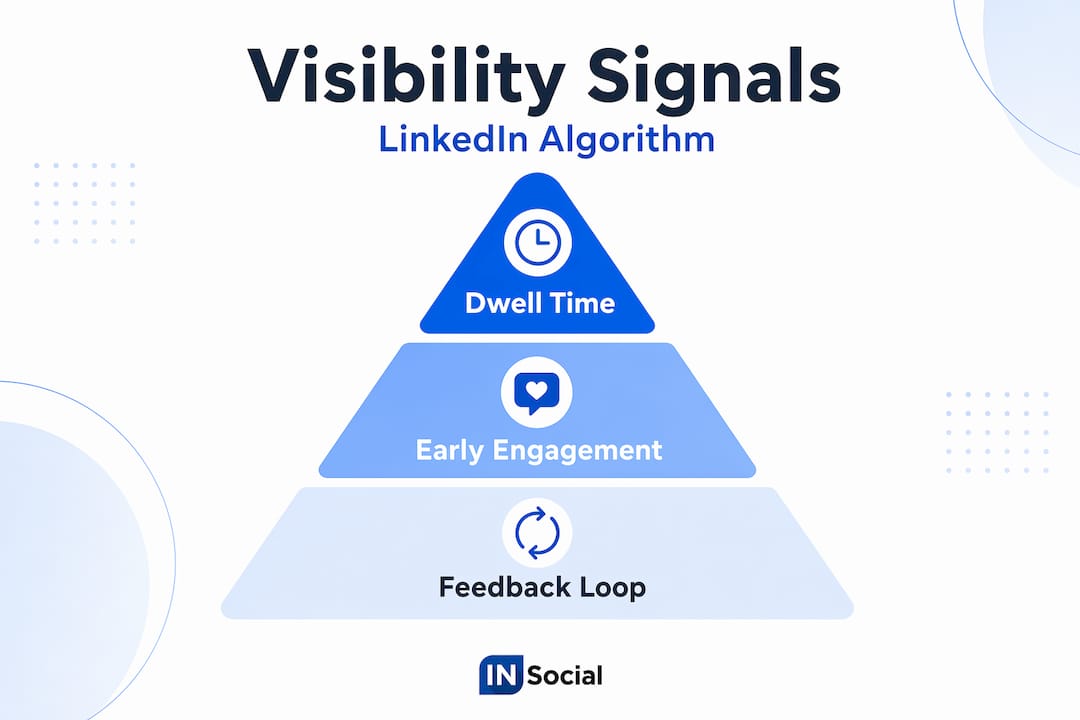
There is also a feedback loop at play. What you engage with shapes what the algorithm shows you in return. If your account consistently interacts with content from decision-makers in a specific industry, LinkedIn begins surfacing more of that content to you, and surfaces you more readily to them. This is valuable for B2B networking because it means intentional, targeted engagement has a compound effect over time.
The table below summarises the key algorithmic signals and how they affect your LinkedIn networking outcomes:
| Signal | What it measures | Impact on reach |
|---|---|---|
| Dwell time | Time spent viewing your post | High: more time equals more distribution |
| Engagement velocity | Speed of early likes/comments | High: slow starts limit overall reach |
| Comment quality | Depth and relevance of replies | Medium: shallow comments count less |
| Click-through behaviour | Clicks to external links | Negative: LinkedIn deprioritises off-platform links |
| Profile strength | Completeness and keyword relevance | Medium: affects search visibility |
| Connection relevance | How closely connected commenters are | High: comments from 2nd connections amplify reach |
The click-through finding is particularly counter-intuitive. LinkedIn's algorithm actively suppresses posts that drive users off the platform. This means posts with external links, such as links to your website or a landing page, typically reach far fewer people than posts that keep the conversation on LinkedIn. To boost engagement for B2B, put your link in the first comment rather than the post body itself.
Pro Tip: Write your posts so that the key insight is visible before the "see more" cut-off. If readers have to click to expand, that action itself registers as engagement, which signals to the algorithm that your content is worth amplifying.
The best effective LinkedIn content examples share a common structure: they lead with a specific, relatable problem, build to a clear insight, and end with a question that invites genuine responses. That structure is not accidental. It is engineered to hold attention, generate comments, and extend dwell time simultaneously.
Compliance and data rules: Staying legitimate on LinkedIn
Understanding the algorithmic rules is only half the puzzle; staying compliant is often the trickier challenge. LinkedIn has become significantly stricter about how its platform and data are used, and the consequences of getting this wrong are severe.
The official LinkedIn Marketing API comes with explicit restrictions on data use: you cannot use member data obtained through the API for sales prospecting, recruiting, or building lead lists for cold outreach campaigns. This catches many B2B teams off guard, particularly those who have invested in tools built on top of LinkedIn's API and assumed they were operating within the rules.
Scraping and unofficial automation create even greater risk. Tools that bypass LinkedIn's official access controls violate the platform's terms of service and can trigger immediate account restrictions, or worse, a permanent ban. Losing a LinkedIn account that has taken years to build represents a significant business setback, especially for a sales team whose pipeline depends on it.

Here is a comparison of compliant versus non-compliant activity to help you audit your current approach:
| Activity | Compliant | Non-compliant |
|---|---|---|
| Sending connection requests manually | Yes (within daily limits) | Mass-sending via automation bots |
| Engaging with posts in your feed | Yes | Using tools to auto-like or auto-comment |
| Exporting your own connections | Yes (via Settings) | Scraping competitor audiences |
| Using Sales Navigator for prospecting | Yes | Using scraped data for cold email lists |
| Posting content manually or via approved schedulers | Yes | Auto-posting via unofficial third-party tools |
The safe, stepwise workflow for B2B teams looks like this:
- Build your ideal customer profile based on job title, industry, and company size using LinkedIn's native search
- Send personalised, value-led connection requests within LinkedIn's recommended daily limits (typically 20 to 25 per day)
- When a connection accepts, engage with their content before sending a direct message
- Nurture the relationship with relevant comments and shares over one to two weeks
- Open a conversation with a specific observation about their business, not a sales pitch
Following a content workflow that complies with LinkedIn's terms is not just about avoiding penalties. It also produces better results because authentic, manual engagement builds the kind of trust that converts into meetings.
Pro Tip: Use LinkedIn's native analytics to track which types of content attract profile views from your target audience. This tells you what is resonating without needing any third-party tool, and it keeps your activity fully within the platform's guidelines.
A strong strategy workflow for B2B teams combines consistent publishing, targeted manual outreach, and weekly time set aside purely for genuine engagement with others' content.
Social selling, not cold selling: The strategic shift for 2026
To apply what works within the rules above, you need to rethink your entire approach to outreach. Cold pitching is losing effectiveness fast. The data and the user sentiment on LinkedIn both point in the same direction.
LinkedIn is no longer suitable for cold selling in the traditional sense. Sending a connection request followed immediately by a pitch message is the fastest way to get ignored, reported, or blocked. Decision-makers on LinkedIn are bombarded with these messages daily, and they have become remarkably good at recognising and dismissing them.
Social selling is the alternative. It works on a simple principle: become known, trusted, and relevant to your ideal buyer before you ever ask for anything. That happens through consistent, valuable content, genuine comment engagement, and a willingness to share insight without expecting an immediate return.
Consistent engagement and posting can produce above-average engagement rates when executed with discipline and intent, showing that volume matters far less than strategic consistency. Posting three well-crafted pieces of content per week, each written to address a specific pain point your buyers face, will outperform five generic posts every time.
Here is what a social selling approach looks like in practice:
- Comment meaningfully on posts from your target accounts before ever sending a connection request
- Share industry insights that your buyer finds useful, not just content about your own services
- Use LinkedIn's native polling and document features to create interactive content that invites participation
- Acknowledge and respond to every comment on your own posts within the first two hours, this extends dwell time and signals genuine conversation
- Build a sequence of warm touches before any direct outreach: view profile, engage with content, send personalised connection request, then message
"The B2B buyers who respond on LinkedIn are not responding to the best pitch. They are responding to the person they already feel they know."
The B2B marketing tips that consistently deliver results are rooted in this philosophy. For practical inspiration, effective LinkedIn outreach examples can help you model the tone and structure of messages that actually get replies. And if you are unsure what to post, start with content that attracts clients by addressing the specific challenges your best customers face.
Our hard-won lessons on mastering LinkedIn networking
We work with B2B sales teams every day, and the most consistent pattern we see is this: the businesses that struggle most on LinkedIn are not the ones doing too little. They are the ones doing too much of the wrong thing. Volume without strategy just accelerates failure.
Generic outreach scripts are one of the fastest ways to stall your LinkedIn growth. We have tested hundreds of message variations across multiple industries, and the conclusion is clear: context and trust outperform cleverly worded templates every time. A message that references a specific post someone wrote, or acknowledges a challenge unique to their sector, will consistently outperform a polished cold script. The personalisation does not need to be elaborate. It just needs to be real.
Compliance has, counter-intuitively, made our clients better at networking. When you cannot rely on automation to send thousands of messages, you are forced to be selective. That selectivity leads to better targeting, higher quality conversations, and ultimately stronger pipeline. The B2B teams that thrive on LinkedIn in 2026 are the ones doing less, but doing it with far more precision.
One of our most effective organic list-building tactics involves a consistent commenting strategy. Before we ever approach a target account on behalf of a client, we spend two to three weeks engaging meaningfully with that person's content. By the time a connection request or message arrives, it does not feel like cold outreach. It feels like a natural next step in an already-existing conversation.
The quality of your comment engagement also has a lasting impact that individual connection requests simply do not. A thoughtful, insightful comment on a popular post within your niche can drive dozens of profile views from exactly the right people, none of whom you had to cold message. Our meaningful engagement guide goes deeper into how to structure this kind of activity for sustained results.
The uncomfortable truth is that LinkedIn networking cannot be automated to success. The platform's algorithm, compliance rules, and user behaviour all punish shortcuts. But when you approach it with genuine intent, consistent effort, and a clear understanding of how the system works, the results are both predictable and scalable.
Next steps: Amplify your LinkedIn networking advantage
Ready to put these lessons into action? The strategies in this article work, but they work significantly faster when you have experienced support behind you.
At IN Social, we combine human expertise with AI-driven insight to help B2B businesses navigate LinkedIn's algorithmic and compliance complexities without the guesswork. Whether you need a clearer strategy or a fully managed service, we can help you build real pipeline from LinkedIn. Our lead generation guide is the ideal starting point if you want to understand the full framework. If you are ready to hand over the day-to-day execution, our managed LinkedIn service puts qualified lead generation on autopilot. And if cold outreach is not delivering, explore how we approach lead generation without cold outreach to build warm, converting conversations at scale.
Frequently asked questions
What is LinkedIn dwell time and why does it matter for networking?
Dwell time is the amount of time a user spends looking at your post before scrolling on, and LinkedIn's feed ranking uses this signal to determine how widely your content is distributed, making it one of the most important factors for networking visibility.
Is using LinkedIn automation or scraping tools safe for my account?
No. Scraping or bypassing access controls violates LinkedIn's terms of service and creates a real risk of account suspension or permanent ban, which can cripple a sales team's pipeline overnight.
Can I use LinkedIn data from the API to find leads or build an audience list?
Official LinkedIn Marketing API terms prohibit using member data for sales prospecting, recruiting, or building cold outreach lists, so any tool doing this on your behalf puts your account and business at risk.
Is cold outreach still effective on LinkedIn in 2026?
Cold sales approaches are declining sharply in effectiveness; LinkedIn works better as a relationship channel, and shifting to a social selling model centred on relevance and trust produces far stronger and more sustainable results.