

You've sent the connection requests. You've written the messages. You've posted content. Yet your pipeline stays stubbornly quiet. Sound familiar? Many sales teams and business owners pour hours into LinkedIn without a clear strategy, and the results reflect that. The good news is that a structured, relationship-driven approach changes everything. This guide walks you through exactly what you need: the right foundations, a proven step-by-step process, the mistakes to sidestep, and how to measure your progress so every hour on LinkedIn moves you closer to a closed deal.
Table of Contents
- Why LinkedIn is essential for B2B sales growth
- Preparing for LinkedIn sales success: essential tools and requirements
- Executing a winning LinkedIn B2B sales process: step by step
- Common mistakes and how to avoid them on LinkedIn
- Tracking, measuring, and scaling your LinkedIn B2B sales results
- Take your LinkedIn B2B sales further with expert support
- Frequently asked questions
Key Takeaways
| Point | Details |
|---|---|
| LinkedIn drives B2B growth | Focusing your effort on LinkedIn yields better leads and higher sales for business-to-business teams. |
| Relationships outperform spam | Building multiple buyer connections delivers twice the win rate and avoids damaging your brand. |
| AI enhances results | AI tools can generate 77% more revenue when applied correctly in LinkedIn sales processes. |
| Track and optimise | Monitoring key LinkedIn metrics lets you continue improving outcomes and scale success efficiently. |
Why LinkedIn is essential for B2B sales growth
LinkedIn is not just another social network. It is where B2B decisions get made. With over one billion members globally and a platform built specifically for professional relationships, LinkedIn gives you direct access to the decision-makers, budget holders, and influencers who matter most to your business.
When you want to grow leads and boost sales, LinkedIn consistently outperforms other channels for B2B. Here is why:
- Decision-maker density: More than 65 million decision-makers are active on LinkedIn, making it the most targeted B2B environment available.
- Buyer intent: LinkedIn users are in a professional mindset, actively seeking solutions, partners, and suppliers.
- Content reach: Thought leadership posts and articles reach buyers at every stage of the funnel, from awareness to consideration.
- Trust signals: A well-optimised profile and consistent activity build credibility before a single conversation takes place.
The data backs this up. LinkedIn users practising deep sales are twice as likely to exceed their quotas compared to peers who rely on surface-level activity. Understanding the full lead generation benefits of LinkedIn helps you appreciate why this platform deserves a central role in your sales strategy, not an afterthought.
Preparing for LinkedIn sales success: essential tools and requirements
Understanding LinkedIn's value, your next step is to set up the foundations to maximise your potential. Rushing into outbound activity without the right setup is one of the most common reasons sales efforts stall.
| Tool or feature | Purpose | Priority |
|---|---|---|
| LinkedIn profile | First impression and credibility builder | Essential |
| Sales Navigator | Advanced prospecting and account tracking | High |
| Company page | Brand visibility and content hub | High |
| LinkedIn analytics | Performance tracking and audience insights | Medium |
| Content planner | Consistent posting schedule | Medium |
| AI tools | Personalisation, targeting, and efficiency | High |
Before you send a single message or post a single piece of content, work through this checklist:
- Profile audit: Does your profile speak to your buyer's problems, not just your job title? Optimise your profile and content before anything else.
- Buyer personas: Know exactly who you are targeting: their role, their challenges, their goals.
- Content plan: Decide what you will post, how often, and what value each piece delivers.
- Team alignment: Ensure your sales and marketing teams are working from the same playbook.
- Network foundations: Start to build your LinkedIn network with intention, connecting with relevant prospects and industry peers.
Pro Tip: Do not limit yourself to one contact per target company. Multi-threading boosts win rates by 130% for large deals. Building relationships with seven or more stakeholders at a single account dramatically increases your chances of closing. Avoid spammy outreach tactics that damage your reputation before the relationship even begins.
Executing a winning LinkedIn B2B sales process: step by step
With essentials in place, let's look at the exact workflow that yields measurable B2B sales gains. This is not about blasting messages. It is about building a repeatable, scalable process.
- Identify high-potential accounts: Use Sales Navigator filters to build a targeted account list based on company size, industry, growth signals, and recent activity.
- Map the stakeholders: For each account, identify multiple decision-makers and influencers. Remember, multi-threading is your competitive advantage.
- Warm up with content: Engage with your prospects' posts before reaching out. Like, comment thoughtfully, and share relevant insights. This makes your connection request feel natural.
- Send a personalised connection request: Reference something specific about their work or company. Generic requests get ignored.
- Open the conversation: Once connected, start with value. Share a relevant article, insight, or resource. Do not pitch immediately.
- Qualify and nurture: Ask questions. Understand their priorities. Move the conversation forward only when there is genuine interest and fit.
- Transition to a meeting: Suggest a short call once you have established rapport and identified a clear need.
- Follow up consistently: Most deals require multiple touchpoints. Use your content strategy workflow to stay visible between conversations.
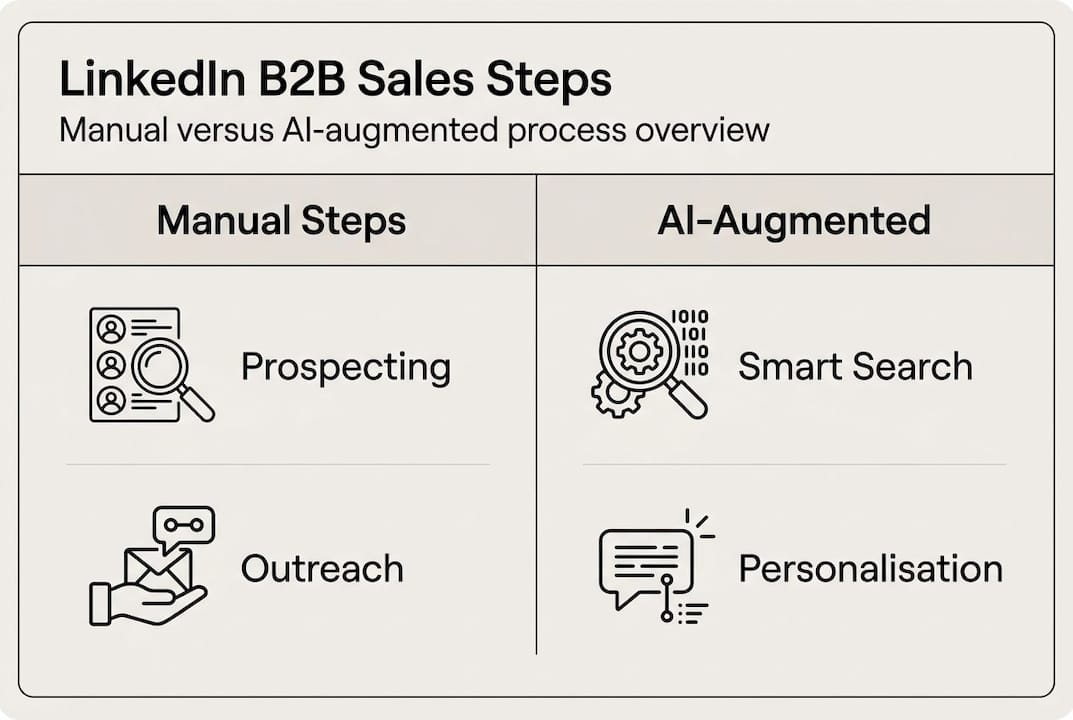
Here is how a manual approach compares to an AI-augmented one:
| Activity | Manual process | AI-augmented process |
|---|---|---|
| Prospecting | Time-intensive, limited scale | Fast, data-driven targeting |
| Personalisation | Inconsistent, effort-heavy | Scalable, context-aware |
| Follow-up timing | Guesswork | Optimised by engagement signals |
| Reporting | Manual spreadsheets | Automated dashboards |
| Revenue impact | Baseline results | Significantly higher output |
Pro Tip: Use LinkedIn's advanced search filters alongside AI-powered recommendations to sharpen your targeting. AI-powered sellers generate 77% more revenue than those not using AI tools in their process. Pair this with the insight that deep sellers are twice as likely to exceed quota, and the case for a structured, tech-enabled approach becomes undeniable. Improving how you improve engagement at every stage compounds your results over time.
Common mistakes and how to avoid them on LinkedIn
Even the best process can be undermined by avoidable errors. Here is what to watch out for on your journey.
The most frequent mistakes we see from B2B sales teams include:
- Sending generic pitches: Copy-paste outreach signals low effort and gets deleted. Personalise every message.
- Neglecting relationship nurturing: Connecting and then going silent is a wasted opportunity. Stay engaged.
- Inconsistent activity: Posting once a month and expecting results is unrealistic. Consistency builds trust and visibility.
- Focusing only on new connections: Your existing network is a goldmine. Re-engage warm contacts regularly.
- Skipping the value step: Every message should offer something useful, an insight, a resource, a relevant observation. Not just a request for time.
- Ignoring the importance of network building: A shallow network limits your reach and referral potential significantly.
Spam tactics harm brand trust and erode the credibility you have worked hard to build. Social selling is a long game. Expect meaningful results within three to six months, but the relationships you build will deliver far stronger loyalty and lifetime value than any cold outreach campaign ever could.
Patience is not a weakness here. It is a strategy. The sales teams that commit to consistent, value-led activity on LinkedIn are the ones who build pipelines that keep filling themselves.
Tracking, measuring, and scaling your LinkedIn B2B sales results
Avoiding mistakes ensures you keep progressing. Now, here is how to monitor and expand the gains you have made.
You cannot improve what you do not measure. These are the core metrics every B2B sales team should track on LinkedIn:
- Social Selling Index (SSI): LinkedIn's own score measuring your profile strength, network quality, engagement, and relationship building.
- Connection growth rate: Are you consistently adding relevant prospects to your network each week?
- Engagement rate: How many of your target audience are interacting with your content?
- Pipeline size: How many qualified conversations are active at any given time?
- Deal velocity: How quickly are prospects moving from first contact to meeting to proposal?
| Metric | Target | Recommended tool |
|---|---|---|
| SSI score | 70 or above | LinkedIn SSI dashboard |
| Weekly new connections | 20 to 40 relevant contacts | Sales Navigator |
| Post engagement rate | 3% or higher | LinkedIn analytics |
| Active pipeline conversations | 10 or more per rep | CRM or Sales Navigator |
| Deal close rate | Improving quarter on quarter | CRM with AI reporting |
Use LinkedIn analytics to review what content resonates, which outreach messages convert, and where prospects drop off. Iterate based on real data, not assumptions.

Scaling is where team selling becomes a powerful lever. Team selling results in 67% larger deals on average. When multiple team members are active on LinkedIn, sharing content, engaging with prospects, and building relationships simultaneously, your brand's reach and credibility multiply. Coordinate your team's activity, align on messaging, and watch your average deal size grow.
Take your LinkedIn B2B sales further with expert support
For those looking to fast-track their LinkedIn B2B sales engine, dedicated expertise is a click away.
Implementing everything in this guide takes time, skill, and consistency. If you want to accelerate your results without the trial and error, working with specialists who live and breathe LinkedIn sales strategy makes a real difference.
At IN Social, we combine human expertise with advanced AI tools to build personalised LinkedIn sales strategies that generate qualified leads and drive measurable revenue. Whether you need done-for-you LinkedIn lead generation strategies, access to our community-driven IN Social Sales Club, or a full suite of sales services and solutions tailored to your business, we have the tools and experience to help you grow. Your pipeline should be working as hard as you are. Let us make that happen.
Frequently asked questions
How long does it take to see results from LinkedIn B2B sales?
Typically, you can expect meaningful engagement and pipeline activity within three to six months when following a consistent, relationship-based approach rather than relying on cold outreach alone.
What is multi-threading on LinkedIn, and why does it matter?
Multi-threading means building connections with several stakeholders at a target account simultaneously. It boosts win rates by 130% for large deals, making it one of the highest-impact tactics available to B2B sales teams.
Can artificial intelligence really improve LinkedIn sales results?
Absolutely. AI-powered sellers generate 77% more revenue than those not using AI in their sales process, making it a significant competitive advantage on LinkedIn.
Why shouldn't I just use LinkedIn for cold outreach?
Spam tactics damage brand trust and rarely convert well. Social selling on LinkedIn takes patience but consistently delivers more loyal, higher-value clients over the long term.