

TL;DR:
- Proper LinkedIn training transforms profiles into lead-generating assets through strategic optimization and engagement.
- Consistent, value-driven content and authentic outreach are essential for building trust and converting prospects.
- Embedding a mindset shift and continuous measurement maximizes long-term results across sales, marketing, and leadership.
Most B2B companies treat LinkedIn like a digital business card, somewhere to park a profile and occasionally scroll through updates. That's a costly assumption. LinkedIn has evolved into the most powerful sales and lead generation platform available to B2B businesses, yet the majority of teams never tap its full potential. The difference between a profile that generates consistent enquiries and one that sits dormant often comes down to one thing: proper training. This guide explains why structured LinkedIn training is one of the smartest investments your business can make, what it covers, and how to implement it effectively.
Table of Contents
- Why LinkedIn matters for B2B sales and brand visibility
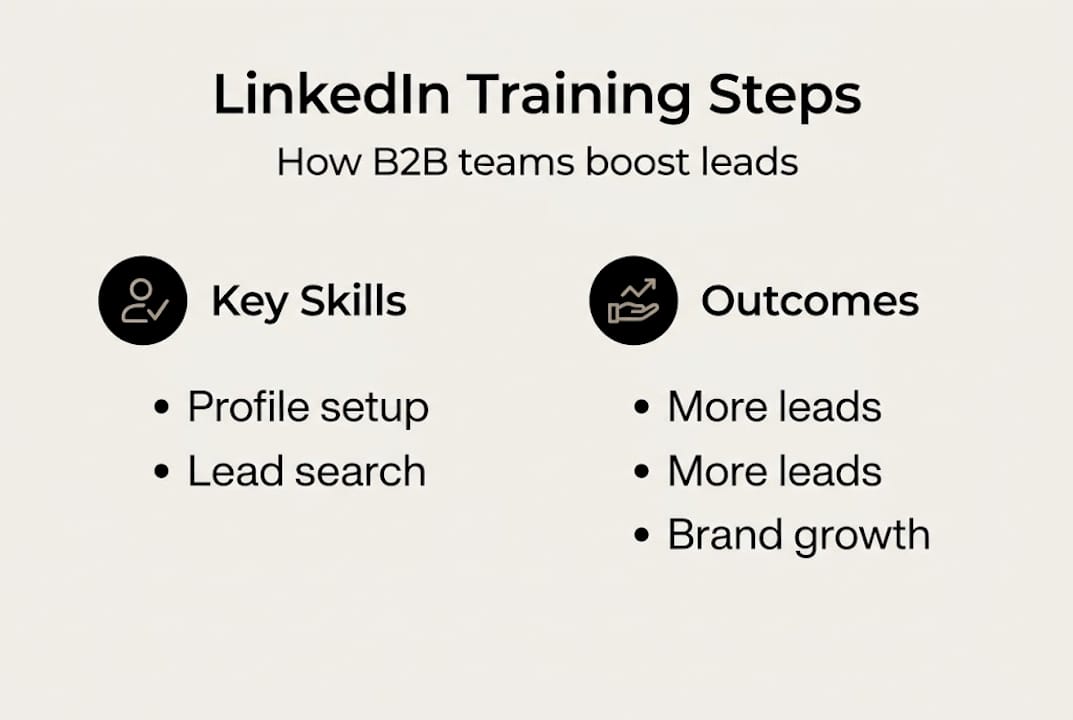
- What LinkedIn training delivers: Key skills and outcomes
- Common LinkedIn mistakes B2B teams make without proper training
- Implementing effective LinkedIn training in your organisation
- What most businesses overlook about LinkedIn training
- Take the next step with LinkedIn training solutions
- Frequently asked questions
Key Takeaways
| Point | Details |
|---|---|
| LinkedIn's B2B power | Optimised use of LinkedIn dramatically enhances B2B sales and brand reach. |
| Training drives results | Formal LinkedIn training equips teams with the skills needed for consistent, measurable growth. |
| Avoid common mistakes | Proper training prevents typical messaging errors and maximises every connection opportunity. |
| Continuous improvement | Layering ongoing training with regular performance tracking yields sustained lead generation success. |
Why LinkedIn matters for B2B sales and brand visibility
LinkedIn isn't just another social platform. With over 930 million members globally, it hosts an extraordinary concentration of business decision-makers, procurement managers, and senior leaders. No other platform gets close to that level of professional intent.
For B2B companies, this matters enormously. LinkedIn is the top platform for B2B lead generation, consistently outperforming Facebook, Instagram, and X when it comes to converting professional connections into genuine sales conversations. The audience is already in a business mindset when they log in. That's a significant advantage.
Here's how LinkedIn compares to other social channels for B2B purposes:
| Platform | B2B lead quality | Audience intent | Content reach for professionals |
|---|---|---|---|
| Very high | Business-focused | Excellent | |
| Medium | Mixed | Moderate | |
| Low | Consumer-focused | Limited | |
| X (Twitter) | Low to medium | Mixed | Limited |
Beyond raw numbers, LinkedIn enables you to build credibility through thought leadership. When your team shares insights, comments on industry conversations, and publishes value-driven content, your brand becomes associated with expertise. Prospects trust you before they ever contact you. That trust accelerates the sales cycle considerably.
Key benefits LinkedIn delivers for B2B companies:
- Targeted outreach to specific job titles, industries, and company sizes
- Inbound lead generation through consistent, valuable content
- Brand visibility that compounds over time with regular engagement
- Relationship building that supports longer B2B sales cycles
- Recruitment and partnerships as a secondary but valuable benefit
Businesses that tap into LinkedIn marketing benefits report stronger pipeline quality alongside improved brand recognition. Exploring LinkedIn sales growth strategies reveals that companies leaning into the platform strategically generate measurably better results than those treating it as an afterthought.
What LinkedIn training delivers: Key skills and outcomes
Knowing LinkedIn matters is one thing. Knowing how to use it well is another entirely. This is where formal training creates a real competitive edge.
Companies that invest in LinkedIn training see more consistent inbound leads, largely because trained teams operate with a clear framework rather than guesswork. Every interaction becomes purposeful.

Here's what effective LinkedIn training typically covers, and the business impact each skill creates:
| Skill area | What teams learn | Business impact |
|---|---|---|
| Profile optimisation | Headlines, summaries, social proof | More profile views, stronger first impressions |
| Strategic messaging | Personalised outreach, follow-up cadence | Higher response rates from decision-makers |
| Content creation | What to post, how often, what formats work | Increased brand visibility and inbound enquiries |
| Engagement tactics | Commenting, sharing, community building | Wider reach and warmer leads |
| Performance tracking | Key metrics, analytics tools, KPI setting | Data-driven improvement and ROI clarity |
A trained team approaches effective LinkedIn lead generation with consistency and intent. They know how to speak to a senior buyer without sounding scripted, and how to create content that attracts rather than repels. Strong LinkedIn management practices, from scheduling posts to monitoring engagement, keep momentum going beyond an initial burst of effort.
The steps to getting value from LinkedIn training are straightforward:
- Audit your current LinkedIn presence to identify gaps
- Set clear goals, whether lead volume, meeting bookings, or brand visibility
- Enrol your team in structured training covering both technical and strategic skills
- Practise using LinkedIn Sales Navigator tips and advanced search tools
- Review performance monthly and adjust based on real data
Pro Tip: Don't silo LinkedIn training within just your sales team. When marketing and leadership also understand the platform, your entire business presence becomes more cohesive and credible.
Common LinkedIn mistakes B2B teams make without proper training
Without proper guidance, even well-intentioned teams fall into patterns that actively damage their results. Understanding these pitfalls is the first step to avoiding them.
Many B2B companies miss out on leads due to inconsistent posting and bland messaging. A profile that goes quiet for weeks, then suddenly publishes five posts in a day, signals to the LinkedIn algorithm and to prospects that there's no real strategy behind it. Consistency signals professionalism.
According to LinkedIn usage trends, the platform's most active users engage with content daily. If your team only surfaces occasionally, you're invisible to the very buyers you want to reach.
Here are the most common mistakes untrained B2B teams make:
- Unoptimised profiles that look generic and fail to speak to the target buyer
- Copy-paste outreach messages that prospects spot and ignore immediately
- Posting without a strategy, leading to content that gets no traction
- Ignoring comments and messages, which signals disinterest and damages relationships
- Jumping straight to a sales pitch before any trust has been established
The hard sell is the most damaging of all. LinkedIn users are sophisticated. They've seen every variation of "I'd love to jump on a quick call" and they're tired of it. Creating LinkedIn content that genuinely helps your audience, rather than content designed purely to sell, builds the kind of goodwill that converts over time.
"The businesses that win on LinkedIn are those that give before they ask. Value first, conversation second, sale third."
Applying LinkedIn B2B marketing tips around personalisation and genuine engagement makes a measurable difference. A message tailored to someone's recent post or business challenge will always outperform a generic template.
Pro Tip: Before sending any outreach message, ask yourself: "Would I respond to this?" If the honest answer is no, rewrite it until it feels like something a real person would genuinely want to read.
Implementing effective LinkedIn training in your organisation
Now you understand what's at stake, here's how to build a training approach that actually sticks and delivers results your team can measure.
Regularly measuring LinkedIn performance metrics is crucial for ongoing success. Without tracking, you're flying blind, and even the best-trained teams can lose focus without clear performance indicators to rally around.
Follow this process to implement LinkedIn training effectively:
- Identify training needs by reviewing current profile quality, post frequency, and outreach results across your team
- Set measurable goals such as a target number of qualified conversations per month or a specific increase in profile views
- Choose your training format, whether internal workshops, external specialist sessions, or a blended programme
- Assign accountability so each team member knows what they're responsible for delivering
- Schedule review checkpoints at 30, 60, and 90 days to assess progress and refine the approach
Here's a quick overview of what to track at each stage:
| Metric | Why it matters | Review frequency |
|---|---|---|
| Profile views | Indicates visibility and discoverability | Weekly |
| Connection acceptance rate | Shows quality of outreach and targeting | Weekly |
| Content engagement rate | Reflects content relevance and reach | After each post |
| Response rate to messages | Measures effectiveness of outreach copy | Monthly |
| Leads or meetings generated | Tracks direct business impact | Monthly |
Resources such as LinkedIn Learning offer a useful starting point, particularly for foundational skills. For driving LinkedIn B2B sales at a more strategic level, working with a specialist partner often accelerates results significantly.
Pro Tip: Embed a monthly peer review session where team members share one piece of LinkedIn content that performed well and one that didn't. This creates a culture of learning that goes far beyond a one-off training day.
What most businesses overlook about LinkedIn training
Most organisations approach LinkedIn training as a technical exercise. They want to know how to write a better headline, how to use Sales Navigator, or how to get more post impressions. These skills matter, but they're only half the picture.
What truly separates the top performers is mindset. The businesses generating consistent results from LinkedIn have shifted how their teams think about digital engagement altogether. They don't see LinkedIn as a task on a to-do list. They see it as an extension of how they build relationships and create value in the real world.
Authentic storytelling is still wildly undervalued in most LinkedIn training programmes. A post that shares a genuine lesson, a real client challenge, or an honest opinion will nearly always outperform a polished promotional piece. People connect with people, not with brands performing.
Teams committed to results-driven LinkedIn lead strategies understand this. They invest in building community, not just an audience. Those who combine technical skills with cultural change, where LinkedIn becomes part of how the business thinks and communicates, see the highest and most sustainable long-term returns. That cultural shift is the real competitive advantage.
Take the next step with LinkedIn training solutions
If this article has clarified one thing, it's that LinkedIn training isn't a nice-to-have. For B2B companies serious about lead generation and brand visibility, it's a strategic necessity.
At IN Social, we work specifically with small and medium B2B businesses to design training that matches your goals, your team, and your industry. Whether you want to master lead generation without cold outreach, join a community of like-minded sellers through the IN Social Sales Club, or explore bespoke solutions through IN Social's LinkedIn training, we're ready to help you build something that delivers real results. Your next qualified lead is closer than you think.
Frequently asked questions
What results can B2B companies expect from LinkedIn training?
Effective LinkedIn training often leads to increased lead volume, higher brand visibility, and stronger sales conversions. Companies that invest in LinkedIn training see more consistent inbound leads as their teams develop a clear, repeatable strategy.
How long does it take to see results from LinkedIn training?
Most teams notice improvement in engagement and lead quality within 2 to 3 months of consistent training and application. Trained teams engage decision-makers more effectively, which speeds up the time to visible results.
Do small teams benefit from LinkedIn training as much as larger organisations?
Yes, and often more so. In a small team, every individual's improvement has a direct impact on overall results. Measuring LinkedIn performance metrics consistently helps small teams stay focused and show meaningful progress quickly.
Is LinkedIn training relevant for non-sales staff?
Absolutely. Marketing, leadership, and even operations roles all contribute to your business's LinkedIn presence. When more of your team shows up consistently and credibly on the platform, your brand authority grows across every touchpoint.