

TL;DR:
- LinkedIn training enhances B2B sales by improving prospecting, content creation, and outreach techniques.
- LinkedIn Learning offers scalable, on-demand courses with practical exercises, certifications, and personalized recommendations.
- Combining platform-based learning with coaching accelerates results and builds a sustainable LinkedIn sales strategy.
Most businesses treat LinkedIn as a digital CV board. Recruiters use it, job seekers browse it, and sales teams occasionally post content and hope for the best. Yet LinkedIn is one of the most powerful structured learning and lead generation platforms available to B2B teams right now. With over 25,000 expert-led courses spanning sales, marketing, and leadership, the platform offers far more than a profile page. This guide breaks down what LinkedIn training actually is, how the main formats compare, and how your sales team can use it to generate qualified leads and build a stronger pipeline.
Table of Contents
- What is LinkedIn training and why does it matter?
- LinkedIn Learning explained: features, formats, and certification
- LinkedIn Learning versus third-party coaching: which is best for your team?
- How to apply LinkedIn training for your B2B team: action plan and practical results
- Why most businesses underuse LinkedIn training—and what actually works
- Get more from LinkedIn training with IN Social
- Frequently asked questions
Key Takeaways
| Point | Details |
|---|---|
| LinkedIn training defined | Structured learning on LinkedIn helps sales teams generate more leads and improve results. |
| LinkedIn Learning vs coaching | Platform learning is scalable; third-party coaching is more personalised but often costs more. |
| Action equals impact | Applying LinkedIn training with real-world outreach drives better B2B growth than theory alone. |
| Certification boosts trust | Earning LinkedIn Learning certificates signals credibility to prospects and customers. |
What is LinkedIn training and why does it matter?
LinkedIn training covers a broad range of structured courses, workshops, and coaching programmes designed to help individuals and teams master LinkedIn's business and sales features. It is not a single product. It is an ecosystem of learning options, from self-paced digital courses on the LinkedIn Learning platform to expert-led workshops focused specifically on B2B prospecting, content strategy, and social selling.
The misconception most businesses carry is that LinkedIn training is for individuals updating their careers or HR teams building recruitment pipelines. That framing misses the point entirely. LinkedIn training for teams is one of the most direct ways to improve how your salespeople find, engage, and convert prospects on the platform.
Why does it matter for B2B specifically? Because LinkedIn is where your buyers spend professional time. Decision-makers scroll their feeds, read thought leadership articles, and assess vendors based on profile credibility and content quality. A sales team trained to operate confidently on LinkedIn will always outperform one relying on cold emails alone.
Here is what structured LinkedIn training typically covers:
- Profile optimisation for sales credibility and search visibility
- Prospecting techniques using LinkedIn's search and Sales Navigator features
- Content creation to attract inbound leads and build authority
- Outreach and messaging frameworks that generate replies without being pushy
- Analytics and tracking to measure what is working
Supporting business growth on LinkedIn through training also builds team confidence. Salespeople who understand the platform convert connections into conversations far more reliably than those who wing it.
Pro Tip: When choosing a LinkedIn training programme for your team, prioritise options with hands-on exercises and real outreach scenarios. Theory without practice rarely changes behaviour on the platform.
LinkedIn Learning explained: features, formats, and certification
LinkedIn Learning is the backbone of most structured LinkedIn training strategies. It is an on-demand platform where courses are bite-sized and accessible anytime on any device, complete with quizzes, exercise files, and certificates you can share directly on your LinkedIn profile.
What makes it particularly useful for B2B teams is that LinkedIn Learning combines personalised recommendations with data drawn from LinkedIn itself, matching learners to skills that are genuinely relevant to their professional goals and industry context.
Here is a breakdown of the key features:
| Feature | Detail |
|---|---|
| Course format | Short video modules, typically 2 to 5 minutes each |
| Learning paths | Curated sequences for specific roles or goals |
| Certificates | Shareable directly to LinkedIn profiles |
| Device access | Desktop, tablet, and mobile |
| Recommendations | Personalised based on role, industry, and skills gaps |
| Languages | Available in multiple languages |
For sales teams, the most directly relevant content includes modules on lead generation, solution-based selling, and using AI tools in marketing and outreach. A course like this can take a salesperson from basic LinkedIn awareness to confident prospecting in a matter of days, not months.
LinkedIn Learning also supports team-level management. Managers can assign specific courses to team members, track completion rates, and align learning objectives with quarterly sales targets. This makes it genuinely scalable for small to medium-sized businesses that need a structured but affordable training approach.

Using a step-by-step LinkedIn guide alongside LinkedIn Learning modules gives your team a practical framework to apply what they learn immediately. That combination, structured content plus real-world application, is where results accelerate.
The certification aspect should not be overlooked either. When team members complete courses and display badges on their profiles, it signals credibility to prospects who visit their pages. For B2B buyers, that visible expertise matters when deciding who to engage with.
LinkedIn Learning versus third-party coaching: which is best for your team?
Not every business will get the best results from platform-based training alone. Choosing between LinkedIn Learning and an external coaching provider depends on your team size, your sales challenges, and how quickly you need results.
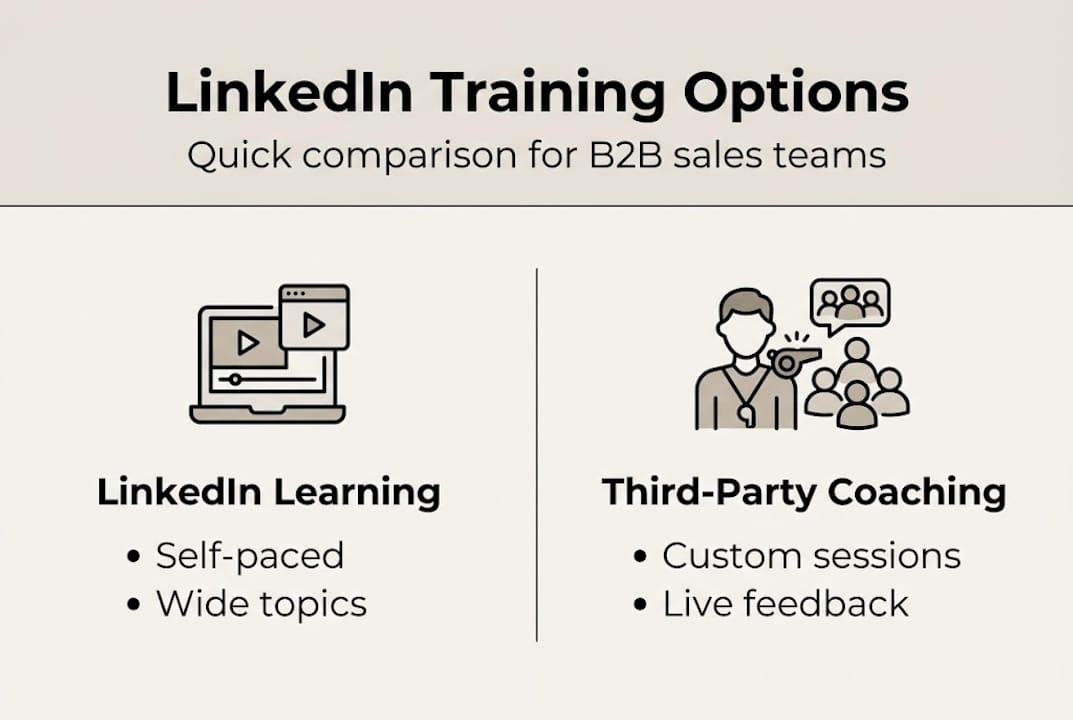
LinkedIn Learning is broad and scalable. It is cost-effective, especially for larger teams, and allows learners to progress at their own pace. But it is also generic by design. The modules are built for a global audience, which means they rarely address your specific product, your target market, or the nuances of how your buyers behave.
Third-party coaching providers, such as Luminetics or Flume, offer a very different experience. Sessions are tailored to your business, your sales cycle, and your team's current capability. The interaction is direct, feedback is immediate, and the strategies are custom-built. The trade-off is cost and time. External coaching requires a bigger investment, and you often need to schedule sessions around your team's availability.
Here is a side-by-side comparison to help you decide:
| Factor | LinkedIn Learning | Third-party coaching |
|---|---|---|
| Cost | Lower, subscription-based | Higher, project or session fees |
| Customisation | Generic content | Tailored to your business |
| Scalability | High, suitable for large teams | Lower, more intensive |
| Speed to results | Gradual, self-paced | Faster with direct application |
| Interaction | Solo learning | Live, interactive sessions |
For many small to medium-sized B2B businesses, a blended approach works best. Start with LinkedIn Learning to build baseline knowledge across the team, then bring in LinkedIn training for teams from an expert partner to accelerate results and apply learning directly to your pipeline.
"Personalised coaching unlocks unique growth for sales teams, but LinkedIn Learning remains the most scalable solution."
Ask yourself these questions before choosing:
- How large is your team? Larger teams benefit more from scalable platform training.
- How specific are your sales challenges? Complex or niche challenges need tailored coaching.
- What is your budget? Platform subscriptions are easier to justify at early stages.
- How quickly do you need results? External coaching accelerates outcomes when speed matters.
How to apply LinkedIn training for your B2B team: action plan and practical results
Having the right training in place is only half the work. Applying it consistently is where most teams fall short. Here is a straightforward action plan to roll out LinkedIn training effectively and start seeing measurable returns.
- Assess your team's current skill gaps. Before choosing any training, audit where your team struggles most. Is it profile quality, outreach messaging, or content creation? Pinpointing this shapes everything that follows.
- Select relevant LinkedIn Learning modules. LinkedIn Learning offers sales-specific courses covering solution-based selling, lead generation foundations, finding prospects, and AI-assisted marketing lead generation. Match modules to the gaps you identified.
- Build a realistic completion schedule. Assign modules with clear deadlines. Two to three short modules per week is manageable alongside full sales workloads.
- Pair learning with live practice. Use the step-by-step LinkedIn implementation framework to apply each lesson immediately. Send outreach messages using new techniques the same week you learn them.
- Track the right metrics. Measure profile views, connection acceptance rates, message reply rates, and meetings booked. Link these to specific training modules to see what is actually moving the needle.
- Review and iterate monthly. Hold a short team review each month. Share wins, spot patterns, and adjust the training focus based on live data.
For content-driven lead generation, pairing your training with a strong content strategy for lead generation significantly amplifies results. Posts and articles drive inbound interest, which your trained team can then convert.
Also consider how you build your LinkedIn network as part of the training rollout. A larger, more relevant network multiplies the reach of every skill your team develops.
Pro Tip: Incentivise your team to share completed LinkedIn Learning certificates on their profiles. It takes thirty seconds, boosts their personal credibility, and signals to potential buyers that your company invests in expertise.
Why most businesses underuse LinkedIn training—and what actually works
Here is something we see repeatedly. A business invests in a LinkedIn Learning subscription, assigns a handful of courses, and waits for leads to appear. They do not. The team completes the modules, ticks the box, and returns to the same habits. Sound familiar?
The problem is not the training content. It is the assumption that consuming information changes behaviour. It rarely does without structured application and regular review. Teams who consistently outperform on LinkedIn are not the ones with the most certificates. They are the ones who practise what they learn in real outreach, receive feedback on their messaging, and treat LinkedIn as an ongoing sales skill rather than a one-time project.
There is also a tendency to treat LinkedIn as a lead database rather than a relationship platform. Training helps you understand the mechanics, but the mindset shift is what drives actual pipeline growth. The businesses getting the best results are those embedding LinkedIn skills into their weekly sales rhythm, supported by LinkedIn marketing for growth strategies that keep the engine running long after the courses are done.
Schedule monthly team reviews. Make them short and specific. What did we try? What worked? What will we change? That habit, more than any single course, is what separates teams that grow from those that stagnate.
Get more from LinkedIn training with IN Social
LinkedIn training gives your team the knowledge. IN Social gives you the results.
At IN Social, we work with B2B sales teams who want to move beyond courses and start generating real pipeline. Whether you need expert-led LinkedIn lead generation services or fully managed LinkedIn support that handles the heavy lifting for you, we combine human expertise with advanced tools to deliver measurable outcomes. If your team has the knowledge but needs the strategy, structure, and accountability to turn training into revenue, we are ready to help you build it.
Frequently asked questions
What exactly is LinkedIn training for businesses?
LinkedIn training for businesses refers to structured courses and coaching that teach sales and marketing teams how to use LinkedIn's tools for lead generation and outreach. The LinkedIn Learning platform alone offers over 25,000 expert-led courses covering business, technology, and creative fields.
How does LinkedIn Learning differ from hiring an external LinkedIn coach?
LinkedIn Learning offers scalable, affordable courses that teams can complete at their own pace, while external coaching provides tailored, interactive support built around your specific sales challenges but at a higher cost. Platform training versus coaching each suit different team sizes, budgets, and speed-to-results requirements.
Can LinkedIn training really help generate B2B leads?
Yes. Sales-focused LinkedIn training improves how your team connects with prospects, crafts outreach messages, and delivers value through content. Courses covering AI-assisted lead generation are particularly effective for teams looking to modernise their prospecting approach.
Are LinkedIn Learning certificates valuable for companies?
Absolutely. When team members share completed certificates on their LinkedIn profiles, it builds credibility with prospects and demonstrates that your business invests in up-to-date sales expertise, which matters to B2B buyers assessing who to trust.