

TL;DR:
- A deliberate LinkedIn social selling strategy involves positioning content, relationship-building, and analytics.
- Success depends on consistent, long-term effort rather than quick tactics or viral posts.
- Building genuine relationships and trust over months yields higher-quality B2B leads than cold outreach.
Most B2B professionals treat LinkedIn like a digital business card. They update their job title, accept a few connection requests, and wonder why nothing happens. The reality is that LinkedIn is far more powerful than that. When you apply a deliberate social selling strategy, the platform becomes your most productive sales channel. LinkedIn is the leading B2B social platform for lead generation, and the businesses winning on it are not the loudest ones. They are the most strategic. This guide gives you the frameworks, tactics, and mindset shifts to build a LinkedIn social selling strategy that generates real, qualified leads.
Table of Contents
- What is a LinkedIn social selling strategy?
- Building the foundations: LinkedIn profile and network optimisation
- Content creation and engagement: driving value, building authority
- Social selling in action: outreach, nurturing, and conversion tactics
- What most guides miss about LinkedIn social selling
- Need expert help with LinkedIn social selling?
- Frequently asked questions
Key Takeaways
| Point | Details |
|---|---|
| Social selling defined | A LinkedIn social selling strategy means leveraging your profile, content, and relationships to drive qualified B2B leads. |
| Profile and network matter | A trusted profile and purposeful connections form the backbone of successful social selling. |
| Content builds authority | Posting useful, consistent content attracts prospects and demonstrates credibility in your industry. |
| Value over volume | Thoughtful, tailored messaging outperforms cold pitches in both response rates and conversions. |
| Patience pays off | True LinkedIn social selling success comes with long-term effort, not instant tactics. |
What is a LinkedIn social selling strategy?
Social selling on LinkedIn is not about blasting connection requests or posting motivational quotes. It is a structured approach to building relationships with the right people, at the right time, using content, conversation, and credibility as your primary tools.
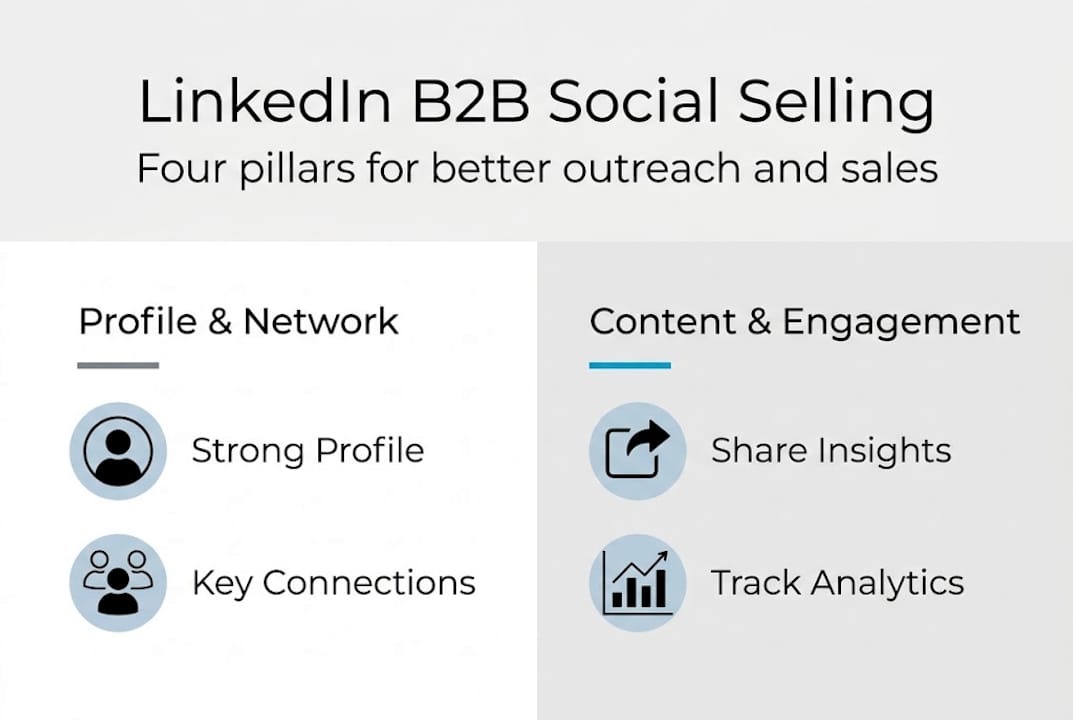
A LinkedIn social selling strategy brings together four core pillars:
- Positioning: How you show up on the platform and what you are known for
- Content: The insights, stories, and expertise you share to attract and educate prospects
- Relationship-building: Genuine, consistent engagement that moves people from strangers to warm contacts
- Analytics: Tracking what works so you can improve over time
This is fundamentally different from cold outreach. Cold outreach interrupts. Social selling invites. Instead of pitching to someone who has never heard of you, social selling warms prospects up gradually. By the time you reach out directly, they already recognise your name, respect your perspective, and are far more likely to respond.
Understanding why LinkedIn is effective for B2B helps clarify why this approach works so well. The platform's professional context means your content reaches people in a buying mindset, not a scrolling-for-entertainment mindset.
It is also distinct from pure content marketing. Content marketing focuses on publishing. Social selling focuses on relationships. You use content as a conversation starter, not just a broadcasting tool. The key LinkedIn sales benefits compound when you combine all four pillars consistently.
"Social selling is not a tactic. It is a discipline that rewards consistency, patience, and genuine interest in your prospects."
Your LinkedIn Social Selling Index (SSI) score measures how well you are executing across these pillars. It ranges from 0 to 100 and gives you a clear benchmark for improvement. Most professionals score below 50. The top performers in any industry tend to score above 70.
Building the foundations: LinkedIn profile and network optimisation
Your LinkedIn profile is your first impression, your credibility signal, and your conversion tool all at once. Before you post a single piece of content or send a single message, your profile needs to do serious work.
Here is a quick checklist to get the foundations right:
- Professional photo: Use a clear, recent headshot with good lighting. Profiles with photos receive significantly more profile views.
- Compelling headline: Do not just list your job title. State the value you deliver. "Helping B2B sales teams close more deals through LinkedIn" beats "Sales Director at XYZ Ltd" every time.
- Value-driven summary: Your About section should speak directly to your ideal client. What problem do you solve? What results do you deliver? Keep it conversational and specific.
- Featured section: Use this to showcase case studies, articles, or lead magnets that demonstrate your expertise.
- Recommendations: Three or more genuine recommendations build social proof and credibility instantly.
Once your profile is strong, focus on your network. Quality matters more than quantity here. A network of 500 highly relevant contacts will outperform a network of 5,000 random connections every time. Building a high-value LinkedIn network is one of the most impactful investments you can make in your social selling results.
A well-built network increases B2B sales success because warm introductions and mutual connections dramatically increase response rates when you do reach out.

When connecting with prospects, always personalise your request. Reference something specific: a post they shared, a mutual connection, or a challenge relevant to their industry. Generic requests get ignored.
Pro Tip: Use LinkedIn's search filters to identify prospects by job title, industry, company size, and location. This precision targeting means every connection request you send is going to someone who could genuinely benefit from what you offer. Combine this with networking for sales best practices to accelerate your pipeline.
Content creation and engagement: driving value, building authority
Content is the engine of your LinkedIn social selling strategy. It is how you stay visible, demonstrate expertise, and give prospects a reason to engage with you before you ever send a direct message.
The types of content that generate the most B2B traction on LinkedIn include:
- Short-form posts: Insights, lessons, and observations from your industry. These drive the most reach.
- Long-form articles: Deeper expertise pieces that position you as a thought leader.
- Video: Particularly effective for personal connection and explaining complex ideas quickly.
- Polls: Great for sparking engagement and gathering market intelligence.
- Events and newsletters: Ideal for building a consistent, subscribed audience.
Consistent, relevant content can triple B2B engagement rates compared to sporadic posting. That statistic should change how you think about your posting schedule. Consistency is not optional. It is the mechanism.
Here is a simple content performance overview to guide your planning:
| Content type | Reach potential | Lead generation value | Effort level |
|---|---|---|---|
| Short-form post | High | Medium | Low |
| Long-form article | Medium | High | Medium |
| Video | High | High | Medium |
| Poll | High | Low | Low |
| Newsletter | Low | Very high | High |
Aim to post at least three times per week. Mix content types to keep your feed fresh and reach different segments of your audience. Follow LinkedIn content best practices to structure each post for maximum engagement.
Engagement is just as important as publishing. Comment meaningfully on posts from your target prospects. Share content with added context. Reply to every comment on your own posts. These micro-interactions build familiarity fast. Boosting LinkedIn engagement through genuine dialogue signals to the algorithm that your content is worth distributing further.
Track your performance using LinkedIn's native analytics. Monitor impressions, engagement rate, and profile visits. When a post performs well, analyse why and replicate the format. LinkedIn's B2B marketing blog offers platform-specific data to help you benchmark your results. Also explore resources on creating B2B LinkedIn content that converts attention into conversations.
Social selling in action: outreach, nurturing, and conversion tactics
Once your profile is optimised and your content is building authority, it is time to move prospects forward. This is where social selling separates itself most clearly from traditional methods.
| Cold outreach | Social selling | |
|---|---|---|
| First impression | Unknown sender | Familiar name |
| Response rate | Low (under 10%) | Significantly higher |
| Trust level | Zero | Already established |
| Conversation quality | Transactional | Relationship-driven |
| Time to conversion | Long | Shorter |
Non-cold outreach methods result in higher conversion rates for B2B sales because the groundwork has already been laid. When you reach out to someone who has seen your content, engaged with your posts, or shares mutual connections, the conversation starts from a position of trust.
Here is a practical outreach sequence that works:
- Engage first: Comment on their posts or react to their content for two to three weeks before connecting.
- Connect with context: Send a personalised connection request referencing something specific and relevant.
- Open with value: Your first message should offer something useful, not pitch your services immediately.
- Nurture with content: Share a relevant article, case study, or insight tailored to their challenges.
- Identify conversion signals: Watch for replies, questions about your work, or requests for more information. These are your green lights.
- Move to conversation: Suggest a short call only when there is clear mutual interest.
Personalisation at scale is possible. Use templates as a starting point, then customise the key details for each prospect. Voice notes and short video messages are increasingly effective because so few people use them. They stand out immediately.
Pro Tip: Keep a simple CRM or spreadsheet to track where each prospect is in your nurturing sequence. This prevents you from following up too soon or letting warm leads go cold. Explore a step-by-step LinkedIn sales framework and a growth strategy for LinkedIn leads to systematise this process.
What most guides miss about LinkedIn social selling
Here is the uncomfortable truth most LinkedIn guides will not tell you: the tactics matter far less than the timeline.
Every week, we see businesses invest in a polished profile, post consistently for three weeks, send a handful of thoughtful messages, and then conclude that social selling does not work. It does work. It just does not work in three weeks.
The professionals generating consistent pipeline from LinkedIn are not doing anything dramatically different from what you have read in this guide. They are simply doing it longer. They have been showing up, refining their message, and building genuine relationships for six, twelve, or eighteen months.
Shortcuts attract attention but rarely deliver high-value leads. Viral posts feel exciting, but the leads that convert tend to come from quiet, consistent relationship-building over time. The person who comments thoughtfully on your posts every week is worth more than a thousand impressions from a trending post.
A strategic growth approach on LinkedIn requires you to measure progress in months, not days. Adjust your expectations, commit to the process, and the results will follow.
Need expert help with LinkedIn social selling?
If this guide has given you a clear picture of what LinkedIn social selling involves, you may also be wondering how to execute it consistently alongside everything else on your plate.
At IN Social, we help B2B businesses build and run LinkedIn strategies that generate qualified leads without relying on cold outreach. Whether you want a fully managed LinkedIn service that handles everything for you, or a proven framework for lead generation without cold outreach, we have the expertise and tools to make it happen. Get in touch to find out how we can turn your LinkedIn presence into a consistent source of sales conversations.
Frequently asked questions
What is the LinkedIn Social Selling Index (SSI) and why does it matter?
The LinkedIn SSI measures how effectively you are establishing your brand, finding the right prospects, and building meaningful relationships on the platform. A higher score indicates stronger social selling performance and correlates with better pipeline results.
How often should I post content on LinkedIn for best results?
Aim for at least two to three posts per week to maintain visibility and stay front of mind with your target audience. Consistent posting is directly linked with greater B2B engagement and profile growth.
Does social selling work better than cold outreach for B2B sales?
Yes. Warm, value-driven outreach consistently achieves higher response rates and deeper trust than cold outreach, because prospects already recognise you before the first direct message.
Can small businesses benefit from a LinkedIn social selling strategy?
Absolutely. LinkedIn offers scalable tools that work for teams of any size, and B2B lead generation at small to medium firms is one of the areas where a focused social selling strategy delivers the most proportional impact.