
TL;DR:
- A LinkedIn sales funnel is a structured process moving prospects from awareness to loyalty.
- Inbound strategies outperform outbound cold outreach, closing at eight to nine times higher rates.
- Effective funnels rely on authentic content, targeted networking, and personalized engagement over automation.
Most B2B professionals assume LinkedIn success means sending hundreds of connection requests and hoping someone replies. It does not. A LinkedIn sales funnel is a structured, repeatable process that moves the right prospects from first impression to signed contract, without spamming your network. Inbound strategies close at eight to nine times the rate of outbound cold outreach. That stat alone should reframe how you think about LinkedIn. This guide is for B2B sales and marketing professionals at small to medium-sized businesses who want a practical, proven framework for building a LinkedIn funnel that actually generates revenue.
Table of Contents
- What is a LinkedIn sales funnel?
- Why LinkedIn sales funnels outperform traditional methods
- Key components of an effective LinkedIn sales funnel
- Common pitfalls and how to avoid them
- Why most LinkedIn funnels fail—and what actually works
- Ready to build your LinkedIn sales funnel?
- Frequently asked questions
Key Takeaways
| Point | Details |
|---|---|
| Value-first approach | Building authority and trust outperforms cold, automated outreach on LinkedIn. |
| Structured funnel stages | A successful LinkedIn sales funnel moves leads from awareness to conversion with content and engagement. |
| Common pitfalls to avoid | Avoid over-automation, generic messaging, and neglecting relationship nurturing for best results. |
| Faster, warmer sales cycles | Inbound LinkedIn funnels shorten sales cycles compared to traditional outbound methods. |
What is a LinkedIn sales funnel?
A sales funnel is a model that maps the journey a prospect takes from first hearing about you to becoming a paying client. When you adapt that model to LinkedIn, the platform's unique features, such as content, connections, messaging, and events, become the tools that move people through each stage.
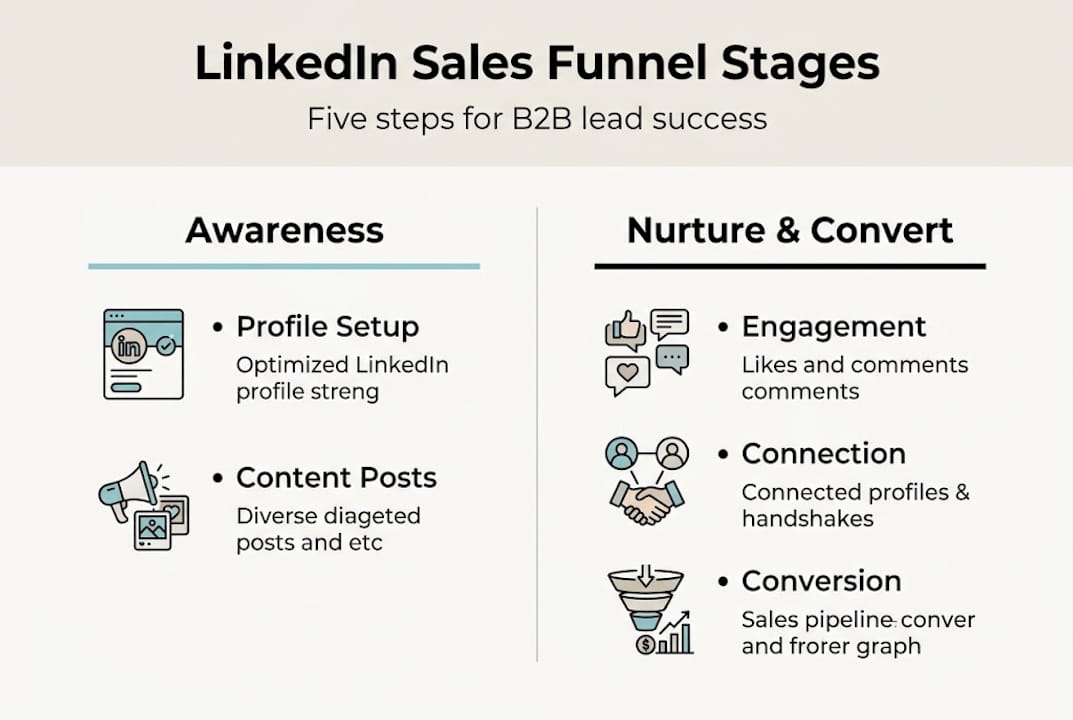
A LinkedIn sales funnel typically moves through five stages:
- Awareness: Your target audience discovers you through posts, comments, or shared content.
- Engagement: They interact with your content, visit your profile, or accept a connection request.
- Nurture: You build the relationship through valuable content, personalised messages, and meaningful conversations.
- Conversion: The prospect agrees to a call, a demo, or a proposal.
- Loyalty: A satisfied client refers others or returns for more services.
Each stage requires a different action from you. Awareness demands consistent, visible content. Nurture demands patience and genuine interest in the other person's challenges. Conversion demands a clear, low-friction ask. Many B2B teams skip straight to conversion and wonder why nobody responds.
The contrast between a traditional sales funnel and a LinkedIn funnel is significant. Here is how they compare:
| Element | Traditional funnel | LinkedIn funnel |
|---|---|---|
| Primary channel | Cold calls, email blasts | Content, connections, DMs |
| Lead quality | Often unqualified | Pre-warmed, researched |
| Trust-building | Slow, adversarial | Faster, relationship-led |
| Close rate | Lower, outbound-driven | Up to 8-9x higher |
| Sales cycle | 2 to 6 months | Often 1 to 3 months |
When you commit to building your LinkedIn network with intention, rather than spraying messages at strangers, the entire funnel becomes more efficient. A well-defined growth strategy for B2B leads puts structure behind your daily LinkedIn activity, so every post and every connection serves a clear purpose.
Why LinkedIn sales funnels outperform traditional methods
The numbers speak clearly. Cold outbound tactics, whether calls, emails, or generic LinkedIn messages, produce thin results compared to an inbound, authority-led approach. Inbound strategies close at eight to nine times the rate of cold outbound, with sales cycles running one to three months rather than two to six. That is not a marginal difference. That is a structural advantage.
The reason is straightforward. By the time a well-nurtured LinkedIn lead agrees to a call, they already know what you do, respect your point of view, and have self-selected as interested. You are not persuading a cold stranger. You are having a conversation with someone who has already done some of the convincing themselves.
The uncomfortable truth about cold messaging: Sending 500 generic InMails does not make you proactive. It makes you noise. Every unremarkable message you send trains your target market to ignore you.
Generic automation is one of the biggest traps in LinkedIn lead generation. Tools that send bulk connection requests, templated follow-ups, and robotic responses might feel efficient, but they corrode trust at scale. LinkedIn actively limits accounts that exhibit spammy behaviour, and your prospects notice. One poorly worded automated message can undo months of content-building.
The approach that consistently delivers results for driving B2B sales outcomes combines three things: visible authority through content, genuine relationship-building through selective networking, and smart use of LinkedIn's native features such as Sales Navigator and events.
What value-first actions actually look like:
- Sharing a short post that solves a common problem your ideal client faces
- Commenting thoughtfully on a prospect's post before sending a connection request
- Attending or hosting a LinkedIn event to meet warm contacts in context
- Sending a personalised message that references something specific about the person
Pro Tip: Before you send any outreach message, ask yourself: "Would I find this message valuable if I received it?" If the honest answer is no, rewrite it.
These actions build the credibility that makes conversion feel natural rather than forced. If you want to generate LinkedIn leads effectively in 2026, value-first is not optional. It is the foundation.

Key components of an effective LinkedIn sales funnel
Knowing why value-first funnels work gives you the mindset. Now you need the mechanics. Here are the core components that make a LinkedIn sales funnel function in practice.
1. An optimised LinkedIn profile Your profile is your landing page. It must communicate who you help, how you help them, and what results you deliver, within the first three lines of your summary. Use a professional photo, a clear headline that speaks to your client's outcome, and a featured section that showcases social proof or key content.
2. A targeted connection strategy Connect with purpose. Use LinkedIn's search filters or Sales Navigator to identify prospects by industry, role, and company size. Send personalised connection requests that reference a shared interest or a piece of their content. Never lead with a pitch.
3. A consistent content strategy Content is the engine of your awareness stage. Aim to post material that educates, challenges assumptions, or shares a relevant experience. Your LinkedIn B2B sales guide should include a content calendar, so posting becomes a system rather than a scramble.
4. Engagement-led nurturing Once someone is in your network, nurture the relationship before making any ask. Comment on their posts. React to their updates. Share something relevant to their specific situation. This is where most B2B funnels stall, because teams forget to stay present.
5. A clear conversion pathway Know exactly what action you want a nurtured lead to take next. Is it booking a discovery call? Downloading a resource? Visiting your website? Make the ask simple, direct, and low-pressure. The right posting frequency for lead generation keeps you visible long enough for leads to feel ready.
Pro Tip: Map your funnel on paper before you start. Know which content type serves awareness, which messages serve nurture, and what your conversion ask looks like. Clarity in the plan saves weeks of confusion in execution.
Quick-reference funnel checklist:
- Profile optimised for your target client
- Targeted connection list built using filters or Navigator
- Weekly content plan in place
- Nurture sequence defined for new connections
- Conversion action clearly identified
Common pitfalls and how to avoid them
Even with a solid plan, LinkedIn funnels fail when certain mistakes go unchecked. Recognising these patterns early saves you time, reputation, and pipeline.
Spray-and-pray outreach Sending mass connection requests with copy-paste messages is the fastest way to get ignored and flagged. Cold spray-and-pray tactics produce low engagement and signal to LinkedIn's algorithm that your account may be behaving like a bot. Focus your energy on fewer, better-targeted outreach messages.
Neglecting the nurture stage Many B2B teams connect with a prospect, send one follow-up, and then disappear. Relationships are not built in a single exchange. If you are not consistently showing up with valuable content and genuine engagement, your leads will forget you exist.
Over-relying on automation Automation tools can support research and scheduling, but they should never replace authentic human interaction. Over-automation risks account restrictions and destroys the personal touch that LinkedIn relationships depend on.
Failing to track results If you are not measuring your funnel, you are guessing. Track connection acceptance rates, content engagement, message reply rates, and the number of conversations that move to calls. Without data, you cannot improve.
Pro Tip: Set a monthly review date to audit your funnel metrics. Even 30 minutes of analysis each month can reveal which part of your funnel is leaking leads.
Common pitfall summary:
- Generic mass outreach with no personalisation
- Skipping the nurture stage and jumping to the pitch
- Relying on automation for human-led conversations
- No measurement or tracking in place
- Inconsistent content, making you invisible between outreach attempts
Understanding the types of LinkedIn lead generation available to you helps you choose the right combination for your audience. A winning LinkedIn pipeline is built on consistent habits, not one-off campaigns.
Why most LinkedIn funnels fail—and what actually works
Here is something most guides will not tell you: the majority of LinkedIn sales funnels fail not because of strategy, but because of patience. Businesses invest two weeks, see limited results, and conclude that LinkedIn does not work. In reality, they abandoned the process before trust had time to compound.
We see this repeatedly. A business sets up a profile, posts three times, sends twenty connection requests, and expects pipeline. When it does not arrive, they blame the platform. But LinkedIn is a long game built on visibility and credibility, not volume and speed.
The organic, value-first approach, combined with Sales Navigator and LinkedIn events, consistently outperforms automated, transactional methods. The businesses that win on LinkedIn treat it like relationship management, not a broadcasting channel.
You need to build your network for B2B sales as if every connection is a person, not a target. When that mindset takes hold, conversion becomes a natural next step rather than a forced outcome. Structured process plus authentic engagement. That is what actually works.
Ready to build your LinkedIn sales funnel?
If this framework resonates but you are not sure where to begin, or you want to accelerate the results you are already seeing, expert support makes a measurable difference.
At IN Social, we specialise in building value-first LinkedIn lead generation systems for B2B businesses. From profile optimisation and content strategy to personalised outreach and pipeline tracking, our LinkedIn lead generation service is built around your goals. No cold spam. No guesswork. Just a proven process that generates qualified conversations. Explore our full range of LinkedIn and sales services or book a consultation to see how we can build your funnel together.
Frequently asked questions
How is a LinkedIn sales funnel different from a traditional sales funnel?
A LinkedIn sales funnel uses the platform's networking and content features to move leads organically from awareness to conversion, rather than relying on cold calls or outbound channels. The result is warmer leads and faster decisions.
Can I automate my LinkedIn sales funnel?
Full automation risks account restrictions and erodes trust. Organic engagement over automation is the recommended approach, using tools only for research or scheduling while keeping conversations human.
How long does it take to see results from a LinkedIn sales funnel?
Inbound LinkedIn leads typically close within 1 to 3 months, significantly faster than outbound cold outreach, which can take two to six months to convert.
What are the signs my LinkedIn funnel is not working?
If connections are not engaging with your content, conversations stall after the first message, or few leads progress toward a call, your outreach or content needs refining.