

LinkedIn is used by 95% of recruiters worldwide, yet many recruitment professionals barely scratch the surface of its strategic potential. For small to medium-sized B2B companies, posting job adverts alone won't deliver the quality hires you need. This guide reveals how to leverage LinkedIn's advanced sourcing tools, employer branding capabilities, and data-driven insights to transform your talent acquisition outcomes and build sustainable recruitment pipelines.
Table of Contents
- Understanding LinkedIn's role in modern recruitment
- Leveraging LinkedIn for employer branding in SMBs
- Advanced talent sourcing strategies on LinkedIn
- Common misconceptions about LinkedIn recruitment
- Data-driven metrics to measure LinkedIn recruitment success
- Implementing LinkedIn recruitment: practical steps for SMBs
- How IN Social supports LinkedIn recruitment for SMB B2B companies
Key takeaways
| Point | Details |
|---|---|
| LinkedIn outperforms traditional job boards | Hires sourced via LinkedIn show 40% better retention rates compared to conventional recruitment channels. |
| Employer branding slashes recruitment costs | Strong LinkedIn branding reduces cost-per-hire by up to 50% whilst attracting higher-quality candidates organically. |
| Advanced tools accelerate hiring workflows | Boolean search, AI filters, and Recruiter Premium cut sourcing time by 40% and improve targeting precision. |
| Data-driven metrics enable continuous optimisation | Real-time analytics help track applicant quality, time-to-fill, and source effectiveness for iterative strategy improvements. |
| Common misconceptions limit effectiveness | Many SMB recruiters underutilise LinkedIn's full capabilities, missing passive talent pools and premium features. |
Understanding LinkedIn's role in modern recruitment
LinkedIn has fundamentally transformed how recruitment professionals identify, engage, and secure top talent. The platform's dominance isn't accidental. It combines sophisticated sourcing algorithms, robust employer branding opportunities, and detailed candidate insights in ways traditional job boards simply cannot match.
For B2B SMBs, LinkedIn's integrated ecosystem addresses specific recruitment challenges you face daily. Unlike posting on generic job sites where applications flood in from mismatched candidates, LinkedIn enables targeted outreach to both active job seekers and passive candidates who aren't actively looking but might be open to the right opportunity. This dual approach dramatically expands your talent pool whilst maintaining quality standards.
The platform's network effects create unique advantages. When you engage authentically on LinkedIn through thought leadership content and community participation, you build visibility that attracts candidates before positions even open. This proactive talent pipeline development is exactly why LinkedIn drives 25% more B2B leads compared to other professional networks.
Key advantages LinkedIn offers recruitment professionals include:
- Access to over 900 million professionals globally, with detailed profile data enabling precise candidate matching
- Integrated messaging and InMail tools for direct, personalised candidate outreach that bypasses gatekeepers
- Company pages and content sharing that showcase your employer brand continuously to potential candidates
- Advanced search filters and Boolean operators that narrow candidate pools to exact specifications within minutes
- Analytics dashboards providing real-time recruitment performance metrics to optimise strategies iteratively
Understanding LinkedIn business development B2B impact helps contextualise recruitment within broader organisational goals. Following LinkedIn content best practices ensures your recruitment messaging resonates with target candidates effectively.
Leveraging LinkedIn for employer branding in SMBs
Your employer brand on LinkedIn directly influences both the quantity and quality of candidates who apply to your roles. Strong branding acts as a magnet, drawing qualified professionals towards your organisation whilst simultaneously filtering out poor fits. For resource-constrained SMBs, this organic filtering reduces cost-per-hire by up to 50% compared to traditional recruitment advertising.

Consistent content sharing positions your company as an attractive workplace. When you publish insights about your industry, showcase employee achievements, or share behind-the-scenes glimpses of your culture, passive candidates begin following your organisation. These followers form talent pools you can tap when positions open, significantly reducing time-to-fill.
Employee advocacy amplifies your reach exponentially. When team members share company updates or thought leadership pieces with their networks, your employer brand gains credibility through trusted personal connections. This grassroots approach costs nothing but creates authentic touchpoints with potential candidates who value peer recommendations over corporate messaging.
Effective employer branding strategies for SMBs include:
- Publishing weekly content that highlights your company values, team culture, and industry expertise consistently
- Encouraging employees to optimise their profiles and mention their association with your company prominently
- Participating actively in relevant LinkedIn groups where your ideal candidates spend time and share insights
- Showcasing employee testimonials and career progression stories that demonstrate growth opportunities within your organisation
- Responding promptly and professionally to all comments and messages to reinforce your commitment to engagement
Pro Tip: Create a simple content calendar alternating between educational industry posts, company culture highlights, and employee spotlights. This variety keeps your feed engaging whilst consistently reinforcing your employer brand without overwhelming your marketing resources.
Implementing LinkedIn content best practices ensures your branding efforts translate into measurable recruitment outcomes. Passive talent pools assist 70% of SMB recruiters in filling roles faster when nurtured through consistent employer branding activities.
Advanced talent sourcing strategies on LinkedIn
LinkedIn's search capabilities extend far beyond basic keyword matching. Mastering Boolean operators and AI-powered filters transforms sourcing from a time-consuming manual process into a precise, efficient workflow. Boolean and AI filters cut sourcing time by 40% by enabling you to construct complex search queries that surface exactly the candidate profiles you need.
Recruiter Lite and Premium subscriptions unlock additional targeting precision. These tools provide expanded search filters, unlimited profile views, and enhanced InMail credits for direct candidate outreach. The investment pays dividends quickly. Premium tools improve targeting precision and ROI by 35% through features like saved searches, talent pipeline management, and competitor intelligence.
Personalised outreach dramatically improves response rates. Generic connection requests and templated messages get ignored. Crafting brief, specific messages that reference a candidate's recent post, shared connection, or relevant experience shows genuine interest and respect for their time. This personalisation signals you're not mass-spamming but genuinely interested in their unique qualifications.
Advanced sourcing tactics that deliver results include:
- Combining Boolean operators like AND, OR, NOT with LinkedIn's native filters to create hyper-targeted candidate searches
- Saving high-performing search queries and setting up alerts for new profiles matching your criteria automatically
- Using LinkedIn's "Open to Work" and "Open to Opportunities" signals to prioritise candidates actively seeking new roles
- Reviewing mutual connections and requesting warm introductions to strengthen initial candidate outreach credibility
- Tracking candidate engagement with your content to identify those already familiar with your company before outreach
| LinkedIn tool | Time savings | Quality improvement | Best for |
|---|---|---|---|
| Boolean search | 30-40% faster sourcing | High precision targeting | Niche technical roles |
| Recruiter Lite | 25% reduction in time-to-fill | 20% better candidate fit | SMBs hiring 5-15 roles yearly |
| Recruiter Premium | 40% faster pipeline building | 35% improved offer acceptance | High-volume or competitive hiring |
| AI recommendations | 50% less manual screening | 25% higher quality shortlists | Roles with clear skill requirements |
Pro Tip: Start each sourcing session by reviewing profiles of your best recent hires. Note common skills, previous employers, and career progression patterns. Use these insights to refine your search criteria and messaging for similar high-quality candidates.
Understanding LinkedIn management explained helps integrate these sourcing strategies into your broader recruitment workflows. Leveraging LinkedIn lead generation insights ensures your sourcing aligns with organisational growth objectives.
Common misconceptions about LinkedIn recruitment
Many SMB recruiters hold outdated beliefs about LinkedIn that severely limit their recruitment effectiveness. Recognising and correcting these misconceptions unlocks the platform's full potential for your talent acquisition efforts.
The biggest myth is that posting job adverts alone suffices. Passive job posting generates applications, but rarely from the passive candidates who represent the best talent. Top performers typically aren't actively browsing job boards. They're engaged in their current roles, visible on LinkedIn through their activity and profiles, but require direct, personalised outreach to consider new opportunities.
Another common error is assuming LinkedIn recruitment only works for large enterprises with substantial budgets. SMBs actually benefit more from LinkedIn's targeting precision because you need specific skill sets and cultural fits, not volume. Free LinkedIn features combined with strategic employer branding deliver significant results before any premium investment becomes necessary.
Some recruiters believe premium tools don't justify their cost. This perception stems from underutilising available features rather than actual tool limitations. When you actively use saved searches, pipeline management, and InMail strategically, premium subscriptions typically pay for themselves within the first quality hire by reducing time-to-fill and lowering overall recruitment costs.
Misconceptions that undermine LinkedIn recruitment success include:
- Treating LinkedIn purely as a job board rather than a comprehensive talent engagement platform
- Neglecting employer branding efforts because results aren't immediately measurable in application numbers
- Avoiding premium features due to cost concerns without calculating time savings and quality improvements
- Assuming candidates will find your jobs organically without proactive sourcing and outreach initiatives
- Overlooking the importance of profile optimisation and content activity in attracting passive candidate interest
Correcting these misconceptions through education and strategic experimentation transforms LinkedIn from a supplementary recruitment channel into your primary talent acquisition engine. Following LinkedIn content best practices ensures your approach remains grounded in proven methodologies rather than assumptions.
Data-driven metrics to measure LinkedIn recruitment success
Without clear metrics, you're recruiting blind. LinkedIn's analytics dashboards provide real-time visibility into what's working and what needs adjustment in your recruitment strategies. Tracking the right KPIs enables continuous optimisation that compounds recruitment effectiveness over time.
Applicant quality metrics matter more than volume. Monitor the percentage of LinkedIn-sourced candidates who progress through each hiring stage compared to other sources. If LinkedIn candidates advance further or receive offers at higher rates, that signals superior targeting and sourcing effectiveness worth expanding.
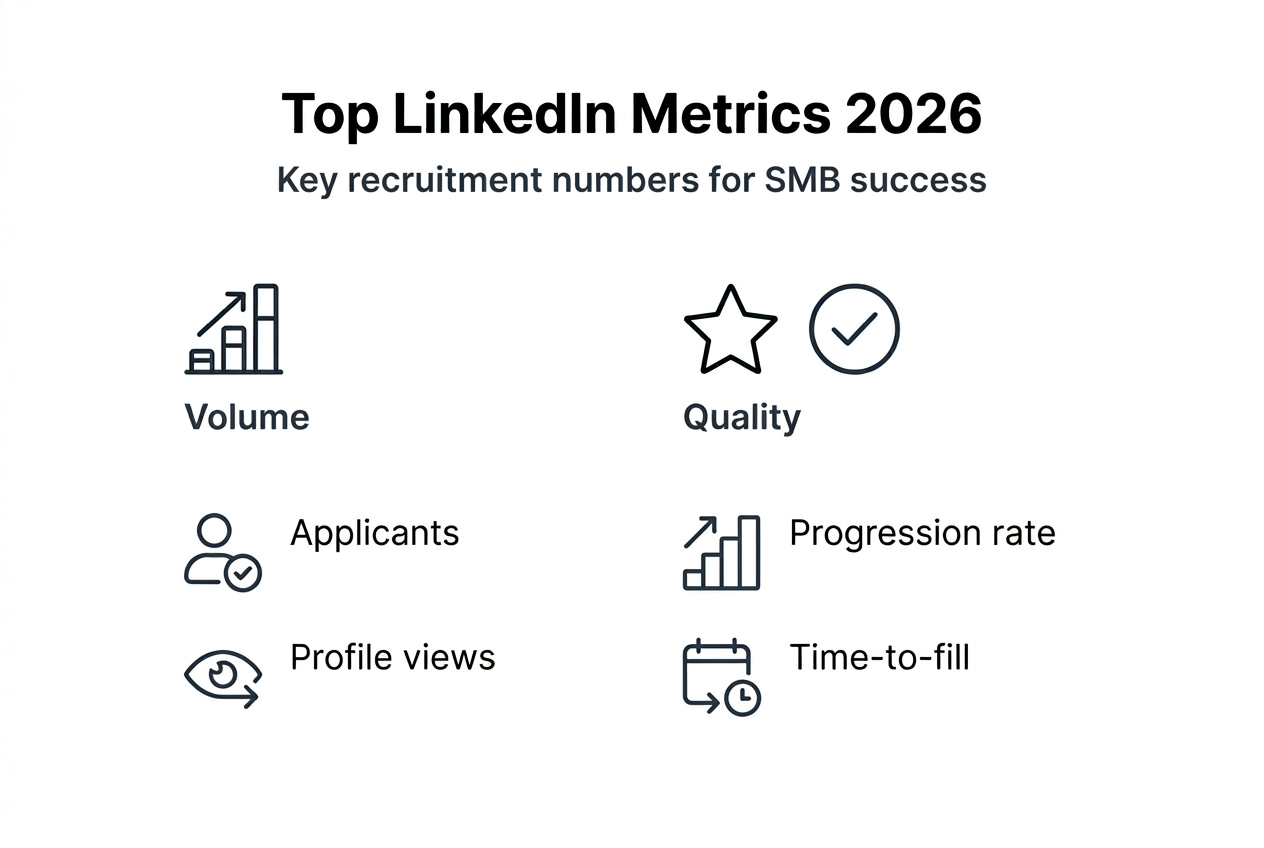
Time-to-fill directly impacts business operations. Track how quickly LinkedIn-sourced candidates move from initial contact to offer acceptance. Faster hiring cycles reduce productivity gaps and lower costs associated with prolonged vacancies. LinkedIn's pipeline management tools help visualise bottlenecks so you can address delays systematically.
Source effectiveness analysis reveals which LinkedIn activities generate the best candidates. Compare results from job postings, direct sourcing, employee referrals via LinkedIn, and content-driven applications. Allocate more resources to high-performing channels whilst refining or eliminating underperforming tactics.
Steps to interpret and apply LinkedIn recruitment metrics effectively:
- Establish baseline metrics for your current recruitment performance across all sources before implementing new LinkedIn strategies.
- Set specific, measurable goals for LinkedIn recruitment such as reducing time-to-fill by 20% or improving offer acceptance rates by 15%.
- Review LinkedIn analytics dashboards weekly to track progress towards goals and identify emerging trends or anomalies early.
- Conduct monthly deep-dive analysis comparing LinkedIn performance against other recruitment channels and historical benchmarks.
- Adjust sourcing tactics, messaging templates, and employer branding content based on data insights rather than assumptions or anecdotes.
| Metric | Definition | Target range for SMBs | How to track |
|---|---|---|---|
| Source quality rate | Percentage of LinkedIn candidates reaching final interview stage | 35-50% | Compare stage progression by source in ATS |
| Time-to-fill | Days from job posting to offer acceptance for LinkedIn-sourced hires | 25-35 days | Track date stamps in recruitment workflow |
| InMail response rate | Percentage of InMail messages receiving candidate replies | 20-30% | Monitor via LinkedIn Recruiter dashboard |
| Cost-per-hire | Total LinkedIn investment divided by number of hires from platform | £800-£1,500 | Calculate subscription costs plus time investment |
| Offer acceptance rate | Percentage of offers accepted by LinkedIn-sourced candidates | 75-85% | Track final hiring outcomes by source |
Understanding LinkedIn analytics for B2B success provides broader context for interpreting recruitment-specific metrics within your overall LinkedIn strategy and organisational objectives.
Implementing LinkedIn recruitment: practical steps for SMBs
Transforming LinkedIn recruitment insights into tangible results requires a structured implementation approach. Follow these sequential steps to build sustainable LinkedIn recruitment capabilities within your SMB.
Step 1: Optimise your company LinkedIn profile to reflect your authentic employer brand. Update your company description to highlight culture, values, and what makes your workplace unique. Add high-quality visuals, showcase recent achievements, and ensure all information remains current. Your company page serves as the first impression for candidates researching your organisation.
Step 2: Develop a consistent content calendar focused on engaging potential candidates before positions open. Plan weekly posts mixing industry insights, employee stories, and company updates. Consistency builds familiarity and trust, making future recruitment outreach more effective because candidates already recognise and respect your organisation.
Step 3: Master LinkedIn's advanced search capabilities and consider Recruiter tools based on your hiring volume. Start with Boolean searches using free LinkedIn features. As you identify patterns in successful hires, invest in Recruiter Lite or Premium to access enhanced targeting and pipeline management that scales your efforts efficiently.
Step 4: Craft personalised outreach messages that demonstrate genuine interest in each candidate's unique background. Reference specific accomplishments from their profile, explain why you're reaching out to them specifically, and clearly articulate the opportunity's value proposition. Personalisation transforms cold outreach into warm conversations.
Step 5: Establish a rhythm of monitoring recruitment KPIs through LinkedIn analytics and adjusting strategies responsively. Set monthly review sessions to assess what's working, identify improvement opportunities, and experiment with new approaches. Continuous iteration based on data ensures your LinkedIn recruitment effectiveness compounds over time.
Practical implementation steps:
- Audit your current company LinkedIn presence and identify three immediate improvement opportunities within your first week.
- Create a basic content calendar with at least one post per week for the next month, assigning clear ownership for content creation.
- Conduct three trial Boolean searches for your most common role types and save the most effective queries for ongoing use.
- Draft and test three different InMail templates with small candidate samples, measuring response rates to identify top performers.
- Schedule monthly 60-minute analytics review sessions to track progress, celebrate wins, and course-correct underperforming tactics.
Pro Tip: Don't attempt to implement all premium features simultaneously. Start with free tools and basic employer branding, then add one new capability monthly as you master each element. This incremental approach prevents overwhelm whilst building sustainable recruitment competencies.
Learning how to generate LinkedIn leads effectively provides transferable skills applicable to recruitment outreach. Understanding LinkedIn management explained helps contextualise recruitment activities within broader LinkedIn strategies.
How IN Social supports LinkedIn recruitment for SMB B2B companies
Implementing these LinkedIn recruitment strategies requires expertise, time, and ongoing optimisation. IN Social specialises in helping SMB B2B companies maximise their LinkedIn recruitment outcomes through tailored support that addresses your specific hiring challenges and resource constraints.
Our recruitment services include company profile optimisation, employer branding content strategies, advanced sourcing training, and analytics integration that transforms LinkedIn into your primary talent acquisition channel. We combine human recruitment expertise with AI-powered tools to identify ideal candidates faster whilst reducing your cost-per-hire substantially.
Whether you need help establishing your initial LinkedIn recruitment presence or optimising existing strategies for better results, IN Social's proven methodologies deliver measurable improvements in hire quality, time-to-fill, and recruitment ROI. Explore our comprehensive services or visit our homepage to discover how we empower recruitment teams to attract better candidates whilst saving valuable time.
FAQ
How can small to medium businesses measure the success of LinkedIn recruitment?
Use LinkedIn's analytics dashboards to track KPIs such as time-to-fill, applicant quality, source effectiveness, and InMail response rates. Regularly review these metrics and adjust recruitment strategies based on data insights rather than assumptions.
What are the best LinkedIn features for sourcing candidates effectively?
Utilise Boolean and AI-based search filters, LinkedIn Recruiter Premium, saved searches with alerts, and personalised InMail messaging for efficient, targeted sourcing. These features significantly reduce sourcing time whilst improving candidate quality and response rates.
How important is employer branding on LinkedIn for recruitment?
Strong employer branding reduces cost-per-hire by up to 50% and attracts more qualified candidates organically before positions even open. It builds long-term passive talent pipelines that continuously feed your recruitment funnel beyond active job postings.
Can small businesses use LinkedIn recruitment strategies without premium tools?
Yes, SMBs can start with free LinkedIn features including basic search, company page optimisation, and organic content sharing to build employer brand. Gradually adopt premium tools like Recruiter Lite based on hiring volume and budget to maximise ROI as recruitment needs scale.