

Most business owners think LinkedIn is just for networking. They scroll through updates, connect with peers, and maybe share the odd company milestone. But here's what they're missing: LinkedIn is one of the most powerful recruiting tools available to small and medium-sized businesses. Unlike traditional job boards that cast wide nets and hope for the best, LinkedIn recruiting combines public profile data, active outreach, and employer branding to simplify talent acquisition. For B2B companies competing for specialist skills, this platform offers precision, speed, and cost efficiency that agencies and job boards struggle to match. This article breaks down what LinkedIn recruiting actually is, how it works, and how your business can use it to attract top talent without burning through your budget.
Table of Contents
- What is LinkedIn recruiting?
- How LinkedIn recruiting works: Tools, steps, and workflows
- LinkedIn recruiting versus traditional hiring methods
- Best practices for successful LinkedIn recruiting
- Measuring success and improving your LinkedIn recruitment
- How IN Social can elevate your LinkedIn recruitment strategy
- Frequently asked questions
Key Takeaways
| Point | Details |
|---|---|
| Targeted candidate search | LinkedIn lets SMBs directly approach and engage highly relevant professionals for open roles. |
| Cost-effective and efficient | Recruiters can fill positions faster and often at a lower cost than traditional agencies. |
| Brand authority boost | A strong company page and content help attract talent and build trust with candidates. |
| Metrics-driven improvement | LinkedIn's analytics make it easy to assess and refine your hiring strategy for better results. |
What is LinkedIn recruiting?
LinkedIn recruiting is the strategic use of LinkedIn's platform to identify, engage, and hire candidates. It goes far beyond posting a job advert and waiting for applications. Instead, recruiters actively search for professionals using advanced filters, reach out directly through InMail, and build relationships before a role even opens up. This proactive approach transforms hiring from a reactive scramble into a targeted, relationship-driven process.
The platform offers several core features that make this possible:
- Advanced search filters that let you narrow candidates by location, industry, skills, job title, and even company size
- InMail messaging to contact professionals who aren't in your network
- Company pages and career sections that showcase your culture and values
- Job postings that reach LinkedIn's 900 million users, with options to promote roles to specific audiences
For B2B and SMBs, this is a game changer. Traditional recruitment often means paying agencies hefty fees or posting on job boards where your advert drowns in hundreds of others. LinkedIn lets you target the exact person you need, whether they're actively job hunting or happily employed but open to the right opportunity. You're not waiting for candidates to find you. You're finding them.
Many business owners assume LinkedIn recruiting is only for large corporations with dedicated HR teams. That's simply not true. Small businesses can use free LinkedIn features to build a strong employer brand and attract interest. When you're ready to scale, premium tools like Recruiter Lite offer affordable access to advanced search and messaging capabilities. The real misconception is thinking LinkedIn is just about posting jobs. It's about building visibility, engaging talent early, and creating a pipeline of candidates who already know and respect your brand.
"The best candidates aren't always looking for jobs. They're looking for opportunities that align with their goals. LinkedIn lets you start that conversation before they even think about leaving their current role."
How LinkedIn recruiting works: Tools, steps, and workflows
Understanding the mechanics of LinkedIn recruiting helps you move from theory to action. The process follows a clear workflow that combines technology with human judgement. Here's how it typically unfolds:
- Identify your ideal candidate profile based on skills, experience, location, and cultural fit
- Use LinkedIn's search tools to build a shortlist of potential matches
- Review profiles to assess qualifications, career trajectory, and engagement on the platform
- Reach out with personalised messages that explain why your opportunity matters
- Engage in conversations to build rapport and answer questions
- Guide interested candidates through your application and interview process
This modern workflow involves searching, outreach, engagement, and tracking, all optimised within LinkedIn. The platform's tools support each stage, making it easier to manage multiple candidates simultaneously.
Pro Tip: Use LinkedIn's Boolean search operators to combine filters and find niche candidates quickly. For example, searching for "sales AND SaaS NOT agency" helps you zero in on in-house SaaS sales professionals.
Let's look at the key tools in more detail:
| Tool | Purpose | Best for |
|---|---|---|
| LinkedIn Recruiter Lite | Advanced search, InMail credits, candidate tracking | SMBs hiring 1-5 roles per quarter |
| LinkedIn Recruiter | Unlimited search, team collaboration, pipeline management | Businesses with ongoing hiring needs |
| Job Posts | Advertise open roles to LinkedIn's audience | Attracting active job seekers |
| Company Page | Showcase culture, values, and employee stories | Building employer brand |
For a B2B company hiring a sales manager, the workflow might look like this: You start by searching for professionals with "sales manager" in their title, filtering for B2B experience and your target industry. You review 20 profiles, shortlist 8 strong candidates, and send personalised InMail messages explaining your company's growth trajectory and why this role matters. Three respond positively. You schedule calls, assess fit, and move two into formal interviews. One accepts your offer. Total time: three weeks. Total cost: a fraction of what an agency would charge.
LinkedIn recruiting versus traditional hiring methods
Traditional recruitment relies heavily on job boards like Indeed or Reed, recruitment agencies, or employee referrals. These methods have their place, but they come with limitations that LinkedIn recruiting addresses head-on. Job boards attract active job seekers, but they miss passive candidates who aren't actively looking but would consider the right opportunity. Agencies offer expertise but charge 15-25% of the first year's salary. Referrals are valuable but limited by your existing network.
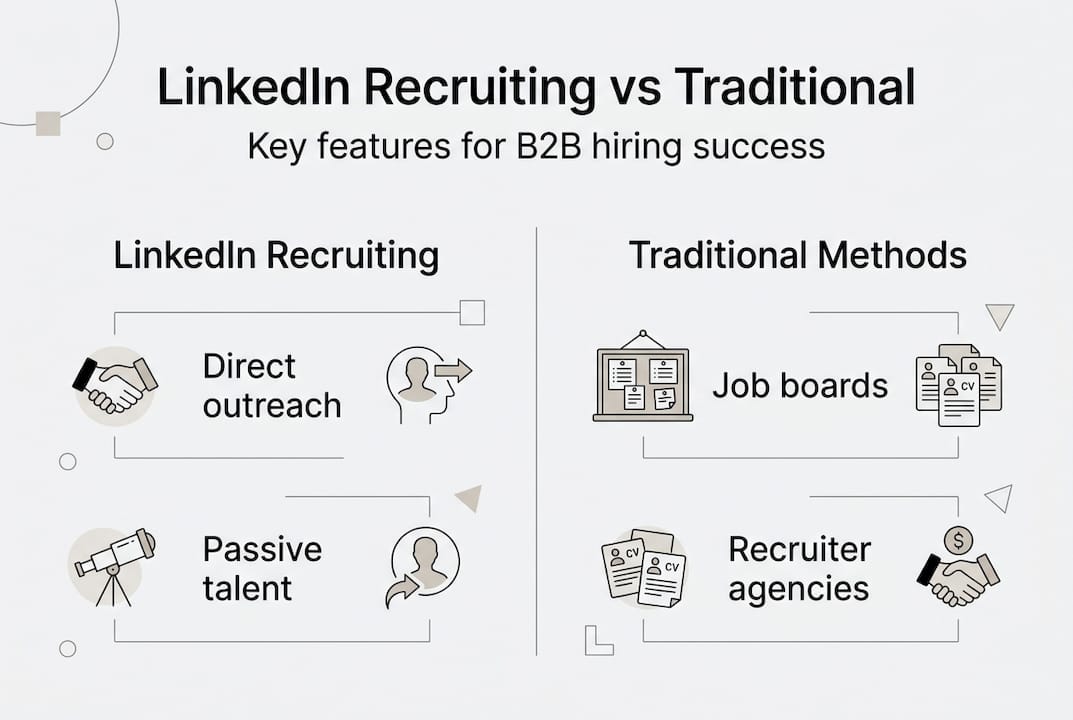
LinkedIn is more targeted and cost-effective for SMBs compared to traditional recruitment methods. Here's a direct comparison:
| Feature | LinkedIn Recruiting | Traditional Job Boards | Recruitment Agencies |
|---|---|---|---|
| Targeting precision | High (filters by skills, industry, location) | Low (broad audience) | Medium (depends on agency) |
| Access to passive candidates | Yes | No | Limited |
| Cost | £0-£150/month for tools | £100-£500 per post | 15-25% of salary |
| Employer branding | Strong (company page, content) | Weak (just job ads) | None |
| Speed to hire | 2-4 weeks | 4-8 weeks | 3-6 weeks |
The data backs this up. Research shows that 70% of the global workforce consists of passive candidates who aren't actively job hunting but are open to new opportunities. LinkedIn gives you direct access to this talent pool. Traditional job boards don't. For B2B SMBs, this means you can recruit specialists with niche skills who would never see your job advert on a generic board.
Consider a manufacturing SMB looking for a supply chain analyst with ERP experience. On a job board, you'd post an advert and hope the right person applies. On LinkedIn, you search for "supply chain analyst" with "ERP" skills, filter by location, and directly message 10 qualified candidates. You're not competing with 200 other job posts. You're having one-to-one conversations with people who match your exact requirements.
Statistic spotlight: Companies that invest in employer branding on LinkedIn see a 50% reduction in cost per hire and attract twice as many applications from qualified candidates.
Best practices for successful LinkedIn recruiting
Knowing the tools and processes is one thing. Using them effectively is another. Here are the practices that separate successful LinkedIn recruiters from those who waste time and budget:
- Build a compelling company page that showcases your culture, values, and employee stories. Candidates research you before responding to outreach.
- Post regular content that demonstrates thought leadership and industry expertise. This builds trust and makes your brand memorable.
- Personalise every message you send. Generic InMail gets ignored. Messages that reference a candidate's specific experience or achievements get responses.
- Engage with candidates' content by liking, commenting, and sharing their posts. This builds familiarity before you even reach out.
- Use employee advocacy by encouraging your team to share company updates and job openings. Their networks become your talent pool.
Employer branding and targeted content are critical for attracting in-demand talent. When candidates see your company regularly sharing valuable insights, they perceive you as an industry leader. That perception makes them more likely to respond positively when you reach out.
Do's and don'ts for SMB LinkedIn recruiting:
Do:
- Research candidates thoroughly before reaching out
- Explain why your opportunity is relevant to their career goals
- Follow up politely if you don't hear back within a week
- Keep your company page updated with recent news and achievements
Don't:
- Send copy-paste messages to dozens of candidates
- Focus only on what you need without considering what candidates want
- Ignore candidates who express interest but aren't perfect fits
- Neglect your employer brand by leaving your company page dormant
Pro Tip: Personalised outreach trumps generic job posts every time. A message that says "I noticed your work on X project and think your skills in Y would be perfect for our team" will always outperform "We have an opening you might be interested in."
Authenticity matters. Candidates can spot corporate jargon and empty promises from a mile away. Share real employee experiences, honest insights about your challenges, and genuine enthusiasm about your company's mission. This approach attracts people who align with your values, not just those looking for any job.
For more strategies on generating LinkedIn leads and building meaningful connections, the same principles apply: be genuine, provide value, and focus on relationships over transactions.
Measuring success and improving your LinkedIn recruitment
You can't improve what you don't measure. LinkedIn recruiting generates data at every stage, from initial outreach to final hire. The key is knowing which metrics matter and how to use them to refine your approach.
Start by setting clear KPIs:
- Response rate: Percentage of candidates who reply to your outreach
- Interview rate: Percentage of respondents who agree to interviews
- Offer acceptance rate: Percentage of offers accepted
- Time to hire: Days from first contact to signed contract
- Quality of hire: Performance and retention of recruited employees
These metrics tell you where your process works and where it breaks down. A low response rate suggests your messaging needs work. A low interview rate means you're targeting the wrong candidates or failing to sell the opportunity effectively. A low acceptance rate indicates issues with your offer or interview process.
Good LinkedIn recruitment strategies track outreach, engagement, and conversion rates for refinement. Here's a sample tracking table:
| Metric | Target | Actual | Action needed |
|---|---|---|---|
| Response rate | 30% | 22% | Improve message personalisation |
| Interview rate | 50% | 48% | Maintain current approach |
| Offer acceptance | 75% | 60% | Review compensation and benefits |
| Time to hire | 21 days | 28 days | Streamline interview scheduling |
After every hiring cycle, review your data and ask:
- Which messages generated the highest response rates?
- What candidate sources produced the best hires?
- Where did candidates drop out of the process?
- What feedback did unsuccessful candidates provide?
- How can we improve the candidate experience?
This iterative approach turns LinkedIn recruiting from a one-off tactic into a continuously improving system. You learn what works for your industry, your roles, and your company culture. Over time, your response rates climb, your time to hire shrinks, and the quality of your hires improves.
Don't forget to test different approaches. Try varying your message length, tone, and content. Experiment with different search filters. Test whether video messages outperform text. Small changes can produce significant improvements in results.
How IN Social can elevate your LinkedIn recruitment strategy
You now understand what LinkedIn recruiting is, how it works, and how to measure success. But implementing these strategies whilst running your business is challenging. That's where specialist support makes the difference.
IN Social combines human expertise with AI-powered tools to help B2B companies maximise their LinkedIn presence. Our LinkedIn recruitment services handle everything from building your employer brand to identifying and engaging top talent. We don't just post jobs and hope. We proactively reach the candidates you need, craft personalised outreach that gets responses, and manage the entire process so you can focus on interviews and decisions.
Our managed LinkedIn recruiting service is designed specifically for SMBs that need results without the overhead of a full-time recruiter. We become an extension of your team, understanding your culture, your requirements, and your growth plans. Then we execute a targeted strategy that fills your pipeline with qualified candidates who actually want to work for you.
Whether you need help with a single critical hire or want to build a sustainable recruitment system, discover how IN Social can transform your approach to talent acquisition. Your next great hire is already on LinkedIn. Let's help you find them.
Frequently asked questions
What are the main advantages of using LinkedIn for recruiting?
LinkedIn enables better targeting, access to passive candidates, and enhanced employer branding compared to traditional job boards. You reach specialists who aren't actively job hunting but would consider the right opportunity.
How much does LinkedIn recruiting cost for small businesses?
Costs range from free for basic features up to premium fees for advanced recruiter tools and paid job postings. Recruiter Lite starts around £100 per month, whilst full Recruiter subscriptions cost more but offer unlimited search and team collaboration.
How do I attract better candidates on LinkedIn?
Optimise your company page, leverage employee advocacy, post engaging content, and use advanced search to proactively reach top talent. Personalised outreach that references specific achievements always outperforms generic messages.
Can LinkedIn recruiting work for specialist or niche roles?
Yes, advanced search capabilities help SMBs reach highly specialised candidates in B2B sectors. Boolean search and detailed filters let you pinpoint professionals with exact skill combinations that traditional job boards can't match.