

TL;DR:
- Automation amplifies LinkedIn outreach efficiency by handling repetitive tasks while human oversight ensures personalization.
- Proper preparation, including profile optimization and manual messaging tests, is essential to avoid account restrictions.
- Current trends focus on AI-managed follow-up workflows, but strategic human involvement remains crucial for success.
Manual LinkedIn outreach is exhausting. You spend hours crafting individual messages, chasing cold connections, and watching your pipeline stall while competitors scale faster. For B2B owners and sales managers at mid-sized companies, this approach simply does not hold up against the demands of modern sales growth. Strategic automation changes that equation entirely. Done correctly, it multiplies your reach, keeps your messaging consistent, and frees your team to focus on closing deals rather than sending the same follow-up for the fifth time. This guide walks you through the fundamentals, the preparation, the execution, and how to measure what actually works.
Table of Contents
- Understanding LinkedIn outreach automation
- What you need before automating LinkedIn outreach
- Step-by-step: Automating your LinkedIn outreach process
- Troubleshooting and optimising for better results
- Our take: The future of LinkedIn outreach automation for B2B
- Boost your LinkedIn outreach the smart way
- Frequently asked questions
Key Takeaways
| Point | Details |
|---|---|
| Strategy shapes results | Automation multiplies outcomes only when built on a solid LinkedIn outreach strategy. |
| Preparation prevents risk | Manual engagement and account warm-up are critical to avoid LinkedIn restrictions. |
| AI trends expand automation | In 2026, AI agents handle more outreach steps, but human oversight remains essential. |
| Measure and adapt | Use analytics to refine targeting, messaging, and campaign timing for best B2B lead generation performance. |
Understanding LinkedIn outreach automation
LinkedIn outreach automation means using software tools to handle repetitive tasks within your prospecting workflow. Instead of manually sending every connection request or follow-up message, automation platforms execute these actions on your behalf, based on rules and sequences you define in advance.
The tasks most commonly automated include:
- Connection requests sent to targeted prospect lists
- Initial outreach messages triggered after a connection is accepted
- Follow-up sequences sent at scheduled intervals
- Profile visit actions that prompt reciprocal engagement
- Campaign tracking to monitor open and reply rates
What automation cannot do is equally important to understand. It cannot read nuance in a prospect's reply, build genuine rapport, or make judgement calls about whether a lead is sales-ready. Those tasks remain firmly human. As
but cannot replace it, the best results always come from testing your approach manually before switching to automated delivery.In 2026, the landscape has shifted noticeably. AI agents are now capable of managing larger workflow chunks, including intelligent follow-up routing and dynamic message personalisation based on a prospect's recent activity. This is a significant step forward from simple drip sequences.
| Automation capability | What it handles | What it cannot handle |
|---|---|---|
| Connection requests | Volume and targeting | Relationship context |
| Message sequences | Timing and delivery | Nuanced replies |
| Follow-ups | Consistency | Tone adjustments |
| Analytics tracking | Data collection | Strategic interpretation |
The core benefit for B2B teams is scale without proportional effort. You can generate LinkedIn leads across multiple segments simultaneously, while maintaining a consistent brand voice. The B2B lead generation benefits of this approach extend beyond volume, improving pipeline predictability and reducing the time from first touch to qualified conversation.
Pro Tip: Start with one targeted segment and one message sequence. Automation works best when your strategy is already proven at a small scale.
What you need before automating LinkedIn outreach
Preparation is your safeguard against wasted effort and account issues. Rushing into automation without the right foundations is one of the most common and costly mistakes B2B teams make.
Here is a practical checklist to work through before you switch anything on:
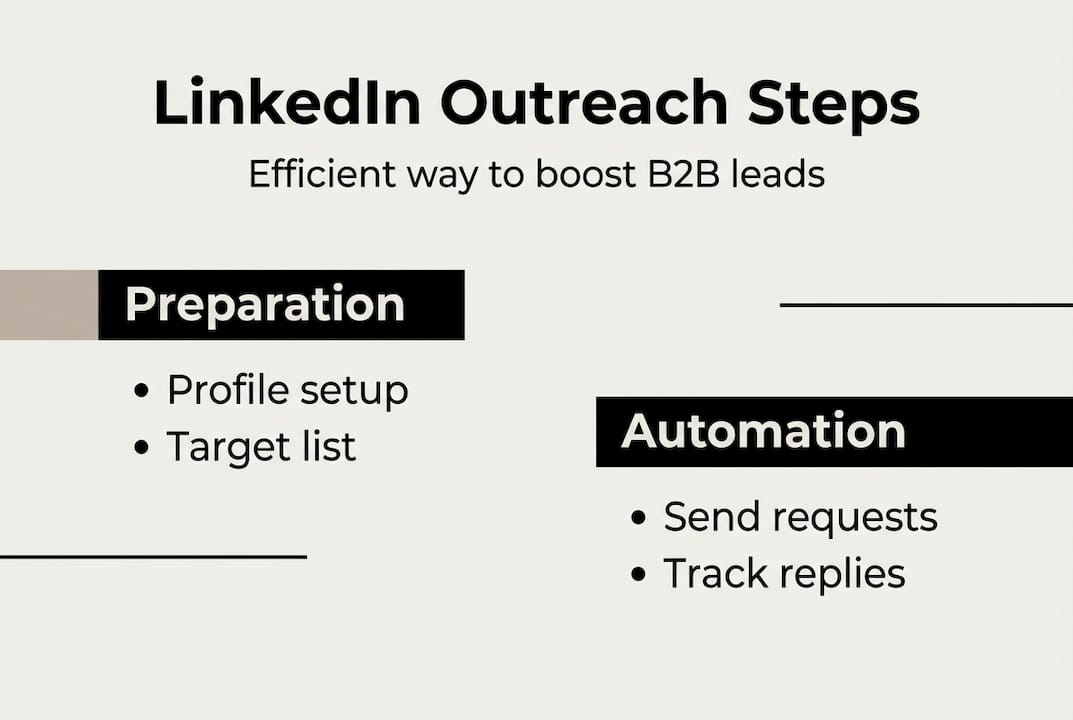
- Complete your LinkedIn profile fully. Your profile is the first thing prospects see after accepting your request. A professional photo, a clear headline, a compelling summary, and recent activity all build credibility before a single word of your message is read.
- Warm up your account. If your LinkedIn account has been relatively inactive, spend two to three weeks engaging manually. Comment on posts, send a handful of personal connection requests, and respond to messages. This mimics organic behaviour and reduces restriction risk.
- Test your messaging manually first. As testing messaging manually first minimises risk and increases efficiency, you should validate your scripts before automating them. Send 20 to 30 messages by hand and track acceptance and reply rates.
- Choose a compliant automation tool. Not all tools are equal. Prioritise platforms that operate within LinkedIn's usage guidelines, offer randomisation of actions, and provide clear analytics.
- Set up analytics tracking. Know your baseline metrics before you start so you can measure improvement accurately.
| Preparation step | Manual approach | Automated approach | Risk if skipped |
|---|---|---|---|
| Profile optimisation | Review and update manually | N/A | Low credibility, poor conversion |
| Account warm-up | Daily organic engagement | Cannot be automated | Account restriction |
| Message testing | Send and track manually | Automate after validation | Poor campaign performance |
| Compliance check | Review LinkedIn policies | Tool-level settings | Account suspension |
Solid LinkedIn management basics underpin every successful campaign. Equally, investing in content creation for outreach ensures your profile and messages reflect genuine authority in your field.

Pro Tip: Aim for a connection acceptance rate above 25% on your manual tests before scaling. Below that, refine your targeting or message angle first.
Step-by-step: Automating your LinkedIn outreach process
With your foundations in place, you can move confidently into building and running your first automated campaign.
- Select the right automation tool. Look for platforms that support cloud-based operation rather than browser extensions, as these are generally safer and more stable. Features to prioritise include campaign scheduling, message personalisation tokens, and daily action limits.
- Define your targeting criteria precisely. Use filters such as industry, company size, seniority level, and geography. The tighter your targeting, the more relevant your messaging and the better your reply rates.
- Build your message templates with light personalisation. Use tokens like first name and company name, but keep the core message human and value-led. Avoid generic openers. Lead with a specific, relevant observation about their industry or role.
- Schedule your campaigns thoughtfully. Set daily connection request limits between 20 and 40 to stay within safe thresholds. Space follow-up messages three to five days apart to avoid appearing aggressive.
- Enable randomisation and throttling settings. These features mimic natural human behaviour by varying the timing of actions, which significantly reduces the risk of triggering LinkedIn's automated activity detection.
- Prioritise response handling as semi-automated. When a prospect replies, a human should take over. Nurture leads through genuine conversation once initial contact is made.
Inbound engagement via automation is less risky than cold outbound approaches. Where possible, warm prospects through content before sending connection requests.
Strong content creation strategies running alongside your outreach campaigns create a powerful combination. Prospects who have already seen your posts are far more likely to accept and respond. You can also improve LinkedIn engagement by ensuring your profile activity remains visible and consistent throughout your campaign period.
Pro Tip: Review every active campaign at least once per week. Small adjustments to message timing or template wording can produce significant improvements in reply rates.
Troubleshooting and optimising for better results
Even well-constructed campaigns need ongoing attention. Knowing what to look for and how to respond keeps your results moving in the right direction.
Signs your campaign needs attention:
- Connection acceptance rate below 20%
- Reply rate below 5% on follow-up sequences
- A sudden drop in profile views or outreach delivery
- LinkedIn warning messages or temporary sending restrictions
If your acceptance rate is low, the issue is usually targeting or your connection request note. Revisit your audience filters and test a shorter, more direct message. If reply rates are falling, the problem is typically your opening message. It may be too generic, too salesy, or not relevant enough to the prospect's actual situation.
To avoid LinkedIn restrictions, keep daily connection requests under 40, vary the times you run campaigns, and never send identical messages in bulk without personalisation tokens. Mimicking human behaviour is the single most effective protection against account issues.
A/B testing is your most reliable optimisation tool. Run two versions of a message template simultaneously to different segments of the same audience, then compare reply rates after a minimum of 50 sends per version. Small changes in subject framing or call-to-action wording often produce measurable differences.
Use your campaign analytics to create a feedback loop. If a particular industry segment is responding well, double down on that targeting. If a message sequence is underperforming, pause it and rebuild from your best-performing template. Driving B2B sales with LinkedIn requires this kind of iterative thinking, not a one-and-done setup. For ongoing inspiration, revisit effective LinkedIn lead tips as your campaigns mature.
In 2026, AI agents managing follow-ups and nuanced workflow tasks represent the next evolution in outreach automation. Early adopters are already seeing faster lead qualification and reduced manual workload.
Our take: The future of LinkedIn outreach automation for B2B
Here is something most automation guides will not tell you: the biggest risk in 2026 is not getting your account restricted. It is building a perfectly functioning machine that produces perfectly mediocre results.
"Set and forget" automation is a shortcut that undermines genuine lead generation. When every message sounds the same, prospects notice. When your sequences run for months without human review, you miss shifts in your audience's priorities and language. Strategy is amplified but not replaced by automation, and manual validation remains the difference between a pipeline and a noise machine.
Our view is that the B2B teams winning on LinkedIn in 2026 are not the ones with the most sophisticated automation stack. They are the ones using automation to handle volume while investing real effort in inbound content, personal engagement, and timely human responses. If you want to optimise LinkedIn content alongside your outreach, that combination is where genuine competitive advantage lives. Automation is the engine. Strategy and human oversight are the steering wheel.
Boost your LinkedIn outreach the smart way
If this guide has shown you anything, it is that effective LinkedIn outreach automation is not about switching everything to autopilot. It is about using the right tools, in the right way, with the right strategy behind them.
At IN Social, we help B2B companies build compliant, results-driven outreach campaigns that generate qualified leads without risking your account or your reputation. Whether you are looking to explore LinkedIn lead generation without cold outreach or want to see the full range of our LinkedIn outreach services, we are ready to help you scale with confidence. Get in touch today and let us build a strategy that works for your business.
Frequently asked questions
Is automating LinkedIn outreach safe for my account?
Automation is safe when you stay within LinkedIn's daily action limits, use a warmed account, and ensure your tool mimics natural human behaviour. Testing manually first before scaling significantly reduces the risk of restriction.
What tasks can LinkedIn outreach automation handle?
Automation manages connection requests, message sequences, follow-ups, and campaign analytics effectively. However, as automation amplifies strategy rather than replacing it, nuanced replies and relationship building still require human involvement.
How do I avoid LinkedIn restrictions with automation?
Keep daily connection requests between 20 and 40, rotate your message templates, and use tools with randomisation features. Inbound engagement via automation carries less risk than aggressive cold outbound, so combining content with outreach is a smart protective strategy.
What is the biggest 2026 trend in LinkedIn outreach automation?
AI agents managing follow-ups and broader workflow tasks are the standout development in 2026. The teams seeing the best results are pairing these tools with a clear human-led strategy rather than relying on full automation alone.