

For many B2B sales managers, reaching genuine decision-makers feels like searching for a needle in a haystack. LinkedIn offers a unique platform where professionals are actively seeking business solutions instead of casually browsing. Mastering the core concepts of LinkedIn lead generation helps you target the right people, build credibility, and nurture warmer relationships that are far more likely to convert. This guide shows how strategic LinkedIn approaches can turn routine outreach into measurable sales outcomes.
Table of Contents
- Core Concepts Of LinkedIn Lead Generation
- Inbound Versus Outbound LinkedIn Strategies
- Essential Tools And Targeting Techniques
- Common Pitfalls And Platform Limitations
- Best Practices For Measurable Sales Outcomes
Key Takeaways
| Point | Details |
|---|---|
| Focus on Warm Leads | Prioritise building relationships with warm and hot leads, as they convert better than cold outreach. |
| Combine Inbound and Outbound Strategies | Use both inbound and outbound tactics to balance long-term authority building with immediate results. |
| Leverage LinkedIn Tools | Utilise features like Sales Navigator and optimise profiles to enhance credibility and target the right prospects. |
| Track Key Metrics | Measure success through metrics like response rates and meeting bookings to refine your strategy effectively. |
Core Concepts Of LinkedIn Lead Generation
LinkedIn lead generation combines sales and marketing efforts to attract potential customers and convert them into qualified prospects. On LinkedIn specifically, this means identifying decision-makers, building credibility with them, and nurturing relationships until they're ready to buy.
The platform offers a unique advantage: you're connecting with professionals actively working in their roles. They're not casually scrolling—they're on LinkedIn for business reasons.
Understanding Lead Quality
Not all leads are created equal. Lead generation blends sales and marketing to categorise prospects by engagement level:
- Cold leads have shown zero interest in your company or solution
- Warm leads engage with your content but haven't expressed buying intent
- Hot leads actively engage, ask questions, and demonstrate genuine interest
Your job is moving prospects from cold to hot through consistent engagement and value delivery.
On LinkedIn, warm and hot leads convert far better than cold outreach alone—focus your effort on building these warmer relationships first.
The LinkedIn Advantage for B2B
LinkedIn B2B lead generation works because decision-makers spend time here professionally. Unlike other platforms, people check LinkedIn to research companies, read industry updates, and connect with peers.

You can reach the right person at the right company without guessing. This precision matters when your sales cycle is long and complex.
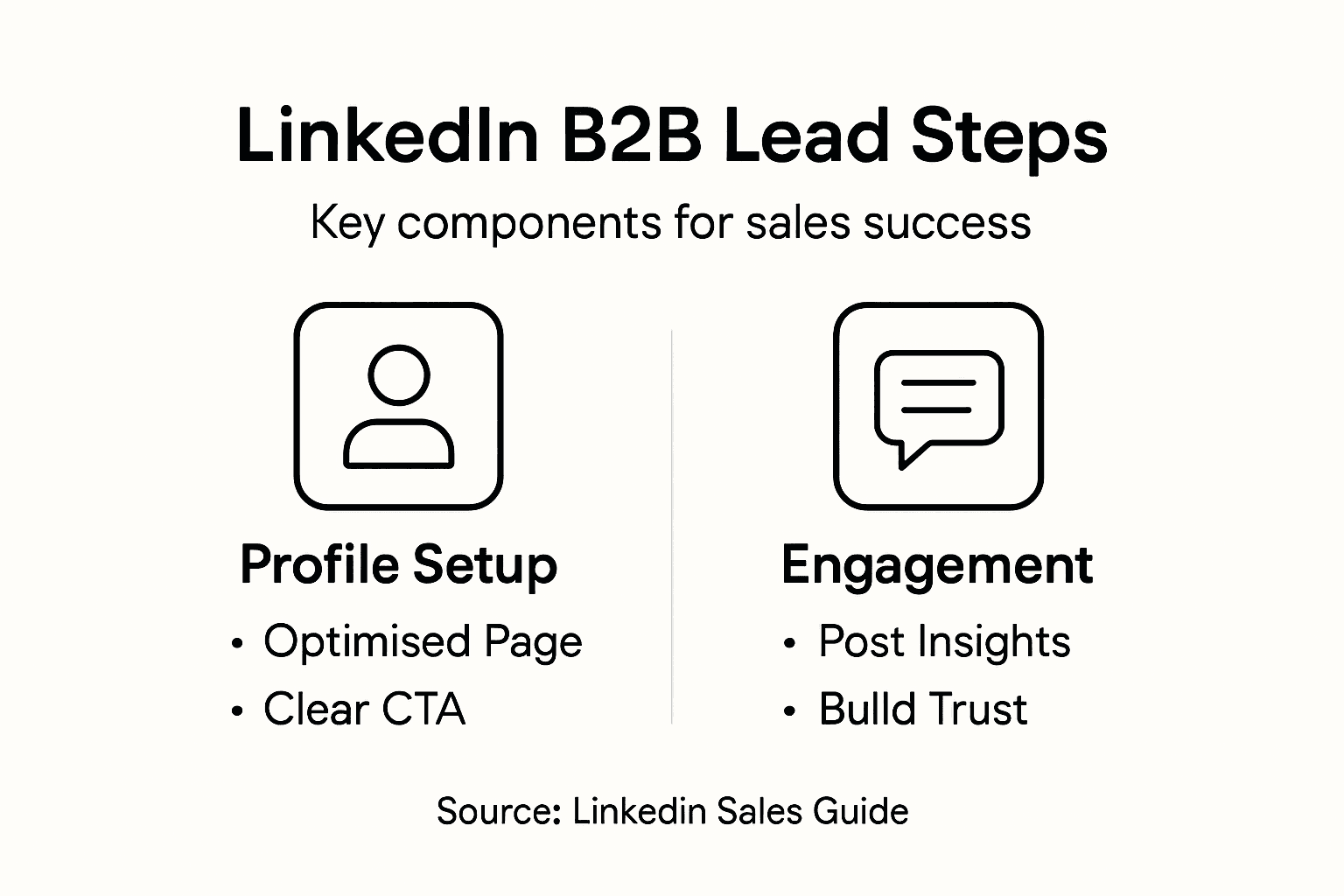
Key Components of LinkedIn Lead Generation
Three elements form the foundation:
- Profile Optimisation – Your company and personal profiles must showcase credibility and attract the right prospects
- Content Strategy – Regular, valuable content keeps you visible and positions you as knowledgeable
- Relationship Building – Genuine connection requests and personalised messages convert interest into conversations
Each component feeds the others. A strong profile gives people reason to connect. Good content gives them reason to engage. Personalised follow-up turns engagement into sales discussions.
Why LinkedIn Works Differently
Traditional lead generation relies on casting wide nets. LinkedIn lets you fish in specific ponds. You target by job title, company size, industry, and seniority level.
You're also building in public. When prospects see your activity—comments on industry posts, thoughtful insights, helpful responses—they develop familiarity with you before you ever send a message.
Trust precedes the sale on LinkedIn. Visibility + credibility = qualified conversations.
Measuring Success
Understanding what counts as a successful lead matters. A LinkedIn connection means nothing if they never respond to messages. A meaningful lead is someone who engages with your content, responds to your message, or takes action.
Track metrics like response rates, meeting bookings, and opportunities created—not just connection counts.
Pro tip: Start by defining what a qualified lead looks like for your business before launching any LinkedIn strategy—this clarity determines which prospects you pursue and how you measure campaign success.
Inbound Versus Outbound LinkedIn Strategies
LinkedIn success requires choosing between two fundamentally different approaches. You can attract prospects to you, or you can reach out and find them. Both work—they just operate on completely different timelines and budgets.
Understanding Inbound on LinkedIn
Inbound marketing means creating valuable content that pulls prospects toward you. You publish insights, share industry knowledge, engage in discussions, and let people discover you organically.
This approach builds credibility because you're not interrupting anyone. People find you because you're solving problems they actually care about.
Inbound tactics include:
- Publishing thoughtful LinkedIn articles and posts
- Engaging with prospect comments and industry discussions
- Building your personal brand as a knowledgeable resource
- Creating content that ranks in LinkedIn's search results
Inbound marketing uses tactics like content creation and social media to draw interested leads. It builds credibility and encourages engagement but takes time to scale.
Understanding Outbound on LinkedIn
Outbound marketing means actively reaching out to prospects through direct messages, connection requests, and targeted ads. You control the timing and who sees your message.
Outbound is faster. You can identify decision-makers and start conversations immediately. The trade-off is cost and intrusion—some people resent unsolicited messages.
Outbound tactics include:
- Sending personalised connection requests to target prospects
- Direct messaging decision-makers with relevant offers
- Running LinkedIn advertising campaigns to specific audiences
- Using LinkedIn Sales Navigator to find and contact prospects
Which Approach Works Better?
Inbound works when you have time to build authority. Outbound works when you need results quickly. Most successful B2B teams use both simultaneously.
Inbound generates warm leads who already know your reputation. Outbound generates quick conversations but requires more follow-up work.
To clarify how inbound and outbound strategies differ on LinkedIn, see this comparison table:
| Aspect | Inbound Approach | Outbound Approach |
|---|---|---|
| Lead Warmth | Naturally warmer leads | Often starts with cold leads |
| Brand Building | Yes, via content | Minimal, more direct outreach |
| Time to Results | Slow to build, long-term | Quick, immediate conversations |
| Cost & Effort | Low financial cost | Higher budget requirements |
| Control Over Targeting | Limited, relies on discovery | High, can choose recipients |
| Ideal Use Case | Authority and trust building | Account-based selling and fast results |
The Real Difference
Inbound marketing is cost-effective and builds credibility, whilst outbound marketing provides faster results and better control. Inbound demands patience. Outbound demands budget.
For small sales teams without large marketing budgets, inbound builds a sustainable engine over time. For teams targeting specific accounts, outbound delivers immediate conversations.
Combining Both Strategies
The strongest approach blends inbound and outbound. You build visibility through content whilst simultaneously reaching out to decision-makers who match your ideal customer profile.
When a prospect sees your thoughtful LinkedIn post and then receives a personalised message from you, the combination is powerful. They already have positive impressions before you ask for anything.
Pro tip: Start with outbound to generate immediate conversations whilst building an inbound content engine in the background—this way you maintain revenue momentum whilst developing long-term lead generation assets.
Essential Tools And Targeting Techniques
LinkedIn lead generation relies on using the right tools strategically. The platform offers built-in features designed specifically for B2B prospecting, and knowing which ones to leverage makes the difference between scattered efforts and systematic results.
LinkedIn Sales Navigator
Sales Navigator is LinkedIn's premium prospecting tool. It lets you filter prospects by job title, company size, industry, seniority, and dozens of other criteria.
You can save prospect lists, track who views your profile, and receive alerts when prospects change jobs or companies. This matters because job changes signal potential sales opportunities.
Sales Navigator users typically see higher response rates because they're reaching genuinely qualified prospects, not just random connections.
Profile And Page Optimisation
Your foundation matters. LinkedIn offers data-driven tools and optimising business pages reflects professionalism and customer needs.
Prospects judge your credibility in seconds. A professional headshot, clear headline, and compelling "About" section make prospects want to engage.
Optimisation essentials:
- Professional profile photo with clear, confident expression
- Headline that communicates your value, not just your job title
- About section that addresses prospect pain points
- Up-to-date work experience and recommendations
- A call-to-action directing prospects how to connect
Your LinkedIn profile is your 24/7 sales representative—it must convince prospects to respond before you ever send a message.
Targeting Techniques
Precision targeting separates successful outreach from wasted effort. Rather than connecting with everyone, identify your ideal customer profile first.
Define your targets by:
- Job titles (decision-makers in your target roles)
- Company size (do you sell to startups or enterprises?)
- Industry vertical (which sectors actually buy from you?)
- Geographic location (are you targeting specific regions?)
- Company growth signals (recently funded, expanded staff?)
When you narrow your focus, your message resonates more because it's genuinely relevant.
LinkedIn Advertising
LinkedIn Ads provide targeted ad campaigns with conversion tracking and analytics to maximise return on investment. You can run image ads, video ads, carousel ads, or conversation ads depending on your goal.
Advertising works best when combined with organic outreach. Ads reach cold prospects, whilst direct messages reach warm prospects you've identified.
Automation And Follow-Up
Automation tools streamline repetitive tasks—connection requests, message sequences, and follow-ups. However, personalisation still matters. Generic automated messages underperform significantly.
The best approach automates the mechanics whilst keeping messaging personalised and human.
Here’s a summary table of core LinkedIn lead generation tools and their primary business impacts:
| Tool/Feature | Purpose | Business Impact |
|---|---|---|
| Sales Navigator | Advanced prospect filtering | Higher response rates, better targeting |
| Profile Optimisation | Enhance credibility | Increased engagement and connection requests |
| LinkedIn Ads | Targeted campaigns | Reach cold audiences, fast awareness |
| Automation Tools | Streamline outreach | Boost efficiency, manage follow-ups |
| CRM Integration | Track interactions | Improved lead qualification and pipeline clarity |
Pro tip: Build a systematic targeting process: define your ideal customer profile, use Sales Navigator to find matching prospects, personalise your first message, then track responses—this repeatable system scales faster than random outreach.
Common Pitfalls And Platform Limitations
LinkedIn lead generation looks straightforward until you hit real obstacles. The platform has strict rules, and ignoring them costs you access to prospects. Understanding these limitations upfront saves you months of wasted effort.
The Data Scraping Problem
LinkedIn aggressively protects user data. The platform prohibits third-party tools that scrape profiles, connection lists, or email addresses without authorisation.
Several popular lead generation providers have been removed from LinkedIn's ecosystem entirely. If you rely on scraped data or unauthorised extraction tools, you risk losing account access permanently.
LinkedIn prohibits third-party tools that scrape user data, leading to removal of providers using unauthorised methods. This creates challenges for sellers relying on such tools and highlights strict enforcement of terms and data privacy policies.
Over-Relying On Cold Leads
Cold outreach converts poorly. Many sales teams blast connection requests to hundreds of people and wonder why response rates collapse.
Common pitfalls include over-reliance on cold leads without sufficient nurturing and neglecting lead qualification. You can't scale on cold leads alone. They require extensive follow-up and nurturing to convert.
Instead, focus on warm leads—prospects who have engaged with your content or share mutual connections.
Lead Qualification Failures
Not every connection is a sales opportunity. Some people connect for networking, others are competitors, and many lack buying authority.
Common mistakes include:
- Pursuing unqualified leads because they connected with you
- Skipping background research before reaching out
- Assuming title means buying authority (spoiler: it doesn't)
- Treating all leads identically instead of prioritising high-value prospects
Spend time qualifying before investing in conversations.
Quality over quantity. One conversation with a decision-maker beats 100 conversations with unqualified contacts.
Platform Reach Constraints
LinkedIn limits free users to 100 connection requests monthly. Premium members get more, but still face limits. You can't scale infinitely on organic outreach alone.
The algorithm also controls visibility. Your posts reach only a fraction of your network unless people actively engage. This makes consistency crucial—you need multiple touchpoints, not one-off messages.
Privacy And Compliance Issues
Privacy regulations evolve constantly. GDPR, CCPA, and similar laws require explicit consent before contacting prospects.
Generic mass messages violate these regulations. You need documented consent to contact people, especially outside your immediate network.
Multi-Channel Dependency
Relying solely on LinkedIn limits your reach. Email, phone calls, and other channels strengthen your approach, but LinkedIn alone restricts scalability.
The strongest campaigns combine LinkedIn outreach with email follow-up, ensuring prospects see your message across multiple channels.
Pro tip: Focus your effort on 50 genuinely qualified prospects rather than 500 cold connections—invest time in research, personalisation, and multi-touch follow-up to convert higher-quality leads at faster rates.
Best Practices For Measurable Sales Outcomes
LinkedIn lead generation only matters if it drives actual sales. Without measurement, you're flying blind. You need clear metrics to know what's working and what's wasting your time.
Define Your Key Metrics
Start by deciding what success looks like. Is it meetings booked? Opportunities created? Revenue closed? Different businesses measure differently, so clarity matters.
Common metrics include:
- Connection acceptance rate (percentage of requests accepted)
- Message response rate (percentage of prospects who reply)
- Meeting booking rate (conversations that become scheduled calls)
- Opportunity creation rate (leads that enter your sales pipeline)
- Cost per lead (total investment divided by qualified leads generated)
- Sales cycle time (days from first contact to closed deal)
Track at least three metrics simultaneously to understand the full picture.
Use Data To Refine Strategy
LinkedIn analytics enable refining targeting and messaging to improve results. Pay attention to which messages get responses, which content generates engagement, and which prospect profiles convert fastest.
If your message response rate drops, test different approaches. If certain industries convert better, focus there. Data reveals patterns that intuition misses.
Data-driven decisions beat guesswork. Track your metrics obsessively, then adjust based on what the numbers tell you.
Align Sales And Marketing
Successful B2B lead generation combines data-driven approaches with relationship-building and requires aligning sales and marketing efforts. When your sales team and marketing team disagree on lead quality, leads fall through cracks.
Define what qualifies as a sales-ready lead together. Meet weekly to review pipeline metrics. This alignment ensures no opportunity gets wasted.
Implement Systematic Tracking
Use your CRM (customer relationship management) system to log every interaction. Document:
- Initial outreach date and method
- First response (or non-response)
- Meeting outcome and date
- Next steps and follow-up date
- Deal stage and timeline
Systematic tracking reveals bottlenecks. Maybe prospects respond but rarely take meetings. Or meetings happen but deals stall. Identifying where things break is the first step to fixing them.
Measure At Multiple Levels
Don't just track revenue. Measure leading indicators too:
- Profile views from target accounts
- Content engagement rates
- Connection request acceptance rates
- Initial message response rates
- Meeting booking progression
Leading indicators tell you if you're building momentum before revenue appears. If metrics collapse at the top of the funnel, you'll know to adjust before deals close.
Test And Optimise Continuously
Change one variable at a time. Test different message templates, headline optimisations, or target segments. Give each test at least 30 conversations before drawing conclusions.
Small improvements compound. A 5 per cent increase in response rate, combined with a 10 per cent improvement in meeting conversion, dramatically improves results over time.
Pro tip: Create a simple weekly dashboard showing your three key metrics—this visibility keeps your team focused on what drives sales results and surfaces problems before they become crises.
Unlock Your LinkedIn Lead Generation Potential Today
The challenges of LinkedIn lead generation are clear: converting cold leads into warm prospects, building credibility through content, and navigating platform limitations all require expertise and time. If you want to avoid common pitfalls like over-relying on cold outreach or struggling with inconsistent results, a personalised, strategic approach is key. At In-Social, we combine human insight with advanced AI tools to optimise your LinkedIn presence, attract qualified leads, and convert conversations into measurable sales growth.
Are you ready to supercharge your LinkedIn strategy with tailored solutions that focus on profile optimisation, targeted outreach, and continuous performance tracking? Visit our digital marketing agency page to discover how our bespoke LinkedIn management and content creation services can build your authority and accelerate your B2B sales pipeline. Act now to start transforming your LinkedIn activity into real revenue opportunities.
Frequently Asked Questions
What are the key components of LinkedIn lead generation?
The key components of LinkedIn lead generation include profile optimisation, content strategy, and relationship building. A strong profile builds credibility, valuable content keeps you visible, and personalised messages foster genuine connections.
How can I measure the success of my LinkedIn lead generation efforts?
Success can be measured through metrics such as connection acceptance rate, message response rate, meeting booking rate, opportunity creation rate, and cost per lead. Tracking these metrics helps you understand your lead generation effectiveness.
What differentiates inbound and outbound strategies on LinkedIn?
Inbound strategies attract prospects through valuable content and engagement, while outbound strategies involve actively reaching out to potential leads through direct messages and connection requests. Both approaches have their advantages depending on your timing and budget needs.
Why is targeting important in LinkedIn lead generation?
Targeting is crucial as it allows you to connect with the right decision-makers within your ideal customer profile, leading to higher engagement and conversion rates. Precise targeting ensures that your efforts resonate with genuinely interested prospects.