

TL;DR:
- LinkedIn is a key platform for SMBs to generate qualified B2B leads and growth.
- Target companies at the growth threshold of 10 to 50 employees for high-value opportunities.
- Effective strategies combine targeted outreach, relevant content, and relationship-building efforts.
Most B2B marketers assume LinkedIn is too expensive for small and medium-sized businesses. That assumption is costing them qualified leads. 68% of SMBs credit LinkedIn for their growth, and engagement with SMB members has surged 25 times in just two years. Those numbers are hard to ignore. This guide cuts through the noise and gives you proven LinkedIn growth frameworks built specifically for B2B companies like yours. You will learn how to attract the right prospects, convert them efficiently, and build a pipeline that actually produces revenue.
Table of Contents
- Why LinkedIn dominates B2B growth for SMBs
- Understanding the LinkedIn lead generation funnel
- Targeting strategies that fuel high-value growth
- Content and engagement tactics that drive real results
- What most LinkedIn growth strategies miss for SMBs
- Ready to activate your LinkedIn strategy?
- Frequently asked questions
Key Takeaways
| Point | Details |
|---|---|
| LinkedIn’s B2B advantage | LinkedIn offers unmatched B2B lead generation especially for growing SMBs. |
| Value of targeted campaigns | Focusing on the right company sizes and buying committees leads to much higher returns. |
| Quality over quantity | Though cost-per-lead may be higher, LinkedIn delivers stronger conversion rates and deal values. |
| Content and engagement matter | Modern LinkedIn growth requires consistent, high-quality content and strategic engagement. |
Why LinkedIn dominates B2B growth for SMBs
LinkedIn is not just another social platform. It is the only major network built around professional identity, career intent, and business decision-making. That distinction matters enormously when you are trying to reach buyers who hold real purchasing authority.
Other platforms such as Instagram or Facebook can generate awareness, but they were designed for consumer behaviour. LinkedIn, by contrast, puts you in front of finance directors, operations managers, and founders who are actively thinking about business challenges. That mindset shift in the audience changes everything about how your message lands.
"LinkedIn engagement with SMB members has grown 25 times in just two years, and 68% of SMBs credit the platform for their growth."
That level of engagement is not accidental. LinkedIn has invested heavily in tools for SMBs, from targeted advertising to Sales Navigator, making it easier than ever to reach niche audiences with precision. If you want to prioritise LinkedIn marketing and justify that focus internally, the data backs you up.
Here are some of the most common misconceptions that hold SMBs back from using LinkedIn effectively:
- "It only works for enterprise companies." Not true. SMBs consistently outperform larger brands on engagement when they use personalised outreach.
- "Organic reach is dead." LinkedIn's algorithm still rewards consistent, relevant content from individuals and company pages alike.
- "You need a huge following to generate leads." Quality connections matter far more than follower count. Ten targeted conversations beat a thousand passive followers.
- "LinkedIn ads are too expensive for our budget." When you factor in deal value and conversion rates, the return often outperforms cheaper alternatives.
The reality is that LinkedIn offers SMBs something rare: direct access to decision-makers at scale. When you combine that access with the right strategy, you can grow leads and boost sales in ways that other channels simply cannot match. The platform rewards consistency, relevance, and genuine relationship-building. Those are exactly the strengths that agile SMBs can leverage.
Understanding the LinkedIn lead generation funnel
Having established LinkedIn's strengths, let's clarify exactly how B2B lead generation unfolds on the platform. The process follows four core stages: Attract, Engage, Convert, and Nurture. Each stage requires a different tactic and a different mindset.
- Attract: Build visibility through optimised profiles, regular content, and targeted connection requests. Your goal here is to appear credible and relevant to your ideal buyer before any conversation begins.
- Engage: Start meaningful interactions through comments, direct messages, and content responses. Engagement signals intent and builds familiarity over time.
- Convert: Move warm prospects towards a specific action, whether that is booking a call, downloading a resource, or visiting your website. Clear calls-to-action are essential at this stage.
- Nurture: Not every lead is ready to buy immediately. Consistent follow-up through content and personal outreach keeps you top of mind until the timing is right.
Understanding where each prospect sits in this funnel helps you respond appropriately rather than pushing too hard too soon.
| Stage | Average cost-per-lead | Conversion rate |
|---|---|---|
| Organic outreach | Low | Moderate |
| LinkedIn ads | $50 to $200 CPL | 2 to 3x higher than other platforms |
| Combined approach | Medium | Highest overall |
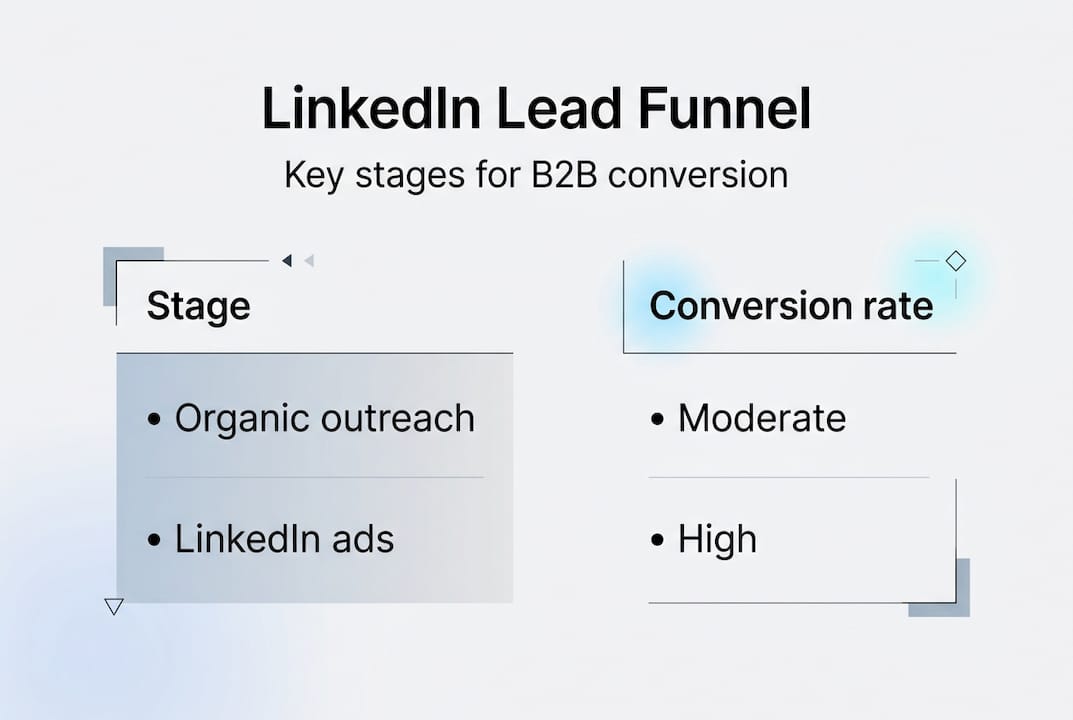
Yes, LinkedIn's cost-per-lead is higher than platforms like Facebook or Google Display. But the 2 to 3x better conversion rates and significantly larger average deal values mean the return on investment frequently justifies the spend. Building a strong LinkedIn pipeline for B2B means understanding that cost-per-lead is only one part of the equation.
Pro Tip: Use LinkedIn's built-in lead qualification signals such as profile views, post reactions, and connection requests to prioritise your outreach. Someone who views your profile after engaging with your content is far warmer than a cold connection. Pair these signals with engagement strategies that deliver leads to sharpen your qualification process.
Targeting strategies that fuel high-value growth
Now that the lead funnel is clear, it is time to focus on who you should actually be targeting for maximum return on investment.
Not all SMBs are equally valuable as targets. Research identifies what is known as the "growth threshold," a point in a company's development where spending habits shift dramatically. SMBs with 10 to 50 employees at these growth thresholds form buying committees and increase their spend by three to four times. Targeting these firms at the right moment can transform your pipeline.
| Targeting approach | Broad targeting | Committee-focused targeting |
|---|---|---|
| Audience size | Large | Smaller, more precise |
| Engagement quality | Low to moderate | High |
| Average deal value | Lower | Significantly higher |
| Sales cycle length | Shorter | Longer but more predictable |
| ROI | Variable | Consistently stronger |
The key insight here is that buying decisions at growing SMBs are rarely made by one person. When a company reaches employee milestones of around 11 or 50, multiple stakeholders get involved in purchasing. Reaching only the CEO misses the full picture.
Here are the top LinkedIn tools and filters to sharpen your audience segmentation:
- Company size filter: Target firms in the 10 to 50 employee range specifically.
- Job function and seniority: Identify all relevant stakeholders, not just the top decision-maker.
- Industry and geography: Narrow your focus to sectors where you have the strongest case studies.
- Sales Navigator: Use saved searches and lead lists to track buying committee members across a single organisation.
- Engagement history: Prioritise accounts where multiple people have interacted with your content.
Building a strong LinkedIn network for B2B sales means thinking beyond individual contacts and mapping entire buying groups. This approach takes more time upfront but delivers far stronger results at the close. LinkedIn also plays a growing role in SMB recruitment, which means your targets are already active on the platform and receptive to relevant outreach.
Content and engagement tactics that drive real results
With your targeting refined, next comes the question: what content and engagement moves deliver the best returns right now?

The answer is not about producing more content. It is about producing the right content and distributing it with intent. LinkedIn's algorithm favours posts that generate genuine conversation, not just passive likes. That means your content needs to provoke a reaction, ask a question, or share a perspective that makes your audience stop scrolling.
Content types proven to drive B2B engagement on LinkedIn include:
- Short-form text posts sharing a specific insight or lesson from your experience
- Carousel posts that break down a process or framework into digestible steps
- Video content featuring real people, not polished brand videos, which consistently outperforms produced content
- Case study snippets that demonstrate measurable results without giving everything away
- Polls that invite your audience to share their perspective and spark discussion
Engagement tactics that support lead nurturing include commenting meaningfully on prospects' posts, sharing their content with a genuine observation, and sending personalised connection requests that reference something specific. Generic messages get ignored. Specific, relevant ones get responses.
SMB engagement on LinkedIn has grown 25 times in two years, signalling that your audience is more active and reachable than ever before.
Pro Tip: Post between Tuesday and Thursday, ideally between 8am and 10am or 12pm and 1pm. These windows consistently produce higher engagement for B2B content. Review your content best practices for UK SMBs and make sure your profile is fully optimised for B2B sales before scaling your output. You can also use a structured content checklist for B2B leads to keep your approach consistent and measurable.
What most LinkedIn growth strategies miss for SMBs
Here is the uncomfortable truth most LinkedIn guides will not tell you: content alone does not build a pipeline. We see this pattern repeatedly. A business invests in great posts, gains followers, and watches engagement climb. Then they wonder why their sales conversations are not increasing at the same rate.
The missing piece is almost always the relationship layer. LinkedIn is a conversation platform first and a content platform second. The businesses generating the most qualified leads are not necessarily posting the most. They are following up, responding thoughtfully, and treating every interaction as the start of a relationship rather than a transaction.
Sales and marketing alignment matters here too. When your marketing team creates content for B2B lead generation without a clear handoff process to sales, warm leads go cold. The strongest LinkedIn strategies we have seen combine consistent content with a disciplined outreach cadence and a shared definition of what a qualified lead actually looks like. That alignment is what separates good results from exceptional ones.
Ready to activate your LinkedIn strategy?
If these frameworks resonate, you already know that executing them consistently takes time, expertise, and the right tools. That is exactly where we come in.
At IN Social, we help B2B businesses implement LinkedIn strategies that generate measurable results without the guesswork. From advanced targeting and content creation to fully managed outreach, our team combines human expertise with AI-powered insights to build pipelines that perform. If you want to generate LinkedIn leads without cold outreach and start having better sales conversations faster, we would love to show you how. Get in touch today and let's build something that works.
Frequently asked questions
What is a LinkedIn growth strategy for B2B?
A LinkedIn growth strategy for B2B is a focused plan that combines targeted outreach, high-quality content, and engagement tactics to consistently generate qualified leads and drive sales growth. Unlike other channels, LinkedIn delivers 2 to 3x better conversion rates alongside higher average deal values.
Why target SMBs at the growth threshold on LinkedIn?
SMBs at the growth threshold of 10 to 50 employees are more likely to form buying committees and increase their spend by 3 to 4x, making them prime targets for high-value B2B campaigns.
Is LinkedIn worth the higher cost-per-lead for B2B marketers?
Yes. While LinkedIn's cost-per-lead sits between $50 and $200, the platform consistently delivers 2 to 3x better conversions and larger deal values compared to most other digital channels.
How can I improve engagement rates for my LinkedIn company page?
Focus on posting timely, relevant content and participating in targeted conversations. SMB engagement on LinkedIn has surged 25 times in the past two years, meaning your audience is already there and ready to engage.