

TL;DR:
- Quality engagement boosts LinkedIn algorithm favorability, brand authority, and lead generation in B2B marketing.
- Posting 3 to 5 times weekly with diverse formats like videos, carousels, and polls optimizes growth and engagement.
- Inbound strategies outperform outbound on LinkedIn, with higher close rates and more qualified leads.
Most B2B marketing managers assume that posting more often is the answer to LinkedIn growth. It is not. Inbound leads convert at 14.6% compared to just 1.7% for outbound tactics, yet many teams still rely on cold outreach and volume-led posting schedules. That gap tells a clear story: LinkedIn engagement is not about how loudly you broadcast, it is about how strategically you show up. This guide breaks down the evidence-based strategies, content formats, and conversion frameworks that actually move the needle for B2B companies in 2026.
Table of Contents
- What is LinkedIn engagement and why does it matter?
- The best posting strategies for sustained LinkedIn growth
- Content formats that maximise LinkedIn engagement
- Inbound vs outbound: Which LinkedIn engagement strategies work best?
- Nailing conversion: Turning LinkedIn engagement into leads
- The uncomfortable truth about LinkedIn engagement most guides avoid
- Supercharge your LinkedIn engagement with expert support
- Frequently asked questions
Key Takeaways
| Point | Details |
|---|---|
| Focus on inbound | Inbound engagement on LinkedIn delivers up to 8x better close rates than outbound tactics. |
| Follow the 4-1-1 rule | A balanced content mix of educational, promotional, and personal posts consistently drives engagement. |
| Choose proven formats | Videos, carousels, and case studies outperform other content types for B2B results. |
| Move from engagement to leads | Convert LinkedIn activity into business by following up with value and personalised outreach. |
What is LinkedIn engagement and why does it matter?
Having surfaced the necessity for evidence-based engagement, let us clarify exactly what 'LinkedIn engagement' means and why it should be your focus.
LinkedIn engagement covers every meaningful interaction your content and profile attract. That includes likes, comments, shares, saves, direct messages, and profile views. Each of these signals tells the algorithm that your content is worth distributing further. Not all of them carry equal weight, though. A thoughtful comment from a decision-maker is worth far more than fifty passive likes from people outside your target sector.
This is where many B2B marketers go wrong. They chase vanity metrics, follower counts, reaction tallies, and impression numbers, without asking whether those numbers are driving real conversations. As LinkedIn engagement explained highlights, a clear understanding of engagement is foundational for LinkedIn marketing success.
There are three reasons engagement deserves your full attention:
- Algorithm favourability: LinkedIn's algorithm rewards content that sparks genuine reactions and dialogue, pushing it to wider audiences without paid promotion
- Brand authority: Consistent, high-quality engagement positions you as a credible voice in your industry, making prospects more receptive when you do reach out
- Lead generation: Engaged prospects are warm. They already know who you are and what you stand for, which shortens the sales cycle significantly
A common myth is that only posting volume matters. The reality is that one post generating 30 meaningful comments outperforms ten posts that generate none. The benefits of LinkedIn marketing compound when quality drives your approach rather than frequency alone.
"Engagement quality beats quantity in B2B contexts. Focus on sparking dialogue, not just broadcasting messages."
The best posting strategies for sustained LinkedIn growth
Now that you understand the importance of meaningful engagement, let us look at how often and how smartly you should post.
Posting 3 to 5 times per week using the 4-1-1 rule is the recommended approach for consistent B2B growth. The 4-1-1 rule works like this: for every six posts, four should educate your audience, one should promote your services, and one should be personal or values-led. This balance keeps your feed relevant without feeling like a sales brochure.
Here is how a sample weekly schedule might look:
| Day | Post type | Example topic |
|---|---|---|
| Monday | Educational | Industry trend or insight |
| Tuesday | Educational | How-to or practical tip |
| Wednesday | Personal | Team story or business lesson |
| Thursday | Educational | Client challenge or common mistake |
| Friday | Promotional | Service spotlight or case study |
Consistency matters more than bursts of activity. Posting daily for two weeks then going quiet for a month damages your algorithmic standing and confuses your audience. The best posting frequency for most B2B teams sits at four posts per week, with each post serving a clear purpose.
Common pitfalls to avoid:
- Posting only promotional content, which trains your audience to scroll past you
- Copying competitor posting styles instead of finding your authentic voice
- Publishing at random times rather than testing when your specific audience is most active
Exploring proven LinkedIn growth strategies will help you identify the right rhythm for your sector and audience size.
Pro Tip: Schedule at least two different content formats each week, for example a text post and a carousel, to keep your audience curious and the algorithm rewarded.
Content formats that maximise LinkedIn engagement
With your posting rhythm set, selecting the right content formats becomes the next lever for outpacing your competition.
Carousels, videos, polls, and case studies rank as the top-performing LinkedIn content types for B2B audiences. But each format serves a different goal, so choosing randomly wastes effort.

| Format | Best for | Engagement type |
|---|---|---|
| Video | Brand awareness, personality | Views, comments |
| Carousel | Education, step-by-step guides | Saves, shares |
| Poll | Audience insight, quick reach | Votes, comments |
| Case study | Lead generation, credibility | DMs, profile visits |
| Text post | Thought leadership | Comments, shares |
Video drives the highest engagement benchmarks on LinkedIn, but document posts and carousels can outperform for B2B lead generation because they deliver structured value that readers save and return to. That distinction matters when you are planning a quarter of content.
Formats to test this quarter:
- Carousels: Break down a complex process into five to eight slides, ending with a clear call to action
- Short videos: Under 90 seconds, filmed candidly, addressing a single pain point your audience faces
- Polls: Ask a question your prospects genuinely debate, then comment with your own perspective
- Case studies: Share a real client outcome with specific numbers, even if the client remains anonymous
A word of caution: do not chase novelty for its own sake. Explore effective LinkedIn post formats and content tips for 2026 to build a format strategy grounded in what actually converts, not just what looks impressive.
Inbound vs outbound: Which LinkedIn engagement strategies work best?
Now let us tackle one of the most debated choices in B2B LinkedIn strategy: should you prioritise inbound or outbound engagement?
The data is clear. Inbound close rates reach 14.6% on LinkedIn, compared to just 1.7% for outbound. That is not a marginal difference; it fundamentally changes how you should allocate your time and budget.
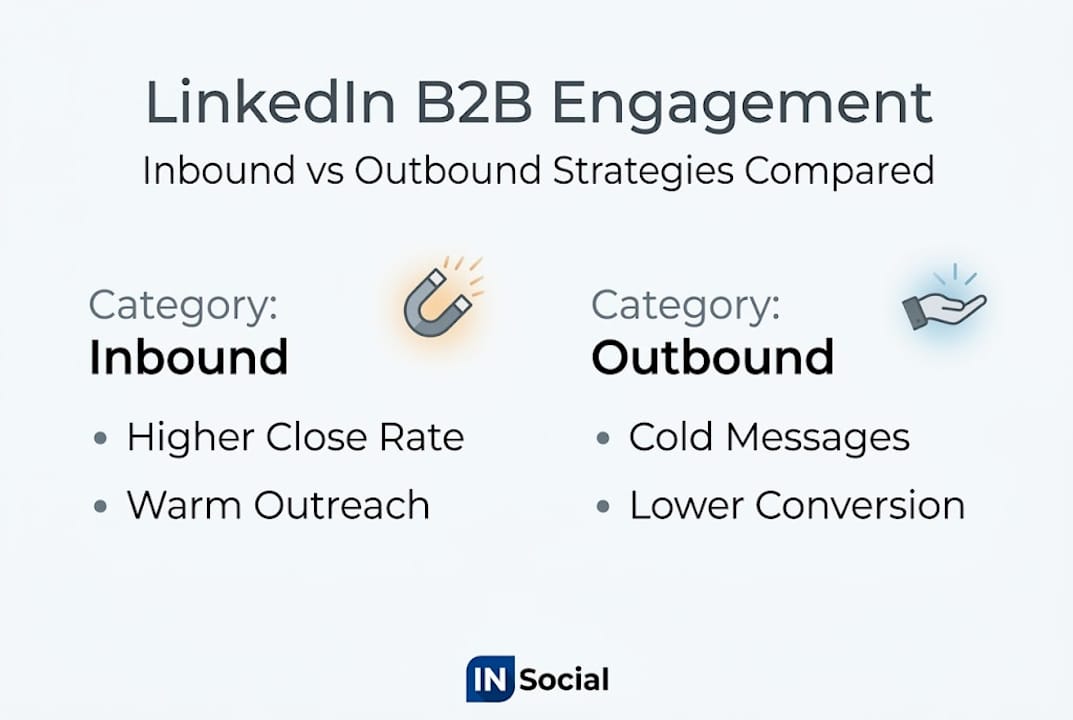
| Approach | Close rate | Cost per lead | Sustainability | |---|---|---| |---| | Inbound | 14.6% | Lower over time | High | | Outbound | 1.7% | Higher per contact | Medium |
Building an inbound pipeline on LinkedIn takes patience, but the compounding effect is significant. Here is a practical framework:
- Optimise your profile as a landing page, not a CV. Focus on the problems you solve, not your job title
- Publish consistent, value-led content that addresses your ideal client's challenges
- Engage genuinely with other people's content in your target sectors before expecting engagement back
- Respond to every comment and DM promptly to signal that you are accessible and credible
- Use your content to drive inbound leads by ending posts with questions or soft invitations to connect
Outbound still has a place, but only when paired with a strong inbound presence. Cold messages land better when the recipient has already seen your content. Visit our LinkedIn tips for lead growth to see how both approaches work together effectively.
Pro Tip: Avoid opening any outbound message with a sales pitch. Reference something the prospect has posted or shared, and lead with curiosity, not a close.
Nailing conversion: Turning LinkedIn engagement into leads
Effective engagement is only as valuable as the leads it creates. Here is how to bridge the gap from visibility to opportunity.
The moment someone comments on your post, views your profile after seeing your content, or sends a connection request, they are raising their hand. Most B2B marketers ignore these signals or respond too slowly. Speed and personalisation together are what convert warm interactions into actual conversations.
A simple follow-up framework for LinkedIn interactions:
- Within 24 hours of a meaningful comment, reply publicly and then send a brief, personalised connection request
- Once connected, send a short message referencing the specific post or topic they engaged with
- Share one piece of relevant content, not a pitch, that deepens the conversation
- After two or three exchanges, offer a clear next step such as a short call or a relevant resource download
The best calls to action to include in your posts:
- "What has your experience been with this? Comment below"
- "If this resonates, I would be happy to share the full framework. Just send me a message"
- "Tag someone who needs to see this"
- "Follow for more insights on [your core topic]"
Personal brand storytelling drives the most consistent B2B results when blended with engaging content, because it creates an emotional connection that makes your outreach feel welcome rather than intrusive. Explore proven demand generation strategies to build a full-funnel approach that turns content into pipeline.
Pro Tip: Use a short personal story in your posts to illustrate a business challenge. Stories trigger warm outreach far more reliably than tips or statistics alone.
The uncomfortable truth about LinkedIn engagement most guides avoid
With the mechanics covered, it is worth pausing to challenge the conventional wisdom and reveal what is rarely discussed about LinkedIn engagement.
Most guides present best practices as fixed rules. They are not. What works brilliantly for one B2B brand in professional services may fall flat for another in manufacturing. Algorithms evolve. Audience expectations shift. The only reliable constant is your audience's curiosity about genuine expertise and real human perspective.
Smaller B2B teams actually hold an advantage here. You can experiment faster, pivot content without a three-week approval process, and inject personality that large corporate accounts simply cannot replicate. The brands winning on LinkedIn right now are not the ones with the biggest budgets. They are the ones willing to try an unusual angle, share an honest failure, or post a format their competitors avoid because it feels too vulnerable.
Focusing on improving your approach through deliberate micro-experiments, tracking what each post generates in real conversations rather than just impressions, is how you build sustainable momentum. Do not wait for a perfect strategy. Test, learn, and adjust every month.
Pro Tip: Dare to post about a topic or use a format that none of your direct competitors are trying. Standing out on LinkedIn is less about polish and more about perspective.
Supercharge your LinkedIn engagement with expert support
Ready to stop guessing and start generating qualified leads from LinkedIn? Everything covered in this guide, from posting rhythm and content formats to inbound pipelines and conversion frameworks, requires consistent execution over time. That is where many SMB marketing teams hit a wall.
At IN Social, we combine human expertise with AI-powered tools to manage your LinkedIn presence, create content that converts, and build inbound pipelines that work without cold outreach. Whether you need fully managed LinkedIn support or a strategic starting point, our team is ready to help. Explore our expert LinkedIn lead generation services and find out what a structured, results-focused approach could mean for your business.
Frequently asked questions
What is the 4-1-1 rule for LinkedIn?
The 4-1-1 rule means posting four educational posts, one promotional post, and one personal post per week to maintain a balanced and engaging LinkedIn presence.
What content formats perform best for LinkedIn B2B marketing?
Videos, carousels, polls, and case studies consistently rank as the highest-performing formats for B2B engagement and lead generation on LinkedIn.
How often should B2B companies post on LinkedIn for best results?
Posting three to five times per week is recommended for maximising B2B engagement, with each post serving a clear and distinct purpose.
Is inbound or outbound engagement more effective on LinkedIn?
Inbound strategies deliver far stronger results, with inbound close rates at 14.6% compared to just 1.7% for outbound, making lead quality significantly higher.
How can LinkedIn engagement turn into qualified leads?
Qualified leads follow when you respond promptly to warm signals such as comments and profile views, then use personalised follow-up and clear calls to action to move the conversation forward.