

TL;DR:
- LinkedIn is a highly effective platform for B2B demand generation targeting decision-makers.
- A structured, consistent approach combining content creation and targeted outreach yields long-term pipeline growth.
- Authenticity, personalization, and patience are crucial for sustainable success on LinkedIn.
Most marketing managers treat LinkedIn as a place to post job adverts and connect with old colleagues. That is a costly mistake. LinkedIn is the most powerful B2B demand generation platform available today, with over one billion members and an audience that skews heavily towards decision-makers, budget holders, and senior professionals. If you are responsible for pipeline growth at a small or medium-sized business, ignoring LinkedIn's demand generation potential means leaving qualified leads on the table every single day. This guide gives you practical frameworks, content strategies, and outreach approaches that turn LinkedIn from a passive networking tool into a consistent engine for B2B revenue growth.
Table of Contents
- Understanding the role of LinkedIn in demand generation
- Building your LinkedIn demand generation framework
- Content strategies that drive B2B engagement
- Optimising outreach and nurturing leads on LinkedIn
- A fresh perspective: Why consistency and personalisation trump quick wins
- Take your LinkedIn demand generation strategy to the next level
- Frequently asked questions
Key Takeaways
| Point | Details |
|---|---|
| LinkedIn leads outperform | LinkedIn consistently delivers stronger B2B demand generation compared to other social platforms. |
| Framework is key | A structured strategy combining targeting, content, and outreach drives measurable results. |
| Engagement drives conversion | Quality content and ongoing interaction nurture prospects and increase lead conversion rates. |
| Automation with care | Automation improves efficiency but should always be paired with genuine, personalised interactions. |
| Consistency wins | Sustained, authentic activity on LinkedIn builds lasting demand and trust for B2B brands. |
Understanding the role of LinkedIn in demand generation
LinkedIn is not just another social platform. Its audience composition sets it apart entirely. More than 65 million decision-makers use LinkedIn actively, and four out of five members drive business decisions at their organisations. No other platform gives you that level of direct access to the people who actually sign contracts and approve budgets.
The platform's targeting capabilities are equally impressive. You can filter by job title, seniority, company size, industry, geography, and even specific skills. That precision means your content and outreach reach the right people rather than a broad, unqualified audience. As a result, LinkedIn generates more B2B leads than other social platforms, making it the logical home for any serious demand generation effort.
Why LinkedIn outperforms other platforms for B2B demand generation:
- Professional intent: Users visit LinkedIn specifically for business purposes, making them far more receptive to relevant B2B content
- Rich data: LinkedIn profiles contain detailed professional information that enables highly accurate targeting
- Multiple content formats: Articles, short posts, polls, video, newsletters, and documents all perform well
- Organic reach: LinkedIn's algorithm still rewards quality content with meaningful organic distribution
- Trust signals: A well-optimised company page and personal profile build credibility before a conversation even starts
| Platform | B2B audience quality | Targeting precision | Organic reach potential |
|---|---|---|---|
| Very high | Excellent | High | |
| Low to medium | Good | Low | |
| X (Twitter) | Medium | Limited | Medium |
| Low | Moderate | Medium |
A common misconception is that LinkedIn demand generation requires a large advertising budget. Organic strategies, when executed consistently, can deliver significant pipeline results without paid media. The key is understanding that LinkedIn rewards genuine expertise and relationship-building, not volume alone.
"LinkedIn's professional context means that when your content resonates, it resonates with exactly the right people. That is the foundation of effective demand generation."
Building your LinkedIn demand generation framework
With LinkedIn's potential established, here is how to architect your demand generation framework step by step. A structured approach prevents the common trap of posting sporadically and wondering why nothing converts.
A holistic LinkedIn growth strategy combines content creation and targeted outreach into a single, coherent system. Neither element works as well in isolation. Content builds awareness and trust; outreach converts that trust into conversations.
Your four-pillar demand generation framework:
- Define your ideal customer profile (ICP): Before anything else, get specific about who you are targeting. Job title, company size, industry, and pain points all matter. Vague targeting produces vague results.
- Build a content calendar: Plan posts, articles, and multimedia content at least two weeks ahead. Consistency is non-negotiable for algorithm performance and audience trust.
- Set up a structured outreach sequence: Connection requests, follow-up messages, and value-add touchpoints should follow a repeatable sequence rather than ad hoc messaging.
- Define your metrics and review cadence: Decide upfront which KPIs matter: connection acceptance rate, message reply rate, content impressions, and meetings booked. Review weekly.
| Campaign type | Best for | Typical outcome |
|---|---|---|
| Organic content | Brand awareness, thought leadership | Long-term pipeline growth |
| Direct outreach | Targeted prospecting | Near-term sales conversations |
| LinkedIn Ads | Scaling reach quickly | Faster lead volume, higher cost |
| Employee advocacy | Amplifying content reach | Increased organic impressions |
Pro Tip: Do not rely on manual outreach alone. Automation tools can handle connection requests and initial follow-ups at scale, but always personalise the opening message. A name, a company reference, or a shared interest makes a significant difference to reply rates.
The framework is not complicated, but it does require discipline. Most B2B marketing managers abandon LinkedIn strategies within six to eight weeks because they do not see immediate results. Demand generation on LinkedIn is a medium to long-term play, and the compounding effect of consistent activity is where the real value lies.
Content strategies that drive B2B engagement
Now that you have a framework, let us pinpoint what content actually works to sustain lead generation. Not all LinkedIn content performs equally, and understanding the difference between formats can dramatically improve your results.
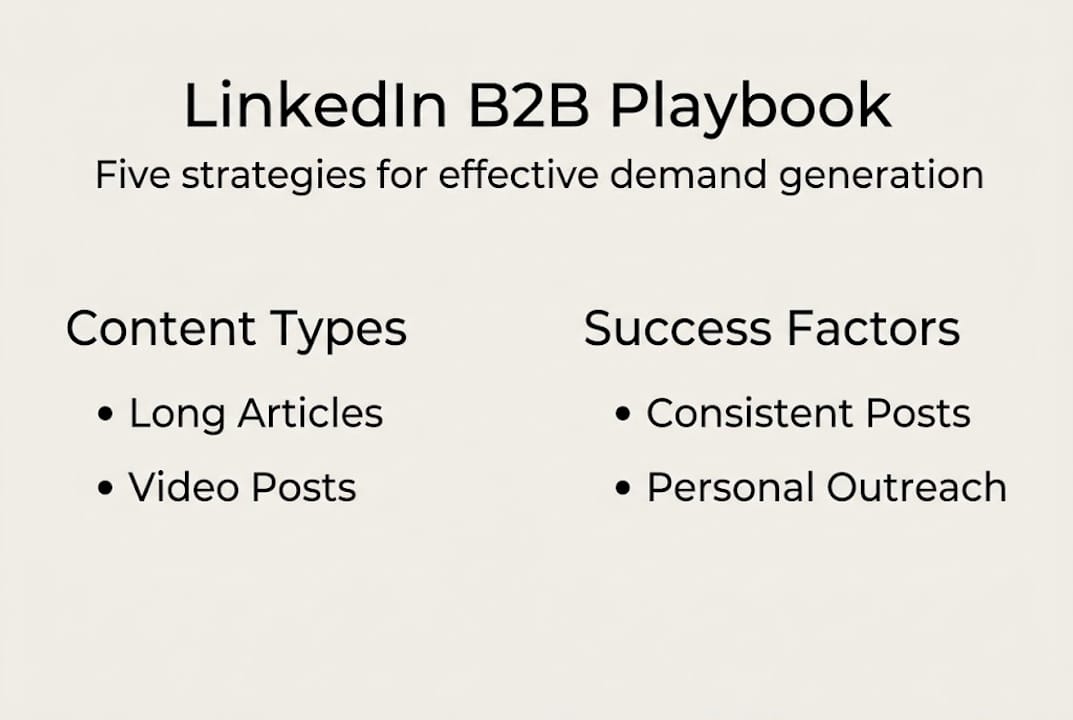
Long-form articles position you as a genuine authority in your field. They take more effort to produce, but they continue to generate views and engagement long after publication. Short-form posts, by contrast, drive immediate engagement and keep you visible in your network's feed on a regular basis. The most effective LinkedIn strategies use both.
Content quality and regular posting are critical for LinkedIn lead generation. Posting three to five times per week consistently outperforms posting daily for two weeks and then going quiet. The algorithm rewards reliability.
Content optimisation practices that actually move the needle:
- Open every post with a strong first line that stops the scroll. LinkedIn truncates posts after two to three lines, so the hook must earn the click to read more
- Use specific numbers and outcomes rather than vague claims. "We reduced client acquisition costs by 34%" is far more compelling than "we improved results"
- Ask a direct question at the end of posts to encourage comments, which signals relevance to the algorithm
- Share genuine opinions and contrarian takes. Safe, generic content is ignored; a clear point of view builds a following
- Document real client results, lessons learned, and behind-the-scenes processes. Authenticity consistently outperforms polished corporate messaging
Pro Tip: Employee advocacy is one of the most underused levers in B2B LinkedIn marketing. When your team members share and engage with company content, the organic reach multiplies significantly. A simple internal programme encouraging five to ten employees to engage weekly can triple your content's visibility without any additional budget. You can find more LinkedIn content tips to support your team's activity.
Video content is growing rapidly on LinkedIn and currently receives above-average organic reach. Short, talking-head videos of 60 to 90 seconds that address a specific pain point perform particularly well with B2B audiences.
Optimising outreach and nurturing leads on LinkedIn
Effective content brings attention; optimised outreach converts that attention into actual leads. Many B2B marketers produce good content but then fail to follow up with the people who engage with it. That is a missed opportunity every single time.

Automation tools can increase LinkedIn outreach efficiency for B2B marketing teams significantly, but the key is using them intelligently rather than blasting generic messages at scale.
A proven outreach sequence for B2B lead nurturing:
- Identify warm prospects: Start with people who have liked, commented on, or shared your content. They already know who you are, which dramatically improves connection acceptance rates.
- Send a personalised connection request: Reference something specific, a post they commented on, a shared connection, or a relevant industry topic. Keep it to two sentences.
- Deliver value in the first message: After connecting, do not pitch immediately. Share a useful resource, a relevant article, or a genuine observation about their business. Build rapport first.
- Follow up with a soft ask: After one or two value-add messages, introduce what you do and ask a low-commitment question. "Would it be useful to have a brief conversation about X?" works far better than a hard sell.
- Move non-responders to a nurture sequence: Not everyone is ready to buy now. Tag prospects in your CRM and re-engage every four to six weeks with fresh value.
"The B2B marketers seeing the best results on LinkedIn in 2026 are not the ones sending the most messages. They are the ones sending the most relevant messages to the most precisely defined audience."
Pro Tip: Segment your LinkedIn audience before building outreach sequences. A CFO at a 50-person professional services firm has entirely different concerns from a sales director at a 200-person technology company. Tailored nurture campaigns that speak to specific roles and industries consistently outperform generic sequences. For a deeper look at building this process, explore effective LinkedIn lead generation approaches that align with your sales goals.
Common outreach mistakes to avoid include sending connection requests without a personalised note, pitching in the first message, and following up too aggressively. Each of these behaviours damages your reputation and reduces your chances of building genuine relationships.
A fresh perspective: Why consistency and personalisation trump quick wins
Here is the uncomfortable truth that most LinkedIn "growth hacks" conveniently ignore. The marketers chasing shortcuts, whether that is bulk automation, templated messages sent to thousands of contacts, or viral post formulas, are building on sand. They might see a spike in activity, but they rarely build a sustainable pipeline.
In our experience working with B2B companies, the results that genuinely compound over time come from two things: showing up consistently and treating every prospect like a human being rather than a conversion target. That sounds obvious, but the pressure to hit short-term pipeline numbers pushes many teams towards tactics that actively undermine trust.
"Building demand means building relationships. Automation is a tool, not a substitute."
The businesses that win on LinkedIn are those that commit to purpose-driven LinkedIn content and genuine outreach over a sustained period. Six months of consistent, personalised activity will outperform six months of high-volume automation every single time. Patience is not a weakness in demand generation. It is a competitive advantage.
Take your LinkedIn demand generation strategy to the next level
If you are ready to move from theory to practice, expert support can accelerate your results significantly. Building and executing a LinkedIn demand generation strategy takes time, skill, and consistent effort, and many marketing managers simply do not have the bandwidth to do it all in-house.
At In-Social, we combine human expertise with advanced tools to build LinkedIn strategies that generate real pipeline for B2B businesses. Whether you need a fully managed LinkedIn service or a targeted LinkedIn lead generation programme that avoids cold outreach, we tailor everything to your specific goals and audience. Get in touch today to find out how we can help you turn LinkedIn into your most reliable source of qualified leads.
Frequently asked questions
What is demand generation on LinkedIn in B2B marketing?
Demand generation on LinkedIn uses targeted content, outreach, and lead nurturing to build awareness and attract qualified business prospects. LinkedIn generates more B2B leads than other social platforms, making it the most effective channel for this purpose.
How do I structure a LinkedIn demand generation campaign?
A LinkedIn campaign should combine audience targeting, engaging content, personalised outreach, and metrics tracking for optimal results. A holistic LinkedIn strategy that integrates both content and outreach consistently outperforms single-channel approaches.
Which LinkedIn content formats are best for generating leads?
Long-form articles, interactive posts, and video tend to drive higher engagement and conversions with B2B audiences. Content quality and regular posting together determine how well your content performs over time.
How can automation help LinkedIn demand generation?
Using automation tools can boost outreach efficiency significantly but must be balanced with thoughtful personalisation to build genuine relationships and maintain your professional reputation.