

Finding the right approach to LinkedIn content can feel like navigating a maze for many B2B marketing managers. Success depends on understanding exactly which companies you want to reach and what outcomes matter most. By focusing on clarity of target audience and content goals, you will attract the right business buyers, build trust, and drive measurable engagement that supports your sales cycle.
Table of Contents
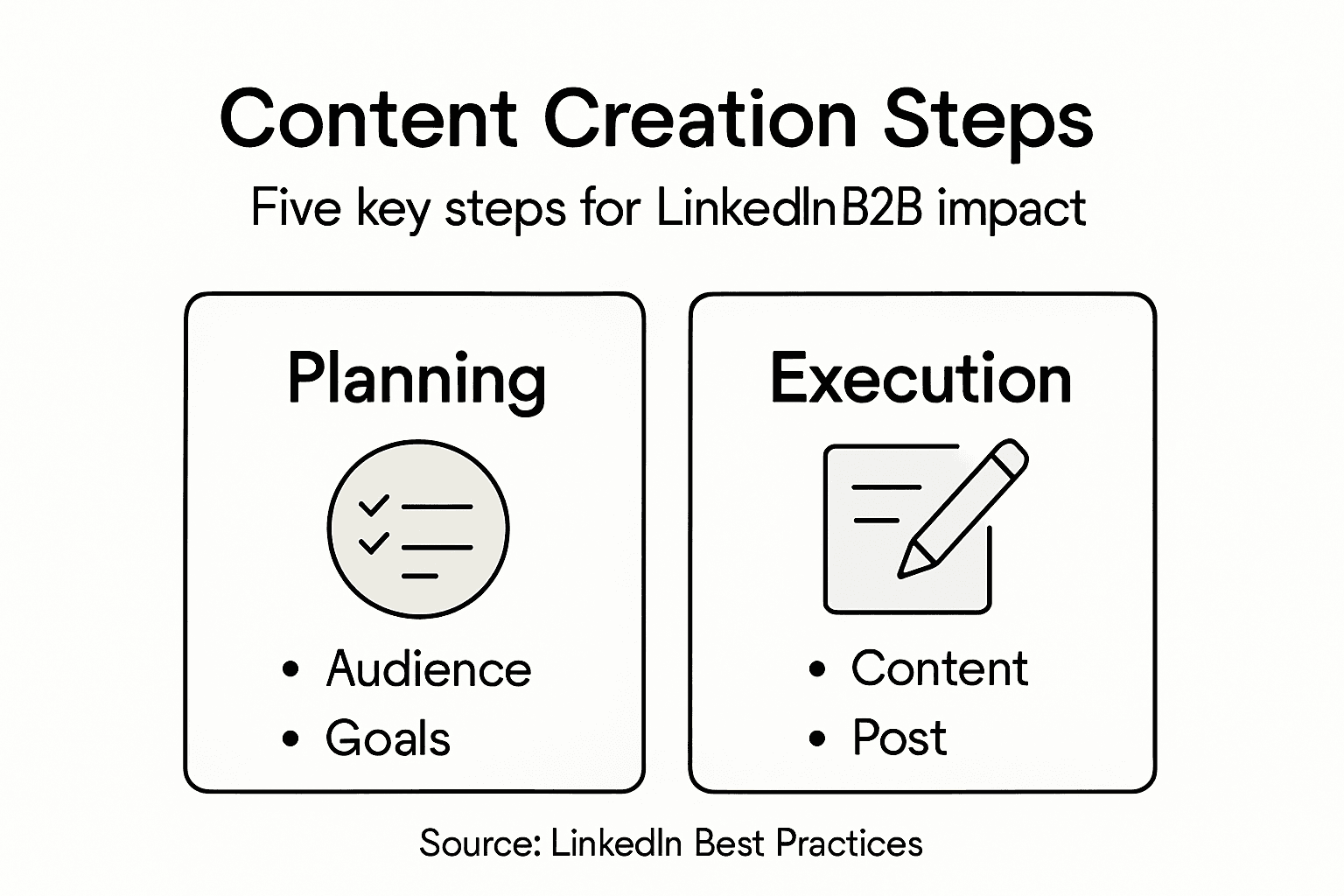
- Step 1: Define target audience and content goals
- Step 2: Plan content themes and posting schedule
- Step 3: Craft engaging LinkedIn posts with AI tools
- Step 4: Optimise posts for reach and interaction
- Step 5: Review analytics and refine your strategy
Quick Summary
| Essential Insight | Explanation |
|---|---|
| 1. Define Your Target Audience | Understand the characteristics of your ideal clients for effective B2B marketing strategies. |
| 2. Set Measurable Content Goals | Establish specific, quantifiable goals to track success in your LinkedIn efforts. |
| 3. Create a Consistent Posting Schedule | Plan regular content updates to engage your audience without overwhelming yourself. |
| 4. Optimise for Visibility and Engagement | Use keywords and questions to enhance post reach and encourage audience interaction. |
| 5. Regularly Review Analytics | Analyse performance metrics to refine strategy and improve content effectiveness over time. |
Step 1: Define target audience and content goals
Your LinkedIn content strategy starts with clarity. You need to know exactly who you're trying to reach and what you want them to do. Without this foundation, your content becomes generic and your effort scatters across audiences that may never convert.
Begin by understanding your business buyers. Unlike consumer marketing, B2B audiences make decisions collectively. Research shows that defining a target audience involves identifying specific characteristics like company size, industry, job titles, and buying challenges. For LinkedIn, this means moving beyond demographics to what professionals call firmographics—the business equivalent of knowing your audience.
Start with these questions about your ideal client:
- What industry or verticals do they operate in?
- What company sizes are they at (revenue, employee count)?
- Which job titles and departments make purchasing decisions?
- What problems do they face that your service solves?
- How long is their typical sales cycle?
Once you understand who you're reaching, define your content goals. B2B content builds trust and demonstrates ROI across longer sales cycles. Your goals might include generating qualified leads, establishing thought leadership, supporting sales conversations, or building brand awareness within your sector.
Make your goals measurable and specific. Rather than "increase engagement," aim for "generate 25 qualified leads per month from LinkedIn posts" or "achieve 500 profile views monthly from target accounts." This clarity helps you choose the right content types and measure what actually works.
Next, map your buyer journey. Most B2B decisions involve multiple stakeholders at different stages. Some audiences need awareness content about industry trends. Others need proof that your solution works. Many need reassurance before committing. Your content goals should address these different stages, not just the final sale.
Document everything in a simple one-page reference. Include your target audience profile, their key pain points, your content goals, and the metrics you'll track. Return to this document regularly. It keeps your content focused and prevents you from chasing every trending topic that passes by.
Your target audience clarity determines whether you attract qualified prospects or waste time on connections who'll never buy.
Pro tip: Interview your existing best customers to uncover the real firmographic patterns and decision-making triggers that actually drive sales—what your data assumes and what actually happens are often different.
Step 2: Plan content themes and posting schedule
Consistency beats perfection on LinkedIn. Your audience needs regular content to stay engaged, and you need a plan to make it manageable without burning out. This step transforms your target audience insights into an actual publishing calendar.
Start by mapping your content themes to your audience's journey. Content themes should align with different stages of awareness, consideration, and decision. Think about what your buyers need at each stage. Early-stage prospects need educational content about industry challenges. Mid-stage prospects want to see how solutions work. Late-stage prospects need case studies and ROI proof.
Create four to six core themes that reflect these stages:
- Awareness content: Industry trends, challenges, research findings
- Educational content: How-to guides, best practices, skill development
- Solution-focused content: Product benefits, comparisons, implementation tips
- Social proof: Case studies, testimonials, customer success stories
- Thought leadership: Insights, predictions, expert commentary
- Engagement content: Questions, polls, behind-the-scenes glimpses
Once your themes are set, develop a consistent posting schedule that maintains regular contact with prospects. This doesn't mean posting multiple times daily. For most B2B marketing managers, three to five posts per week on LinkedIn works well. The key is consistency you can actually sustain.
Plan your posts weekly or monthly using a simple spreadsheet or content calendar tool. Include the publishing date, theme, content type, and key message. This prevents last-minute scrambling and ensures you balance themes evenly across weeks.
Think about optimal posting times for your audience. LinkedIn usage patterns peak on weekday mornings when professionals check in before work, and again during lunch. Test posting at different times and track which generates the most engagement with your specific audience.
Remember that B2B sales cycles are long. Your content calendar should repeat themes regularly because prospects at different stages need different messages. You're not boring your existing audience by revisiting topics—you're reaching new prospects who missed your earlier posts.
A realistic posting schedule you maintain beats an ambitious one you abandon after two weeks.
Pro tip: Batch-create your content monthly so you're writing when you're in the right headspace, then schedule posts throughout the month to maintain consistency without daily stress.
Step 3: Craft engaging LinkedIn posts with AI tools
AI has transformed how B2B marketers write posts. Rather than staring at a blank screen, you now have tools that generate ideas, refine your messaging, and optimise for engagement. The key is knowing how to use them effectively without sounding robotic.

Start by using AI to generate headline variations. Your opening line determines whether people scroll past or stop to read. Feed your AI tool a core idea—say, "LinkedIn best practices for lead generation"—and generate 10 headline options. AI tools streamline content creation by suggesting engaging headlines and enhancing language clarity across your posts. Pick the strongest three and test them with small audiences before committing.
Next, use AI to enhance your core message. Write your main point in conversational language, then use AI to improve clarity without losing your voice. Ask it to strengthen weak verbs, remove jargon, or make technical concepts accessible. The AI does the heavy lifting on refinement while you maintain control of the direction.
AI excels at personalisation too. Feed your tool information about your target audience—their pain points, industry, job titles—and ask it to reframe your message for maximum relevance. This makes posts feel tailored rather than generic.
Consider these practical uses for AI in post creation:
- Generate multiple versions optimised for different audience segments
- Suggest trending topics and keywords your audience cares about
- Refine calls to action for higher click-through rates
- Develop visual descriptions that complement your images
- Create compelling hooks that work for carousel posts
Remember that crafting compelling LinkedIn posts involves clear messaging, visuals, and calls to action optimised for professional context. AI handles the text generation, but you provide the strategy and authenticity. Never publish AI-generated content without reviewing and personalising it first.
Set aside 15 minutes per post for AI refinement. Your time investment drops significantly compared to writing from scratch, but you maintain quality control.
Here is a comparison of how AI transforms each stage of LinkedIn content creation versus traditional methods:
| Stage | Traditional Approach | AI-Driven Approach | Business Impact |
|---|---|---|---|
| Headline Writing | Manual brainstorming | AI generates varied headlines | Faster, more effective testing |
| Message Refinement | Slow manual editing | AI improves clarity instantly | Consistency, saves time |
| Personalisation | Generic as default | AI tailors for segments | Higher relevance, better reach |
| Visual Integration | Manual matching | AI suggests or describes visuals | Enhanced post engagement |
| Call to Action | Manually drafted | AI optimises wording | Increased conversions |
AI is your writing assistant, not your writer. Your perspective and insights make posts valuable; AI just makes them sharper.
Pro tip: Create an AI prompt template you reuse for similar post types so you spend less time explaining what you want and more time refining the output.
Step 4: Optimise posts for reach and interaction
A well-written post that nobody sees is wasted effort. Optimisation ensures your content reaches the right people and compels them to engage. This step transforms decent posts into ones that drive real conversations and lead generation.
Start with strategic keyword placement. LinkedIn's algorithm favours posts that match what people are searching for. Research keywords your audience uses when looking for solutions in your space. Weave these naturally into your opening line and first few sentences where they carry the most weight. Optimising LinkedIn posts involves using keywords and hashtags aligned with audience activity to enhance visibility and reach.
Next, focus on encouraging conversation. The LinkedIn algorithm rewards posts that generate comments because comments signal genuine engagement. End your posts with questions that invite responses, not ones that feel forced. Instead of "What do you think?" try "What's your biggest challenge with lead generation on LinkedIn?" Specificity triggers better replies.
Consider your post format strategically. Native video and carousel posts perform exceptionally well on LinkedIn because the algorithm prioritises them. When possible, use video or carousel formats rather than static images or text-only posts.
Timing matters more than most marketers realise. Post when your audience is most active. For most B2B audiences, Tuesday through Thursday between 8am and 10am works well. However, track your own analytics because industry patterns vary. LinkedIn provides engagement data showing exactly when your followers are online.
Implement these optimisation tactics:
- Open with a hook that addresses a specific pain point
- Use line breaks to improve readability on mobile devices
- Include one clear call to action (don't overwhelm with multiple asks)
- Tag relevant companies or individuals when appropriate
- Use 3 to 5 relevant hashtags, not more
- Respond to early comments quickly to boost algorithmic visibility
After posting, monitor performance for the first 24 hours. Posts that gain traction early tend to reach more people. If engagement lags, you'll know to adjust your approach for future posts.
Posts optimised for the algorithm reach more people, but posts that spark genuine conversation create actual business relationships.
Pro tip: Track which post types, topics, and posting times generate the most comments and shares from your target audience, then double down on what works rather than experimenting constantly.
Step 5: Review analytics and refine your strategy
Data tells the story your gut feeling might miss. Without reviewing analytics, you're essentially throwing posts into the void and hoping something sticks. This step transforms raw data into actionable insights that make your next month dramatically more effective.
Start by identifying your key metrics. Reviewing analytics is critical to understand how content performs in reaching and engaging your target audience. Focus on metrics that matter to your business goals, not vanity numbers. If your goal is lead generation, prioritise clicks to your website and profile views from target accounts. If it's thought leadership, track shares and comments that indicate substantive engagement.
Pull your LinkedIn analytics weekly or monthly. Look for patterns, not individual posts. Which topics generated the most engagement? Did carousel posts outperform text-only ones? Did certain posting times consistently perform better? These patterns reveal what your audience genuinely wants.
Track these critical performance indicators:
Here is a summary of key LinkedIn metrics and what they reveal about your strategy:
| Metric | What It Measures | Strategic Insight |
|---|---|---|
| Engagement Rate | Reactions, comments, shares | Content relevance and value |
| Click-Through Rate | Link clicks per post view | Effectiveness of messaging |
| Profile Views | Visits from target accounts | Targeting accuracy |
| Follower Growth | New followers over time | Brand resonance and growth |
- Engagement rate (comments, reactions, shares combined)
- Click-through rate to your website or landing pages
- Profile views from your target industry or company size
- Connection requests from qualified prospects
- Follower growth rate month over month
- Time spent on posts (LinkedIn shows this metric)
Analysing analytics data enables refinement of content strategies by identifying top-performing post types and optimal posting times. Use this feedback to adjust your approach. If video posts get 3x more engagement than images, shift your content mix. If Tuesday mornings outperform Wednesday afternoons, adjust your posting schedule accordingly.
Here's what refinement looks like in practice. Last month your industry trend posts got 2% engagement. Your customer win posts got 8%. This month, increase customer wins to two per week. Reduce trend posts to one per month. This is data-driven adjustment, not guessing.
Set a monthly review meeting with yourself. Spend 30 minutes looking at what worked and what flopped. Document your findings in a simple spreadsheet so you spot trends across months. Seasonal patterns matter too. January content performs differently than summer content.
Numbers don't lie, but they do require interpretation. Track metrics aligned with your actual business goals, not the metrics that look impressive in a report.
Pro tip: Compare your performance against your own historical baseline, not competitor benchmarks, since LinkedIn's algorithm favours established accounts differently than new ones.
Elevate Your LinkedIn Strategy with Expert Guidance and AI Precision
The challenge of creating a focused LinkedIn content strategy that truly resonates with your B2B audience is clear. From defining your target firmographics to crafting engaging, optimised posts and refining your approach based on analytics, many businesses struggle to consistently convert LinkedIn activity into qualified leads and measurable sales growth. The article highlights how understanding buyer journeys, maintaining a sustainable posting schedule, and leveraging AI tools for content creation are vital for maximum impact.
At in-social.co.uk, we specialise in transforming these complex content creation steps into streamlined, results-driven strategies tailored to small and medium-sized B2B companies. Our expert team combines human insight with advanced AI to personalise your LinkedIn posts, enhance engagement, and optimise reach based on your unique business goals. Whether you need comprehensive LinkedIn management, bespoke content creation, or targeted training to empower your sales teams, we provide the clarity and consistency your LinkedIn presence demands.
Take control of your LinkedIn performance now by partnering with the agency that understands the full LinkedIn content creation process for B2B impact. Visit in-social.co.uk to book a free consultation and start generating qualified leads with confidence today.
Frequently Asked Questions
How do I define my target audience for LinkedIn content?
You can define your target audience by identifying characteristics such as industry, company size, job titles, and specific buying challenges. Start by creating a profile of your ideal client and document their key pain points to tailor your content effectively.
What are some effective content themes for B2B LinkedIn posts?
Effective content themes for B2B posts include industry trends, educational how-to guides, solution-focused content, social proof through case studies, and thought leadership insights. Plan to develop four to six core themes that align with the different stages of your audience's journey to maintain engagement.
How often should I post on LinkedIn for maximum engagement?
Aim to post three to five times a week on LinkedIn to maintain regular contact with your audience. Create a content calendar to schedule your posts consistently, which helps keep your audience engaged without overwhelming yourself.
How can I use AI to enhance my LinkedIn posts?
You can use AI tools to generate headline variations, refine your messaging, and personalise content for different audience segments. Dedicate around 15 minutes per post to utilise AI effectively while ensuring you maintain the authenticity of your message.
What key metrics should I track for my LinkedIn content performance?
Focus on tracking metrics such as engagement rate, click-through rate, profile views, and follower growth rate. Regularly analyse these metrics to identify patterns and refine your strategy, adjusting your content types and posting times based on what resonates most with your audience.
How can I optimise my LinkedIn posts for better reach?
To optimise your LinkedIn posts, incorporate strategic keyword placements and encourage conversation by asking specific questions. Use engaging formats like video or carousel posts and consider posting during peak engagement times, such as Tuesday to Thursday mornings, to maximise visibility.
Recommended
- IN Social
- Content Marketing: Succeed with Impactful Content Strategies
- Content Creation Best Practices for Humanized SEO Success