

Many UK B2B sales teams believe posting daily on LinkedIn maximises visibility, yet data reveals over-posting reduces engagement by up to 18%. The most effective LinkedIn content strategies for small to medium-sized businesses balance frequency, format and messaging to generate qualified leads whilst building brand authority. This guide explores proven techniques that drive measurable results for UK SMB sales and marketing teams seeking to optimise their LinkedIn presence and convert connections into revenue opportunities.
Table of Contents
- Introduction to LinkedIn content strategy for B2B SMBs
- Audience targeting and segmentation on LinkedIn
- Effective LinkedIn content formats to boost engagement
- Optimal posting frequency and timing for maximum visibility
- Balancing brand voice and sales intent in LinkedIn content
- Common pitfalls and misconceptions in LinkedIn content strategy
- How to use LinkedIn analytics to optimize content strategy
- Case studies relevant to UK SMB B2B companies
- Get expert support for your LinkedIn content strategy
- Frequently asked questions
Key takeaways
| Point | Details |
|---|---|
| Targeted content boosts conversions | Audience segmentation and personalised messaging improve lead conversion rates by up to 30% |
| Optimal posting frequency matters | Publishing 3-5 times weekly maximises visibility without causing audience fatigue |
| Rich media outperforms text-only | Posts with video or images receive over 50% more engagement than plain text |
| Analytics drive continuous improvement | Using LinkedIn analytics tools leads to a 15% average uplift in lead generation through iterative optimisation |
| Storytelling doubles engagement | Narrative-driven content generates roughly twice the interaction compared to direct sales pitches |
Introduction to LinkedIn content strategy for B2B SMBs
LinkedIn remains the primary social platform for professional B2B engagement in the UK, with over 33 million members actively seeking business solutions and industry insights. For small to medium-sized businesses, this represents an unparalleled opportunity to connect directly with decision-makers, showcase expertise and generate qualified leads without traditional advertising costs.
Effective LinkedIn content serves dual purposes for UK SMBs. It establishes brand authority through thought leadership whilst simultaneously nurturing prospects through the sales funnel. Unlike other social platforms where B2B messaging often feels intrusive, LinkedIn users actively expect and engage with business-focused content, creating a receptive environment for strategic messaging.
The challenge facing UK SMBs centres on standing out in an increasingly crowded digital space. Every competitor recognises LinkedIn's potential, meaning generic content disappears into the noise. Success requires a strategic approach that balances audience needs with business objectives, delivering consistent value whilst maintaining clear commercial intent.
Key strategic considerations for UK B2B SMBs include:
- Aligning content topics with buyer pain points and industry challenges
- Maintaining consistent publishing schedules that build audience anticipation
- Balancing educational content with promotional messaging to preserve trust
- Leveraging platform-specific features like LinkedIn Groups and company pages
- Measuring performance metrics to refine strategy based on actual engagement data
Audience targeting and segmentation on LinkedIn
Precise audience targeting transforms LinkedIn content from generic broadcasting into personalised conversations that resonate with specific buyer personas. Research consistently demonstrates that targeted messaging improves lead conversion by up to 30% compared to broad-based campaigns, making segmentation essential for resource-constrained UK SMBs seeking maximum return on content investment.
Defining buyer personas starts with analysing your existing customer base. Identify common job titles, industries, company sizes and professional challenges among your best clients. LinkedIn's advanced search filters enable you to locate similar prospects by combining criteria like seniority level, geographic location and functional area, creating focused audience segments for tailored content strategies.
Segmentation tactics extend beyond basic demographics. Join and monitor LinkedIn Groups relevant to your target industries, observing conversations to understand pressing concerns and knowledge gaps. Track which job titles engage most with your content, then create messaging that speaks directly to their specific responsibilities and objectives. This granular approach ensures every post delivers relevant value to defined audience segments.
Pro Tip: Create separate content calendars for different buyer personas, alternating posts that address specific challenges faced by sales directors, marketing managers and business owners. This rotation maintains broad appeal whilst ensuring each audience segment receives regular targeted content.
Effective segmentation methods include:
- Filtering prospects by job function to address role-specific challenges
- Targeting specific industries with tailored case studies and examples
- Segmenting by company size to match solution complexity with organisational needs
- Using LinkedIn's geographic filters to focus on UK-based decision-makers
Effective LinkedIn content formats to boost engagement
Content format selection dramatically impacts engagement rates and lead generation effectiveness on LinkedIn. Posts incorporating rich media receive over 50% more engagement than text-only updates, making visual elements essential for cutting through platform noise and capturing audience attention in crowded feeds.

Video content particularly resonates with B2B audiences, combining visual appeal with information density. Short-form videos under 90 seconds generate highest completion rates, ideal for quick tips, product demonstrations or client testimonials. Native LinkedIn video posts receive 5 times more engagement than shared YouTube links, as the platform algorithm prioritises content keeping users on-site.
Written posts remain valuable when optimised for platform behaviour. Short-form updates around 150 words consistently outperform longer articles in engagement metrics, though long-form posts excel for demonstrating deep expertise on complex topics. Interactive formats like polls drive exceptional engagement by inviting participation, often generating 3-4 times more comments than standard posts whilst providing valuable audience insights.
| Content Format | Average Engagement Rate | Best Use Case | Production Complexity |
|---|---|---|---|
| Short video (60-90 seconds) | High | Product demos, quick tips | Medium |
| Image posts with captions | High | Data visualisation, quotes | Low |
| Text-only updates (150 words) | Medium | Thought leadership, questions | Low |
| Long-form articles (1200+ words) | Low engagement, high authority | Deep expertise, SEO | High |
| LinkedIn polls | Very high | Audience research, discussion starters | Low |
| Document carousels | High | Multi-step guides, comparison charts | Medium |
Pro Tip: Repurpose successful blog content into LinkedIn document carousels by breaking key points into individual slides. This format receives strong engagement whilst driving traffic to your website for complete information.
Content format best practices:
- Test multiple formats weekly to identify what resonates with your specific audience
- Include captions on all videos for silent mobile viewing
- Use high-quality images that maintain clarity on mobile devices
- Explore LinkedIn's content format add-ons to enhance production quality
Optimal posting frequency and timing for maximum visibility
Posting frequency significantly influences LinkedIn visibility and audience engagement. Research confirms that publishing 3-5 times per week maximises reach without triggering audience fatigue, striking the crucial balance between maintaining presence and overwhelming followers with excessive content.
Timing matters equally for UK B2B audiences. Weekday mornings between 7-9am capture professionals checking LinkedIn during commutes or before meetings start. Tuesday through Thursday posts typically achieve highest engagement, as Monday focus centres on workload planning whilst Friday attention shifts toward weekend plans. Lunchtime posts between 12-1pm and early evening updates around 5-6pm also perform well.
Audience fatigue emerges as a real concern when posting exceeds 5 times weekly. Followers begin scrolling past content from over-active accounts, reducing engagement rates and algorithm visibility. Quality consistently trumps quantity on LinkedIn, where a single well-crafted post often generates more leads than multiple mediocre updates.
| Posting Frequency | Typical Engagement Impact | Recommended For |
|---|---|---|
| 1-2 times per week | Low visibility, inconsistent audience building | Testing phase only |
| 3-5 times per week | Optimal engagement and reach | Most B2B SMBs |
| 6-10 times per week | Declining engagement, audience fatigue | Large enterprises with diverse content teams |
| Daily or more | Significant engagement drop, unfollows | Not recommended |
Implementing an effective posting schedule:
- Start with 3 posts weekly, scheduled for Tuesday, Wednesday and Thursday mornings
- Monitor engagement metrics for 4 weeks to establish baseline performance
- Test additional posting days and times based on when your audience actively engages
- Adjust frequency up to 5 weekly posts only if engagement rates remain stable
- Maintain consistent timing so followers anticipate your content
"Consistency matters more than frequency. Three quality posts published reliably each week outperform sporadic daily posting that inevitably becomes unsustainable for resource-constrained SMB teams."
Balancing brand voice and sales intent in LinkedIn content
Authentic storytelling generates approximately double the engagement compared to direct sales pitches on LinkedIn, yet B2B SMBs must ultimately drive revenue from their content efforts. The solution lies in balancing educational value with commercial intent, positioning your business as a trusted advisor rather than a persistent salesperson.
The 80/20 rule provides practical guidance for content balance. Dedicate roughly 80% of posts to genuinely helpful insights, industry analysis, practical tips and thought leadership that addresses audience challenges without promoting your services. Reserve the remaining 20% for explicit promotional content showcasing solutions, client successes and service offerings.
Story-driven posts humanise your brand whilst demonstrating expertise. Share behind-the-scenes glimpses of how your team solves client problems, discuss lessons learned from challenging projects or highlight employee expertise. These narratives build emotional connections and trust, making audiences receptive when promotional content appears.
Maintaining credibility requires resisting the temptation to include sales calls-to-action in every post. When audiences sense excessive commercial intent, engagement plummets and unfollows increase. Position promotional content as natural extensions of educational posts, demonstrating how your solutions address challenges previously discussed.
Brand voice integration techniques:
- Frame promotional posts as case studies showing real problem-solving, not product features
- Use client testimonials that tell stories rather than generic praise
- Share industry insights that subtly demonstrate your expertise and positioning
- Respond authentically to comments, building relationships beyond broadcasting
Common pitfalls and misconceptions in LinkedIn content strategy
Many UK SMBs sabotage LinkedIn success through persistent myths and strategic errors. The belief that more posts automatically generate better results represents the most damaging misconception, with excessive posting actually reducing engagement by up to 18% through audience fatigue and algorithm penalties for over-active accounts.
Content format misunderstandings similarly limit effectiveness. Some businesses assume professional audiences prefer formal, corporate-style posts, yet conversational, personality-driven content consistently outperforms sterile corporate messaging. Others invest heavily in long-form articles whilst ignoring short-form posts that generate higher immediate engagement and broader reach.
The gravest mistake involves publishing without measuring results. Countless SMBs maintain consistent LinkedIn activity whilst completely ignoring analytics, continuing ineffective strategies because they lack performance visibility. Without data-driven iteration, content strategy becomes guesswork rather than systematic optimisation toward business objectives.
Pro Tip: Review LinkedIn analytics monthly rather than daily. Weekly fluctuations create misleading patterns, whilst monthly analysis reveals genuine trends worth acting upon. Focus on engagement rate percentages rather than absolute numbers, as follower growth naturally increases raw metrics over time.
Critical mistakes to avoid:
- Copying competitors' content strategies without testing fit for your specific audience
- Focusing solely on follower count rather than engagement quality and lead generation
- Abandoning tactics after brief trials before gathering statistically meaningful data
- Neglecting to optimise company pages alongside personal profiles
- Treating LinkedIn as a broadcasting platform rather than building genuine conversations
- Failing to align content topics with buyer journey stages and decision-making needs
Understanding whether LinkedIn suits your sales strategy prevents wasted effort on misaligned tactics. Some business models generate better results through alternative channels, making strategic assessment essential before committing significant resources.
How to use LinkedIn analytics to optimize content strategy
LinkedIn analytics transforms content strategy from intuition-based activity into data-driven optimisation that systematically improves results. Research demonstrates that using analytics tools leads to a 15% average uplift in lead generation through continuous refinement based on actual audience behaviour rather than assumptions about what should work.
Engagement rate stands as the single most important metric, measuring total interactions (likes, comments, shares) as a percentage of impressions. This normalised metric enables fair comparison across posts regardless of follower count fluctuations. Engagement rates above 2% indicate strong content resonance, whilst rates below 1% signal need for strategic adjustment in topics, formats or targeting.
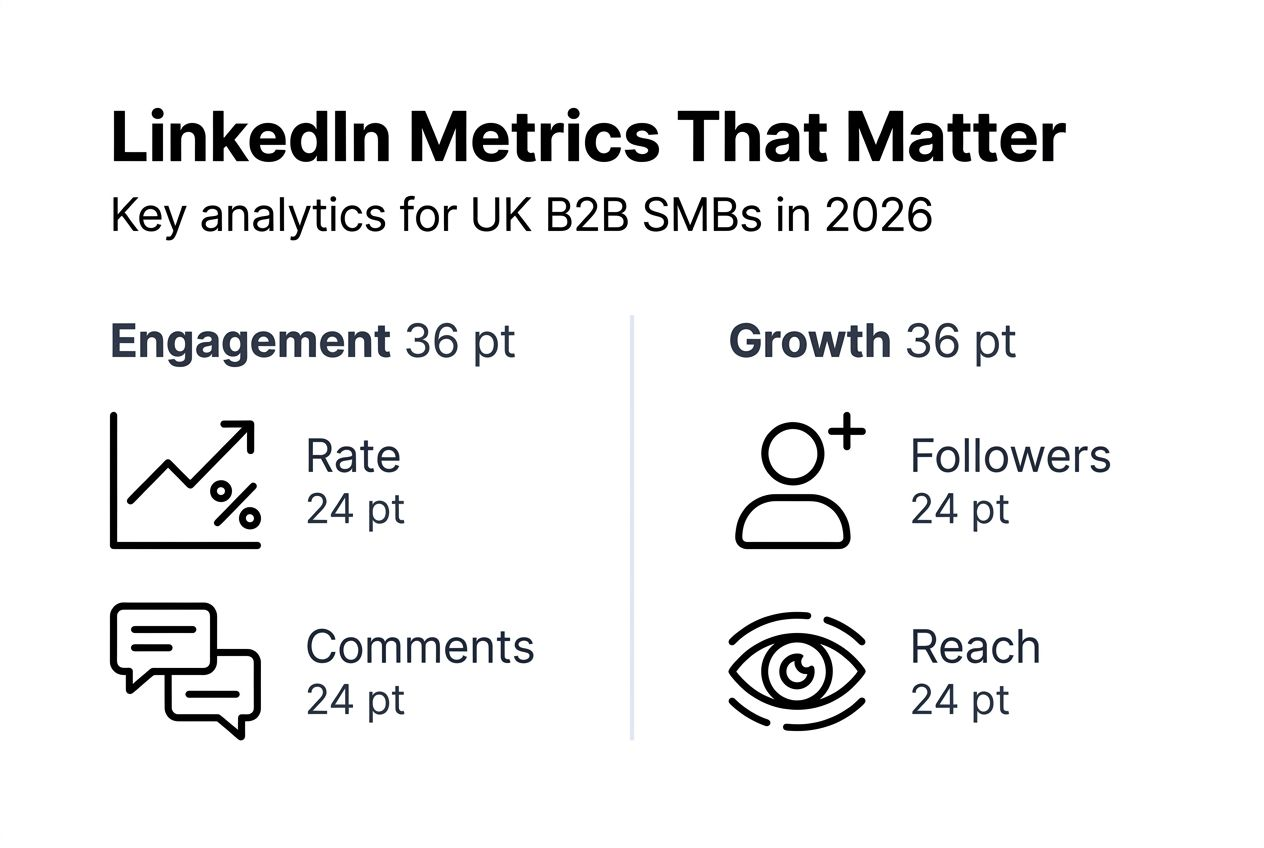
Follower growth tracking reveals whether content attracts your target audience. Steady increases validate strategic direction, whilst plateaus or declines indicate messaging misalignment. Analyse which specific posts correlate with follower spikes, then create similar content to replicate growth patterns and expand reach within target segments.
Post reach metrics show how many unique users view your content, influenced by both follower count and algorithm amplification from engagement. Comparing reach across different posting times, days and formats identifies optimal publishing patterns for your specific audience behaviour, enabling schedule refinement that maximises organic visibility.
Key metrics for iterative improvement:
- Monitor engagement rate trends to identify content topics generating strongest audience response
- Track click-through rates on links to measure content effectiveness at driving website traffic
- Analyse demographic data of engaged users to refine targeting and messaging
- Compare performance across content formats to allocate resources toward highest-performing types
- Review follower job titles and industries monthly to ensure audience alignment with ideal customers
Implementing managed LinkedIn services provides expert interpretation of analytics data, translating metrics into actionable strategy adjustments that accelerate results. Professional analysis identifies subtle patterns and opportunities that inexperienced teams often miss, particularly regarding lead generation strategies that convert engagement into qualified sales conversations.
Regular analysis using LinkedIn analytics tools combined with broader marketing analytics strategies creates comprehensive visibility into content performance. This systematic approach enables confident strategy decisions based on evidence rather than guesswork, essential for resource-constrained SMBs requiring maximum return from limited marketing investment.
Case studies relevant to UK SMB B2B companies
Real UK SMB success stories demonstrate practical application of LinkedIn content best practices and quantify achievable results for businesses implementing strategic approaches. These examples prove that systematic content strategies generate measurable improvements in lead volume, engagement rates and brand visibility for companies similar to yours.
M8 Solutions exemplifies effective LinkedIn transformation for a UK technology provider. By implementing targeted content addressing specific IT challenges faced by their ideal clients, they increased qualified lead volume by 47% within six months. Their strategy focused on short-form technical tips and client success stories, posted consistently three times weekly during optimal engagement windows.
Infigo's LinkedIn success centred on content format optimisation. Shifting from text-only posts to rich media content incorporating product demonstration videos and customer testimonials increased their engagement rate from 1.2% to 3.8%. This dramatic improvement translated directly into pipeline growth, with LinkedIn-sourced opportunities increasing from 12% to 31% of total sales pipeline.
Healthpath Pro demonstrates the power of audience segmentation and personalised messaging. Creating separate content streams for different healthcare buyer personas, they improved conversion rates by 34% compared to their previous broad-based approach. Their analytics-driven iteration process identified optimal posting times and formats specific to their audience, enabling continuous performance enhancement.
Common success factors across UK SMB case studies:
- Consistent posting schedules maintained over minimum six-month periods
- Strategic content mix balancing educational value with commercial messaging
- Regular analytics review driving iterative refinement based on performance data
- Investment in quality content production rather than excessive posting frequency
- Clear alignment between LinkedIn content topics and core business offerings
Get expert support for your LinkedIn content strategy
Implementing effective LinkedIn content strategies requires ongoing commitment, strategic expertise and continuous optimisation based on performance data. Many UK SMBs struggle to maintain consistent quality whilst managing day-to-day business demands, limiting their ability to fully capitalise on LinkedIn's lead generation potential.
IN Social specialises in managed LinkedIn services tailored specifically for B2B SMBs seeking measurable results without diverting internal resources from core activities. Our team combines deep platform expertise with proven lead generation strategies that transform LinkedIn presence into reliable revenue pipelines. Whether you need complete content management or strategic guidance for internal teams, we deliver solutions aligned with your specific business objectives and growth targets. Discover how IN Social can accelerate your LinkedIn results through expert strategy and execution.
Frequently asked questions
What is the best posting frequency for LinkedIn content in 2026?
The optimal frequency is 3-5 posts per week, which maximises visibility and lead generation without causing audience fatigue. This balance maintains consistent presence whilst allowing time to create quality content that genuinely serves your audience. Posting more frequently typically reduces engagement rates as followers become overwhelmed.
How can LinkedIn analytics improve my content strategy?
LinkedIn analytics enable you to measure engagement rates, post reach and follower growth, identifying which content types and topics resonate most with your audience. Using analytics tools leads to a 15% average uplift in lead generation by revealing optimal posting times, formats and messaging approaches. Regular review allows iterative refinement that systematically improves results over time, particularly when combined with strategic sales guidance.
What types of content perform best for B2B lead generation on LinkedIn?
Rich media posts incorporating video or images consistently outperform alternatives, with posts including visuals receiving over 50% more engagement than text-only updates. Short-form posts around 150 words generate higher engagement rates than long-form articles, whilst interactive content like polls drives exceptional participation. The most effective approach combines multiple formats strategically rather than relying exclusively on any single type.
How do I balance educational content with promotional messaging?
Apply the 80/20 rule by dedicating approximately 80% of posts to genuinely helpful insights, practical tips and thought leadership that address audience challenges without explicit promotion. Reserve the remaining 20% for showcasing solutions, client successes and service offerings. This balance builds trust and positions your business as a valuable resource, making audiences receptive when promotional content appears naturally within your content mix.