

TL;DR:
- LinkedIn generates 277% more B2B leads than Facebook or Twitter due to decision-maker access and trust.
- Focusing on quality connections and authentic engagement yields better results than just increasing connection numbers.
- Tracking relevant metrics like engagement and lead conversions is essential for measuring LinkedIn strategy success.
Most sales teams treat LinkedIn like a digital Rolodex. They connect, forget, and wonder why nothing converts. Yet LinkedIn generates 277% more B2B leads than Facebook or Twitter, making it the single most powerful platform for business development available to you right now. The real issue is not the size of your network. It is what you do with it. This article unpacks the common misconceptions holding sales teams and B2B entrepreneurs back, and gives you a practical, results-focused framework for turning your LinkedIn connections into genuine business opportunities.
Table of Contents
- What makes LinkedIn connections so valuable for B2B?
- Common mistakes: Why most sales teams misuse their networks
- How to strategically leverage LinkedIn connections for business growth
- Measuring results: How to track the true value of your LinkedIn network
- Our take: Why connection quality beats quantity every time
- Take the next step: Unlock LinkedIn-driven growth
- Frequently asked questions
Key Takeaways
| Point | Details |
|---|---|
| Focus on quality | Relevant, engaged LinkedIn connections drive more leads than simply increasing numbers. |
| Avoid common pitfalls | Many sales teams waste LinkedIn potential by neglecting engagement and alignment. |
| Leverage strategic steps | Segment, nurture, and activate LinkedIn networks for tangible business growth. |
| Track meaningful metrics | Measure engagement, conversions, and ROI to refine your LinkedIn strategy. |
What makes LinkedIn connections so valuable for B2B?
LinkedIn is not just another social platform. It is where business decisions get made. The audience is fundamentally different from any other network: over 65 million decision-makers are active on LinkedIn, and the majority are there specifically for professional purposes. That means your connections are not scrolling past cat videos. They are looking for solutions, suppliers, and partners.
This is why LinkedIn for B2B lead generation consistently outperforms other channels. The trust dynamic is built into the platform itself. When someone accepts your connection request, they are signalling professional openness. That is a warm starting point that cold email or paid advertising simply cannot replicate.
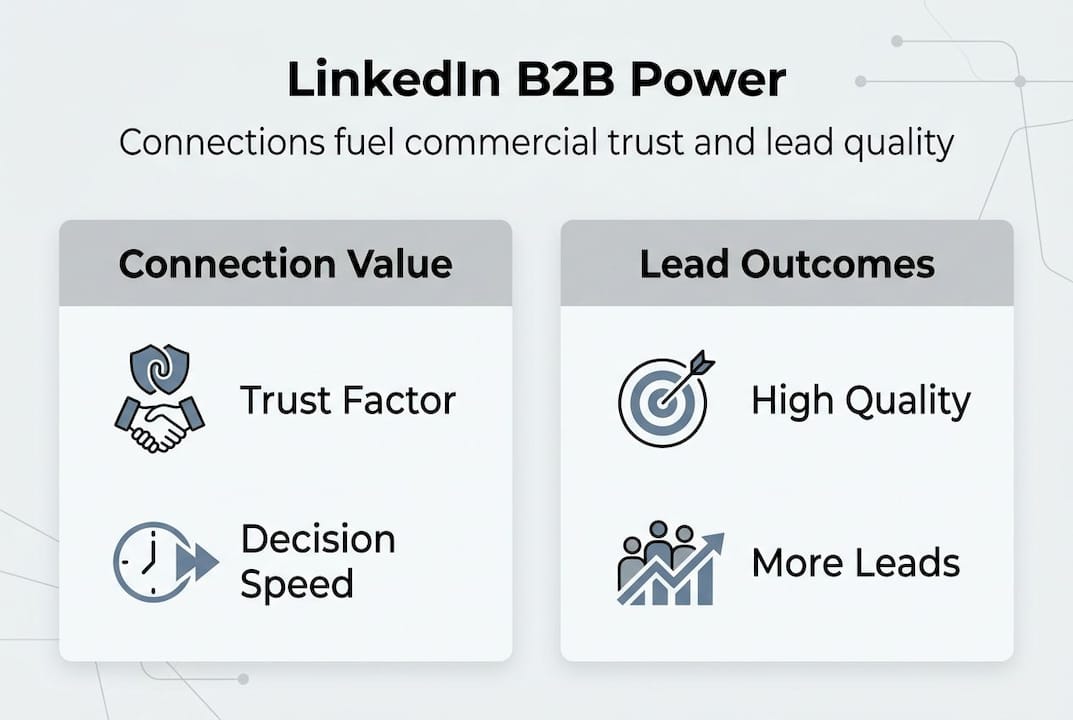
Here is how LinkedIn compares to other platforms for B2B outcomes:
| Platform | B2B lead quality | Audience intent | Trust factor |
|---|---|---|---|
| Very high | Professional | High | |
| Low | Mixed | Low | |
| Twitter/X | Medium | Mixed | Medium |
| Low | Consumer | Low |
The numbers reinforce this. LinkedIn generates 277% more B2B leads than Facebook or Twitter, a gap that continues to widen as more professionals migrate their business conversations to the platform.
Key reasons LinkedIn connections carry more weight for B2B:
- Decision-maker access: You can connect directly with CFOs, MDs, and procurement leads without gatekeepers.
- Context-rich profiles: Every connection comes with a professional history, making personalisation straightforward.
- Relationship signals: Mutual connections, shared groups, and endorsements all build credibility before a single message is sent.
- Intent alignment: People on LinkedIn expect business conversations. They are receptive in a way that audiences on other platforms simply are not.
The foundation of building a LinkedIn network that actually delivers results is understanding this unique environment. Your connections are not just contacts. They are potential advocates, referral sources, and future clients.
Common mistakes: Why most sales teams misuse their networks
Once the importance of quality connections is clear, it is equally vital to avoid mistakes that can undermine your network's potential. The most damaging habit? Treating LinkedIn like a numbers game.
Many B2B professionals focus on quantity over quality, which limits engagement and ultimately reduces the commercial value of the entire network. A profile with 5,000 disconnected contacts will consistently underperform one with 800 highly relevant, actively engaged connections.

Here is a direct comparison of the two approaches:
| Strategy | Connection volume | Engagement rate | Lead quality | Long-term value |
|---|---|---|---|---|
| Quantity-focused | High | Very low | Poor | Minimal |
| Quality-focused | Moderate | High | Strong | Significant |
The most common mistakes sales teams make on LinkedIn:
- Sending generic connection requests with no personalisation or context, which results in low acceptance rates and zero relationship foundation.
- Going silent after connecting, never following up with value, commentary, or conversation.
- Pitching immediately, which destroys trust before it has had any chance to develop.
- Ignoring content engagement, missing the opportunity to stay visible and relevant to connections over time.
- Failing to align outreach with business goals, connecting randomly rather than targeting the right sectors, roles, or company sizes.
The fix is simpler than most teams expect. Your LinkedIn B2B sales guide starts with intention. Every connection request should have a clear reason behind it, and every new connection should enter a simple nurture process rather than disappearing into a growing list.
Pro Tip: Before sending a connection request, spend 60 seconds reviewing the person's recent activity. Comment on something specific in your request message. Acceptance rates improve dramatically, and the conversation starts on a far stronger footing.
To improve LinkedIn engagement across your network, consistency matters more than volume. Showing up regularly with relevant insights keeps you front of mind without requiring a hard sell.
How to strategically leverage LinkedIn connections for business growth
Having seen what to avoid, now focus on what actually works: proven steps to turn connections into tangible business value.
The first move is segmentation. Not all connections are equal, and treating them as if they are wastes your time and theirs. Group your network by role, industry, buying stage, or relationship warmth. This lets you tailor your outreach and content to the right people at the right moment.
"A tailored content strategy amplifies LinkedIn network impact, turning passive connections into active prospects."
Here is a practical framework for activating your LinkedIn connections:
- Segment your network into tiers: warm prospects, cold contacts, referral partners, and industry peers.
- Create content that speaks to each tier, addressing their specific challenges and goals rather than broadcasting generic updates.
- Use LinkedIn messages strategically, not to pitch, but to share relevant articles, congratulate milestones, or ask a genuine question.
- Request introductions through mutual connections where trust already exists. A warm introduction converts at a significantly higher rate than cold outreach.
- Endorse and recommend selectively, as this triggers reciprocity and keeps you visible without any direct selling.
- Identify co-marketing or referral opportunities within your network, particularly with non-competing businesses serving the same audience.
The content workflow for B2B leads is often the missing piece. Posting consistently with value-driven content keeps your profile active in your connections' feeds, so when they are ready to buy, you are already familiar.
Pro Tip: Set aside 20 minutes each morning to engage with three to five connections' posts before publishing your own content. This reciprocal engagement builds goodwill and increases the reach of your own posts organically.
When building your LinkedIn network with this framework in mind, every action compounds. Referral partnerships develop naturally. Sales conversations begin without a cold opener. The pipeline fills through relationship rather than interruption.
Measuring results: How to track the true value of your LinkedIn network
Strategic leveraging is only worthwhile if you can measure its impact, so let us look at specific ways to track and improve results.
Most sales teams track the wrong things. Follower counts and profile views feel satisfying but tell you very little about commercial impact. The metrics that matter are the ones tied directly to business outcomes.
LinkedIn drives 25% more B2B leads for UK SMBs in 2026, but only for those who track and optimise their activity. Without measurement, you are operating on instinct rather than evidence.
Key LinkedIn KPIs to track:
| Metric | What it tells you | Target benchmark |
|---|---|---|
| Connection acceptance rate | Quality of outreach personalisation | Above 30% |
| Engagement rate on posts | Content relevance and audience fit | 2% or above |
| Message response rate | Relationship strength and message quality | Above 20% |
| Leads generated per month | Direct commercial output | Tied to sales targets |
| Introductions made or received | Network activation depth | 2 to 5 per month |
Beyond the numbers, track qualitative signals too:
- Are connections mentioning your content in conversations?
- Are offline meetings or calls being booked through LinkedIn activity?
- Are referrals coming through mutual connections?
- Is your network mix shifting towards your ideal client profile?
Review your LinkedIn B2B lead statistics monthly and adjust your outreach focus accordingly. If your engagement rate is strong but lead conversions are low, the issue is likely in your follow-up process, not your content. If acceptance rates are low, revisit your connection request personalisation.
Measuring LinkedIn engagement consistently gives you the data to make smarter decisions, reduce wasted effort, and double down on what is genuinely working for your business.
Our take: Why connection quality beats quantity every time
We have worked with enough B2B sales teams to say this with confidence: the obsession with connection counts is one of the most persistent and damaging myths in LinkedIn strategy.
Businesses come to us with networks of 8,000 or 10,000 connections and almost no pipeline to show for it. Then there are clients with 600 carefully chosen, actively nurtured connections who are booking calls every week. The difference is not effort. It is intention.
Vanity metrics feel like progress. A growing follower count, rising profile views, hundreds of new connections each month. But none of that translates to revenue unless those connections are relevant, engaged, and part of a deliberate strategy.
Success in B2B networking comes from treating every connection as the beginning of a relationship, not a number on a dashboard. The businesses that win on LinkedIn are the ones who would rather have a genuine conversation with 10 ideal prospects than blast a generic message to 1,000 random contacts.
Quality is not just a nice principle. It is a commercial advantage.
Take the next step: Unlock LinkedIn-driven growth
If this article has made one thing clear, it is that LinkedIn's real power lies in how you manage and activate your connections, not simply how many you have. Knowing the strategy is one thing. Executing it consistently, at scale, while running a business is another challenge entirely.
At in-social.co.uk, we specialise in doing exactly that for B2B sales teams and entrepreneurs. From LinkedIn lead generation solutions that remove the guesswork from outreach, to a fully managed LinkedIn service that handles your presence end to end, we combine human expertise with advanced tools to drive measurable results. If you are ready to turn your LinkedIn network into a consistent source of qualified leads, we are ready to help you get there.
Frequently asked questions
What is the main benefit of leveraging LinkedIn connections?
The main benefit is generating qualified B2B leads and building trust with key decision-makers faster than on any other platform. LinkedIn generates 277% more B2B leads than Facebook or Twitter, making it the highest-value channel for relationship-driven sales.
How do I turn LinkedIn connections into sales opportunities?
Segment your network, engage authentically with value, and use LinkedIn tools to nurture relationships into partnerships or client deals. A tailored content strategy is central to moving connections from passive contacts to active prospects.
What metrics should I use to measure LinkedIn connection success?
Track engagement rate, lead conversions, and network growth tied to business outcomes for the clearest picture of ROI. LinkedIn drives 25% more B2B leads for UK SMBs who actively measure and optimise their activity.
Is it better to have more connections or more relevant ones?
Fewer, high-quality connections aligned with your goals are more valuable than a large, unfocused network. Focusing on quality over quantity consistently produces stronger engagement rates and better commercial outcomes.