

TL;DR:
- LinkedIn outreach yields reply rates of 10-15%, doubling cold email effectiveness.
- Trust, professional context, and precise targeting make LinkedIn more effective for B2B outreach.
- Combining LinkedIn with email in multi-channel sequences maximizes lead quality and response rates.
If your sales team still relies primarily on cold email to fill the pipeline, you may be leaving a significant number of qualified conversations on the table. LinkedIn outreach now delivers reply rates of 10 to 15%, compared to just 4 to 5% for cold email, making it at least twice as effective at starting real B2B conversations. For small and medium-sized B2B companies where every sales rep's time counts, that difference is not a minor detail. It is the gap between a full calendar and an empty one.
Table of Contents
- Why LinkedIn is essential for modern B2B outreach
- Top benefits of LinkedIn outreach for sales teams
- LinkedIn outreach vs. cold email: A side-by-side comparison
- How to maximise LinkedIn outreach results
- What most B2B teams get wrong about LinkedIn outreach
- Partner with experts to boost your LinkedIn outreach
- Frequently asked questions
Key Takeaways
| Point | Details |
|---|---|
| Higher response rates | LinkedIn outreach typically secures double the replies of standard cold emails, building greater trust instantly. |
| Better lead quality | Professionals engaging via LinkedIn are more likely to convert into qualified sales leads. |
| Precise targeting | Advanced LinkedIn tools enable you to focus your outreach on ideal buyer profiles with integrated CRM features. |
| Multi-channel success | Integrating LinkedIn with email outreach drives the best overall results for B2B teams. |
Why LinkedIn is essential for modern B2B outreach
With cold outreach response rates declining across the board, the platform you choose matters more than ever. LinkedIn has become the default professional environment for decision-makers, and that context shapes everything about how buyers receive and respond to your messages.
Trust is the single most powerful factor in whether a prospect replies to an outreach message. When you send a connection request or InMail on LinkedIn, the recipient can immediately see your profile, your role, your company, your mutual connections, and your activity on the platform. That instant visibility removes the scepticism that greets an unknown email address arriving in an already crowded inbox. Understanding why LinkedIn matters for B2B begins with recognising that the platform itself acts as a trust signal before you have even typed a single word.
"95.7% of B2B marketers use LinkedIn on a weekly basis, 89% rely on it for lead generation, and 62% report measurable success from it."
Buyer behaviour has shifted dramatically. Senior decision-makers now spend meaningful time on LinkedIn, engaging with thought leadership content, commenting on industry discussions, and evaluating vendors before they ever agree to a meeting. That means your outreach lands in a context where the buyer is already in a professional, receptive mindset. Cold calls interrupt; LinkedIn outreach meets people where they already are. Here are the core reasons why the platform leads the way for B2B teams:
- Lead quality: LinkedIn's professional data means you are reaching actual decision-makers, not generic contact lists.
- Professional context: Buyers are in a business mindset when they use LinkedIn, making them more open to relevant outreach.
- Higher reply rates: The combination of trust signals and professional context produces significantly better response rates than cold email alone.
- Warmer engagement: A well-optimised profile and consistent content activity warm up prospects before you even send a message.
- Precision targeting: Filters by job title, company size, industry, seniority, and geography make it possible to reach exactly the right person.
Smart sales teams are also using LinkedIn content for lead generation to build familiarity before outreach even begins, so that when they do make contact, it feels like a natural next step rather than a cold interruption.
Top benefits of LinkedIn outreach for sales teams
Having established why LinkedIn is the platform of choice, let us get specific about the real advantages it brings to your sales and marketing efforts, particularly if you are working within the resource constraints typical of a small or medium-sized business.
| Metric | LinkedIn outreach | Cold email |
|---|---|---|
| Average reply rate | 10 to 15% | 4 to 5% |
| Lead quality | High (verified profiles) | Variable |
| Targeting precision | Very high | Moderate |
| CRM integration | Strong (especially with Sales Navigator) | Standard |
| Trust level | High (transparent profiles) | Low to moderate |
| Scalability | Moderate | High |
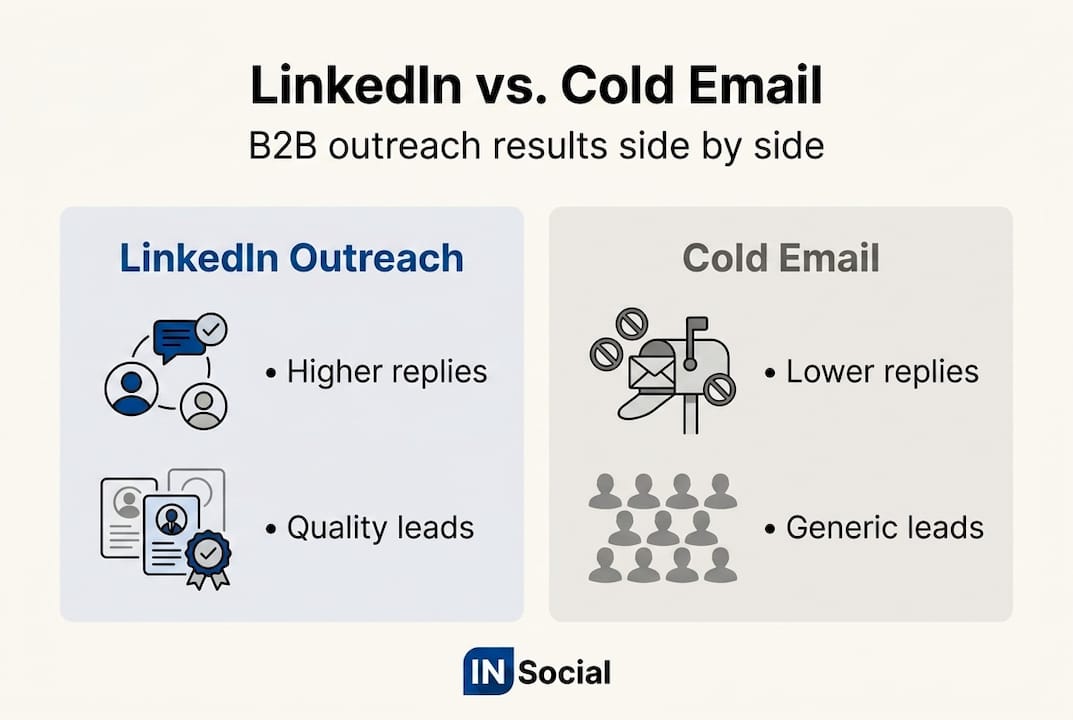
The table above makes the trade-offs clear. LinkedIn wins on quality, trust, and targeting. Email wins on pure scale. For most SMB sales teams, quality beats volume every time, because chasing unqualified leads wastes the very resources you cannot afford to squander.
Here are the most important benefits, ranked by impact for B2B sales teams:
- Higher response rates: The double the reply rate advantage translates directly into more booked meetings per rep per week.
- Personal connection: LinkedIn outreach feels like a professional introduction, not a mass marketing blast, which sets the tone for a genuine sales conversation.
- Precise message targeting: You can tailor every message to a specific job title, challenge, or recent company event, dramatically improving relevance.
- Improved lead quality: Because you are targeting by verified professional data, the leads you generate are far more likely to match your ideal customer profile.
- Better brand visibility: Even connection requests that go unanswered still expose your brand and profile to a relevant audience.
Explore proven LinkedIn messaging strategies to see how small adjustments to message structure can produce significant uplifts in reply rates.
Pro Tip: If you are serious about precision targeting, invest in LinkedIn Sales Navigator. Sales Navigator enables precise targeting and offers CRM integrations that make it easier to manage prospects and track engagement over time. Gartner and G2 reviews consistently praise it for lead generation quality, though there is a learning curve, so allow your team time to get comfortable with it before judging the results.

For small and medium-sized teams, these benefits are amplified further. You are not running a high-volume outreach operation with dozens of reps. You need every conversation to count. LinkedIn's combination of targeting, trust, and contextual relevance gives your team the best possible chance of turning each message into a qualified opportunity. You can review real LinkedIn lead generation results from B2B businesses to see what is genuinely achievable.
LinkedIn outreach vs. cold email: A side-by-side comparison
While the benefits of LinkedIn are clear, it is helpful to compare it head-to-head with the other B2B staple. Cold email is not dead, but its effectiveness has declined, and understanding where each channel excels will help you allocate your team's effort wisely.
| Channel | Reply rate | Cost | Trust level | Scalability | Best for |
|---|---|---|---|---|---|
| LinkedIn outreach | 10 to 15% | Moderate (tool costs) | High | Moderate | Warm, targeted outreach |
| Cold email | 4 to 5% | Low | Low to moderate | High | Volume-based prospecting |
| LinkedIn + email combined | Highest | Moderate to high | High | High | Full-funnel campaigns |
The strongest results in B2B outreach consistently come from combining LinkedIn and email in a structured, multi-channel sequence rather than relying on either channel alone.
The data is clear. Neither channel is universally superior. The question is not "LinkedIn or email?" but rather "How do we use both at the right moments?" Here is how to think about it:
Prioritise LinkedIn outreach when:
- You are targeting senior decision-makers at named accounts.
- Your ideal customer profile is narrow and well-defined.
- You want warm, relationship-first engagement rather than volume.
- You are in an industry where professional credibility matters, such as professional services, technology, or recruitment.
- You want to build brand visibility alongside direct outreach.
Blend LinkedIn with cold email when:
- You need to reach a broader prospect pool efficiently.
- You have already made LinkedIn contact but want to follow up through a different channel.
- Your sales cycle is longer and requires multiple touchpoints across several weeks.
- You want to test messaging across channels to see what resonates.
Learning about automating LinkedIn outreach can help your team manage multi-channel sequences without losing the personal feel that makes LinkedIn effective in the first place. The key is structure. A well-designed sequence that begins on LinkedIn, follows up via email, and then returns to LinkedIn for engagement creates a coherent journey that feels intentional rather than spammy.
How to maximise LinkedIn outreach results
The comparison highlights possibilities. Now, here are pragmatic steps your team can take to maximise success with LinkedIn outreach in practice. These are not theoretical ideals; they are the specific actions that separate high-performing B2B teams from those who try LinkedIn for three months and conclude "it doesn't work."
-
Optimise your profile first. Your profile is the first thing a prospect sees when they receive your connection request. A professional headshot, a clear headline that explains the value you deliver, and a well-written summary focused on client outcomes will dramatically improve your acceptance rate before you send a single message.
-
Write targeted, personalised connection requests. Generic connection requests get ignored. Reference something specific about the person's role, a piece of content they shared, or a challenge common in their industry. Sixty words of genuine personalisation will outperform a thousand automated generic requests every time.
-
Lead with value, not a pitch. Once a connection is accepted, your first message should offer something useful: a relevant insight, a useful resource, or a thought-provoking question. Do not pitch immediately. Build the relationship first, and the sales conversation will follow naturally.
-
Use consistent follow-ups. Most replies come after the second or third message. Build a structured follow-up sequence that spaces messages across one to two weeks, and always vary the content so each message adds something new rather than simply repeating the first one.
-
Engage with content before and after outreach. Liking, commenting, and sharing a prospect's content before you send a connection request creates genuine familiarity. It also means your name appears in their notifications, making your outreach feel less out of the blue.
Reviewing LinkedIn marketing tips will give you additional tactical ideas for combining content activity with direct outreach to create a more complete strategy.
Common mistakes to avoid:
- Over-automating your outreach to the point where messages feel robotic and impersonal.
- Sending the same generic message to every prospect regardless of industry, role, or company size.
- Neglecting your profile, which undermines every message you send because prospects judge your credibility instantly.
- Pitching too early in the conversation before any trust has been established.
- Giving up after one unanswered message instead of following up thoughtfully.
Pro Tip: Once you have the basics working, invest time in learning Sales Navigator's targeting features properly. The ability to save lead lists, set up alerts when prospects change jobs or post content, and integrate directly with your CRM is genuinely powerful for SMB teams. Yes, there is a learning curve, but the improvement in lead quality makes it worth the effort. You can also explore the full range of LinkedIn lead generation benefits to understand the broader commercial case for investing in the platform.
What most B2B teams get wrong about LinkedIn outreach
Now that you know the best practices, let us dig deeper. Experience working with B2B clients reveals one mistake that comes up again and again, and it is not a lack of budget or a bad product. It is the assumption that more automation automatically means better results.
This belief is understandable. Every sales team wants to do more with less, and automation tools promise exactly that. But LinkedIn's core advantage is trust, and trust is inherently personal. The moment your outreach starts to feel like a broadcast rather than a conversation, you lose the very thing that makes LinkedIn work. A prospect who receives a generic sequence of automated messages learns very quickly that there is no real human behind it. They ignore it, or worse, they report it.
We have seen clients who switched from high-volume automated campaigns to lower-volume, highly personalised sequences and immediately saw their reply rates double. Not because they reached more people, but because the people they did reach actually responded. The maths are simple: a 15% reply rate on 100 personalised messages beats a 2% reply rate on 1,000 automated ones, and the conversations are far more likely to convert.
The other persistent mistake is treating LinkedIn outreach as a standalone tactic rather than part of a broader relationship-building strategy. The teams who get the best results are not just sending messages; they are posting valuable content, engaging with their target audience's posts, and positioning themselves as credible voices in their space. When your outreach lands in someone's inbox and they have already seen your name three times that week, it is not cold outreach anymore. Research shows that LinkedIn drives 25% more leads for UK SMBs who take a consistent, multi-touch approach compared to those using it purely for direct messaging.
"The teams winning on LinkedIn are not sending the most messages. They are sending the most relevant ones, to the most relevant people, at the most relevant time."
That is not a technology challenge. It is a strategy challenge. And it is one that any motivated B2B sales team can solve.
Partner with experts to boost your LinkedIn outreach
You have seen what separates effective LinkedIn outreach from the tactics that get ignored. The gap between knowing the strategy and executing it consistently is where most SMB teams struggle, because the day-to-day demands of running a sales operation leave little time for optimising profiles, crafting personalised messages, and refining follow-up sequences.
That is exactly where IN Social can help. We combine human expertise with advanced AI tools to build and manage LinkedIn outreach programmes that generate qualified leads for B2B businesses like yours. Whether you are looking for a fully managed LinkedIn service or want to explore LinkedIn lead generation without cold outreach, we design strategies around your specific goals, audience, and resources. Visit IN Social to find out how we can help your team start more of the right conversations.
Frequently asked questions
Why do LinkedIn messages get higher response rates than email?
LinkedIn builds instant trust by displaying your profile, role, company, and mutual connections, so recipients can verify who you are before deciding to reply, unlike an anonymous cold email. Reply rates of 10 to 15% on LinkedIn compare favourably to just 4 to 5% for cold email precisely because of this trust advantage.
Is LinkedIn outreach suitable for small teams without much tech experience?
Yes, LinkedIn's core tools are intuitive, and platforms like Sales Navigator make it straightforward for SMBs to target, track, and organise leads effectively even without a large technical team. There is a learning curve with advanced features, but the fundamentals are accessible from day one.
How do I avoid being 'salesy' in LinkedIn outreach?
Open every conversation with a personalised message that offers a relevant insight or asks a genuinely curious question, rather than leading with a product pitch or a request for a meeting.
What is the best combination of LinkedIn and email for outreach?
The most effective approach is using LinkedIn to make first contact and establish credibility, then following up via email to nurture the conversation further. Multi-channel sequences consistently outperform either channel used in isolation.
Should I automate all of my LinkedIn outreach?
Full automation tends to hurt response rates because it removes the personal element that makes LinkedIn effective. The best results come from using automation for scheduling and tracking while keeping the actual messaging authentic and individually tailored.