

LinkedIn accounts for 80% of B2B social media leads, yet most businesses treat new connections like a finished job rather than the start of a conversation. The real revenue sits in what happens after the connection request is accepted. Without a structured nurture process, those leads go cold, your pipeline stalls, and competitors who do follow up win the business instead. This guide walks you through every stage of LinkedIn lead nurturing, from setting up the right tools to crafting sequences that convert, so you can turn a growing network into a consistent source of qualified meetings.
Table of Contents
- Why nurturing LinkedIn leads matters
- Essential tools and preparation for nurturing LinkedIn leads
- Planning your LinkedIn nurture sequence
- Delivering value: Content and conversation strategies
- Tracking results and optimising your lead nurture process
- Accelerate your LinkedIn lead nurturing with expert support
- Frequently asked questions
Key Takeaways
| Point | Details |
|---|---|
| Focus on real conversations | The best lead nurture turns connections into genuine, timely dialogues—not just one-off messages. |
| Use a structured workflow | Sequenced reminders, CRM tagging, and personalised messaging boost conversion rates over ad hoc outreach. |
| Integrate multiple channels | Combining LinkedIn with email or calls can triple your lead response rates quickly. |
| Track business outcomes | Meetings booked and deals won matter far more than likes or follower growth in B2B sales nurture. |
Why nurturing LinkedIn leads matters
Most small and medium-sized B2B businesses are sitting on a goldmine they have never properly mined. LinkedIn generates 80% of all B2B social media leads, making it far more valuable than any other social platform for sales. But generating a lead and converting one are two very different things. The gap between the two is where nurturing lives.
Think of a new LinkedIn connection like a warm introduction at a networking event. You would not hand someone your brochure and walk away. You would start a conversation, find common ground, and build enough trust that a follow-up meeting feels natural. The same logic applies here, and the businesses that understand this are consistently outperforming those that do not.
Here is what poor nurturing actually costs you:
- Lost pipeline value from leads who simply forgot you existed
- Wasted prospecting effort because connections never progress to conversations
- Missed revenue from decision-makers who were ready to buy but heard from a competitor first
- Damaged credibility if your only follow-up is a generic sales pitch
"The businesses winning on LinkedIn are not the ones with the most connections. They are the ones with the most consistent, relevant follow-up."
Understanding LinkedIn for B2B growth starts with accepting that the platform rewards relationship-building over broadcasting. And if you want to see how LinkedIn drives 25% more B2B leads for UK SMBs specifically, the data is compelling. Now we understand the importance, let us get clear on what you will need before you begin nurturing leads.
Essential tools and preparation for nurturing LinkedIn leads
Before you send a single follow-up message, you need the right infrastructure in place. Trying to nurture leads from memory or a spreadsheet is a recipe for inconsistency. The tools below form the foundation of any reliable nurture system.

| Tool | Purpose | Example options |
|---|---|---|
| CRM | Track leads, tag by stage, set reminders | HubSpot, Pipedrive, Zoho |
| LinkedIn Sales Navigator | Advanced search, lead lists, InMail | LinkedIn Premium |
| Inbox management | Organise DMs, flag priority replies | LeadDelta, Dux-Soup |
| Content scheduling | Plan and publish posts consistently | Buffer, Hootsuite, Shield |
Your CRM is the most critical piece. Use CRM tagging and reminders for follow-ups at 7, 21, and 45 days rather than tracking vanity metrics like connection counts. This keeps your pipeline honest and your outreach timely.
Before you start any sequence, run through this preparation checklist:
- Optimise your profile so it speaks to your ideal client's problems, not just your credentials
- Clean up your connections by removing irrelevant contacts that skew your targeting
- Segment your existing network by industry, seniority, and buying stage
- Set up CRM tags for new connections, warm leads, and active conversations
- Schedule weekly review time to check reminders and respond to open threads
Pro Tip: When building your LinkedIn network, quality beats quantity every time. A network of 500 well-targeted decision-makers will outperform 5,000 random connections when it comes to nurture conversion rates.
With your toolkit ready, let us move on to crafting your lead nurture sequences.
Planning your LinkedIn nurture sequence
A nurture sequence is a planned series of touchpoints designed to move a lead from cold connection to warm conversation. Without a plan, your outreach becomes random and forgettable. With one, every message has a purpose.
Here is how to build yours step by step:
- Segment your audience by role, industry, and pain point before you write a single message
- Set your nurture window at 14 to 21 days for most B2B leads, which is enough time to build familiarity without overstaying your welcome
- Map your touchpoints across the sequence: connection request, soft opening question, value-add message, insight share, and a clear call to action
- Write message variants for each segment so your outreach feels relevant, not templated
- Build in pauses between messages to avoid coming across as desperate or automated
Combining LinkedIn with email and phone can generate three times more replies than LinkedIn alone. Multi-channel sequences that weave in pain points, useful frameworks, and genuine questions consistently outperform single-channel approaches.
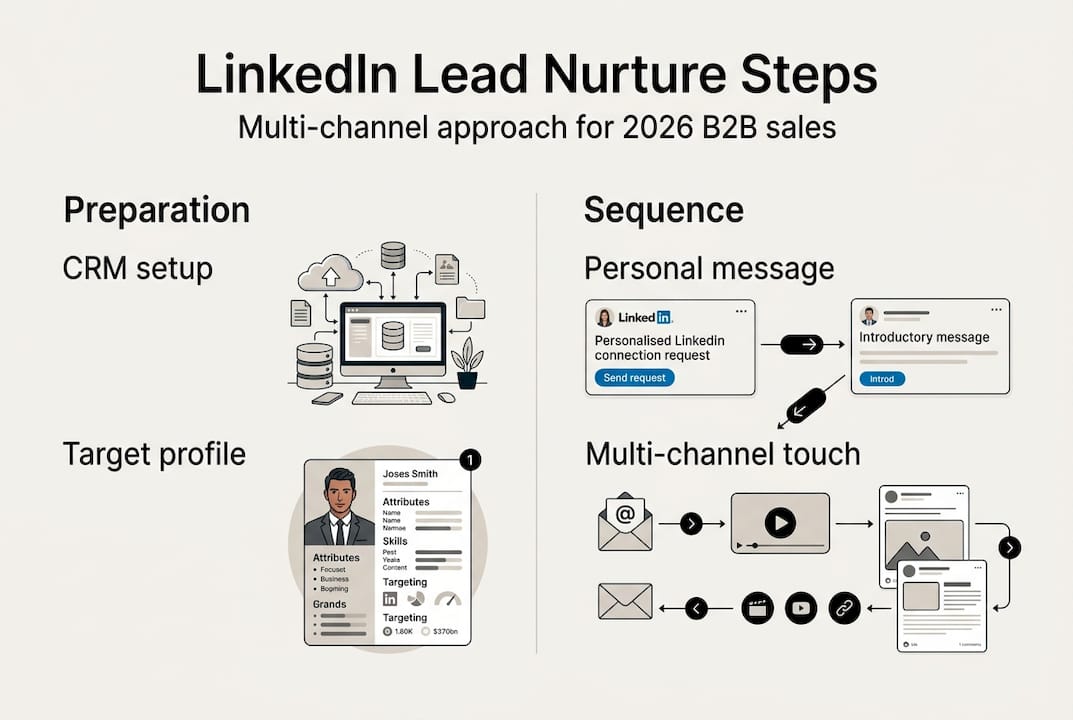
| Feature | Basic workflow | Advanced workflow |
|---|---|---|
| Channels used | LinkedIn only | LinkedIn, email, phone |
| Sequence length | 7 days | 14 to 21 days |
| Personalisation | First name only | Role, pain point, recent activity |
| Content types | One message type | Mix of DMs, posts, comments, emails |
| CRM integration | None | Full tagging and reminders |
| Conversion tracking | Manual | Automated pipeline reporting |
Personalisation is not optional. Leads who receive messages tailored to their specific role and challenges are significantly more likely to respond than those receiving generic outreach. A well-structured content workflow for B2B leads ensures your messaging stays consistent across every stage.
Pro Tip: Do not write your entire sequence in one sitting. Draft the first two messages, test them with real leads, and refine based on reply rates before building out the rest. Real feedback beats assumed best practice every time.
The right sequence is crucial. Now let us ensure every touchpoint delivers genuine value.
Delivering value: Content and conversation strategies
The biggest mistake B2B sales teams make on LinkedIn is treating every message as an opportunity to sell. Leads do not convert because you pitched them well. They convert because you built enough trust that saying yes felt like the obvious next step.
Effective post formats that build that trust include:
- Educational posts that answer a question your ideal client is already asking
- Industry insight posts that show you understand the landscape they operate in
- Framework posts that give away a useful process or checklist for free
- Behind-the-scenes content that humanises your brand and builds familiarity
- Client results posts that demonstrate real outcomes without being boastful
For direct messages, the goal is to open a dialogue, not close a deal. A strong opening message might reference something specific from their profile or recent activity, ask a single relevant question, and leave space for them to respond naturally. Avoid anything that reads like a copied template.
"Personalise beyond the name. Reference their industry, a post they shared, or a challenge common to their role. That is what separates a reply from a delete."
Avoid pitching immediately after a connection is accepted. Respect LinkedIn's messaging limits, personalise every touchpoint, and track your pipeline health monthly to spot where leads are dropping off.
Pro Tip: Share a short case study or client testimonial as a direct message at the midpoint of your nurture sequence. It acts as social proof without feeling like a hard sell, and it gives the lead something concrete to evaluate. Strong B2B content creation and consistent LinkedIn engagement compound over time to make every future outreach easier.
After putting out authentic, helpful content, it is vital to monitor your progress and continuously refine.
Tracking results and optimising your lead nurture process
If you are measuring success by likes and follower counts, you are optimising for the wrong thing. The metrics that actually matter are the ones tied to revenue.
Focus on these core KPIs:
- Meetings booked per week from LinkedIn outreach
- Positive reply rate across your nurture sequences
- Conversion rate from connection to conversation
- Deals influenced by LinkedIn touchpoints in your CRM
- Drop-off points in your sequence where leads go quiet
Track meetings booked, not vanity metrics. Use CRM reminders set at 7, 21, and 45 days to ensure no lead falls through the cracks. Tag every contact by stage so you can see at a glance where your pipeline is healthy and where it needs attention.
"A nurture system that produces no meetings within 30 days is not a nurturing problem. It is usually a targeting or messaging problem. Fix the root cause, not the symptom."
Review your sequences monthly. Look at which messages generate replies and which are ignored. Shorten sequences that drag on too long, and test new opening lines if your response rate drops below 10%. The data will tell you exactly what to fix if you are willing to look at it honestly. For a deeper look at what is working in B2B content creation in 2026, the landscape has shifted towards shorter, more direct formats that respect the reader's time.
As your system produces results, you can refine, scale, and consider expert support to accelerate further.
Accelerate your LinkedIn lead nurturing with expert support
Building and running a high-converting LinkedIn nurture system takes time, consistency, and a clear strategy. Most sales managers and business owners have the intent but not the bandwidth to execute it week after week without it slipping.
At IN Social, we specialise in doing exactly this for B2B businesses across the UK. Whether you need a fully managed approach through our LinkedIn lead nurturing services or want to explore the wider range of options through our full B2B services, we build bespoke strategies that combine human expertise with advanced tools. We handle the sequencing, the content, the follow-up, and the reporting so your team can focus on closing the conversations we start. If you are ready to turn your LinkedIn presence into a consistent pipeline, we should talk.
Frequently asked questions
How often should I follow up with LinkedIn leads?
Follow up at 7, 21, and 45-day intervals using CRM reminders to stay visible without becoming intrusive. Consistency at these intervals keeps you front of mind through a typical B2B buying cycle.
What should my first message to a new lead say?
Start with a relevant question or a specific insight tied to their role or industry, never a sales pitch. Personalise beyond their name by referencing something concrete from their profile or recent activity.
Does multi-channel outreach really improve results?
Yes. Combining LinkedIn with email or phone can triple your reply rate compared to using LinkedIn alone. Multi-channel sequences also reduce the risk of a single platform's algorithm affecting your visibility.
What KPIs are most important for LinkedIn lead nurturing?
Meetings booked and positive replies are the metrics that matter most, not connection counts or post impressions. These are the only numbers directly linked to revenue outcomes.