

Relying on LinkedIn for leads and brand exposure can feel frustrating when your profile and posts do not attract the right people. For B2B sales and marketing managers, the challenge is turning a static profile into a powerful tool that draws in ideal clients and drives real business conversations. Learn why an optimised profile, targeted connections, and consistent content are the backbone of strong LinkedIn engagement and visibility for your brand.
Table of Contents
- Step 1: Optimise your LinkedIn profile for target audience
- Step 2: Build your LinkedIn network strategically
- Step 3: Craft engaging LinkedIn content consistently
- Step 4: Interact with your LinkedIn audience authentically
- Step 5: Monitor LinkedIn engagement and refine tactics
Quick Summary
| Key Insight | Explanation |
|---|---|
| 1. Use a professional photograph | A clear, approachable headshot builds trust and makes a strong first impression on potential connections. |
| 2. Craft a keyword-rich headline | An informative headline enhances search visibility and clearly communicates your expertise to clients. |
| 3. Personalise connection requests | Tailoring messages when connecting fosters genuine relationships and increases engagement with your network. |
| 4. Share valuable, consistent content | Regularly posting insightful material keeps your audience engaged and helps establish your authority in the industry. |
| 5. Monitor and refine your tactics | Tracking engagement metrics allows you to adapt your strategy according to what resonates best with your audience. |
Step 1: Optimise your LinkedIn profile for target audience
Your LinkedIn profile is your digital storefront for attracting the right clients and partners. Getting it right means your target audience finds you easily and sees exactly why they should engage with you.
Start with a professional photograph that projects confidence and approachability. Use a clear headshot with a neutral background and natural lighting. Your photo is often the first thing prospects notice, so invest in a good quality image that reflects your industry.
Next, craft a keyword-rich headline that goes beyond your job title. Instead of "Sales Manager," try "B2B Sales Manager | Lead Generation Specialist | LinkedIn Strategy Expert." This approach helps you appear in more searches and immediately communicates your expertise to your target audience. Optimising your LinkedIn profile means using industry-specific keywords throughout to improve visibility.
Your headline should include:
- Your core specialisation or role
- A key skill or service you offer
- A benefit you deliver to clients
- Relevant industry keywords
Write a compelling About section that tells your story and showcases achievements with quantifiable results. Rather than listing responsibilities, highlight what you've accomplished. For example: "Generated £2.3m in qualified leads for tech clients" or "Helped 47 SMEs build LinkedIn presence and increase sales by 40% within 12 months." This demonstrates real value to prospects evaluating whether to connect or work with you.
Use numbers and measurable outcomes in your profile to instantly build credibility with decision-makers reviewing your background.
Tailor your entire profile to reflect the interests and pain points of your target audience. If you serve B2B manufacturing companies, reference industry-specific challenges and solutions. If you work with financial services firms, highlight relevant compliance knowledge or sector experience. This personalisation shows prospects you understand their world.
Make sure your profile is complete and polished. Include your professional history, certifications, and recommendations from clients or colleagues. Completeness signals that you take your professional presence seriously.
Pro tip: Review your profile from your target audience's perspective—ask a client or colleague what impression it gives them within the first 10 seconds of viewing it.
Here's a quick overview of how each LinkedIn profile element influences client perception:
| Profile Element | Influence on Target Audience | Common Mistake to Avoid |
|---|---|---|
| Profile Photograph | Builds trust and first impression | Using casual or outdated photos |
| Headline | Communicates expertise instantly | Listing only job title |
| About Section | Demonstrates credibility and success | Focusing on duties, not outcomes |
| Recommendations | Adds third-party validation | Skipping this section entirely |
| Industry Keywords | Improves search visibility | Using generic, vague language |
Step 2: Build your LinkedIn network strategically
Building a strong network is about quality, not collecting connections like trophies. Your goal is to connect with people who genuinely align with your business objectives and can become clients, partners, or advocates for your brand.

Start by identifying your target connections. Think about who your ideal clients are, which industries they work in, and what roles they hold. Are you selling to finance directors at tech companies? Connect with them. Do you serve HR leaders in manufacturing? Search for those professionals specifically. This focused approach means every connection serves a purpose.
When you find someone worth connecting with, personalise your connection request. Skip the generic "I'd like to add you to my network" message. Instead, mention something specific—perhaps you both attended a webinar, share industry interests, or work with similar clients. A personalised request might look like: "I noticed you lead marketing at XYZ Corp. I've helped similar tech companies generate qualified B2B leads through LinkedIn. Would be great to connect."
Personalising connection requests requires:
- Reading their recent posts or activity
- Mentioning a shared interest or connection
- Explaining why connecting benefits you both
- Keeping it brief and genuine
Building an authentic professional network on LinkedIn involves engaging consistently with your connections over time. Don't just connect and disappear. Comment on their posts, share their content, and start meaningful conversations. This nurtures relationships and keeps you top-of-mind when they need your services.
Quality connections that you actively engage with are far more valuable than hundreds of dormant contacts gathering dust in your network.
Set a realistic engagement schedule. Aim to interact with at least 10-15 connections weekly through comments, direct messages, or shares. This consistent presence demonstrates you're genuinely interested in building relationships, not just collecting names.
Track your network growth over time. Notice which types of connections become clients, referral sources, or collaborators. Double down on connecting with similar profiles and adjust your strategy accordingly.
Pro tip: When connecting with decision-makers, send a thoughtful message within 48 hours of them accepting your request—this is when engagement rates are highest, making it the perfect moment to start a conversation.
Step 3: Craft engaging LinkedIn content consistently
Consistent, valuable content is what transforms passive followers into active engagers and potential clients. Your goal is to share content that educates, inspires, or solves problems for your target audience.
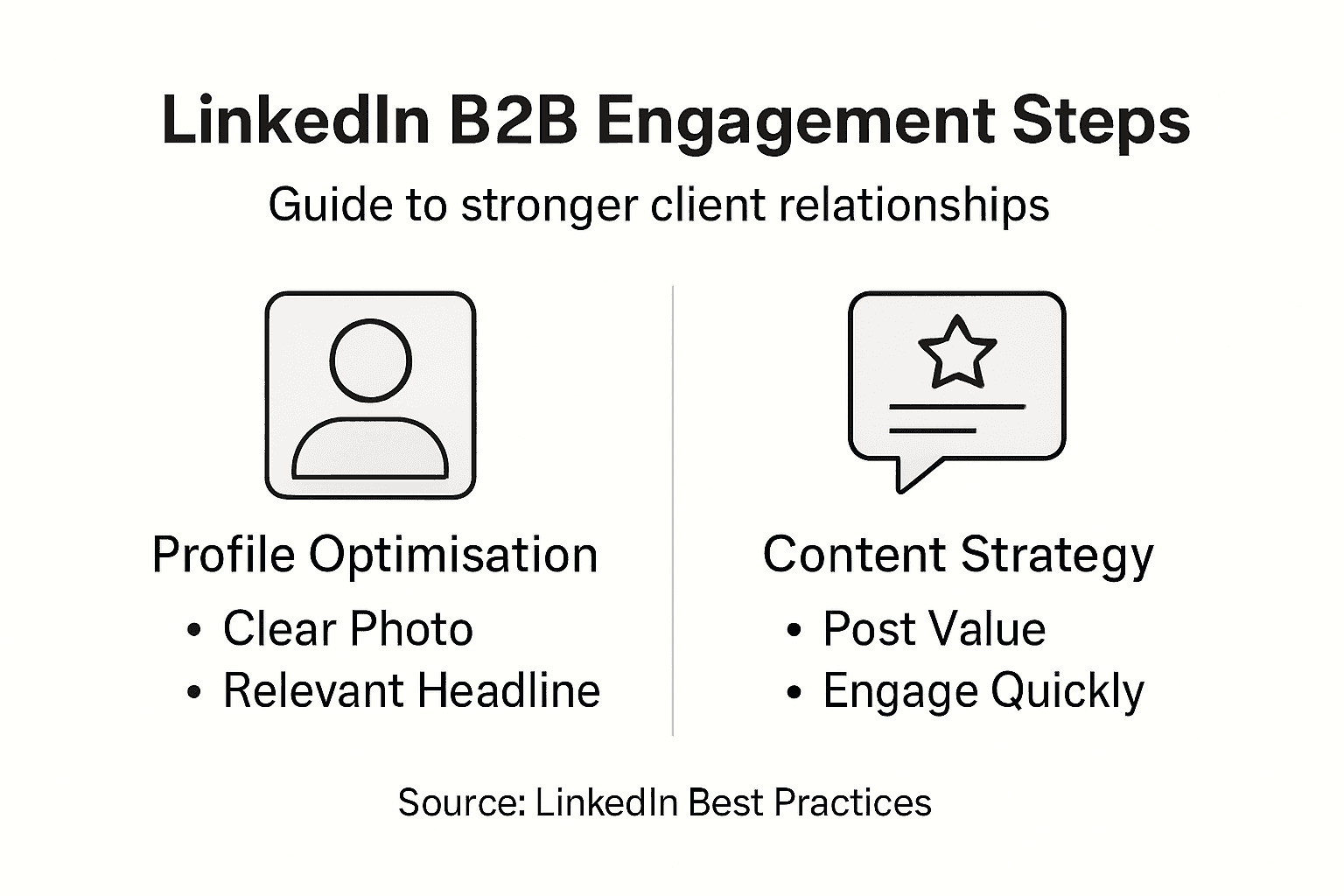
Start by defining your content pillars. These are the 3-5 core topics you'll focus on repeatedly. If you work in B2B lead generation, your pillars might include LinkedIn strategy tips, client success stories, industry insights, and sales trends. Having clear pillars keeps your content focused and helps your audience know what to expect from you.
Share authentic stories and data-driven insights that resonate with decision-makers. Rather than generic motivational quotes, post about a real challenge you solved for a client. For example, "We helped a manufacturing firm identify 47 qualified leads in 90 days using a targeted LinkedIn outreach strategy. Here's what worked." This type of content proves your expertise and provides practical value.
Your content mix should include:
- Case studies or client success stories
- Industry data and trends
- Actionable advice and tips
- Thought leadership on sector challenges
- Quick wins or lessons learned
Creating an engaging LinkedIn marketing strategy means using hashtags and tagging relevant users to expand your reach. Tag industry peers, relevant companies, or thought leaders when appropriate. Use 3-5 targeted hashtags per post to help people discover your content. This amplifies visibility and encourages interaction from your target audience.
Timing matters too. Post when your audience is most active—typically Tuesday through Thursday, 8am to 10am. Test different times and track which posts get the most engagement, then adjust your schedule accordingly.
Consistent, value-driven content that solves real problems will always outperform generic posts, regardless of how often you publish.
Create a simple content calendar to stay organised. Plan your posts 2-3 weeks in advance, but remain flexible enough to respond to industry news or trending topics. A basic spreadsheet works fine—you don't need expensive software.
Pro tip: Respond to every comment on your posts within the first hour of publishing—early engagement signals to LinkedIn's algorithm that your content is valuable, boosting it to more feeds.
Step 4: Interact with your LinkedIn audience authentically
Authentic interaction is what separates successful LinkedIn profiles from abandoned ones. It's not about broadcasting—it's about building genuine relationships with the people who matter to your business.
Start by commenting thoughtfully on others' posts. When someone shares content relevant to your industry, don't just give a generic "Great post!" Instead, add genuine value. Share a relevant experience, ask a thoughtful question, or offer an additional insight. A strong comment might say: "This aligns with what we saw working for tech clients last quarter. The key difference was timing the outreach during budget cycles."
Meaningful comments should:
- Reference specific points from their post
- Add new information or perspective
- Be relevant to your expertise
- Encourage further conversation
- Avoid self-promotion or sales pitches
Respond promptly to direct messages and comments on your own posts. If someone takes time to engage with you, reciprocate within 24 hours. This demonstrates that you value the interaction and builds stronger relationships. A quick response shows professionalism and genuine interest in connection.
Share other people's content, particularly from your network and industry peers. When you reshare content with your own commentary, you amplify their reach whilst adding value. Your comment might be: "Worth reading—this research on B2B buyer behaviour matches our client data exactly." This positions you as someone who curates quality information, not just promotes yourself.
Authentic engagement means showing up for others before asking them to show up for you. The relationships you build naturally become your best lead sources.
Join relevant LinkedIn groups and participate in discussions. Answer questions, share insights, and help others without expecting immediate returns. Over time, people recognise your expertise and approach you with opportunities.
Avoid spam tactics like automated messages, overly aggressive pitches, or connecting without personalisation. These damage your credibility and push people away from your brand.
Pro tip: Track which types of interactions generate the most meaningful responses and pipeline opportunities, then double down on those activities—your authentic strengths will become your engagement superpowers.
Step 5: Monitor LinkedIn engagement and refine tactics
Data-driven decisions are what separate LinkedIn strategies that work from those that merely exist. Tracking your engagement metrics reveals what resonates with your audience and where to invest your effort.
Access your LinkedIn analytics dashboard to review core metrics. You'll find impressions, clicks, comments, shares, and engagement rates for every post. Impressions show how many people saw your content. Clicks tell you whether people found it compelling enough to take action. Comments and shares indicate genuine interest and extend your reach.
Monitoring LinkedIn engagement analytics helps identify which content types perform best. Track patterns over 4-6 weeks to spot trends rather than reacting to individual posts. You might discover that case studies generate 40% more clicks than general tips, or that posts on Tuesday mornings outperform Thursday evenings.
Key metrics to monitor include:
- Post impressions and click-through rates
- Comment and share counts
- Follower growth rate
- Profile views and search appearances
- Engagement rate by content type
Create a simple tracking spreadsheet to record your results. Document post topic, format, posting time, and engagement metrics. This historical data becomes invaluable for spotting patterns and justifying strategy changes to stakeholders.
Use insights to refine your approach. If video content generates three times more engagement than text posts, shift your content mix accordingly. If morning posts consistently outperform afternoon ones, adjust your publishing schedule. Let data guide your decisions, not assumptions.
Your engagement metrics are a conversation with your audience—listen closely and adapt accordingly.
Test one variable at a time to understand what drives results. Change posting frequency for two weeks and measure impact. Then adjust content format whilst keeping frequency constant. This systematic approach reveals what actually works for your specific audience.
Pro tip: Create quarterly engagement reports comparing key metrics month-to-month—this reveals whether your refinements are moving the needle and keeps your strategy focused on measurable business outcomes.
Below is a summary of essential LinkedIn engagement metrics, their meaning, and how to leverage them for improvement:
| Metric | What It Reveals | How to Act on Insights |
|---|---|---|
| Impressions | Content visibility and reach | Refine posting times and hashtags |
| Engagement Rate | Content appeal and relevance | Increase similar high-performing posts |
| Follower Growth | Audience expansion over time | Analyse peak periods and campaigns |
| Click-through Rate (CTR) | Effectiveness of calls to action | Adjust content structure and CTAs |
| Profile Views | Interest from potential clients | Reach out to recent viewers |
Elevate Your LinkedIn Engagement with Expert Strategies and Support
Improving LinkedIn engagement for B2B success demands more than just effort it requires a personalised approach that addresses your unique challenges such as optimising your profile, building strategic networks, crafting consistent content, and analysing engagement metrics. The article highlights common pain points like tailoring your profile for your target audience and maintaining authentic interactions while tracking performance insights to refine your tactics.
At in-social, we specialise in transforming these LinkedIn obstacles into measurable business growth. Our LinkedIn management and content creation services combine human expertise with advanced AI tools to boost your presence, generate qualified leads, and drive sales specifically for small to medium-sized B2B companies. Whether you need bespoke training to refine your LinkedIn skills or continuous support to nurture your audience authentically, our personalised strategies ensure you engage the right decision-makers effectively.
Ready to move beyond basic LinkedIn efforts and achieve real results?
Discover how our proven LinkedIn lead generation solutions can accelerate your B2B success today. Visit in-social to start your tailored journey towards higher engagement and increased sales now. Explore our full range of expert services designed to empower your LinkedIn presence here.
Frequently Asked Questions
How can I optimise my LinkedIn profile for B2B engagement?
To optimise your LinkedIn profile for B2B engagement, start by using a professional photograph and a keyword-rich headline that highlights your expertise. Write a compelling About section showcasing your achievements with measurable outcomes to establish credibility.
What content should I share on LinkedIn to improve engagement?
Share content that educates and addresses the pain points of your target audience, such as case studies, industry trends, and actionable tips. Aim to post consistently, ideally 2-3 times a week, focusing on topics that resonate with your ideal clients.
How often should I interact with my LinkedIn connections?
Aim to engage with your LinkedIn connections at least 10-15 times a week through comments, shares, or direct messages. This consistent interaction helps nurture relationships and keeps you top-of-mind for potential clients.
What metrics should I track to measure LinkedIn engagement?
Track metrics such as post impressions, engagement rates, and follower growth to evaluate the success of your LinkedIn strategy. Create a simple tracking spreadsheet to document these metrics over time, adjusting your tactics based on the data you collect.
How can I personalise my connection requests on LinkedIn?
Personalise your connection requests by referencing shared interests, recent posts from the individual, or mutual connections. This tailored approach increases the likelihood of acceptance and establishes a foundation for meaningful engagement.
What are effective ways to comment on others' LinkedIn posts?
When commenting on others' LinkedIn posts, add genuine value by referencing specific points they made and sharing relevant experiences or insights. Avoid generic statements, and instead, aim for thoughtful contributions that encourage further discussion.