

TL;DR:
- Most B2B companies on LinkedIn remain invisible due to a lack of a consistent strategy rather than expertise. Building brand awareness requires deliberate effort in optimizing profiles, creating targeted content pillars, and engaging meaningfully with your audience over time. Focusing on quality, intentional posting, and early engagement signals will significantly enhance visibility and generate qualified leads.
Most B2B companies on LinkedIn are invisible. Not because they lack expertise, but because they lack a system. You post occasionally, get a handful of likes from colleagues, and wonder why LinkedIn isn't generating the pipeline your competitors seem to be pulling from it. The answer isn't more effort. It's the right effort, applied consistently. This guide covers how to build LinkedIn brand awareness from the ground up, with a clear framework covering strategy, content, engagement, and measurement so you can turn LinkedIn into a genuine source of visibility, credibility, and qualified leads.
Table of Contents
- How to build LinkedIn brand awareness: understanding the foundations
- Preparing your LinkedIn profile and content pillars for brand clarity
- Creating and rotating engaging content formats for optimal LinkedIn reach
- Driving engagement for enhanced distribution and community growth
- Measuring success and refining your LinkedIn brand strategy
- Why consistent quality beats quantity in LinkedIn brand building
- How IN Social can accelerate your LinkedIn brand and lead generation
- Frequently asked questions
Key Takeaways
| Point | Details |
|---|---|
| Differentiate key concepts | Brand visibility is the input of exposure; brand awareness is the resulting recognition by your LinkedIn audience. |
| Clarify your brand | Define your target audience, content pillars, and unique perspective before posting to maintain consistency and resonance. |
| Rotate content formats | Use a mix of educational, experiential, engaging, and celebratory posts to maximise LinkedIn’s algorithm reach. |
| Drive meaningful engagement | Encourage saves and deep comments promptly after posting to enhance distribution and brand visibility. |
| Measure and refine | Track visibility and awareness metrics regularly and adjust your LinkedIn content strategy based on data insights. |
How to build LinkedIn brand awareness: understanding the foundations
To successfully build your LinkedIn brand awareness, it is crucial to understand two foundational concepts that many businesses conflate. They are related, but they are not the same thing.
Brand awareness is your audience's ability to recognise or recall your brand, while brand visibility is how often and prominently your brand appears to them on LinkedIn. Think of visibility as the input and awareness as the output. You cannot measure awareness without first building visibility, and visibility without a consistent message rarely converts to meaningful recognition.
Here is why this distinction matters strategically:
- Visibility is driven by posting frequency, profile completeness, and algorithmic reach
- Awareness is earned through consistent messaging, a recognisable voice, and repeated exposure over time
- Both compound over time, meaning early investment pays back at an increasing rate the longer you sustain it
For B2B companies specifically, brand visibility on LinkedIn determines whether your ideal buyers encounter your thinking before they need you. That pre-market positioning is what separates businesses that generate inbound enquiries from those that rely entirely on outbound cold contact. Understanding building LinkedIn brand presence from this angle changes how you approach every decision that follows.
Preparing your LinkedIn profile and content pillars for brand clarity
With brand clarity anchored in a strong profile and content pillars, you can move on to executing an effective content strategy. But without this foundation, even high-quality content will underperform.

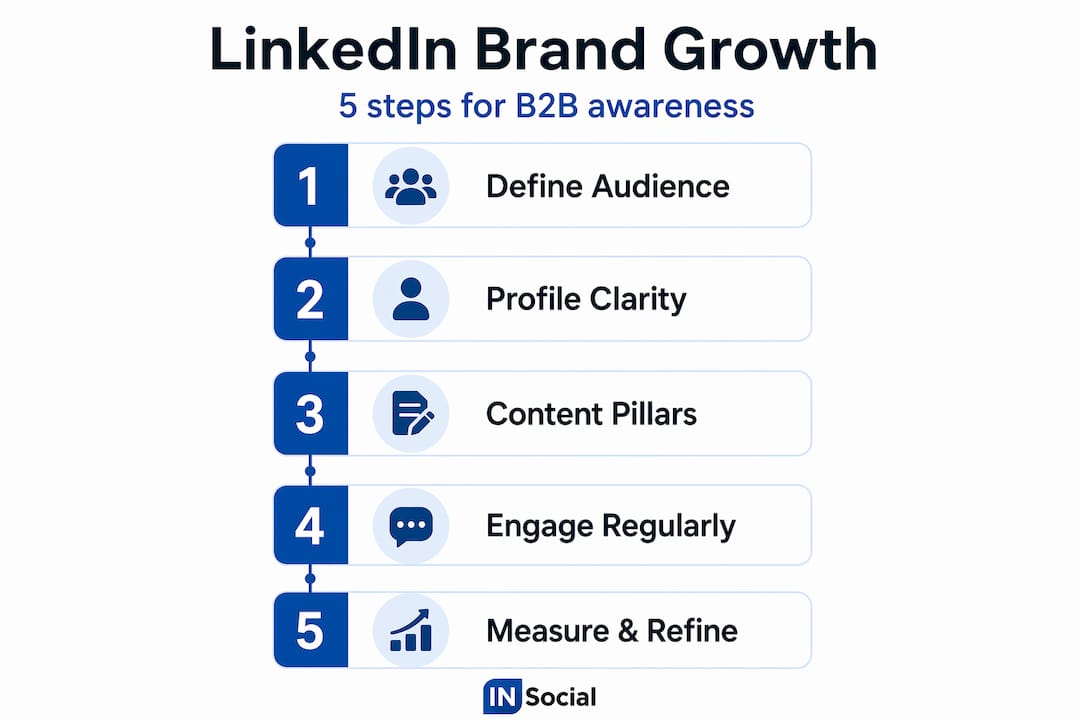
The strongest personal brands are precise about audience, choose 3-5 content pillars at their expertise and passion intersection, and develop a unique perspective. This applies equally to entrepreneurs posting from personal accounts and to company pages managed by marketing teams.
Start with your target audience. Not "SME decision-makers" but rather, for example, "Operations Directors at UK manufacturing businesses with 50 to 200 employees who are struggling to justify technology spend to their board." The narrower your definition, the more your content will resonate with exactly the right people.
Then choose your content pillars. These are the three to five recurring themes your brand will own on LinkedIn:
- A topic where you have genuine expertise and a clear opinion
- A topic your target audience actively searches for or worries about
- A topic that reflects your company culture, values, or way of working
- A topic that demonstrates your results or your clients' transformations
Once your pillars are set, audit your profile. Your headline should state who you help and how, not just your job title. Your banner should reinforce your brand message visually. Your About section should open with your audience's problem, not your company history. The Featured section is prime real estate; use it to highlight case studies, lead magnets, or your best-performing content.
Pro Tip: Write your About section in the first person, even for company representatives. People buy from people. A human voice builds faster trust than corporate copy, and trust is the currency of LinkedIn brand building. Pairing this with LinkedIn thought leadership strategies accelerates the process considerably.
Review your LinkedIn content best practices to ensure your profile and posts work together as a single, coherent brand signal.
Creating and rotating engaging content formats for optimal LinkedIn reach
Having established what to post, let us explore how to engage your audience effectively to boost your brand presence through the right formats.
The most effective way to think about content variety is through a simple framework: the 4E model.
- Educate — Teach your audience something genuinely useful. How-to posts, data breakdowns, and myth-busting content perform consistently well here.
- Experience — Share behind-the-scenes insight, lessons from client work, or your own professional journey. Authenticity is rare on LinkedIn and therefore valuable.
- Engage — Ask questions, run polls, or post a bold opinion that invites a response. These posts are engineered to generate comments.
- Elevate — Celebrate others. Share client wins, team achievements, or industry voices you respect. This builds goodwill and often generates reciprocal engagement.
LinkedIn's algorithm rewards content that generates high dwell time, saves, and meaningful comments; carousels deliver higher dwell time due to multiple slides requiring user interaction. This is not a minor detail. Dwell time is how long someone pauses on your post before scrolling, and it is a powerful signal that tells the algorithm your content is worth distributing further.
Here is a comparison of the most common LinkedIn content formats for B2B brand growth:
| Format | Dwell time | Comment rate | Save rate | Best use case |
|---|---|---|---|---|
| Carousel (PDF) | High | Medium | High | Education, frameworks, guides |
| Native video | High | Medium | Low | Thought leadership, storytelling |
| Text post (long) | Medium | High | Low | Opinion, experience, discussion |
| Image post | Low | Medium | Low | Announcements, visual data |
| Poll | Low | High | Low | Engagement, audience research |
| Document post | High | Low | High | Reports, checklists, resources |
Pro Tip: Your first line is everything. LinkedIn collapses posts after approximately two lines, so your opening sentence must create enough curiosity or tension that readers click "see more." Treat it like a subject line. Weak hooks mean even brilliant content stays invisible.
Rotating across these formats prevents your feed from becoming one-dimensional, and it gives the algorithm more signal types to work with. For more format inspiration, explore this content format types guide alongside your LinkedIn content ideas and LinkedIn content strategy workflow.
Driving engagement for enhanced distribution and community growth
Now that you know how to structure content, let us focus on how to increase LinkedIn follower engagement and generate the early momentum that determines whether a post reaches ten people or ten thousand.
LinkedIn's algorithm evaluates a post heavily in its first sixty to ninety minutes. This is what practitioners call the golden hour. If your post receives meaningful engagement quickly, the algorithm interprets it as high-quality content and distributes it to a wider audience. If it sits quiet, it stalls.
Here is how to generate strong early momentum:
- Post at the right time for your audience. For most UK B2B audiences, Tuesday to Thursday between 8am and 10am tends to perform well, but your own analytics will tell you more than any general advice can.
- Engage with five to ten posts before publishing your own. This warms the algorithm and puts you in front of others' audiences just before your post goes live.
- Reply to every comment within the first hour. Each reply extends the engagement window and signals ongoing activity to the algorithm.
- End posts with a specific question, not a vague "what do you think?" Ask something that has a clear, low-effort answer to reduce the friction of responding.
When you are commenting on others' posts to build social proof strategies, avoid the trap of generic praise. "Great post!" contributes nothing. Instead, add a counterpoint, share a related experience, or extend the idea the author raised. Meaningful comments of 15 or more words, saves, and dwell time are key signals rewarded by the LinkedIn algorithm to boost content reach and brand visibility.
The tactics that reliably produce meaningful engagement include:
- Tagging specific people who would genuinely find the content valuable, not mass-tagging
- Participating in relevant conversations in your niche before your post goes live
- Building a small group of peers who commit to engaging authentically with each other's content
Pro Tip: AI-powered engagement tools can assist with generating contextually relevant initial comments at scale, helping to trigger distribution without crossing into spam territory. The key distinction is whether the tool produces comments that add genuine value to the conversation, or simply generates filler. Choose tools that prioritise quality of engagement over volume.
Explore the full breakdown of how to improve LinkedIn engagement and building LinkedIn brand presence for a deeper view of community-building tactics.
Measuring success and refining your LinkedIn brand strategy
With measurement practices in place, you can continuously improve your LinkedIn brand-building efforts for sustained results.
Treat visibility as a leading indicator and track awareness and consideration downstream; brand visibility compounds over time and builds demand before buyers enter the market. This reframes how you interpret your numbers. A post with 5,000 impressions but only three comments is still building awareness with people who have not yet engaged. Do not dismiss reach prematurely.
Here is a breakdown of the two categories of metrics worth tracking:
| Metric type | Examples | Strategic value | Review frequency |
|---|---|---|---|
| Visibility metrics | Impressions, profile views, follower growth, post reach | Shows how often your brand is being seen | Weekly |
| Engagement metrics | Comments, saves, shares, dwell time | Shows how well content resonates | Weekly |
| Awareness metrics | Inbound enquiries, direct mentions, survey recall | Shows whether visibility is converting to recognition | Monthly |
| Consideration metrics | Connection requests from ICPs, message enquiries | Shows pipeline interest generated | Monthly |
Key visibility metrics to monitor regularly include:
- Impressions — raw reach of your content across LinkedIn
- Profile views — a signal that your content is prompting people to investigate further
- Follower growth rate — slow but consistent growth indicates a healthy content strategy
- Post saves — one of the strongest signals of genuine perceived value
Set realistic benchmarks. For most B2B accounts starting from a modest base, expect three to six months before you see a clear upward trend in inbound enquiries. The compound effect of consistent visibility is real, but it is not instant. Use your content creation process to build a rhythm of regular review and iteration.
Why consistent quality beats quantity in LinkedIn brand building
Here is the opinion most LinkedIn gurus will not say plainly: posting every day rarely builds a brand. More often, it dilutes one.
When you post five times a week without a clear point of view, your audience quickly learns that your content is unpredictable in quality. They stop pausing on your posts. They stop saving them. And when your content no longer earns engagement, the algorithm stops showing it. You have created the appearance of activity without the substance of presence.
LinkedIn's algorithm now prioritises credible expertise, meaningful engagement, and consistency of voice over high-frequency, low-value posting. This is not a minor algorithmic tweak. It is a fundamental shift that rewards B2B companies who think carefully about what they publish rather than those who simply publish often.
We have seen this play out repeatedly with B2B practitioners who cut their posting frequency from daily to three times per week and watched their reach increase. Why? Because each post was crafted with intent. The hook was sharper. The insight was more specific. The call to action invited a real conversation. Readers felt their time was respected, and they responded accordingly.
The most effective LinkedIn brand builders treat each post as a small contribution to a longer argument they are making about their industry. Over time, their audience comes to recognise not just their name, but their perspective. That is what brand awareness actually means on LinkedIn: someone sees your name and already knows roughly what you stand for before they read a word.
Pro Tip: Pace your content to match your capacity to produce quality. Two thoughtful posts per week, every week, for twelve months will outperform seven posts one week and silence the next. Consistency of signal matters more than volume of noise. Pair this with strong thought leadership strategies and your authority compounds with every post you publish.
How IN Social can accelerate your LinkedIn brand and lead generation
Building LinkedIn brand awareness is a long game, and having the right support makes a measurable difference to how quickly and effectively you grow.
At IN Social, we work with B2B businesses and entrepreneurs who want to turn LinkedIn into a consistent source of qualified leads without wasting months figuring out what works. Our approach combines human expertise with advanced tools to deliver LinkedIn lead generation results you can track against clear KPIs. Whether you need fully managed LinkedIn services that handle your content, profile, and engagement on your behalf, or a smarter approach to LinkedIn lead generation without cold outreach, we build strategies tailored to your audience and goals. If you are ready to stop guessing and start growing, we are ready to help.
Frequently asked questions
What is the difference between brand awareness and brand visibility on LinkedIn?
Brand awareness is your audience's ability to recognise or recall your brand, while brand visibility is how often and how prominently your brand appears to them on LinkedIn. Visibility is what you build through posting and engagement; awareness is the recognition that results from sustained visibility over time.
How often should I post on LinkedIn to build brand awareness effectively?
Consistency matters far more than frequency. Posting at high volume without a clear point of view can dilute performance; two to three quality posts per week, sustained over months, will outperform daily low-value content every time.
What types of LinkedIn posts generate the most engagement for brand building?
Posts that encourage saves, meaningful comments, and long dwell time perform best. LinkedIn's algorithm prioritises saves, meaningful comments, and high dwell time, with carousels driving higher dwell time due to multiple slides requiring active user interaction.
How can I measure if my LinkedIn brand awareness efforts are working?
Track impressions, saves, comments, profile views, and follower growth as weekly visibility indicators, then watch for downstream signals like inbound enquiries and follower growth to confirm that visibility is converting into genuine brand recognition.
Can I automate LinkedIn engagement to boost visibility?
Automation tools can help initiate engagement at scale, but quality matters more than volume. AI-powered engagement tools like those used in pods generate highly relevant, meaningful comments aligned with LinkedIn's algorithm requirements, triggering distribution without the spam risk that generic automation carries.