

TL;DR:
- Most B2B sales teams waste time on LinkedIn without generating meaningful results because activity does not equate to sales.
- A structured approach focusing on optimized profiles, targeted outreach, and outcome-based measurement transforms LinkedIn into a revenue-driving channel.
Most B2B sales teams are busy on LinkedIn but not productive. They're posting content, sending connection requests, and racking up profile views, yet the pipeline stays flat and leadership keeps asking for proof that it's working. The gap between LinkedIn activity and actual sales results is one of the most frustrating problems sales managers face in 2026. This guide closes that gap. You'll find a structured, step-by-step approach to building a LinkedIn strategy that generates qualified leads, drives meaningful conversations, and ties directly to measurable sales outcomes.
Table of Contents
- Why LinkedIn matters for sales teams
- What you need before executing your LinkedIn strategy
- Step-by-step: Building and deploying your LinkedIn sales team strategy
- How to measure success and troubleshoot common LinkedIn sales strategy mistakes
- What most leaders get wrong about LinkedIn sales strategy
- Want faster results? Get expert LinkedIn support
- Frequently asked questions
Key Takeaways
| Point | Details |
|---|---|
| Focus on real outcomes | Benchmark LinkedIn activity against conversion and win rates, not just engagement. |
| Prep your team fully | Ensure profiles, messaging, and tools are ready before launching a LinkedIn strategy. |
| Follow a proven playbook | Execute step-by-step for targeting, content, and outreach aligned to sales goals. |
| Track what matters | Monitor KPIs that reflect pipeline quality and sales, not just social noise. |
| Expert support can help | Managed LinkedIn services speed up results and reduce mistakes for B2B teams. |
Why LinkedIn matters for sales teams
Before you invest time and budget into any LinkedIn activity, you need to understand why it consistently outperforms other B2B channels. LinkedIn isn't just a professional networking site. It's the place where buying decisions are researched, trust is built, and relationships are established long before a sales call takes place.
The platform hosts over one billion members, with the majority being decision-makers, senior professionals, and budget holders. For B2B sales teams, that concentration of buying authority is simply not available anywhere else at the same scale. You can reach a CFO at a mid-market firm in Manchester with a single well-timed post or message, without spending a penny on advertising.
The data backs this up clearly. Sales performance benchmarks from HubSpot's 2025 State of Sales Report show a 29% average conversion rate, a 28% win rate, and 68% of leaders reporting improved lead quality year-on-year. These are meaningful numbers, not vanity metrics.
Here's a summary of how LinkedIn stacks up against other common B2B channels:
| Channel | Lead quality | Average conversion rate | Cost per qualified lead |
|---|---|---|---|
| High | 29% | Moderate to low | |
| Cold email | Medium | 5 to 10% | Low |
| Paid search (PPC) | Variable | 2 to 5% | High |
| Events/trade shows | High | 15 to 20% | Very high |
| Cold calling | Low | 2 to 3% | Moderate |
The pattern is clear. LinkedIn consistently delivers superior lead quality and conversion rates compared to traditional outbound channels. If you explore the essential LinkedIn benefits in detail, you'll see why this platform has become a core pillar for UK B2B sales teams rather than an optional extra.
Key advantages of LinkedIn for B2B sales teams include:
- Trust and credibility built through visible professional profiles and shared content
- Warm outreach because prospects can review your background before you speak
- Targeting precision via industry, job title, company size, and seniority
- Longer buying journey support through consistent, nurturing content
- Referral and relationship networks that spread your reputation organically
As one framework widely cited across sales communities puts it:
"LinkedIn doesn't just find you leads. It builds the conditions in which leads want to find you."
That mindset shift, from chasing to attracting, is what separates high-performing LinkedIn sales strategies from wasted effort. You can explore the broader LinkedIn B2B lead stats that underpin this approach before you build your plan.
What you need before executing your LinkedIn strategy
Jumping straight into LinkedIn activity without the right foundations is where most sales teams waste their effort. You can't outwork a bad strategy, and you can't fix a leaky pipeline with more posts. Before rolling out any new LinkedIn activity, these are the assets and capabilities you need to have in place.
Profiles, content, and messaging
Every team member who will be active on LinkedIn needs a professional, buyer-focused profile. This means a clear headline that speaks to what you do for clients, a well-written summary, and recent activity visible to visitors. Your content plan should map to specific buyer challenges, not to what your team finds easiest to write about. Your messaging toolkit should include proven outreach templates, follow-up sequences, and value-first opening lines.

Tools and CRM integration
LinkedIn works best when it feeds into your existing sales infrastructure. You need a CRM (Salesforce, HubSpot, Pipedrive or similar) that can receive and track LinkedIn-sourced leads. Sales Navigator is worth the investment for teams actively prospecting, as it dramatically improves search precision and lead-tracking capabilities. Building your LinkedIn network with a structured tool setup means you're capturing every touchpoint rather than relying on memory.
People and skills
LinkedIn selling is a skill, not a natural talent. Your team needs training on social selling principles, content engagement, and professional outreach. Training your sales team on LinkedIn best practices pays back quickly when it's tailored to your specific market and buyer personas.
Here's a comparison of what prepared versus unprepared teams typically look like at the point of launch:
| Capability area | Prepared team | Unprepared team |
|---|---|---|
| Profile quality | Buyer-focused, complete | Generic, profile photo only |
| Content plan | Mapped to buyer challenges | Ad hoc or inconsistent |
| Messaging toolkit | Tested outreach templates | Improvised messages |
| CRM integration | Leads tracked from LinkedIn | Manual, inconsistent |
| KPIs defined | Conversion, pipeline, win rate | Likes and follower count |
| Training | Completed before launch | Skipped or post-launch |
Executive buy-in and KPI alignment
Senior buy-in is not just a formality. Without it, you'll struggle to get the time investment from your team, the budget for tools, or the patience required to see results build over time. Leadership must understand that LinkedIn lead generation operates on a slightly longer horizon than cold outreach, but the quality of results is significantly higher once momentum builds.
Pro Tip: Align your LinkedIn KPIs to sales outcomes from day one. Benchmarking LinkedIn performance against conversion rates and pipeline value rather than post impressions is what keeps leadership confident and your team focused on what actually matters.
Step-by-step: Building and deploying your LinkedIn sales team strategy
With foundations in place, here is the practical execution sequence that turns LinkedIn effort into pipeline and revenue.
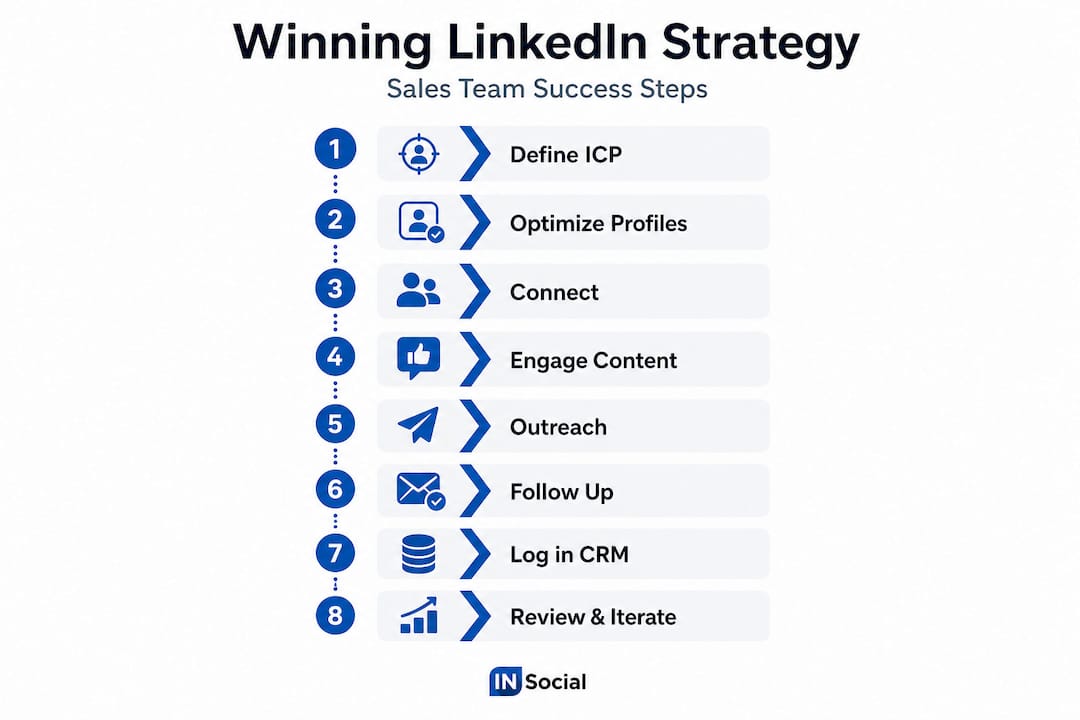
Step 1: Define your ideal customer profile (ICP) and target list
Start by documenting exactly who you're trying to reach. Job title, seniority, industry, company size, geography. Build a target account list of 50 to 150 priority accounts. Use LinkedIn's search functionality or Sales Navigator filters to identify specific individuals at each account.
Step 2: Optimise all active team profiles
Review every profile against a buyer-centric checklist. Update headlines, summaries, and featured sections. Make sure each person's profile reflects what they help customers achieve, not just their job title and employer.
Step 3: Begin connection outreach with a personalised note
Connect with identified targets using a short, specific connection request note. Reference something relevant to them, a recent post, their industry, a shared contact. Do not pitch in the connection request. This is trust-building, not selling. For detailed guidance on every stage, the detailed B2B LinkedIn steps guide is worth bookmarking.
Step 4: Warm the relationship with content engagement
Once connected, engage meaningfully with your prospects' content before sending any outreach message. Comment with genuine insight. Share relevant posts. This warms the relationship and ensures your name is familiar when your message arrives.
Step 5: Send a value-first outreach message
Your first message should lead with something useful to the recipient, a relevant piece of content, an insight about their industry, or a specific question about a challenge you've noticed in their sector. Avoid generic templates. If you need inspiration, LinkedIn messaging strategies that focus on value creation rather than immediate conversion work best.
Step 6: Follow up with a structured sequence
Most deals require multiple touchpoints. Build a follow-up sequence of three to five messages spaced seven to ten days apart. Each follow-up should add a new piece of value rather than simply nudging the prospect to respond.
Step 7: Log every interaction in your CRM
Record each connection, message sent, and response received. Tag conversations by stage in the pipeline. This is where LinkedIn activity becomes trackable sales data. As noted in HubSpot's benchmarks, social-sourced leads can inflate activity metrics if not properly tracked against conversion and win rates, so diligent CRM hygiene is essential.
Step 8: Review weekly and iterate
Hold a short weekly review of what's working. Which outreach messages are generating replies? Which content posts are driving profile visits from target accounts? Use this data to refine your approach continuously. Understanding LinkedIn engagement at a deeper level will help you distinguish meaningful signals from noise.
Pro Tip: Avoid engagement pods and artificial boosting tactics entirely. These inflate your metrics while delivering zero pipeline value. Your goal is qualified sales conversations, not surface-level social proof. Real advanced social selling is built on authentic relationship development, not algorithm gaming.
How to measure success and troubleshoot common LinkedIn sales strategy mistakes
Execution without measurement is just activity. Here's how to tell whether your LinkedIn strategy is genuinely working and what to do when it isn't.
The KPIs that actually matter
Not all LinkedIn metrics are equal. Focus your measurement on these outcome-driven indicators:
- Conversion rate: What percentage of LinkedIn-sourced leads move to a qualified opportunity?
- Win rate: How do LinkedIn-sourced deals close compared to other channels?
- Pipeline contribution: What proportion of your total pipeline originates from LinkedIn activity?
- Lead quality score: Are LinkedIn leads progressing faster or slower through your pipeline stages?
- Response rate to outreach: Are your messages generating replies from target prospects?
Here's a practical benchmark table to reference during your reviews:
| KPI | Below target | On target | Strong performance |
|---|---|---|---|
| LinkedIn conversion rate | Below 15% | 20 to 29% | Above 29% |
| Outreach response rate | Below 10% | 15 to 25% | Above 25% |
| Pipeline from LinkedIn | Below 10% | 20 to 30% | Above 30% |
| Win rate (LinkedIn leads) | Below 20% | 25 to 30% | Above 30% |
Common pitfalls that undermine your LinkedIn ROI
Many sales teams fall into predictable traps. Watch out for these:
- Prioritising content impressions over pipeline creation
- Measuring success by follower growth rather than conversation quality
- Sending outreach messages that are too long or too sales-focused too quickly
- Failing to follow up after the initial message
- Not connecting LinkedIn activity to CRM data, making it impossible to prove ROI
Troubleshooting when results plateau
If your pipeline isn't improving after eight to twelve weeks of consistent activity, check these areas first. Are profiles fully optimised? Is your target list genuinely aligned with your ICP? Are outreach messages personalised or copy-pasted? Is content addressing real buyer pain points or simply broadcasting company news?
"Measuring LinkedIn success by engagement alone is like measuring a sales team's performance by how many calls they made. Volume without quality is just noise."
This principle becomes even more important when reporting upward. Measuring real engagement in a way that connects to revenue is what gives sales leaders credibility in boardroom conversations. And the results are worth chasing: 68% of sales leaders report improved lead quality year-on-year when LinkedIn is used with a structured, outcome-focused approach.
What most leaders get wrong about LinkedIn sales strategy
Here's an uncomfortable truth. Most sales leaders are measuring the wrong things, and their LinkedIn strategies are suffering for it.
Likes, impressions, and follower counts feel like progress. They're visible, they update in real time, and they're easy to screenshot for a slide deck. But they tell you almost nothing about whether your LinkedIn activity is generating revenue. We've seen teams with thousands of followers and zero pipeline contribution. We've also seen small, targeted LinkedIn programmes with modest follower counts driving 30% of a company's new business pipeline.
The difference is always measurement discipline. When you track conversion rates, win rates, and pipeline contribution from LinkedIn specifically, the strategy sharpens immediately. Your team stops creating content for engagement and starts creating content that attracts the right buyers. Outreach stops being volume-driven and starts being precision-driven.
There's another mistake that's harder to spot. Many leaders implement LinkedIn strategies in isolation, treating it as a marketing exercise rather than a sales enablement tool. LinkedIn works best when sales and marketing are aligned around the same buyer personas, the same messaging, and the same pipeline goals. When those two functions operate separately on LinkedIn, you get duplicated effort, inconsistent messaging, and confused prospects.
LinkedIn's evolving role in the B2B sales process is becoming more central, not less. In 2026, buyers are more digitally savvy than ever. They research vendors thoroughly before making contact, and your LinkedIn presence is often the first detailed impression they get of your business and your team. Getting that impression right, and keeping it consistent, is a strategic priority, not a nice-to-have.
The leaders who win on LinkedIn in 2026 are the ones who treat it as a revenue channel, measure it like one, and invest in it accordingly. A hands-on feedback loop between your sales team and your LinkedIn content strategy will always outperform any automated dashboard when it comes to improving results in real time.
Want faster results? Get expert LinkedIn support
Building and executing a high-performing LinkedIn sales strategy takes time, skill, and consistent attention. If you're ready to accelerate your results rather than figure it out through trial and error, we can help.
At IN Social, we combine human expertise with advanced tools to deliver proven LinkedIn lead generation results for B2B sales teams across the UK. Whether you prefer generating leads without cold outreach or want a fully managed LinkedIn service that handles strategy, content, and outreach on your behalf, we have a solution built around your pipeline goals. Speak to our team today and find out how quickly your LinkedIn results can improve with the right support in place.
Frequently asked questions
What is the average LinkedIn sales conversion rate for B2B teams?
Recent data shows a 29% average conversion rate for sales teams using LinkedIn as a primary channel, based on 2025 benchmarks from HubSpot's State of Sales Report. This significantly outperforms most traditional outbound channels.
How can we tell if LinkedIn leads are actually high quality?
Measure lead quality using outcome metrics such as deal progression speed and win rate, then compare these figures against leads from other channels. Benchmarking performance against outcomes rather than engagement scores gives you a far more accurate picture of real lead quality.
What are the biggest mistakes sales teams make on LinkedIn?
Focusing exclusively on engagement metrics while neglecting alignment with sales outcomes is the most common pitfall. Social-sourced leads can easily inflate activity metrics, which masks poor pipeline performance until it becomes a serious problem.
Does LinkedIn activity improve sales pipeline quality?
Yes, consistently. 68% of sales leaders reported a year-on-year improvement in lead quality from LinkedIn, making it one of the most reliable channels for improving overall pipeline health in B2B sales.