

TL;DR:
- Effective LinkedIn visibility in 2026 requires optimizing your profile with clear visuals, keyword-rich headlines, and results-oriented About sections. Creating educational content with compelling hooks and consistent niche topics, combined with strategic early engagement, significantly boosts reach and leads. Building a sustainable presence through quality interactions and aligned brand messaging fosters long-term growth beyond viral campaigns.
Most B2B marketers post on LinkedIn regularly and see almost nothing in return. No meaningful comments, no profile visits, no inbound leads. The problem is rarely effort. It is approach. Understanding how to boost LinkedIn brand visibility requires more than a consistent posting schedule. LinkedIn's 2026 algorithm prioritises relevance, quality, and genuine engagement signals over volume. This guide walks you through exactly how to increase LinkedIn presence by optimising your profile, creating content the algorithm rewards, and turning daily interactions into compounding growth.
Table of Contents
- Preparing your LinkedIn profile for optimal brand visibility
- Creating engaging LinkedIn content that drives visibility and leads
- Executing timely engagement and interaction strategies
- Measuring effectiveness and avoiding common pitfalls
- Rethinking LinkedIn visibility: quality over quantity for lasting impact
- Boost your LinkedIn brand visibility with IN Social's expert methods
- Frequently asked questions
Key Takeaways
| Point | Details |
|---|---|
| Optimise your profile | A keyword-rich headline, professional photo, and clear About section are essential to boost LinkedIn brand visibility. |
| Create educational content | Focus on helpful, relevant posts that provide knowledge and actionable advice to outperform promotional content. |
| Engage quickly and meaningfully | Responding to comments within the first hour maximises reach and sparks valuable conversations. |
| Use strategic commenting | Commenting on relevant posts expands your audience and drives more profile visits than posting alone. |
| Consistency compounds results | Small, daily actions and focused messaging build visibility steadily over time versus sporadic bursts. |
Preparing your LinkedIn profile for optimal brand visibility
Your profile is your first impression and your discoverability engine. Before any content strategy takes hold, the profile itself must signal clearly to both LinkedIn and your target audience exactly who you are and what you deliver.
Start with your visuals. A professional profile photo and a branded banner image immediately communicate credibility. Your banner is prime real estate. Use it to display your value proposition, your company name, or a clear statement of who you help. Generic stock images waste this space entirely.
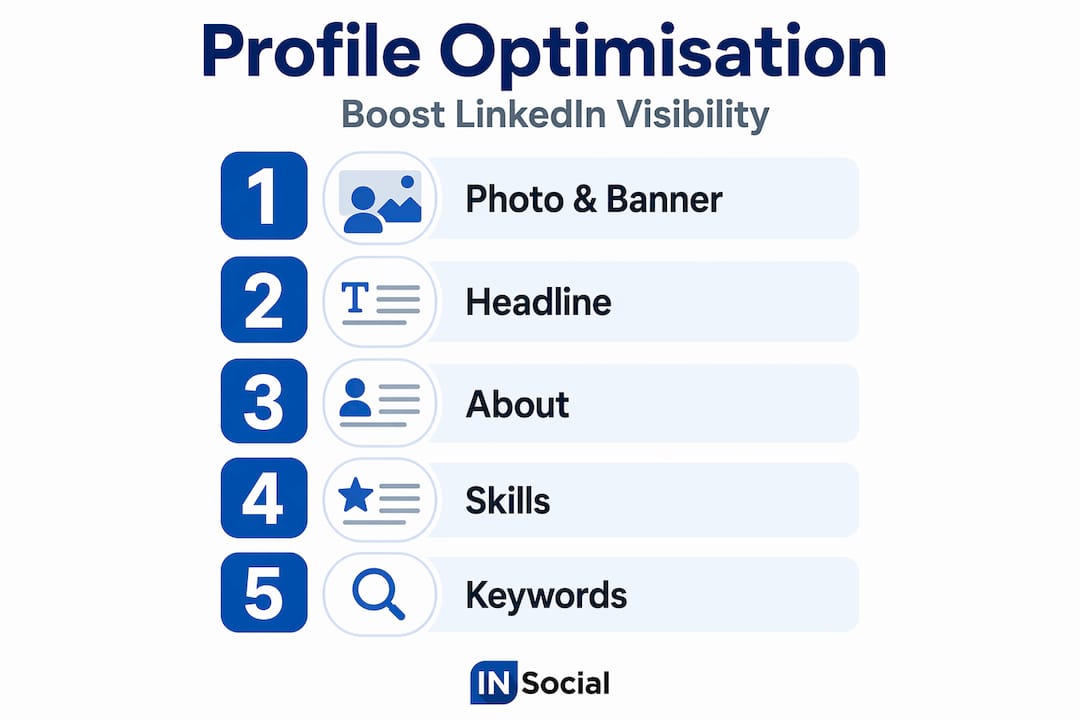
Your headline is where most people undersell themselves. You have up to 220 characters, yet the majority of professionals use only their job title. A keyword-focused headline that communicates your role, your domain, and the outcomes you create will perform far better. For example, "B2B Marketing Director | Helping SaaS companies generate qualified pipeline through LinkedIn content and outreach" does more work than "Marketing Director at XYZ Ltd."
Your About section should follow a simple three-paragraph structure: who you help, the results you achieve, and a clear call to action. Treat it as a short proposal, not a CV summary. Write it in first person and be specific about the outcomes you create for clients.
Skills matter more than most people realise. Profiles with five or more relevant skills receive dramatically higher profile views and show up more often in search results. Choose skills that reflect your niche, not everything you have ever done. Recommendations are the finishing touch. Ask clients or colleagues to cite specific projects and measurable results, not just character endorsements. "Sarah helped us increase qualified lead volume by 40% in three months" is infinitely more persuasive than "I highly recommend Sarah."
To help you optimise your LinkedIn profile for B2B lead generation, here is a summary of the key elements and their impact on visibility:
| Profile element | Impact on visibility |
|---|---|
| Professional photo and branded banner | Increases click-through and first-impression credibility |
| Keyword-rich headline (up to 220 characters) | Improves search ranking and algorithmic categorisation |
| Clear About section with outcomes and CTA | Builds trust and converts profile visitors into connections |
| Five or more relevant skills listed | Boosts discoverability in LinkedIn search results |
| Specific, results-based recommendations | Strengthens social proof and builds trust with new visitors |
| Consistent keyword use across profile | Reinforces LinkedIn's topical categorisation of your expertise |
Pro Tip: Use the same three or four core keywords across your headline, About section, and featured posts. Consistency tells LinkedIn's algorithm precisely what subject matter you are associated with, which improves how it categorises and distributes your content to relevant audiences.
Use the LinkedIn profile optimisation checklist to audit your own profile before investing time in content creation.
With a strong profile foundation laid, the next step is learning how to craft and share content that LinkedIn's algorithm favours.
Creating engaging LinkedIn content that drives visibility and leads
Content is where visibility is either won or lost. One of the most important LinkedIn branding tips you can apply in 2026 is to shift from promotional to educational. Educational content offering practical knowledge and frameworks receives three to five times more reach than promotional posts under the current algorithm. That is not a small difference. It is the difference between 200 impressions and 1,000.
The most effective post structure follows four clear steps:
- Hook — an opening line that stops the scroll. Pose a counterintuitive question or state a surprising problem your audience faces.
- Context — briefly explain why this matters right now. Two to three sentences.
- Insight — your main point, framework, or experience. This is where the value lives.
- Call to action — end with a specific question that invites a substantive response, not just a like.
Sticking to a focused set of niche topics is equally important. LinkedIn categorises your account based on content patterns. If you post about B2B marketing one week and industry news the next, the algorithm has no clear audience to serve your content to. Consistency in topic builds what you might call topical authority on the platform. This directly improves how LinkedIn distributes your posts to relevant users.
Use three to five relevant hashtags per post and reply to all comments within 24 to 48 hours. More than five hashtags starts to look like clutter. Fewer than three misses discoverability opportunities. Choose hashtags that are specific and active, not generic. "#Marketing" reaches millions of irrelevant people. "#B2BLeadGeneration" reaches the right ones.
Timing also plays a role in your strategies for LinkedIn growth. Posting on weekdays between 7 AM and 4 PM aligns with peak audience activity. Publishing outside those windows does not kill a post, but it reduces the size of the initial audience it reaches, which matters enormously in the first hour.
To learn how to create LinkedIn content for B2B success, focus on the hook above everything else. If the first line does not stop the scroll, nothing else matters.
Pro Tip: End your posts with an experience-based question rather than a generic "What do you think?" Try something like: "If you had to cut your lead generation budget by 30%, which channel would you protect first and why?" This type of question generates the detailed, thoughtful comments that the algorithm scores as high-quality engagement.
Find fresh LinkedIn content ideas to boost leads if you find your topics running thin. The content strategy resources at GetResonate are also worth exploring for additional frameworks.
Once you have your profile optimised and content ready, the focus shifts to maximising early post engagement to unlock wider visibility.
Executing timely engagement and interaction strategies
Publishing a great post is only half the job. What happens in the first 60 to 90 minutes determines whether it reaches 300 people or 3,000. LinkedIn tests your post with a small initial audience and uses early engagement quality to decide how widely to distribute it. Prompt and substantive replies tell the algorithm your content is worth spreading.
Here are the core golden hour tactics to put into place immediately:
- Post at a scheduled time when you can actively monitor your device for the next 90 minutes.
- Reply to every comment within 30 minutes, ideally with a follow-up question or added insight.
- Seed the conversation by notifying one or two engaged connections who are likely to comment meaningfully.
- Avoid generic replies such as "Great point!" These add no value to the thread and do not improve engagement quality scores.
- Add a substantive reply to your own post within the first 30 minutes if no comments arrive. This keeps the post active in feeds.
Strategic commenting on other people's posts is one of the most underused visibility tools available. Commenting 10 to 15 times daily on posts from accounts with two to ten times your follower count drives profile visits and new followers faster than posting alone. Your comment appears in front of their audience. If it is insightful, people click your name to find out more. That is free, earned exposure.
| Tactic | Frequency | Expected outcome |
|---|---|---|
| Reply to comments on your posts | Within 30 minutes | Increased post distribution and engagement depth |
| Strategic commenting on others' posts | 10 to 15 times daily | New profile visits and follower growth |
| Seed comments from engaged connections | First 30 minutes after posting | Boosts early engagement quality scores |
| Follow-up questions in comment threads | Every conversation | Extends thread depth and post longevity |

To improve LinkedIn engagement at scale, treat commenting as a daily discipline rather than an occasional habit.
Pro Tip: Set up LinkedIn mobile notifications and block 30-minute windows morning and evening specifically for commenting. Treat these blocks as non-negotiable sales activity, because that is exactly what they are.
Having established how to engage effectively, the next step is knowing how to monitor results and avoid common pitfalls to maintain momentum.
Measuring effectiveness and avoiding common pitfalls
Visibility without measurement is guesswork. To know whether your efforts are working, track four core metrics: engagement rate, dwell time (how long people spend reading your post before scrolling), comment depth (whether conversations extend beyond one exchange), and share counts.
A warning sign is an engagement rate below 2% within the first 30 minutes. This, combined with generic comments and no shares, suggests the algorithm has limited your post's distribution. Low dwell time and slow responses during the golden hour are two of the most common causes of this algorithmic suppression.
Your connection base also affects visibility. Many B2B marketers chase connection volume without considering quality. Prioritising a quality network over sheer quantity positively affects visibility and improves your search ranking. Connecting with hundreds of irrelevant accounts dilutes the signal LinkedIn uses to understand your audience. Keep your network aligned with your niche.
Here is how effective and ineffective behaviours compare in terms of algorithmic impact:
| Behaviour | Effect on distribution |
|---|---|
| Responding to comments with insight within 30 minutes | Boosts post reach significantly |
| Generic one-word replies to comments | Minimal to no impact on distribution |
| Posting consistently on niche topics | Builds topical authority over time |
| Posting across unrelated topics | Confuses categorisation and reduces targeted reach |
| Building a niche-aligned connection base | Improves search ranking and content relevance scoring |
| Adding hundreds of irrelevant connections | Dilutes audience signal and reduces targeted visibility |
To understand LinkedIn engagement more deeply, look beyond surface metrics. A post with ten thoughtful comments outperforms a post with 100 likes in terms of algorithm reward.
Pro Tip: Every three months, audit your content themes and profile keywords together. If you have drifted into new topics, realign your headline and About section to match. LinkedIn's categorisation of your expertise takes time to build. Inconsistency resets that process.
With clear measurement and pitfalls understood, we now share a unique perspective on maximising LinkedIn visibility beyond common advice.
Rethinking LinkedIn visibility: quality over quantity for lasting impact
Most advice on LinkedIn visibility focuses on tactics: post more, use better hashtags, write stronger hooks. These matter. But there is a more important truth that rarely gets said clearly.
LinkedIn visibility is not a campaign. It is a compounding asset. Visibility builds steadily through consistent effort over time, not through one viral post or a burst of activity before a product launch.
We see this pattern with B2B marketers consistently. Those who obsess over individual post performance tend to plateau. Those who build a system of profile consistency, topical focus, and daily engagement tend to see their reach grow month over month, sometimes without changing their content format at all. The difference is that LinkedIn's distribution prioritises relevance and meaning over surface-level virality. It rewards accounts that signal clear expertise to a defined audience, not accounts that chase engagement wherever they can find it.
"LinkedIn's algorithm rewards thoughtful, relevant content that fosters genuine professional conversations, not mere volume or shortcuts."
There is also an alignment issue that many small B2B businesses overlook. When executive personal profiles and the company page speak the same language, use consistent terminology, and address the same audience problems, LinkedIn categorises both more accurately. That means better distribution for both. Most companies treat the company page and personal profiles as entirely separate efforts, and it shows. Aligning them is one of the fastest ways to reduce brand ambiguity and build audience trust at the same time.
Small daily actions, targeted commenting, prompt responses, consistent keyword use, compound over time in a way that sporadic viral attempts never do. Why optimise LinkedIn profiles for B2B sales becomes obvious when you see this pattern clearly. Your profile is not a static document. It is the anchor of an ongoing visibility system.
Boost your LinkedIn brand visibility with IN Social's expert methods
Knowing what to do and having the time and expertise to do it consistently are two different things. That gap is exactly where most B2B marketers stall.
At IN Social, we combine human expertise with AI-driven insight to help B2B companies build LinkedIn visibility that generates real pipeline. We do not chase vanity metrics. We build systems that attract qualified leads and start genuine sales conversations. Our approach is built around the 2026 algorithm realities covered in this article, with measurable outcomes at every stage.
Here is what we can help you with:
- Profile optimisation aligned with your niche, keywords, and ideal client profile
- Content creation built around the educational frameworks that earn algorithmic reach
- Engagement management to ensure golden hour activity is handled consistently
- Analytics tracking to monitor what is working and where to adjust
If you are ready to build a LinkedIn lead generation system that works without cold outreach tactics, explore our approach to LinkedIn lead generation without cold outreach. Or visit the IN Social homepage to see how we can build a tailored strategy for your business.
Frequently asked questions
What type of LinkedIn content gets the most visibility in 2026?
Educational content offering practical knowledge and frameworks gets three to five times more reach than promotional posts, making it the most effective content type under the current algorithm.
How important is the first hour after posting on LinkedIn?
Extremely important. The first 60 to 90 minutes after posting determine how widely LinkedIn distributes your content, with prompt and substantive early replies being the biggest factor.
How many hashtags should I use in my LinkedIn posts?
Using three to five relevant hashtags per post improves discoverability without signalling clutter to the algorithm. More than five tends to reduce rather than increase targeted reach.
Can commenting on other people's posts improve my LinkedIn visibility?
Yes. Strategic daily commenting on posts from accounts with two to ten times your follower count puts your profile in front of new audiences and grows followers faster than publishing alone.