

TL;DR:
- LinkedIn is a powerful lead generation engine when used with a structured, full-funnel approach.
- Most businesses underutilize its potential by relying on disconnected campaigns instead of coordinated, staged tactics.
LinkedIn is far more than a digital rolodex or a job board. For B2B marketing managers who know how to use it properly, it's a structured, measurable lead generation engine. Yet most businesses barely scratch the surface, posting the odd article and waiting for something to happen. The truth is that LinkedIn sales funnel results show a clear pattern: companies that build deliberate, staged funnels consistently outperform those relying on ad hoc activity. This article explains exactly how these funnels work, what they're made of, and how you can build one that actually generates qualified leads.
Table of Contents
- What is a sales funnel on LinkedIn?
- How the LinkedIn sales funnel works: Stages and tools
- Nuances and pitfalls: Intent matters in LinkedIn funnels
- Practical steps to build your LinkedIn sales funnel
- The uncomfortable truth about LinkedIn sales funnels most experts won't tell you
- Boost your LinkedIn funnel results with expert help
- Frequently asked questions
Key Takeaways
| Point | Details |
|---|---|
| Funnel stages matter | Sales funnels on LinkedIn move prospects from awareness to leads using platform tools at each stage. |
| Intent-based segmentation | Tailoring your messaging to different prospect intent signals improves lead quality and efficiency. |
| Lead Gen Forms reduce friction | Using LinkedIn Lead Gen Forms captures leads directly and lowers barriers to conversion. |
| Start simple, improve fast | Launching with a basic funnel and refining as you learn drives faster, more reliable results. |
What is a sales funnel on LinkedIn?
A LinkedIn sales funnel is a structured pathway that moves a prospect from their very first encounter with your brand all the way through to a booked sales conversation. It is not one campaign or one piece of content. It is a coordinated sequence of touchpoints, each designed to match where the buyer is in their decision-making journey.
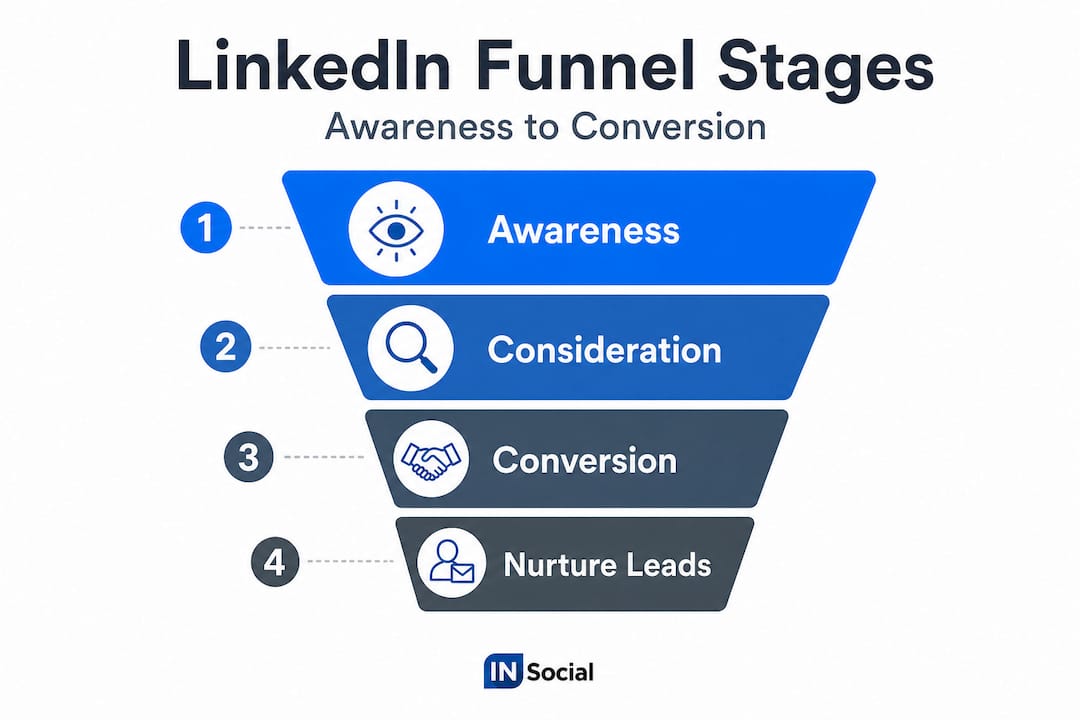
The funnel breaks down into three core stages:
| Funnel stage | Buyer state | Example LinkedIn tactic |
|---|---|---|
| Awareness | Discovering your brand for the first time | Video ads, thought leadership posts, carousel ads |
| Consideration | Evaluating whether your solution is relevant | Retargeted ads, case study content, sponsored articles |
| Conversion | Ready to take a direct action | Lead Gen Forms, Sponsored Messaging, direct outreach |
This staged approach is what separates high-performing B2B marketers from those who waste budget on disconnected activity. As LinkedIn's own guidance confirms, full-funnel LinkedIn marketing runs from awareness content through to retargeting and Lead Gen Forms, covering every phase of the buyer journey.
Key benefits of a LinkedIn-specific funnel over generic lead generation include:
- LinkedIn's professional targeting allows you to reach decision-makers by job title, seniority, industry, company size, and even specific organisations
- Native retargeting lets you re-engage users who have already interacted with your content, so you're not starting from zero each time
- Lead Gen Forms capture contact details without redirecting users away from LinkedIn, which reduces drop-off significantly
- LinkedIn's audience is in a professional mindset when browsing, making them more receptive to B2B offers than audiences on consumer-focused platforms
- Campaign Manager provides granular data on which funnel stages are underperforming, so you can fix problems with evidence rather than guesswork
"A full-funnel approach on LinkedIn treats awareness, consideration, and conversion as interconnected rather than separate campaigns. Brands that align content and targeting to each stage see measurably better pipeline outcomes than those running isolated efforts."
Understanding this structure is the first step. The next is knowing exactly which tools power each stage.
How the LinkedIn sales funnel works: Stages and tools
Now that we're clear on what a LinkedIn sales funnel is conceptually, let's dig into how it actually works in practice. Each stage has its own objective, its own tools, and its own definition of success. Treating them as one blended campaign is one of the most common and costly mistakes B2B marketers make.
| Funnel stage | Objective | LinkedIn tools |
|---|---|---|
| Awareness | Build brand recognition and reach new audiences | Video Ads, Carousel Ads, Thought Leadership Ads, organic posts |
| Consideration | Nurture interest and qualify intent | Retargeting campaigns, Document Ads, website visitor audiences |
| Conversion | Capture leads and initiate sales dialogue | Lead Gen Forms, Sponsored Messaging, Conversation Ads |
Here is a step-by-step process for moving a prospect through your LinkedIn funnel:
- Define your target audience using LinkedIn's demographic filters. Start with job title, seniority level, and industry. Keep it tight at first.
- Create awareness content that educates or challenges your audience's thinking. Video ads and thought leadership posts work well here because they build familiarity without asking for anything.
- Set up retargeting audiences based on users who watched at least 25% of a video ad, visited your website, or engaged with your company page.
- Serve consideration-stage content to your retargeted audiences. This could be a case study, a guide download, or a short webinar clip. The goal is to deepen interest.
- Deploy Lead Gen Forms at the conversion stage. These forms are pre-filled with the user's LinkedIn profile data, which dramatically reduces the effort needed to submit.
- Follow up promptly. A lead captured through LinkedIn still needs a human response. Aim to contact new leads within 24 hours while intent is fresh.
- Measure and iterate. Check completion rates on Lead Gen Forms, cost per lead at each stage, and the quality of leads entering your CRM.
When it comes to building LinkedIn funnels, the conversion stage is where most marketers see the biggest difference. LinkedIn Lead Gen Forms are positioned specifically as a bottom-funnel tactic because they remove the friction of sending users to an external landing page, keeping the experience seamless and the conversion rate higher.
For more detail on the broader toolkit available, explore these LinkedIn lead generation tactics that support every funnel stage.

Pro Tip: Start with simple audience segmentation and two or three distinct pieces of content, one per funnel stage. Once you have real engagement data, you can introduce more granular targeting and personalised messaging without wasting budget on assumptions.
Nuances and pitfalls: Intent matters in LinkedIn funnels
Once you know the tools and steps, it's vital to consider what truly makes a funnel effective: intent signals and careful segmentation. Not every person who sees your awareness ad is remotely close to buying. Treating them all the same way is expensive and ineffective.
The concept of buyer intent refers to the signals that indicate how close someone is to making a purchasing decision. On LinkedIn, these signals include things like visiting your pricing page, downloading a resource, watching a full video ad, or clicking through from a sponsored message. These behaviours tell you something meaningful about where a prospect sits in their journey.
Common retargeting mistakes that drain budget and reduce funnel performance:
- Showing the same call-to-action to all retargeted audiences regardless of how they first engaged
- Retargeting users who bounced from your site in under ten seconds, suggesting low interest from the outset
- Ignoring engagement depth, for example treating someone who watched five seconds of a video the same as someone who watched it in full
- Failing to exclude existing customers or current leads from top-of-funnel campaigns, which wastes spend and can frustrate contacts already in your pipeline
- Using a single creative for weeks without refreshing it, leading to ad fatigue among your most engaged audiences
The underlying principle here is that buyer intent should shape every targeting and messaging decision. Generic retargeting wastes spend on audiences who simply aren't ready or interested.
"The marketers who see real ROI from LinkedIn funnels are not necessarily those with the biggest budgets. They're the ones who obsess over segmentation, match messages to intent signals, and resist the temptation to push for conversion before a prospect is ready."
Refining your LinkedIn messaging strategies to reflect where prospects actually are in the funnel is one of the highest-leverage improvements you can make. Pair that with a consistent LinkedIn content strategy that feeds the awareness stage reliably, and your funnel becomes self-reinforcing over time.
Pro Tip: For SMEs with limited budgets, define just two or three intent-based segments before you launch retargeting. Something as simple as separating "visited pricing page" from "read a blog post" can meaningfully improve your message relevance and reduce cost per lead.
Practical steps to build your LinkedIn sales funnel
Understanding intent and proper segmentation sets the stage. Now here is how you take focused action and build your first LinkedIn sales funnel from the ground up.
The good news is that you do not need a large team or an enterprise-level budget. Most SMEs can get a basic funnel running within a few weeks. The key is to prioritise clarity over complexity at the start.
- Map your funnel stages. Decide which three stages you'll run: awareness, consideration, and conversion. Write down what success looks like at each stage before you touch any campaign settings.
- Define your ideal prospect. Use LinkedIn's targeting options to describe your target audience in specific terms. Job title, seniority, company size, and industry are a good starting point.
- Create one piece of content per stage. A short video or thought leadership post for awareness. A case study or guide for consideration. A Lead Gen Form with a clear, relevant offer for conversion.
- Build your retargeting audiences in Campaign Manager. Set up audiences based on video views, website visitors, and company page engagers. These are the people who move through your funnel automatically.
- Set a realistic budget for each stage. Awareness campaigns can run on modest daily spends. Concentrate your heavier investment on the conversion stage where the value is most direct.
- Go live and collect data. Do not wait until everything is perfect. You will learn more from two weeks of live campaign data than from two months of planning.
- Review lead quality weekly. Ask your sales team whether the leads coming through are the right fit. If not, adjust your targeting or your offer before scaling spend.
- Iterate on segmentation. As your data builds, refine your retargeting audiences and add more nuanced intent signals to improve targeting accuracy over time.
Well-defined funnel audiences and tightly crafted messages are where small B2B teams should focus first, expanding segmentation only once the initial structure is validated. For a detailed walkthrough, this step-by-step LinkedIn sales guide covers the process comprehensively.
Building momentum with LinkedIn lead growth tips will also help you sustain the top of your funnel with consistent organic activity alongside paid campaigns.
Pro Tip: Don't let the pursuit of a perfect funnel stop you from launching. An imperfect funnel that's live and generating data is worth ten perfectly designed ones sitting in a planning document. Get live, review results honestly, and improve with purpose.
The uncomfortable truth about LinkedIn sales funnels most experts won't tell you
Here's a perspective that rarely gets voiced in webinars or whitepapers: most B2B companies are not held back by a lack of funnel knowledge. They're held back by analysis paralysis, spending weeks or months designing the ideal framework before a single campaign goes live.
The funnel frameworks you read about, including the ones in this article, are models. They're useful for thinking, not for avoiding action. In reality, no LinkedIn funnel works exactly as planned in the first iteration. The first campaign teaches you things no amount of research can replicate. Your audience behaves unexpectedly. Your best-performing creative is rarely the one you predicted. Your conversion offer resonates with a slightly different job title than you targeted.
This is not a problem. This is how effective marketing actually works.
We've seen businesses spend three months building what they believed was a sophisticated, perfectly segmented funnel, only to discover that a simpler two-stage approach consistently outperformed it because it was cleaner, faster, and easier to optimise. Complexity, in the early stages especially, is often the enemy of results.
The businesses that win on LinkedIn are not always those with the most elaborate strategies. They're the ones who are willing to ask whether LinkedIn is right for your sales strategy honestly, start with a minimal but functional funnel, and iterate based on evidence rather than ego.
The real differentiator is discipline in measurement and a genuine willingness to change what isn't working. That mindset is rarer than any particular tactic or tool.
Boost your LinkedIn funnel results with expert help
Building a LinkedIn sales funnel that consistently delivers qualified leads takes more than theory. It takes hands-on experience with Campaign Manager, a clear understanding of audience segmentation, and the patience to iterate through multiple cycles of testing.
If you want to shortcut the trial-and-error phase and start seeing results faster, we specialise in exactly this. Our team combines human expertise with advanced AI tools to build, manage, and optimise LinkedIn funnels tailored to your business goals and your specific audience. Whether you're starting from scratch or improving an existing approach, explore our comprehensive LinkedIn lead generation service to see how we work. We also offer a distinctive approach to lead generation without cold outreach for businesses who want to attract inbound interest rather than chase prospects. Let's build something that works.
Frequently asked questions
What are the stages of a LinkedIn sales funnel?
The three core stages are awareness, consideration, and conversion, with each stage using different content types and targeting tactics to guide prospects forward. LinkedIn's own campaign mapping confirms awareness, consideration, and conversion as the standard framework for full-funnel activity.
How do LinkedIn Lead Gen Forms fit into the sales funnel?
Lead Gen Forms operate at the conversion stage, capturing lead data directly within LinkedIn without sending users to an external landing page. As LinkedIn describes, Lead Gen Forms are a bottom-funnel conversion tactic designed to reduce friction and improve submission rates.
Should all LinkedIn retargeting audiences get the same message?
No. Segmenting by intent and behaviour produces significantly better results than using a single message for everyone. Nuanced segmentation consistently outperforms generic retargeting by matching the message to where the buyer actually is in their journey.
How quickly can an SME launch a LinkedIn sales funnel?
Most SMEs can have a basic funnel live within two to four weeks, starting with simple audience definitions and one piece of content per stage, then refining based on early campaign data.
Does a LinkedIn sales funnel work for all B2B industries?
Most B2B sectors can benefit from a LinkedIn funnel, though results vary depending on audience engagement levels, the relevance of the offer, and how well the targeting is matched to actual buyer behaviour.