

Trying to fill your pipeline with qualified leads often feels tedious when cold emails go unanswered and generic ads miss the mark. LinkedIn now offers B2B marketing managers the opportunity to reach decision-makers directly, build trust through genuine relationships, and showcase expertise to those who matter most. By embracing relationship-focused business development and engaging consistently on this platform, you create targeted connections and accelerate sales—without relying on outdated tactics.
Table of Contents
- What is LinkedIn business development?
- Core Strategies Driving LinkedIn Success
- Key Roles And Responsibilities In B2B Sales
- Major Pitfalls And How To Avoid Them
Key Takeaways
| Point | Details |
|---|---|
| LinkedIn as a Business Tool | LinkedIn business development focuses on building relationships and generating leads rather than simply job searching. |
| Targeted Approach | Unlike traditional marketing, this strategy targets specific decision-makers, resulting in higher quality conversations and better conversion rates. |
| Strategic Engagement | Consistently engaging with valuable content and networking is key; it's about meaningful interactions rather than viral posts. |
| Profile Optimisation | A well-optimised profile is essential for visibility; it should clearly convey how you can help potential clients. |
What Is LinkedIn Business Development?
LinkedIn business development is far more than a platform for job seekers. It's a strategic approach to using LinkedIn's professional network to build relationships, identify decision-makers, and accelerate B2B sales growth.
Think of it as your virtual sales office. Instead of cold calling or sending unsolicited emails, you're connecting with real professionals in your industry, sharing relevant insights, and positioning yourself as someone worth talking to. LinkedIn business development transforms the platform from a resume repository into a dynamic lead generation and networking engine.
The Core Difference
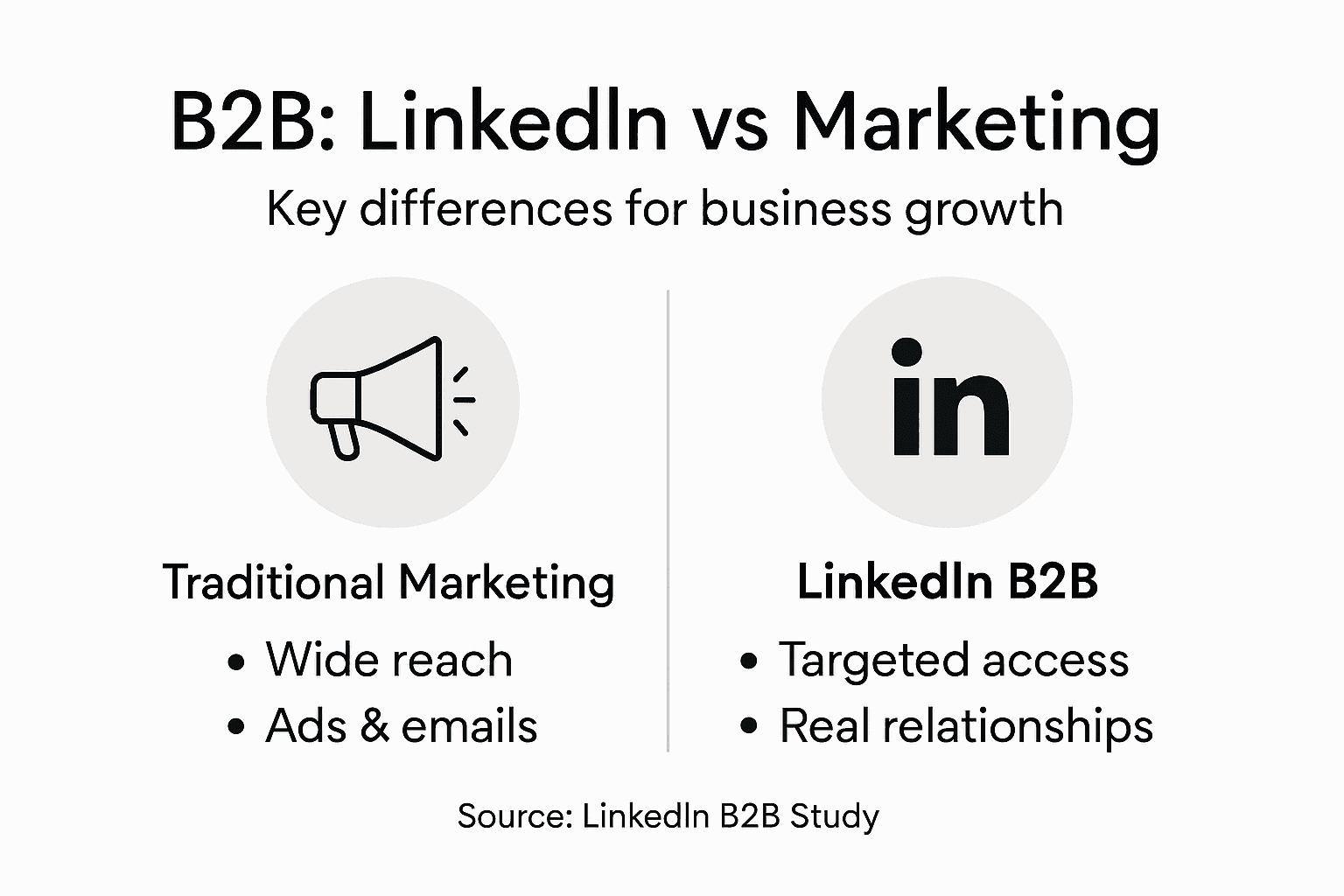
Traditional marketing casts a wide net. LinkedIn business development targets precision.
You're not trying to reach everyone. You're reaching the right people at the right time with the right message. This means higher-quality conversations, shorter sales cycles, and better conversion rates.
What Makes It Different from Other Strategies
LinkedIn business development operates on three key principles:
- Relationship-focused: Build genuine connections before asking for anything
- Content-driven: Share insights that demonstrate expertise and thought leadership
- Data-informed: Use LinkedIn's tools to identify and track decision-makers in your target accounts
You're not broadcasting ads. You're having conversations with professionals who need what you offer.
Why B2B Managers Need This Now
Your decision-makers live on LinkedIn. CEOs, procurement managers, operations directors—they spend time on this platform daily. They read articles, comment on posts, and build professional networks.
LinkedIn networks and lead generation capabilities give you direct access to these people. You can identify them by job title, company size, industry, and seniority level. Then you can reach them with relevant content and genuine conversation starters.
This is fundamentally different from hoping someone finds your website through Google.
Here's a comparison of traditional B2B marketing and LinkedIn business development approaches:
| Aspect | Traditional Marketing | LinkedIn Business Development |
|---|---|---|
| Audience Targeting | Broad, less precise | Highly specific and targeted |
| Communication Style | One-way promotion | Two-way professional conversations |
| Lead Quality | Often unqualified | Qualified decision-makers |
| Relationship Building | Limited ongoing engagement | Relationship-centred growth |
| Platform Role | Website ads, emails | Direct networking via LinkedIn |
What It Actually Accomplishes
When executed properly, LinkedIn business development delivers measurable results:
- Generates qualified leads from decision-makers
- Builds brand awareness within your target market
- Establishes your team as industry experts
- Creates consistent pipeline opportunities
- Reduces customer acquisition costs compared to traditional advertising
LinkedIn business development works because it combines personal relationships with professional credibility—you're not anonymous, you're not intrusive, and you're directly valuable to your audience.
The Real Investment Required
This approach demands consistency, not just money. You need someone on your team to engage regularly, build genuine relationships, and create content that matters. It's an ongoing effort, not a quick campaign.
That's why many B2B companies partner with specialists who understand both LinkedIn's mechanics and sales development strategy. They have the time and expertise to do it properly.
Pro tip: Start by mapping the exact job titles and companies you want to reach. This clarity turns LinkedIn into a surgical lead generation tool instead of a general networking platform.
Core Strategies Driving LinkedIn Success
Success on LinkedIn doesn't happen by accident. It requires a deliberate approach built on three foundational pillars: profile optimisation, strategic relationship building, and consistent engagement.
These aren't complicated tactics. They're straightforward actions that, when executed together, transform LinkedIn from a passive resume platform into an active sales development engine.
Strategy 1: Optimise Your Profile for Discovery
Your profile is your storefront. Decision-makers judge you in seconds based on what they see.
Make it count with these essentials:
- Professional photo: A clear headshot that looks like you
- Compelling headline: Focus on client benefits, not just your title
- Searchable keywords: Use industry terms your prospects actually search for
- Clear value proposition: Explain what problem you solve in your summary section
Your profile should answer one question immediately: "Can this person help me?"
A client-focused profile attracts the right connections and makes your business development work far more efficient.
Strategy 2: Build Relationships Deliberately
Strategic connection building means connecting with purpose, not collecting contacts.

Target specific people: industry peers in your niche, alumni from your university, decision-makers at companies you want to work with. Personalise your connection request with a brief note explaining why you're connecting.
This creates genuine relationships instead of hollow networks.
Strategy 3: Engage Consistently with Valuable Content
Posting occasionally won't cut it. Your target audience needs to see you regularly.
Share content that matters to them:
- Industry insights and trends
- Solutions to common problems they face
- Case studies showing real results
- Thought leadership pieces on your expertise
Engaging in discussions and joining relevant groups keeps you visible and positions you as someone worth talking to.
Strategy 4: Move Beyond Viral Thinking
Forget viral posts. Forget hoping for massive likes and comments.
Instead, focus on reaching the right 50 people who might become clients or referral partners. Consistency and relationship-building beat viral moments every time. One meaningful conversation with a decision-maker is worth more than a thousand random engagements.
Strategy 5: Measure What Matters
Track metrics that actually drive business:
- New qualified connections made
- Conversations started with decision-makers
- Profile views from your target companies
- Engagement from your target audience
- Meetings scheduled from LinkedIn outreach
Vanity metrics like total followers don't matter. Pipeline-building metrics do.
Pro tip: Block 30 minutes each weekday for LinkedIn activities: engage with three relevant posts, share one piece of valuable content, and send two personalised connection requests to target prospects.
Key Roles And Responsibilities In B2B Sales
B2B sales isn't a one-person job. It requires different roles working together, each with specific responsibilities that feed into the overall business development pipeline.
Understanding these roles helps you allocate resources properly and avoid bottlenecks. More importantly, it shows you exactly where LinkedIn fits into your sales machine.
To clarify responsibilities, here's how key B2B sales roles interact with LinkedIn:
| Role | Main LinkedIn Activity | Impact on Sales Pipeline |
|---|---|---|
| Account Executive | Relationship nurturing | Advances deals and closes sales |
| Sales Development Rep (SDR) | Strategic prospecting and outreach | Fills pipeline with qualified leads |
| Business Dev. Manager | Showcasing thought leadership | Identifies new and expansion business |
| All Roles | Credibility building and engagement | Maintains brand trust and visibility |
The Account Executive Role
Account executives own the relationship with individual prospects. They're responsible for moving conversations from initial contact through to closed deals.
Their core responsibilities include:
- Identifying decision-makers within target accounts
- Building trust through regular, valuable communication
- Qualifying opportunities based on fit and budget
- Negotiating terms and closing agreements
LinkedIn is their constant companion here. They use it to research prospects, find common connections, and stay top-of-mind between formal meetings.
The Sales Development Representative (SDR)
SDRs focus on the early pipeline stage. They prospect, research, and qualify leads before handing warm opportunities to account executives.
Their job involves:
- Finding prospects matching your ideal customer profile
- Initiating first contact through multiple channels
- Qualifying basic criteria (budget, authority, need, timeline)
- Scheduling meetings for the sales team
LinkedIn is their prospecting goldmine. Message filters let them target by role, company, seniority, and industry. A skilled SDR generates qualified conversations from cold LinkedIn outreach.
The Business Development Manager
Business development managers think strategically about account relationships. They manage existing clients, identify expansion opportunities, and sometimes handle partnership development.
Their responsibilities span:
- Building long-term client relationships
- Finding upsell and cross-sell opportunities
- Managing key account relationships
- Sometimes sourcing new business opportunities
LinkedIn presence helps showcase expertise and generate leads by positioning managers as thought leaders in their space.
Cross-Role Responsibilities
Every B2B sales role shares certain responsibilities:
- Credibility building: Demonstrate expertise through content and conversation
- Active communication: Respond promptly and maintain regular touchpoints
- Relationship nurturing: Keep prospects engaged beyond initial contact
- Tailored messaging: Customise outreach to each prospect's specific situation
The most effective B2B sales teams treat LinkedIn as a shared prospecting and relationship-building platform, not just a resume database.
Why Role Clarity Matters
When roles are unclear, gaps appear. SDRs waste time doing account management work. Account executives spend too long prospecting instead of closing. Business development managers lack focus.
With clear roles, each person focuses on what drives results. And LinkedIn becomes a systematic tool rather than something people use sporadically when they remember.
Pro tip: Define which LinkedIn activities each role owns: SDRs handle initial outreach, account executives manage ongoing relationships, and business development managers create thought leadership content.
Major Pitfalls And How To Avoid Them
Many B2B companies start strong on LinkedIn then fade. Others never gain traction at all. Usually, it's not because they lack effort. It's because they're making predictable mistakes that undermine their entire strategy.
Knowing these pitfalls gives you a massive advantage. You can sidestep months of wasted effort.
Pitfall 1: Treating LinkedIn Like A Resume Database
Your profile sits there. Passive. Outdated. Waiting for someone to discover you.
This approach guarantees nothing happens. LinkedIn rewards active participation, not passive presence. Treating LinkedIn as just an online resume means you're ignoring 90 percent of the platform's actual value.
Instead, use your profile as a launch point. Update it regularly. Share insights. Engage in conversations. Show you're an active, thinking professional.
Pitfall 2: Posting Without Purpose
People post constantly on LinkedIn. Most posts disappear without making any impact whatsoever.
The mistake: posting content nobody cares about. You share updates about internal processes or self-congratulatory announcements. Your target audience scrolls past.
Post with intent. Every piece of content should either educate, inspire action, or spark conversation with your ideal clients. Quality beats frequency every single time.
Pitfall 3: Random Connection Requests
Sending generic connection requests to everyone in your industry feels efficient. It's actually counterproductive.
When you connect without relevance, you dilute your network. Worse, you appear spammy. Recipients see you as someone collecting contacts, not building relationships.
Connect strategically. Target specific decision-makers at target companies. Personalise your request. Explain why you're connecting. This creates genuine relationships instead of hollow contact lists.
Pitfall 4: Ignoring Strategic Engagement
Many companies underestimate the power of active participation in groups and conversations. They post their own content but never comment on anyone else's.
This is backwards. Engagement builds visibility. When you comment thoughtfully on relevant posts, you reach your target audience. You demonstrate expertise. You start conversations that lead to relationships.
Pitfall 5: Expecting Viral Success
Everyone secretly hopes for a post that goes viral. That never-happens approach wastes mental energy.
Instead, focus on meaningful conversations with the right people:
- One decision-maker at your target company is worth more than a thousand random likes
- Consistent visibility with your niche beats occasional viral moments
- Real relationships drive sales far better than attention metrics
Pitfall 6: Neglecting Profile Optimisation
Your profile won't attract prospects if they can't find you. Missing keywords means decision-makers searching for your services never see you.
Optimise for search and clarity:
- Use industry keywords throughout your profile
- Write headlines that focus on client benefits
- Include clear value propositions in your summary
- Add professional photos
The biggest mistake is thinking LinkedIn is a "set it and forget it" platform. It requires consistent, purposeful effort to generate real business results.
Pro tip: Audit your LinkedIn activity this week: identify which posts generated conversations with actual decision-makers, and replicate that format moving forward instead of chasing vanity metrics.
Transform Your LinkedIn Business Development Strategy Today
The article highlights the challenges B2B managers face when using LinkedIn as more than just a networking platform. You know the frustration of aiming for qualified decision-makers, managing consistent engagement, and building meaningful relationships that actually convert. If these sound like familiar hurdles, our tailored strategies at IN-SOCIAL are designed to help you overcome them by combining expert human insight with advanced AI tools.
Unlock the full potential of LinkedIn business development with our comprehensive services including expertly managed LinkedIn profiles, bespoke content creation, and targeted lead generation campaigns. Stop struggling with ineffective connections or aimless posting. Take action now and partner with specialists who understand how to generate measurable business growth. Visit IN-SOCIAL's website to elevate your LinkedIn presence and start turning meaningful connections into real revenue. Explore how our LinkedIn management and proven sales growth strategies can work for you.
Frequently Asked Questions
What is LinkedIn business development?
LinkedIn business development is a strategic approach that uses the LinkedIn platform to build relationships, identify decision-makers, and drive B2B sales growth, turning the site into a dynamic lead generation and networking tool.
How does LinkedIn business development differ from traditional marketing?
Unlike traditional marketing, which often targets a broad audience, LinkedIn business development focuses on engaging specific decision-makers with tailored messages, resulting in higher quality conversations and better conversion rates.
What are the key strategies for success on LinkedIn?
Success on LinkedIn involves optimising your profile for discovery, deliberately building relationships, consistently engaging with valuable content, and focusing on measurable outcomes rather than vanity metrics.
Why is relationship building important in LinkedIn business development?
Building genuine relationships on LinkedIn is crucial because it fosters trust and engagement, leading to more meaningful interactions and ultimately driving sales as decision-makers are more inclined to connect with professionals they trust.