

LinkedIn generates approximately 80% of B2B social media leads, yet many marketers still treat content as an afterthought rather than a strategic driver. The difference between businesses that generate consistent, high-quality leads and those that struggle often comes down to how they approach content creation and distribution on the platform. Understanding how LinkedIn's algorithm works and aligning your content strategy accordingly transforms your presence from noise into a lead-generation engine. This guide reveals the proven frameworks and tactical insights you need to harness content effectively for measurable B2B lead growth.
Table of Contents
- Why Content Is Pivotal In LinkedIn Marketing For B2B Leads
- Understanding LinkedIn's Content Algorithm: Retrieval And Ranking Stages
- Crafting Content That Aligns With LinkedIn's Algorithm And Audience Behaviour
- Measuring Content Effectiveness And Refining Your LinkedIn Strategy
- Enhance Your LinkedIn Marketing With IN Social's Expert Solutions
- FAQ
Key takeaways
| Point | Details |
|---|---|
| LinkedIn dominates B2B leads | The platform drives roughly 80% of B2B social media leads, making it essential for business growth. |
| Algorithm knowledge matters | Understanding retrieval and ranking stages helps you create content that reaches your ideal prospects. |
| Behavioural alignment is key | Content must match user behaviour history to gain algorithmic favour and visibility. |
| Consistency builds momentum | Regular, strategic posting establishes authority and nurtures prospects through the sales funnel. |
| Measurement drives improvement | Tracking performance metrics enables continuous refinement of your LinkedIn content strategy. |
Why content is pivotal in LinkedIn marketing for B2B leads
Content sits at the heart of every successful LinkedIn marketing strategy, yet many B2B businesses fail to recognise its strategic importance. Whilst some companies invest heavily in paid advertising or cold outreach, they overlook the foundational role that quality content plays in attracting, engaging, and converting prospects. A dominant share of B2B social media leads originate on LinkedIn, making it the single most important platform for business development in 2026.
Your content serves multiple functions simultaneously. It establishes your expertise, builds trust with potential clients, and keeps your brand visible when decision-makers are ready to buy. Different content formats serve distinct purposes: thought leadership posts position you as an industry authority, case studies provide social proof, videos humanise your brand, and articles demonstrate deep expertise. Each format contributes to moving prospects through different stages of awareness and consideration.
The mistake many marketers make is treating LinkedIn content as a broadcasting channel rather than a conversation starter. Content that generates leads doesn't just inform; it provokes thought, challenges assumptions, and invites engagement. When you publish content that resonates with your target audience's pain points and aspirations, you create opportunities for meaningful dialogue that naturally leads to business relationships.
"Content quality and relevance directly influence visibility and engagement on LinkedIn, making strategic content creation non-negotiable for B2B success."
Consider how prospects interact with your content at different funnel stages:
- Awareness stage: Educational posts and industry insights attract new connections
- Consideration stage: Case studies and comparison content help prospects evaluate solutions
- Decision stage: Client testimonials and detailed guides support final purchasing decisions
- Advocacy stage: Thought leadership content keeps existing clients engaged and referring
The businesses that excel at LinkedIn content for B2B lead generation understand that content isn't just marketing collateral. It's the foundation of relationships, the catalyst for conversations, and the mechanism through which trust develops at scale. Without strategic content, you're invisible to the very prospects you're trying to reach.
Understanding LinkedIn's content algorithm: retrieval and ranking stages
LinkedIn's algorithm operates as a sophisticated gatekeeper, determining which content reaches your target audience and which disappears into obscurity. The platform employs a two-stage pipeline comprising Retrieval and Ranking, each serving distinct functions in content distribution. Grasping these mechanisms enables you to craft content that works with the algorithm rather than against it.

The Retrieval stage functions as the initial filter. A Causal large language model analyses your behavioural context, examining your past interactions, connections, and engagement patterns to select candidate content that might interest you. This stage isn't about quality judgements; it's about relevance matching. The algorithm looks at what you've previously liked, commented on, shared, and viewed to predict what content you'll find valuable.
Here's how the two-stage process works in practice:
- Retrieval identifies content candidates based on your network, interests, and behaviour history
- The system pulls content from connections, followed accounts, and trending topics in your industry
- Ranking then evaluates these candidates, scoring each piece based on predicted engagement likelihood
- The highest-scoring content appears at the top of your feed, whilst lower-scoring content gets buried
- User interactions continuously refine the algorithm's understanding of your preferences
The Ranking stage is where content quality truly matters. LinkedIn's algorithm assesses multiple signals: how quickly people engage after seeing your post, the depth of engagement (comments versus likes), the authority of those engaging, and how long users spend viewing your content. Posts that generate meaningful conversations and sustained attention receive algorithmic amplification, appearing in more feeds and staying visible longer.
Pro Tip: Your content's performance in the first 60 minutes largely determines its overall reach. Focus on posting when your target audience is most active, and consider engaging with early commenters to boost initial momentum and signal quality to the algorithm.
Understanding these algorithmic mechanics transforms how you approach LinkedIn content strategy. Rather than creating content in a vacuum, you can intentionally design posts that align with both stages. This means crafting content that matches your audience's demonstrated interests (for Retrieval) whilst also encouraging meaningful engagement (for Ranking). The businesses that master this dual focus consistently outperform competitors who ignore algorithmic realities.
Crafting content that aligns with LinkedIn's algorithm and audience behaviour
Creating content that resonates requires understanding not just what the algorithm favours, but how your target audience actually behaves on LinkedIn. Your behaviour history serves as input for LinkedIn's Generative Recommender, meaning the content you produce must align with the demonstrated interests and engagement patterns of your ideal prospects. This alignment is where strategy meets execution.
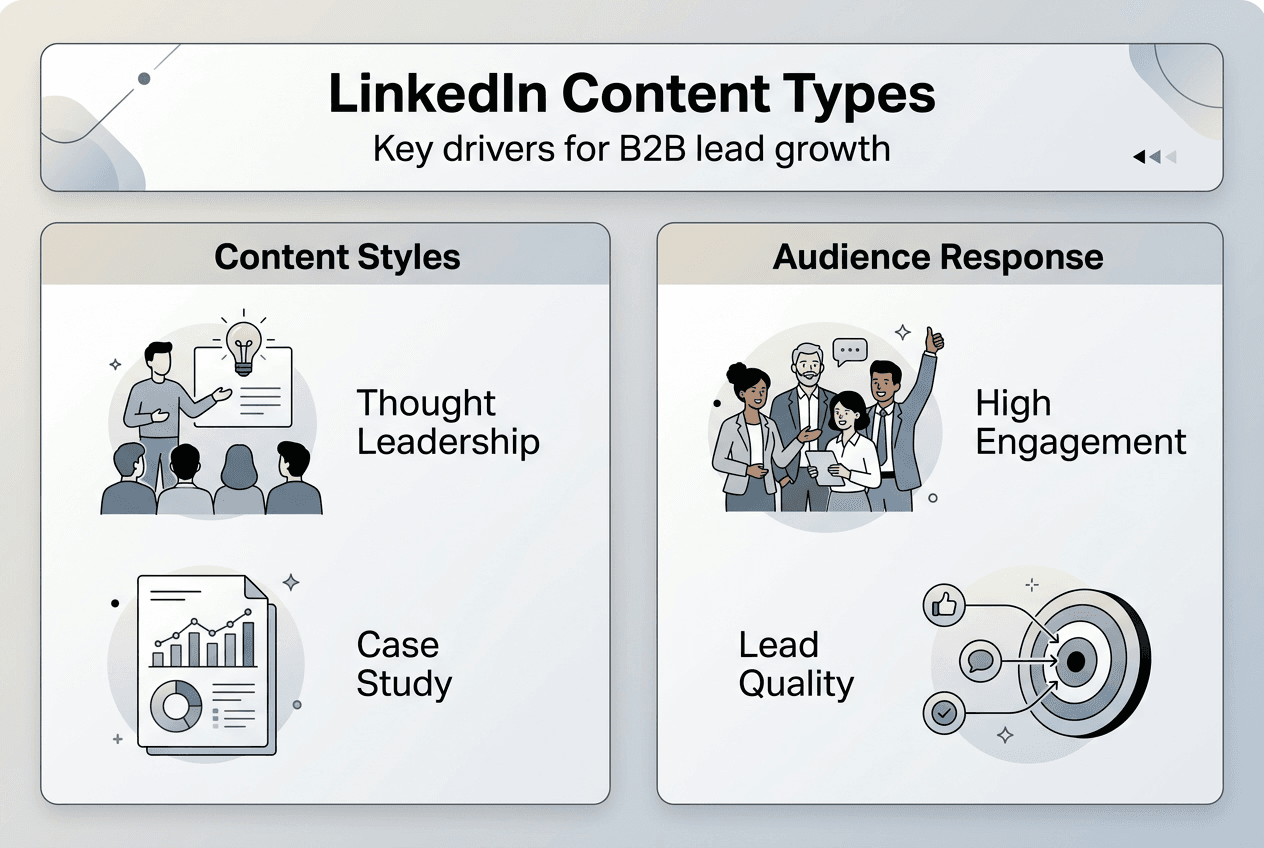
Start by analysing what content formats and topics generate engagement within your target market. Scroll through your ideal clients' activity feeds to identify patterns. What posts do they comment on? Which articles do they share? What questions provoke discussion? This behavioural intelligence informs your content calendar, ensuring you're creating material that matches proven interests rather than guessing at what might work.
Effective LinkedIn content typically falls into these high-performing categories:
- Thought leadership: Original perspectives that challenge conventional wisdom and spark debate
- Case studies: Concrete examples demonstrating how you've solved problems similar to your prospects' challenges
- Educational content: Actionable frameworks, processes, or insights that readers can immediately apply
- Industry analysis: Data-driven observations about market trends, shifts, or emerging opportunities
- Behind-the-scenes content: Authentic glimpses into your company culture, values, or working methods
Consistency matters more than most marketers realise. The algorithm favours accounts that post regularly because consistent activity signals reliability and commitment. However, consistency doesn't mean daily posting if that compromises quality. Three to five well-crafted posts per week typically outperform daily low-effort content. Establish a sustainable rhythm that allows you to maintain quality whilst building algorithmic momentum.
Pro Tip: Create content batches during dedicated creation sessions, then schedule posts to maintain consistency even during busy periods. This approach ensures your LinkedIn presence remains active regardless of daily workload fluctuations.
Engagement is a two-way street. Posting content without interacting with your audience signals to the algorithm that you're broadcasting rather than building community. Respond promptly to comments, ask follow-up questions, and engage meaningfully with others' content in your industry. This activity not only boosts your visibility through the algorithm but also builds the relationships that ultimately convert into leads.
The table below illustrates how different content types align with specific business objectives:
| Content Type | Primary Objective | Engagement Pattern | Lead Quality |
|---|---|---|---|
| Thought leadership posts | Brand awareness | High comments, shares | Medium to high |
| Case studies | Consideration stage nurturing | Moderate engagement, high saves | High |
| Educational how-to content | Audience building | High reach, varied engagement | Medium |
| Industry data analysis | Authority establishment | Professional engagement | Medium to high |
| Client success stories | Conversion support | Targeted engagement | Very high |
Monitor your content performance to identify what resonates most with your specific audience. LinkedIn's native analytics reveal which posts drive profile views, connection requests, and website clicks. These metrics tell you what's working and what needs adjustment. Effective LinkedIn content creation for B2B lead generation in 2026 requires this continuous feedback loop, allowing you to double down on successful approaches whilst refining or abandoning underperforming tactics. The businesses that treat content creation as an iterative process rather than a one-time effort consistently generate better lead outcomes.
Don't forget that LinkedIn rewards native content more favourably than external links. Whilst occasional links to valuable resources add credibility, posts that keep users on the platform typically receive greater algorithmic distribution. When you do include links, ensure they provide genuine value rather than serving as thinly veiled promotional vehicles. The algorithm can detect and suppress overly promotional content, so focus on education and value first. These LinkedIn content tips can significantly boost your lead generation efforts in 2026 when applied consistently.
Measuring content effectiveness and refining your LinkedIn strategy
Creating content without measuring its impact is like driving with your eyes closed. You might move forward, but you have no idea if you're heading in the right direction. Effective measurement transforms LinkedIn content from a hopeful activity into a systematic lead-generation engine. The key lies in tracking the right metrics and using those insights to continuously refine your approach.
Start with engagement metrics that indicate content resonance. Impressions tell you how many people saw your content, but engagement metrics reveal how compelling they found it. Track likes, comments, shares, and click-through rates to understand which content formats and topics generate the strongest response. Comments particularly matter because they signal deep engagement and trigger algorithmic amplification.
However, engagement metrics alone don't tell the full story. The ultimate measure of LinkedIn content success is lead generation. Track how many profile views, connection requests, and direct messages result from your content efforts. Use LinkedIn's Campaign Manager or native analytics to connect content activity with downstream business outcomes. This connection between content and leads often reveals surprising insights about which posts actually drive business results versus which simply generate vanity metrics.
Compare different content approaches systematically:
- Test various posting times to identify when your audience is most active and receptive
- Experiment with different content lengths, from brief observations to detailed analyses
- Try multiple formats including text posts, documents, videos, and polls
- Vary your topics to discover which themes resonate most strongly with your target market
- Monitor how different calls to action influence engagement and conversion rates
The comparison table below illustrates typical performance differences across content types:
| Metric | Text Posts | Video Content | Document Posts | Polls |
|---|---|---|---|---|
| Average reach | Baseline | 150-200% of baseline | 120-150% of baseline | 180-250% of baseline |
| Comment rate | Moderate | High | Low to moderate | Very high |
| Lead quality | Medium | High | Very high | Low to medium |
| Time investment | Low | High | Medium | Very low |
Iterative testing reveals what works for your specific audience and business context. What performs well for one company might flop for another, even within the same industry. This is why copying competitors' content strategies rarely succeeds. Your audience has unique preferences, pain points, and engagement patterns that require tailored approaches.
Remember that LinkedIn continues to drive a dominant share of B2B social media leads, making measurement and optimisation essential rather than optional. Set aside time monthly to review your content analytics, identify patterns, and adjust your strategy accordingly. Look for trends across multiple posts rather than overreacting to individual outliers. A single viral post doesn't necessarily indicate a repeatable strategy, whilst consistent moderate performance often signals a sustainable approach.
Integrate these insights into your ongoing LinkedIn content strategy workflow by creating a feedback loop. Use performance data to inform your content calendar, doubling down on topics and formats that generate qualified leads whilst phasing out approaches that underperform. This disciplined, data-driven approach separates businesses that generate consistent LinkedIn leads from those that post hopefully and wonder why results remain elusive. The companies that measure, learn, and adapt systematically inevitably outperform those that rely on intuition alone.
Enhance your LinkedIn marketing with IN Social's expert solutions
Mastering LinkedIn content strategy requires time, expertise, and consistent effort that many businesses struggle to maintain alongside core operations. Developing content that aligns with algorithmic preferences whilst genuinely resonating with your target audience demands both strategic thinking and tactical execution.
IN Social specialises in transforming LinkedIn presence into measurable lead generation through managed LinkedIn services tailored to B2B companies. Our team combines deep platform expertise with the latest algorithmic insights to create content strategies that consistently deliver qualified prospects. Whether you need comprehensive LinkedIn management or want to join the IN Social Sales Club for ongoing support and training, we provide solutions that align with your business objectives. Discover how IN Social can elevate your LinkedIn marketing and drive sustainable lead growth.
FAQ
What types of content perform best on LinkedIn for B2B lead generation?
Thought leadership posts, case studies, videos, and polls typically drive strong engagement and qualified leads. The key is matching content type to your specific audience's preferences and business objectives. Consistency and relevance to audience needs matter more than chasing trending formats.
How often should I post on LinkedIn to maximise lead generation?
Posting three to five times weekly balances visibility without overwhelming your audience, helping build consistent engagement and algorithmic favour. Quality always trumps quantity, so maintain a sustainable rhythm that allows you to create valuable content rather than rushing to meet arbitrary posting quotas.
Can LinkedIn content alone generate quality B2B leads?
Quality LinkedIn content is foundational, but best results come from integrating content with outreach, networking, and nurturing practices. Content attracts attention and establishes credibility, but relationships and conversations convert prospects into clients. Think of content as the starting point rather than the complete solution.
How long does it take to see lead generation results from LinkedIn content?
Most businesses notice increased engagement within four to six weeks of consistent, strategic posting, with qualified leads typically emerging within two to three months. LinkedIn success requires patience and persistence, as the platform rewards sustained effort and relationship building over quick wins.
Should I focus on personal profiles or company pages for LinkedIn content?
Personal profiles typically generate significantly higher engagement and reach than company pages due to how LinkedIn's algorithm prioritises individual connections. Use your personal profile as the primary content hub whilst leveraging your company page for employer branding and corporate announcements.