

If your sales team is generating plenty of activity on LinkedIn but struggling to convert that activity into predictable revenue, the problem is almost certainly structural. You need a pipeline, not just a presence. B2B companies with a formal sales process generate 18% more revenue than those operating without one, and LinkedIn is the single most powerful platform for building that structure in the B2B space. This guide walks you through every stage of building, running, and optimising a LinkedIn pipeline that consistently delivers qualified leads and real sales conversations.
Table of Contents
- Why LinkedIn pipelines matter for B2B growth
- Tools and requirements for building your LinkedIn pipeline
- Step-by-step process: building your LinkedIn pipeline
- Maintaining and optimising your LinkedIn pipeline
- Common mistakes and troubleshooting tips
- Supercharge your LinkedIn pipeline with expert support
- Frequently asked questions
Key Takeaways
| Point | Details |
|---|---|
| Maximise pipeline coverage | Aim for 3-5x your quota to ensure a predictable B2B sales pipeline on LinkedIn. |
| Use the right tools | Equip your sales team with LinkedIn Sales Navigator, CRM integration, and analytics to streamline lead management. |
| Follow consistent processes | A formal, repeatable approach to LinkedIn pipeline building drives higher win rates and revenue. |
| Avoid common pitfalls | Monitor for data hygiene, avoid over-automation, and keep messaging relevant to each prospect. |
Why LinkedIn pipelines matter for B2B growth
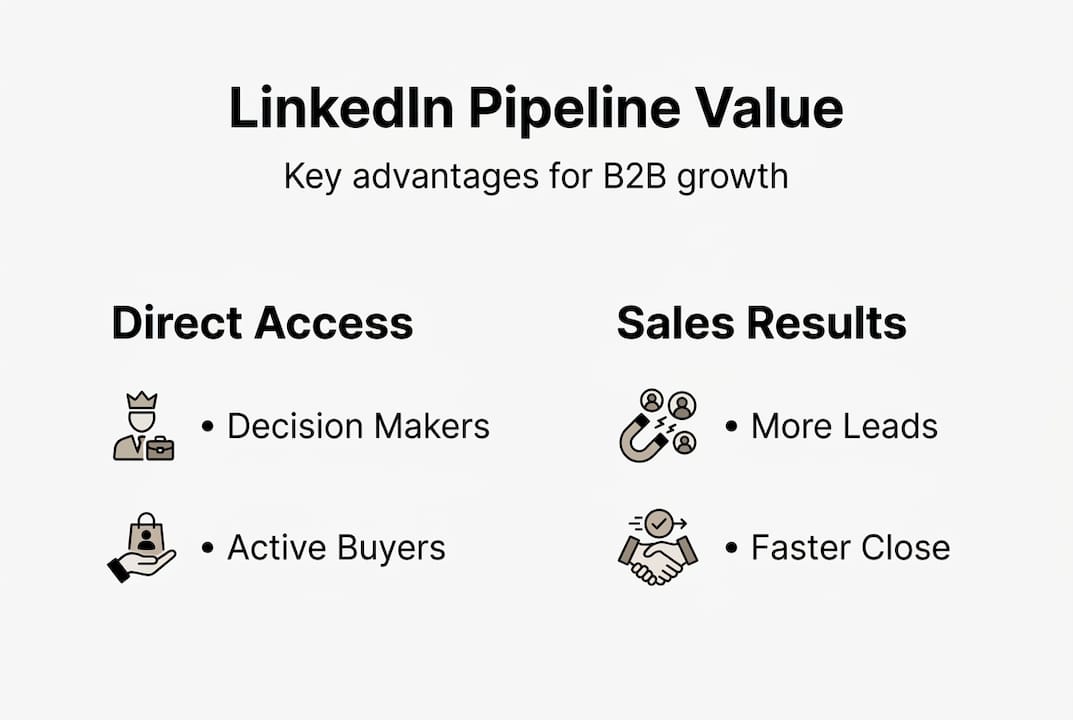
LinkedIn is not simply a professional networking site. It is a live database of decision-makers, buyers, and influencers who are actively engaged in business conversations every day. That makes it fundamentally different from cold email lists or generic advertising channels. When you build a pipeline on LinkedIn, you are working with intent-rich data and warm professional relationships rather than anonymous contacts.
The numbers back this up. Pipeline coverage should be 3-5x your quota to give your team the stability and buffer needed to hit targets consistently, even when deals slip or stall. Without that coverage, one lost deal can derail an entire quarter. LinkedIn's targeting capabilities make it far easier to build that coverage quickly compared to other channels.
Understanding LinkedIn's B2B lead generation power is the first step towards using it strategically. Here is what makes a LinkedIn pipeline distinct from a generic CRM list:
- Decision-maker access: You can reach C-suite and senior buyers directly, without gatekeepers.
- Intent signals: Profile views, post engagement, and connection requests all signal buying interest.
- Relationship context: Every outreach happens within a professional network, which raises response rates significantly.
- Content amplification: Thought leadership content builds trust at scale before a single message is sent.
- Real-time data: Profiles update continuously, so your prospect information stays current.
These advantages translate directly into LinkedIn-driven sales results that outperform most other B2B channels when the pipeline is managed correctly.
Tools and requirements for building your LinkedIn pipeline
Before you start prospecting, you need the right foundations in place. Jumping straight into outreach without the correct tools and a clear setup is one of the most common reasons pipelines underperform. Win rates for SMB pipelines typically sit at 15-20%, and reaching that benchmark requires both the right technology and a well-defined target persona.

Here is a comparison of the core tools you will need:
| Tool | Primary function | Why it matters |
|---|---|---|
| LinkedIn Sales Navigator | Advanced prospect search and lead lists | Filters by role, industry, company size, and activity |
| CRM (e.g. HubSpot, Salesforce) | Contact management and deal tracking | Centralises pipeline data and prevents lead leakage |
| Content scheduling tool | Consistent LinkedIn posting | Keeps your profile active and visible to prospects |
| Analytics platform | Performance tracking | Measures what is working and where to improve |
Beyond tools, your foundational setup must include:
- An optimised LinkedIn profile that speaks directly to your ideal client's challenges, not just your own credentials.
- A clearly defined target persona with specific job titles, industries, company sizes, and pain points.
- A sharp value proposition that you can communicate in two sentences or fewer.
- A content plan that positions you as a credible voice in your sector.
Pro Tip: Sync your CRM with LinkedIn Sales Navigator from day one. This eliminates manual data entry, reduces the risk of leads falling through the cracks, and gives your team a single source of truth for every prospect. Building a strong LinkedIn network becomes far more valuable when every new connection feeds directly into your pipeline system. Good LinkedIn pipeline management starts with clean, connected data.
Step-by-step process: building your LinkedIn pipeline
B2B teams with a formal sales pipeline see measurable revenue gains precisely because they follow a repeatable process rather than relying on ad hoc outreach. Here is the process we recommend:
- Prospect: Use Sales Navigator to build targeted lead lists based on your ideal customer profile. Filter by seniority, industry, geography, and company size. Save searches so new matches appear automatically.
- Qualify: Review each prospect's profile, recent activity, and company news before reaching out. Prioritise those showing intent signals such as engaging with relevant content or posting about challenges you solve.
- Outreach: Send a personalised connection request with a short, specific note. Reference something real, a post they wrote, a mutual connection, or a relevant industry trend. Generic messages get ignored.
- Nurture: Once connected, do not pitch immediately. Engage with their content, share useful resources, and build rapport over several touchpoints. Generating LinkedIn leads effectively means earning trust before asking for a meeting.
- Track and optimise: Log every interaction in your CRM. Monitor reply rates, connection acceptance rates, and meeting conversion rates. Adjust your messaging and targeting based on what the data tells you.
Pro Tip: Automate the repeatable administrative steps, such as logging activities and scheduling follow-up reminders, but keep your initial outreach messages personal and specific. Automation that touches the prospect directly will damage your reply rates and your reputation. Strong content tips for LinkedIn and consistent content creation for B2B support every stage of this process by keeping you visible and credible.
Here is how in-house manual pipeline building compares to a hybrid approach:
| Approach | Speed | Scalability | Personalisation | Cost |
|---|---|---|---|---|
| Manual (in-house) | Slow | Limited | High | Low upfront, high time cost |
| Hybrid (automated + manual) | Fast | High | Moderate to high | Medium investment, strong ROI |
For most SMBs, the hybrid model delivers the best balance of efficiency and quality.
Maintaining and optimising your LinkedIn pipeline
Building a pipeline is only half the work. Keeping it healthy is where most teams fall short. A pipeline that is not actively maintained quickly becomes cluttered with stale leads, missed follow-ups, and inaccurate data, all of which distort your forecasting and slow your growth.
SMB pipeline KPIs include win rate and coverage, and tracking these consistently is what separates teams that grow predictably from those that lurch between feast and famine. Focus on these maintenance habits:
- Schedule weekly follow-ups for every active prospect in your pipeline. Silence is not a no; it is usually just poor timing.
- Track KPIs monthly including pipeline coverage, win rate, reply rate, and average deal cycle length.
- A/B test your messaging regularly. Small changes to subject lines, opening sentences, or call-to-action phrasing can significantly shift reply rates.
- Maintain CRM hygiene by archiving dead leads, updating contact details, and tagging prospects by stage accurately.
- Review your content performance to understand which posts are attracting the right audience and generating inbound interest.
The most common pipeline mistake is treating coverage as a one-time setup task. Your pipeline needs to be replenished continuously. If you are not adding new qualified prospects every week, you are slowly running out of runway.
Effective nurturing of LinkedIn leads is what moves prospects through the pipeline without pressure. Understanding the different lead generation types available on LinkedIn also helps you diversify your pipeline sources and reduce dependency on any single tactic.
Common mistakes and troubleshooting tips
Win rates and pipeline coverage are crucial for predictable growth, yet many B2B teams undermine both through avoidable errors. Recognising these mistakes early saves you months of wasted effort.
- Neglecting data hygiene: Outdated or duplicate records in your CRM lead to embarrassing outreach errors and inaccurate reporting. Clean your data regularly.
- Over-automation: Sending automated connection requests and follow-up sequences at scale without personalisation signals spam behaviour and damages your LinkedIn account's standing.
- One-size-fits-all messaging: A message written for a marketing director will not resonate with a finance director. Segment your outreach by persona and tailor accordingly.
- Ignoring post-connect nurture: Connecting on LinkedIn and then immediately pitching is the fastest way to get ignored. Build the relationship first.
- Skipping pipeline reviews: Without regular reviews, problems compound silently until they become crises.
Pro Tip: Schedule a pipeline audit every four weeks. Review your coverage ratio, check for leads that have gone cold without a follow-up, and assess whether your messaging is still aligned with current market conditions. Understanding why LinkedIn matters for teams at a strategic level helps you make smarter decisions during these audits rather than just firefighting.
Supercharge your LinkedIn pipeline with expert support
For those ready to fast-track results, partnering with LinkedIn sales experts can multiply your pipeline's impact. Building and maintaining a high-performing LinkedIn pipeline takes consistent effort, the right tools, and a strategy that evolves with your market. That is exactly what we do at IN Social.
We work with B2B companies and sales teams to build, manage, and optimise LinkedIn pipelines that generate qualified leads and real revenue. From profile optimisation and content creation to outreach strategy and CRM integration, our LinkedIn lead generation services are designed to deliver measurable results without the guesswork. If you want to learn alongside a community of like-minded sales professionals, our Sales Club community gives you access to expert guidance, templates, and peer support. Get in touch today for a tailored LinkedIn pipeline plan built around your specific goals and market.
Frequently asked questions
How long does it take to see results from a LinkedIn pipeline?
Most B2B teams begin to see measurable lead quality and engagement improvement within 4-8 weeks of implementing a structured LinkedIn pipeline. Formal pipelines deliver predictable results and improved win rates when followed consistently.
What is the optimal pipeline coverage on LinkedIn for B2B sales?
Aim for pipeline coverage of 3-5x your sales quota to ensure steady results and manage the natural risk of deals stalling or falling away.
Which LinkedIn tools are best for pipeline building?
LinkedIn Sales Navigator, CRM integrations, and content scheduling tools are essential for a modern B2B pipeline. Modern LinkedIn pipelines rely on dedicated prospecting and management tools to stay efficient and scalable.
What KPIs should I track for my LinkedIn pipeline?
Focus on pipeline coverage, win rate (typically 15-20% for SMBs), reply rates, connection acceptance rates, and meeting conversion rates to get a full picture of pipeline health.