

TL;DR:
- A structured LinkedIn sales funnel guides prospects from awareness to conversion, improving lead generation.
- Optimizing profiles and creating value-driven content are essential for warming up B2B audiences.
- Consistent, relationship-focused engagement and targeted outreach prevent funnel stalls and build long-term pipeline.
You've spent hours updating your LinkedIn profile, posting regularly, and sending connection requests. Yet somehow, the pipeline stays quiet. No meetings. No qualified leads. Just profile views that go nowhere. This is one of the most common frustrations for B2B marketing managers and sales teams, and it usually comes down to one thing: activity without structure. A LinkedIn sales funnel changes that. It gives your efforts a clear direction, moving prospects from first impression through to genuine sales conversations. This guide walks you through every stage, from building the right foundations to diagnosing what's gone wrong when results stall.
Table of Contents
- Laying the groundwork: Profile and strategy essentials
- Content and value: Attracting and warming B2B audiences
- Building your LinkedIn sales funnel: Step-by-step process
- Avoiding common pitfalls and troubleshooting your funnel
- What most LinkedIn funnel guides miss: The overlooked edge
- Supercharge your LinkedIn sales funnel with expert support
- Frequently asked questions
Key Takeaways
| Point | Details |
|---|---|
| Funnel foundations matter | Optimise your LinkedIn profile and strategy before starting outbound efforts. |
| Content attracts and nurtures | Consistent, valuable LinkedIn content warms up prospects and supports lead generation. |
| Process drives results | A structured, step-by-step funnel multiplies your LinkedIn lead generation success. |
| Beware common mistakes | Avoid being too salesy, neglecting engagement, or automating too much. |
Laying the groundwork: Profile and strategy essentials
Before building the funnel itself, you need the right foundations in place. Think of your LinkedIn profile not as a digital CV, but as a landing page. Every prospect you reach out to will check it. If it does not immediately communicate credibility, relevance, and value, you lose them before the conversation even starts.
Optimising your LinkedIn profile significantly increases conversion rates in B2B funnels, and the elements that matter most are simpler than most people think. Start with a professional, high-resolution headshot taken against a clean background. Your headline should not just state your job title. It should answer the question: "What do I do for people like you?" For example, "I help SaaS companies generate qualified leads through LinkedIn strategy" is far more compelling than "Sales Director at XYZ Ltd."
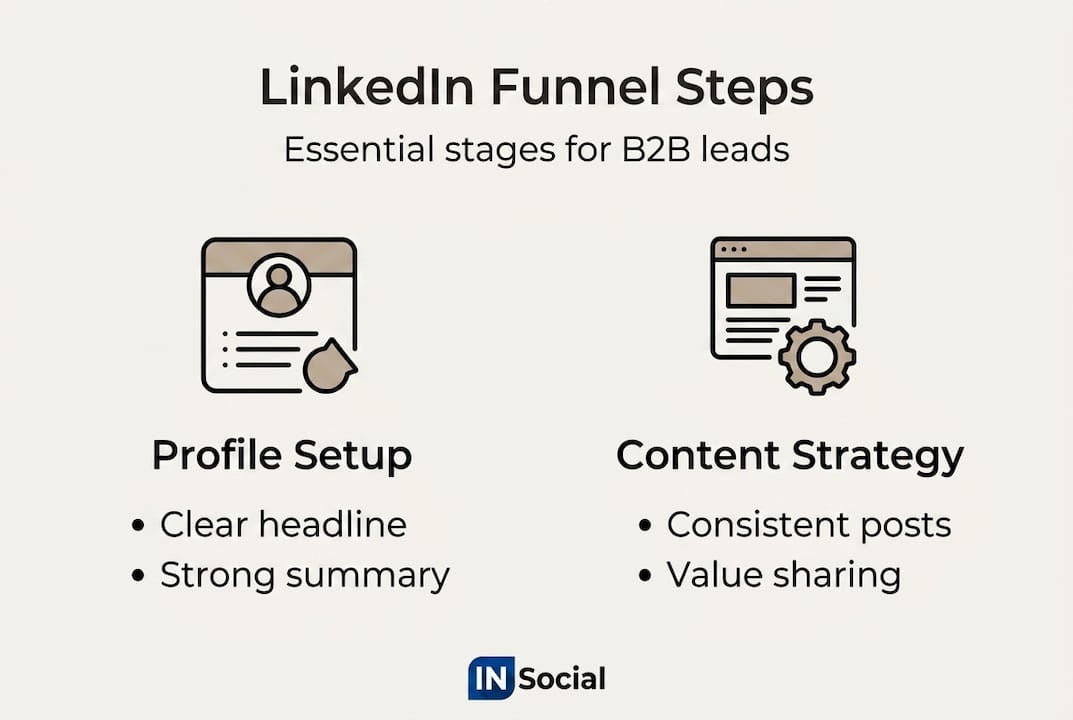
Your summary section is where you earn trust. Write it in the first person, focus on outcomes you deliver rather than features of your service, and include a clear call to action. Recommendations from clients or colleagues add powerful social proof, particularly for decision makers who are evaluating whether to respond to your outreach.
Profile optimisation checklist before outreach:
- Professional headshot and branded banner image in place
- Headline focused on client outcomes, not your job title
- Summary written in first person with a clear call to action
- At least three client or colleague recommendations
- Contact information and website URL updated
- Featured section showcasing relevant content or case studies
- Connection criteria defined: industry, company size, seniority level
Beyond the profile, you also need to define your ideal client persona with precision. Who are you targeting on LinkedIn? What sector, company size, and seniority level? What problems keep them awake at night? The more specific you are here, the more targeted and effective your outreach will be. Visit profile best practices to see how to align every profile element to your ideal audience.
| Profile element | Weak version | Optimised version |
|---|---|---|
| Headline | Sales Manager at ABC Ltd | Helping B2B firms generate pipeline through LinkedIn |
| Summary | Experienced professional with 10 years in sales | I help SMEs build predictable lead generation systems |
| Photo | Cropped group photo | Professional headshot, clean background |
| Recommendations | None | Three to five relevant endorsements |
| Featured section | Empty | Lead magnet, case study, or key post |
Pro Tip: Even small headline tweaks, such as swapping your job title for a client benefit statement, can increase connection acceptance rates by a significant margin. Test two versions over a fortnight and track which generates more replies.
Content and value: Attracting and warming B2B audiences
With your LinkedIn foundations in place, it is time to attract and nurture the right audience. Content is the engine of your funnel. It does the warming work before your outreach even begins, so that when you do reach out, prospects already recognise your name and associate it with genuine expertise.

Consistent, value-driven content is central to the LinkedIn sales funnel for B2B lead generation, and the key is matching your content type to where your prospect sits in the funnel. At the awareness stage, share insights, industry observations, and short educational posts that stop the scroll. At the consideration stage, go deeper with LinkedIn articles, carousel posts, or case studies that demonstrate how you solve specific problems. At the decision stage, use testimonials, results-driven posts, and direct invitations to connect or book a call.
Understanding content's impact on leads helps you appreciate why this sequencing matters. Buyers who have consumed your content are far warmer than cold contacts. They already trust your perspective, which means your connection request lands with context rather than as an interruption.
Five content themes that attract B2B decision makers:
- Lessons learned posts: Share what worked, what did not, and what you would do differently. These are highly relatable and widely shared.
- Data and insights: Original statistics or sector trends position you as a knowledgeable voice in your field.
- Client outcome stories: Brief case studies framed around the client's problem and your solution, without naming names if confidentiality is a concern.
- Contrarian takes: Challenge a widely held assumption in your industry. These generate engagement and conversation.
- How-to frameworks: Actionable, step-by-step content that your audience can apply immediately, building trust in your expertise.
For practical LinkedIn content tips that translate directly into lead generation, consistency matters as much as quality. Posting three to four times per week keeps you visible in your network's feed without overwhelming them.
Pro Tip: Storytelling dramatically outperforms list-based content in terms of reach and inbound enquiries. Open a post with a specific moment, a challenge you faced, a call you had, a result that surprised you. People engage with narrative because it feels human. The best LinkedIn content reads like a conversation, not a brochure.
Building your LinkedIn sales funnel: Step-by-step process
Once you are generating interest through content, you need a structured process to convert that attention into leads. A LinkedIn funnel structure that is systematic rather than reactive can multiply your lead generation effectiveness by up to 8 times, and building it does not need to be complicated.
Step-by-step funnel creation and management process:
- Define your target list. Use LinkedIn's search filters to build a list of ideal prospects based on industry, job title, company size, and geography. Save your search and revisit it weekly.
- Send a personalised connection request. Reference something specific: a post they wrote, a company announcement, or a shared connection. Never lead with a pitch.
- Engage before you message. Like and comment on their posts for one to two weeks before sending a direct message. This warms the relationship and gets your name on their radar.
- Send a value-led opening message. Share a relevant resource, insight, or question. The goal is to start a conversation, not book a meeting. Keep it short and focused on them.
- Nurture through consistent follow-up. If there is no reply, follow up once or twice with additional value. Space your messages at least five to seven days apart.
- Qualify the lead. When a prospect engages, ask a qualifying question to understand their situation and whether your solution is a fit. Listen more than you pitch.
- Move to conversion. Once you have established relevance and interest, propose a brief exploratory call. Frame it around what they gain, not what you are selling.
To generate leads on LinkedIn effectively, balance is everything. Automation tools can help with scheduling and reminders, but personalisation must never be sacrificed for volume. A message that feels templated will be ignored.
| Funnel stage | Key action | Expected outcome |
|---|---|---|
| Connect | Personalised connection request | 30 to 50% acceptance rate |
| Engage | Comment on and react to posts | Name recognition and goodwill |
| Nurture | Value-led direct messages | Responses and two-way dialogue |
| Qualify | Discovery questions | Identifying genuine fit |
| Convert | Call proposal | Booked meetings and pipeline |
The most effective B2B teams treat each stage as a separate goal. They do not try to leap from connection request to sales pitch in a single step. Patience here is not passivity. It is strategy.
Avoiding common pitfalls and troubleshooting your funnel
With your LinkedIn sales funnel active, issues may still arise. Here is how to stay on track.
The most common reason funnels stall is inconsistency. LinkedIn rewards regular activity. If you disappear for two weeks and then send a flurry of messages, the algorithm reduces your visibility and prospects simply do not remember you. Treat LinkedIn like a discipline, not a campaign.
Poor targeting is equally damaging. Sending the same message to everyone in a broad industry sector wastes time and damages your sender reputation. The more precisely you define your ideal client profile, the higher your response rates will be. Lead generation without cold outreach is possible when your targeting is tight enough that inbound interest replaces volume-based prospecting.
Red flags that your LinkedIn funnel needs adjustment:
- Connection acceptance rate below 20%: Your profile or request message needs work
- Response rate to messages below 10%: Your messaging lacks personalisation or value
- Conversations stalling after the first reply: You are moving too fast towards the pitch
- Content engagement dropping consistently: Your themes are not resonating with your audience
- No meetings booked after 60 days: Your qualifying step or call proposal needs reviewing
Important: "Pitch-slapping," which means sending a sales pitch in your first or second message, is the fastest way to destroy credibility on LinkedIn. Prospects will disconnect, mark you as spam, or simply ignore future messages. Every message should add value or advance the relationship, not extract from it.
When results plateau, revisit your content strategy first. Look at which posts generated comments and conversations, and create more content in that vein. Then audit your messaging sequences. Are you following up with fresh value each time, or simply nudging people to reply? Review post frequency for leads if your organic reach has declined, as this directly affects how warm your prospects are before outreach begins.
Many businesses fail to see results because they focus on tactics without a clear funnel strategy. Tactics without structure create noise, not pipeline.
What most LinkedIn funnel guides miss: The overlooked edge
Most LinkedIn funnel guides hand you a template and tell you to follow the steps. The problem is that templates built for large enterprise sales teams often fail smaller, more agile B2B businesses. The rhythm, tone, and volume that works for a 50-person sales function will not translate to a team of three.
What we consistently see in high-performing SME funnels is something that rarely features in standard playbooks: the compounding power of micro-engagements. A well-placed comment on a prospect's post, a direct message responding to something they shared publicly, a short congratulatory note on a work anniversary. These are not just niceties. They are relationship-building moments that make your eventual pitch feel like the next step in a real conversation rather than an unwelcome interruption.
Authenticity also matters far more than automation volume. Running 500 identical connection requests through an automation tool may produce short-term numbers, but it erodes long-term credibility. The case studies on funnel results consistently show that quality engagement outperforms quantity outreach over any meaningful time horizon.
The teams that generate the most consistent results do not have the most complex funnels. They have the most consistent ones. They show up with value every week, they build real relationships before making an ask, and they treat LinkedIn as a long-term channel rather than a short-term quick fix. That shift in mindset is what separates a funnel that generates occasional leads from one that builds genuine pipeline.
Supercharge your LinkedIn sales funnel with expert support
Building a LinkedIn sales funnel correctly takes time, expertise, and consistent execution. This guide gives you a strong framework to start with, but if you want faster, more predictable results without adding to your team's workload, professional support makes all the difference.
At IN Social, we combine human expertise with advanced AI tools to build and manage LinkedIn sales funnels that deliver qualified leads consistently. Whether you want to improve your LinkedIn lead generation strategy or hand the entire process to specialists, we have a solution that fits your goals. Explore our managed LinkedIn services to see how we help B2B teams turn LinkedIn into a reliable, measurable growth channel. Your pipeline deserves more than guesswork.
Frequently asked questions
How long does it take to see results from a LinkedIn sales funnel?
Most companies start seeing measurable leads within one to three months of consistent, strategic funnel activity. The more precisely your targeting and messaging are defined from the outset, the faster results typically appear.
What's the biggest mistake in building a LinkedIn sales funnel?
Focusing on sending pitch messages without first nurturing relationships and establishing trust is a top mistake. Businesses that skip the nurturing stages consistently report low response rates and high rates of being ignored or disconnected.
Can I automate my entire LinkedIn sales funnel?
Some outreach and follow-up tasks can be automated, but human engagement is critical for best results and platform compliance. A systematic funnel approach that blends smart automation with genuine personal touchpoints consistently outperforms fully automated sequences.
How often should I post content on LinkedIn for lead generation?
Posting two to five times per week typically delivers the best balance of reach and engagement for B2B LinkedIn strategies. Regular posting keeps you visible, builds authority, and warms prospects before you make direct contact.
Does my profile really impact LinkedIn sales funnel success?
Yes, your profile is the first filter prospects use to decide whether to engage, so optimisation is essential. Optimising your LinkedIn profile significantly increases conversion rates in B2B funnels because it establishes immediate credibility and relevance.