

TL;DR:
- Personalized, brief LinkedIn messages of 80 to 120 words significantly improve response rates.
- Using connection requests with personalized notes yields higher reply rates than InMails for SMBs.
- Multi-touch, value-led campaigns with human oversight outperform automated or single-message outreach.
Most LinkedIn outreach fails before the prospect even reads the second sentence. The message is too long, too generic, or too focused on the sender rather than the reader. The good news? Small, deliberate changes to your messaging approach can transform your results. Personalised messages boost response rates by 32% compared to generic templates, yet most B2B sales teams still rely on copy-paste scripts. This article unpacks the data behind high-performing LinkedIn messages, compares outreach methods, and gives you a practical playbook to generate more qualified leads and real sales conversations.
Table of Contents
- Why most LinkedIn messages fail: lessons from the data
- The anatomy of a high-performing LinkedIn outreach message
- Connection requests vs InMails: what converts for B2B sales?
- Building multi-touch LinkedIn campaigns that generate real leads
- Why human insight beats automation in LinkedIn messaging
- Ready to supercharge your LinkedIn lead generation?
- Frequently asked questions
Key Takeaways
| Point | Details |
|---|---|
| Personalisation is key | Tailoring LinkedIn outreach by referencing prospects' activity significantly boosts response rates. |
| Keep messages brief | Short, focused messages (under 400 characters) double your chances of getting a reply. |
| Use connection requests | For most SMBs, personalised connection requests yield better results than paid InMails. |
| Warm up before pitching | Interact with prospects’ content to build rapport and improve message acceptance. |
| Human-led, multi-channel wins | Combining manual outreach with email and automation, under human review, drives the highest B2B lead conversion. |
Why most LinkedIn messages fail: lessons from the data
The average B2B decision-maker receives dozens of LinkedIn messages every week. Most go unanswered. Not because the sender lacks a good product, but because the message itself gives the reader no reason to respond. Understanding why this happens is the first step to fixing it.
The data is clear. Value-driven, brief messages of 80 to 120 words outperform generic alternatives by two times. Yet most outreach messages run well over 200 words, packed with company history, product features, and vague promises. Brevity is not laziness. It is respect for your prospect's time, and it converts.
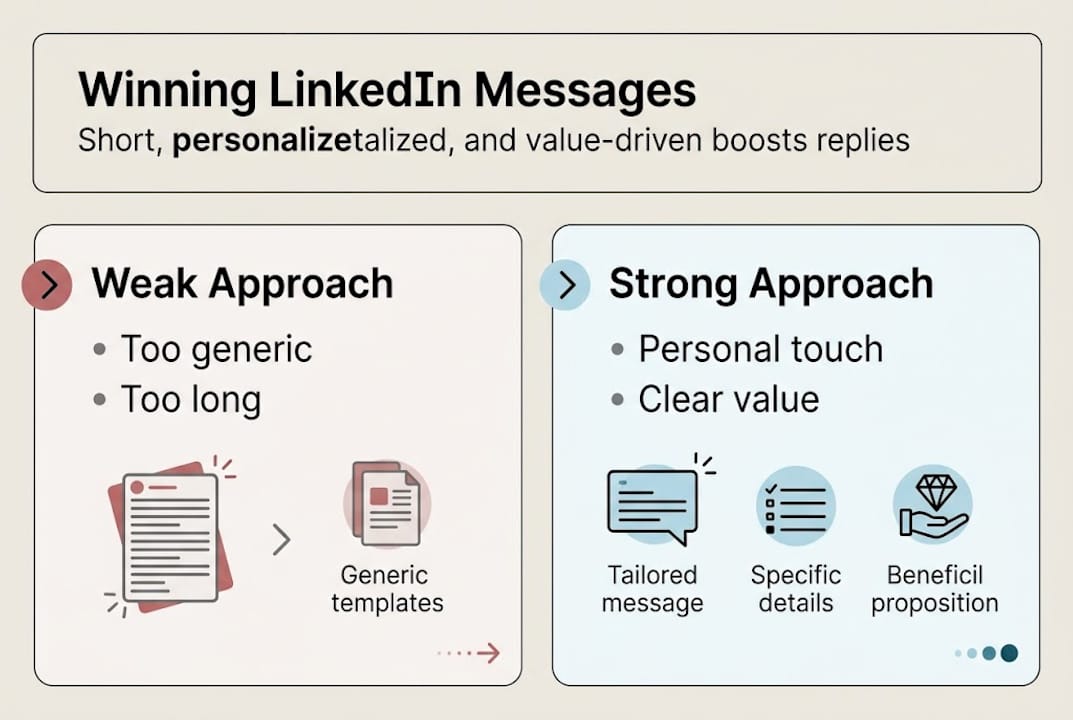
HubSpot sales benchmarks consistently show that the first few seconds of a message determine whether it gets a reply. If your opener is about you rather than the reader, you have already lost them. This is why improving your approach to improving LinkedIn engagement matters beyond just content posting.
Common pitfalls that kill response rates:
- Opening with "I wanted to reach out about our services..."
- Sending the same message to every prospect without any personalisation
- Making a sales pitch in the very first message
- Writing messages that exceed 200 words with no clear ask
- Failing to reference anything specific about the prospect's business
Here is a quick comparison of what the data shows about message performance:
| Message type | Average response rate |
|---|---|
| Generic, unpersonalised | 5 to 8% |
| Personalised, value-led | 16 to 22% |
| Brief (80 to 120 words) | Up to 2x higher |
| Salesy, pitch-first | Below 3% |
"The biggest mistake in LinkedIn outreach is treating it like email marketing. LinkedIn is a conversation platform. Your first message should open a dialogue, not close a deal."
The pattern is consistent. Shorter, personalised, and prospect-focused messages win every time. If your current templates do not reflect this, it is time to rebuild them from the ground up.
The anatomy of a high-performing LinkedIn outreach message
Knowing why messages fail is useful. Knowing exactly how to write one that works is what drives results. A strong LinkedIn B2B message follows a clear structure, and every element earns its place.
The four-part structure of a winning message:
- Personalised opener: Reference something specific, a recent post, a company announcement, or a shared connection. This signals you have done your homework.
- Value statement: In one sentence, explain what you can offer that is relevant to their situation. Not your product features. Their problem.
- Social proof or credibility signal: A brief mention of a result you have achieved for a similar business builds trust without overselling.
- A clear, low-friction CTA: Ask for something small. A 15-minute call, a quick opinion, or a simple yes or no question. Big asks in first messages kill replies.
Formatting matters too. Under 400 characters raises response rates by 22%, which means you need to be ruthless about cutting anything that does not serve the reader. Every word should earn its place.
Here is a side-by-side comparison to make this concrete:
| Element | Weak message | Strong message |
|---|---|---|
| Opener | "Hi, I wanted to connect..." | "Saw your post on scaling sales teams last week..." |
| Value | "We offer great CRM solutions" | "We helped a similar SaaS firm cut their sales cycle by 30%" |
| CTA | "Let me know if you want a demo" | "Worth a 15-minute chat this week?" |
| Length | 250+ words | Under 120 words |
Personalisation is not just about using someone's first name. It means referencing their world. Check their recent activity, their company news, or their LinkedIn B2B benchmarks to understand what matters to them right now. This approach also supports building your LinkedIn network in a way that feels natural rather than transactional.
Pro Tip: Over 57% of LinkedIn traffic comes from mobile devices. Write your messages so they are easy to read on a small screen. Short paragraphs, no walls of text, and a single clear ask at the end.
For inspiration on how this translates into content, explore content examples for B2B leads that have driven real engagement.
Connection requests vs InMails: what converts for B2B sales?
With a strong message template ready, the next decision is which channel to use. LinkedIn gives you two primary options: connection requests with a personalised note, or InMails sent directly to people outside your network. The difference in performance is significant.
Connection requests achieve an 18.4% reply rate versus InMails at 11.8%. That gap matters enormously at scale. If you are sending 100 outreach messages a month, that is roughly six or seven additional conversations simply by choosing the right channel.
When to use connection requests:
- Targeting second or third-degree connections where a mutual connection exists
- Reaching out to prospects who are active on LinkedIn and likely to notice a request
- Working within a limited budget, since connection requests are free
- Building a long-term relationship rather than seeking an immediate sale
When InMails make sense:
- Reaching senior decision-makers who are outside your network and unlikely to accept cold requests
- Time-sensitive campaigns where waiting for a connection to be accepted is not practical
- Targeting very specific, high-value accounts where the cost per send is justified
Here is a direct comparison to guide your decision:
| Factor | Connection request | InMail |
|---|---|---|
| Reply rate | 18.4% | 11.8% |
| Cost | Free | Paid (LinkedIn credits) |
| Best for | Relationship building | High-value cold outreach |
| Personalisation impact | Very high | Moderate |
For most SMBs, LinkedIn B2B outreach via personalised connection requests is the smarter starting point. Reserve InMails for situations where the prospect is genuinely unreachable any other way. Pairing either method with a well-structured LinkedIn growth strategy for B2B leads will amplify your results further.
Building multi-touch LinkedIn campaigns that generate real leads
Single-message outreach rarely converts. The most effective B2B LinkedIn campaigns use multiple touchpoints, spread across time and sometimes across channels, to build familiarity before asking for anything.

The data is striking. Multi-channel outreach combining LinkedIn and email delivers a 287% lift in engagement compared to single-channel approaches. That is not a marginal improvement. It is a fundamentally different outcome.
A high-converting multi-touch LinkedIn campaign looks like this:
- Week one, warm-up: Follow the prospect. Like or comment on one of their recent posts. This puts your name in front of them without any pressure.
- Week one, day five: Send a personalised connection request referencing something specific from their content or profile.
- Week two: Once connected, send your first message using the four-part structure outlined above. Keep it brief and focused on their situation.
- Week three: Follow up once, adding a new piece of value. Share a relevant article, a case study, or a quick insight that is genuinely useful to them.
- Week four: If they are still unresponsive, send a brief email referencing your LinkedIn message. This cross-channel nudge often triggers a reply.
Pro Tip: Use a simple spreadsheet or CRM to track where each prospect sits in your sequence. Without tracking, follow-ups become inconsistent and leads fall through the gaps.
Key principles for campaign success:
- Always add value before asking for anything
- Space your touchpoints to avoid coming across as pushy
- Personalise every message, even follow-ups
- Review replies and adjust your templates based on what is working
For those looking to scale this process, LinkedIn outreach automation tools can help manage sequences at volume. However, automation works best when paired with strong creating LinkedIn content that keeps your profile active and credible. HubSpot sales strategy research reinforces that multi-touch, value-led campaigns consistently outperform single-message blasts.
Why human insight beats automation in LinkedIn messaging
Here is an honest take that most LinkedIn marketing content will not give you. Automation is tempting because it promises scale. But in our experience, high-volume automated outreach almost always produces diminishing returns over time. Response rates drop, lead quality suffers, and you risk account restrictions that set your entire pipeline back.
The businesses that generate the best long-term results on LinkedIn are not the ones sending the most messages. They are the ones sending the right messages to the right people at the right moment. That requires human judgement, not just a sequence tool.
Automation can drive scale but requires human review to maintain quality and avoid account bans. The smartest approach is to use outreach automation for LinkedIn to handle the operational side, while keeping a human in the loop to review replies, adjust messaging, and spot opportunities that a bot will always miss. Relationships are built by people, not programmes.
Ready to supercharge your LinkedIn lead generation?
The strategies in this article work. But knowing what to do and having the time and expertise to execute it consistently are two very different things. That is where professional support makes the difference.
At IN Social, we combine AI-powered insight with hands-on human expertise to build LinkedIn campaigns that generate real, qualified leads for B2B businesses like yours. From managed outreach and content creation to bespoke training and full-funnel strategy, our services are built around measurable results. If you want to see what is possible without cold outreach tactics, explore how we help businesses generate LinkedIn leads without cold outreach. Your next sales conversation could be one well-crafted message away.
Frequently asked questions
What is the ideal length for a LinkedIn B2B sales message?
Short, value-focused messages between 80 and 120 words or under 400 characters achieve the highest response rates. Brevity signals respect for your prospect's time and keeps your ask clear.
Is it better to use LinkedIn connection requests or InMails for B2B prospecting?
Connection requests deliver a higher 18.4% reply rate compared to InMails at 11.8%, making them the more cost-effective choice for most SMBs, especially when personalised.
How can I warm up prospects before sending a LinkedIn sales message?
Engage with their content by liking, commenting, or following before sending a connection request. This warm-up via engagement significantly improves acceptance rates and makes your first message feel far less cold.
Does automating LinkedIn messaging work for B2B sales?
Automation can help you scale outreach efficiently, but it should always be paired with human review for quality and compliance. Without oversight, automated campaigns risk account restrictions and declining lead quality.