

TL;DR:
- Most B2B teams misuse LinkedIn automation by treating it as spam or a mass-messaging tool, damaging their brand and efficiency. Properly implemented, automation boosts response rates, personalisation, and pipeline consistency, but it must be balanced with genuine engagement and compliant practices. Success depends on integrating authentic profile activity, strategic targeting, and human-led follow-up to build credibility and meaningful connections.
Most B2B sales teams treat LinkedIn as either a fully personal channel or a mass-messaging machine. Neither approach works. The reality sits somewhere more nuanced, and the data is genuinely surprising. LinkedIn DMs can generate double the response rates of cold emails when handled with the right automation and targeting. Yet the majority of small to medium-sized businesses either ignore automation entirely or deploy it carelessly and damage their brand in the process. This guide cuts through the confusion and shows you exactly how to automate LinkedIn outreach in a way that drives qualified leads, protects your account, and scales consistently.
Table of Contents
- Understanding the power and principle of LinkedIn outreach automation
- What the data shows: LinkedIn outreach vs. traditional channels
- When automation works and when it doesn't: compliance and risks
- Best practice: blending automation with true personalisation
- Getting started: actionable steps for automating LinkedIn outreach
- Why most B2B teams get LinkedIn outreach automation wrong
- Accelerate your B2B growth with smart LinkedIn automation
- Frequently asked questions
Key Takeaways
| Point | Details |
|---|---|
| Automation amplifies results | Smart automation improves outreach scale, consistency, and reply rates in B2B LinkedIn campaigns. |
| Compliance is crucial | Ignoring LinkedIn policy or sending spammy sequences can lead to account restrictions or shadowbanning. |
| Personalisation drives replies | Best outcomes come from automating only repetitive tasks and adding tailored, human-led engagement. |
| Quality beats volume | Pure automation without real engagement signals often backfires, risking lower campaign effectiveness. |
| Start with clear steps | A structured, step-by-step approach makes automation safer, more effective, and easier to scale. |
Understanding the power and principle of LinkedIn outreach automation
Automation on LinkedIn is widely misunderstood. Many people hear the word and immediately picture generic spam messages flooding inboxes, or they picture accounts getting restricted overnight. Neither image is accurate when automation is applied intelligently.
At its core, outreach automation for B2B covers a specific set of repeatable tasks within your prospecting process. These include sending personalised connection requests at scale, delivering follow-up messages to prospects who have connected but not yet responded, running multi-step message sequences, and tracking which prospects engage with your content before entering a campaign. The point is not to remove human judgement from the process. It is to remove the manual, time-consuming steps that slow your pipeline without adding conversational value.
Here is what automation handles effectively in a well-structured LinkedIn strategy:
- Sending targeted connection requests to segmented prospect lists
- Delivering timed follow-up messages based on connection or engagement status
- Automatically withdrawing unaccepted connection requests after a set period
- Triggering personalised outreach sequences based on profile visits or content interactions
- Logging activity and tracking reply rates across multiple campaigns simultaneously
The shift in thinking is important. Teams automate repetitive LinkedIn outreach steps not simply to send more messages, but to build a more consistent and reliable pipeline. When your follow-up timing is controlled and your messaging is structured, you stop losing warm prospects through human forgetfulness. You also gain the ability to test message variations quickly, which accelerates learning.
"Automation is not a shortcut to better conversations. It is a system for ensuring your best conversations happen more often, with the right people, at the right moment."
Understanding LinkedIn engagement explained helps you see why engagement quality matters as much as outreach volume. For any B2B team considering automation, reviewing an automation checklist for SMBs is a practical starting point before deploying any tool.
What the data shows: LinkedIn outreach vs. traditional channels
With the fundamentals in place, it is time to dig into how automated LinkedIn outreach compares against other B2B lead generation methods, especially for response rates and campaign efficiency.
The 2026 benchmarks are clear. Empirical benchmarks show higher response rates on LinkedIn DMs than cold email across comparable B2B campaigns. The average response rate for LinkedIn DMs sits at 10.3%, compared to approximately 5.1% for cold email. Connection request acceptance rates average 29.61%, and top-performing campaigns record reply rates as high as 16.86%. These are not marginal gains. They represent a fundamentally different level of prospect engagement.
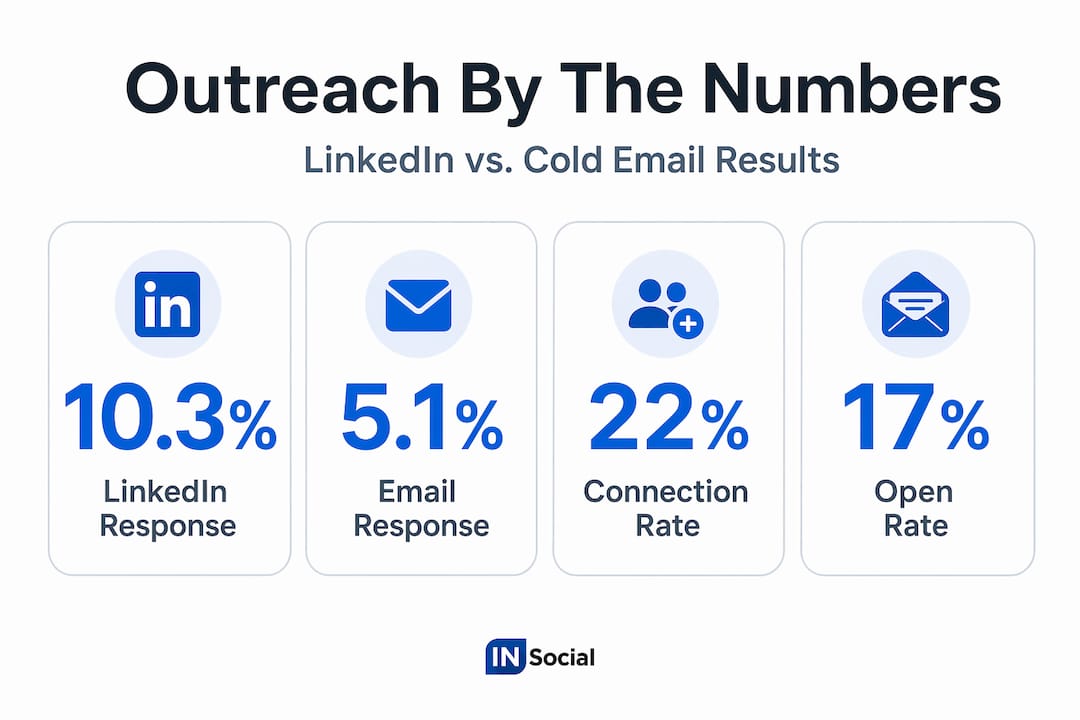
| Metric | LinkedIn DMs | Cold email |
|---|---|---|
| Average response rate | 10.3% | 5.1% |
| Connection or open acceptance | 29.61% | 20–25% open rate |
| Top campaign reply rate | 16.86% | 8–10% |
| Personalisation potential | High (profile data available) | Medium (limited data) |
| Sequence flexibility | Multi-step with triggers | Linear, time-based only |
| Compliance risk | Platform policy dependent | GDPR/CAN-SPAM dependent |
The reason automation fuels these numbers comes down to three factors: timing, rapid testing, and consistent follow-up. When you automate follow-up timing, your messages arrive when prospects are most likely to respond based on activity patterns. When you run A/B tests on message copy automatically across segments, you identify what resonates in days rather than months. When follow-up is automatic rather than manual, you capture responses from prospects who needed three or four touches before engaging.
The reply-rate lift from personalised outreach sequences is significant. Campaigns that include dynamic personalisation fields (referencing a prospect's role, recent activity, or company news) outperform generic sequences by 30 to 50% in reply rate terms. The personalisation does not need to be elaborate. A single relevant reference to the prospect's industry challenge or a recent post they published can double engagement.
Pro Tip: Do not rely on first-name personalisation alone. Use company size, job title, or a recent content interaction as your primary personalisation variable. This level of specificity signals genuine relevance, and prospects notice it immediately in a crowded inbox.
For practical examples of what effective outreach looks like in action, explore these outreach examples for B2B campaigns.
When automation works and when it doesn't: compliance and risks
Seeing the data advantage is tempting, but understanding policy boundaries and risks is essential for anyone considering LinkedIn outreach automation.
LinkedIn's User Agreement prohibits bots or other automated means for sending connection requests and messages. This is the foundational compliance fact that every B2B team must acknowledge before choosing a tool or launching a campaign. The policy exists to protect user experience on the platform, and LinkedIn enforces it through a combination of algorithmic detection and manual review.
The practical risks you need to plan around include:
- Account restrictions. LinkedIn can temporarily or permanently restrict accounts that exhibit mechanical behaviour patterns, such as sending hundreds of connections per day or messaging at unnatural hours.
- Shadowbanning. Your messages may continue to send but stop being delivered effectively. This is particularly damaging because it is invisible and can run for weeks before you notice the drop in replies.
- Compliance dilemmas. If your automation tool collects or stores personal data from LinkedIn profiles, you may face GDPR obligations depending on your location and your prospects' locations.
- Security vulnerabilities. Some third-party automation tools require access to your LinkedIn credentials, which introduces account security risks if those tools are not reputable.
- Reduced campaign credibility. If a prospect receives an obviously templated message with broken personalisation fields or out-of-context references, your brand credibility takes a real hit.
Automation that looks mechanical or violates volume limits risks restrictions, shadowbanning, or reduced campaign success. The solution is not to abandon automation but to configure it to mimic genuine human behaviour.
"The line between effective automation and policy violation is behaviour quality. Systems that mimic natural activity patterns and respect daily limits operate with far lower risk than those chasing raw volume."
For a thorough understanding of what responsible LinkedIn management looks like within these constraints, the lead generation explained resource covers the management side in useful depth.
Best practice: blending automation with true personalisation
To move from theory to application, the next step is a clear framework for B2B teams to automate outreach the right way, safeguarding both compliance and quality simultaneously.
Automation is most effective for routine processes, while human input remains essential for conversational context and authenticity. The practical translation of this principle is straightforward: let your tools handle the cadence, and let your team handle the conversation.

| Stage | Automate | Personalise manually |
|---|---|---|
| Initial outreach timing | Yes, based on activity signals | No |
| Connection request message | Yes, with dynamic fields | For key accounts only |
| Follow-up sequence | Yes, timed to connection | Yes, if they engage with content |
| Reply handling | No, always human | Yes, every time |
| Prospect qualification | Partially, via filters | Yes, before entering sequence |
| Nurture after initial reply | No | Yes, relationship-led |
The framework is simple when you apply it consistently. Use automation for multi-step sequencing, timing, and filtering. Rely on real human activity (commenting on posts, reacting to updates, sending tailored messages) for responses and relationship nurturing. Platform vendors recommend automating cadence and follow-ups, using intent and engagement signals, but stopping sequences the moment a reply occurs.
Here are the core dos and don'ts for practical balance:
- Do set daily connection and message limits below LinkedIn's detection thresholds
- Do use engagement signals (profile views, content interactions) to trigger sequences
- Do write message templates that feel personal through specific, relevant variables
- Do pause sequences immediately when a prospect replies or books a call
- Don't send more than 20 to 30 connection requests per day on a new or unestablished account
- Don't automate responses to inbound messages or handle objections with templated replies
- Don't use automation tools that require your login credentials and have no safety record
- Don't run the same sequence to every segment without adjusting tone, context, or offer
Pro Tip: Before launching any automation campaign, spend two weeks manually engaging with your target segment through comments and posts. This builds genuine activity signals on your profile and makes subsequent automated outreach far less likely to trigger platform scrutiny.
For deeper reading on what makes outreach genuinely resonate, explore personalised outreach strategies and engagement strategies for B2B to round out your approach.
Getting started: actionable steps for automating LinkedIn outreach
Now that you understand the frameworks and principles, you are ready for the practical process. Here is how to put LinkedIn outreach automation into action responsibly.
-
Define your ideal customer profile precisely. Before touching any automation tool, clarify who you are targeting. Industry, company size, job title, geography, and recent behaviour signals should all inform your target list. A tightly defined audience produces far better results than broad, untargeted campaigns.
-
Choose a compliant, reputable automation tool. Select a tool that operates within LinkedIn's recommended behaviour limits, mimics human activity patterns, and does not require you to hand over your account credentials in unsecured ways. Research the tool's compliance record and user reviews before committing.
-
Build your message sequences with personalisation variables. Write between three and five messages per sequence. Each message should add new value rather than simply repeating the previous ask. Use dynamic fields for job title, company name, or a relevant industry reference in at least the first message.
-
Set volume limits and run a pilot. Start with 15 to 20 connection requests per day for the first two weeks. Monitor acceptance rates and reply rates closely. Do not scale volume until your pilot data confirms your messaging and targeting are working.
-
Integrate engagement signals before outreach. Comment on or react to target prospects' posts before entering them into an automated sequence. This creates a genuine, warm context for your connection request and dramatically improves acceptance rates.
-
Monitor and adjust continuously. Track reply rates, connection acceptance rates, and conversation-to-meeting conversion weekly. If a message in your sequence is underperforming, rewrite it before scaling.
-
Hand off to human-led nurture at the right moment. The moment a prospect replies, a human takes over. Automate only the mundane tasks, leaving space for human-driven engagement and pivoting when prospects reply.
For a broader view of how automation fits within your full pipeline, the guide to automate LinkedIn B2B leads and this resource on lead nurturing strategies both add useful context.
Why most B2B teams get LinkedIn outreach automation wrong
After all the clarity and application, it is worth addressing a harder truth: most B2B teams that invest in LinkedIn automation see disappointing results. Not because the tools fail them, but because they focus entirely on the tool and ignore the buyer.
The most common pattern we see is this. A team sets up a solid automation sequence, targets a reasonably defined audience, and then measures success purely by message volume and connection numbers. They treat LinkedIn like an email list. The campaign runs, numbers tick up, but qualified conversations do not follow. Within a few weeks, they conclude that LinkedIn automation does not work.
What they missed is that LinkedIn is a social platform first. Buyers on LinkedIn are not passive email recipients. They are active participants who check who messaged them, look at your profile, review your recent posts, and make a rapid judgement about whether you are someone worth their time. If your profile is thin, your posting activity is zero, and your automation sequence reads like a sales script, no amount of volume will save the campaign.
The contrarian insight is this: automation without engagement authority is invisible. Your outreach lands in a prospect's inbox, they click your name, and they see a profile that signals no real presence or expertise. The message is deleted before it is read twice. Automation amplifies what is already there. If what meaningful engagement means has not been built into your LinkedIn presence first, automation simply speeds up the silence.
The teams that win with LinkedIn automation spend as much time on profile authority, content consistency, and engagement quality as they do on sequence configuration. Automation should amplify authentic B2B outreach. It cannot create credibility from nothing.
Accelerate your B2B growth with smart LinkedIn automation
If this guide has made one thing clear, it is that effective LinkedIn automation requires more than a tool subscription and a list of contacts. It requires the right strategy, the right targeting, and the right balance between automated efficiency and genuine human engagement.
At In-Social, we help B2B teams implement exactly this kind of smart, compliant, results-driven outreach. Whether you are starting from scratch or looking to improve an existing campaign, our LinkedIn lead generation guide outlines the full approach. If you want a fully managed solution, our managed LinkedIn outreach service handles everything from targeting and sequencing to compliance monitoring and lead handoff. For teams keen to generate pipeline without traditional cold outreach, explore lead generation without cold outreach as a smarter alternative. Your next qualified conversation is closer than you think.
Frequently asked questions
Is LinkedIn outreach automation allowed?
LinkedIn's User Agreement prohibits bots or automated messaging tools that violate platform policies, so any automation must mimic natural behaviour and stay within safe usage limits.
Can automation actually increase response rates on LinkedIn?
Yes. LinkedIn DMs yield higher response rates than cold email across B2B campaigns, with smart automation improving consistency, timing, and personalisation at scale.
What's the main risk of automating LinkedIn outreach?
Automation that violates limits risks account restrictions, shadowbanning, or campaign failure, especially when volume is too high or messages appear mechanical rather than genuine.
How do you blend automation and personalisation in outreach?
Automate routine steps and personalise whenever conversational engagement starts, always handing off to a human the moment a prospect replies to maintain authenticity and relationship quality.